Biggest sale yet: 30% off canvas, 25% off framed and posters, 15% off everything else, at checkout through Nov 30.
French-American, 1827-1895
3 artworks
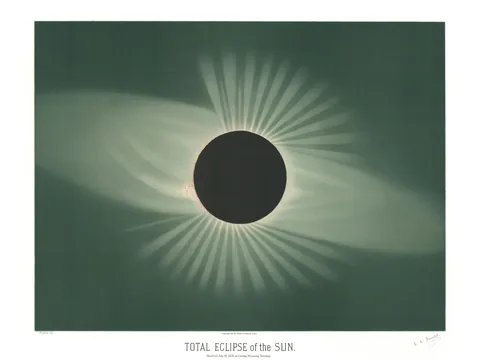
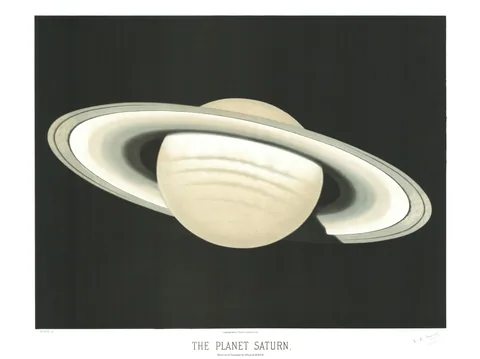
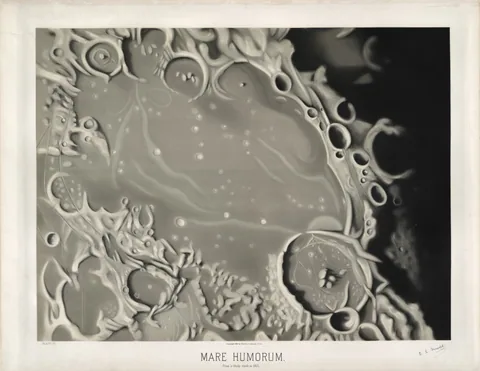
Étienne Léopold Trouvelot led two lives in America, one disastrous and one dazzling. A Frenchman who left France after Louis-Napoleon's coup of 1851, he settled in Medford, Massachusetts, and in the mid-1860s brought over egg masses of the spongy moth, then called the gypsy moth, for experiments; some larvae escaped, and the moth has since damaged millions of trees in the eastern United States. Around 1870 he turned to astronomy. In 1872 the director of Harvard College Observatory hired him on the strength of his drawings, and he went on to make about 7,000 astronomical illustrations and some 50 scientific papers. In 1875 he identified veiled spots on the Sun. Craters on the Moon and on Mars are named after him.
In 1881 Charles Scribner's Sons published fifteen of his drawings as chromolithographs, and the shop's works come from that set: The Planet Saturn, Total Eclipse of the Sun and Mare Humorum, a stretch of the Moon. Their deep blacks and glowing color look dramatic in a black frame in a study or a child's room.
Sources: Wikipedia: Étienne Léopold Trouvelot
