
Guide
How high to hang art: the 57-inch rule, and when to break it
Center it 57 to 60 inches from the floor, unless furniture sits below. Measurements for sofas, beds, stairs and gallery walls, and a nail calculator.
Hang art so its center is 57 to 60 inches from the floor. That’s the whole rule for a bare wall, and it holds in a hallway, a bedroom or a living room, whatever the size of the piece. The exception is furniture: over a sofa, a bed or a sideboard, hang the art 6 to 10 inches above it and forget the floor. Below are the numbers for every case, drawn to scale, and a calculator that turns them into the height of the nail.
from the floor to the center of the art, on a bare wall.
from the top of the furniture to the bottom of the frame.
between frames in a group. Keep every gap the same.
Why 57 inches?
Fifty-seven inches is roughly eye level for most adults, and it’s the height galleries commonly use, so a picture hung there meets people where they look. Plenty of people go a little higher: one art advisor recommends about 60 inches to the center, and others start at 57 and adjust up to 60. Anywhere in that band looks right. What matters more is that the rule measures to the center of the art, not its top or bottom. That is why it works for a postcard and a 4-foot canvas alike: big or small, the middle of the picture sits at the same comfortable height.
It also ties a room together. When every piece on a wall, or every wall in a room, is centered on the same line, the room looks ordered even if the pictures are all different sizes.
From the rule to the nail
You can’t put a nail at the center of a picture, so work up from it. The top of the frame goes at 57 plus half the frame’s height. Then measure how far the hanging wire sits below the top of the frame when it’s pulled tight, and take that off.
Say you have a 24 × 18 in picture in our black frame with a 2-inch mat: about 24.5 inches tall from top to bottom. Half of that is 12.25, so the top of the frame goes at 69.25 inches. If the wire pulls up to 3 inches below the top, the nail goes at 66.25 inches. The calculator does the same sum for any frame, and for art over furniture.
Where does the nail go?
Measure the whole frame, top to bottom. For the wire, pull it up toward the top of the frame as a nail would, and measure from there to the top edge. With a sawtooth hanger, measure to its teeth.
Over furniture: the gap wins
When something sits under the art, the art should belong to it, not float above it. So the measurement that matters is the gap between the two, and the 57-inch rule steps aside.
- Sofas, consoles and sideboards: 6 to 10 inches from the top of the furniture to the bottom of the frame, with 8 a good place to start. Over a sofa we use 8 to 10, so heads clear it. The width matters as much: see What size art goes over a sofa?
- A mantel: about 6 inches above it; a little more over a low mantel, as little as 4 over a tall one.
- A bed: 4 to 10 inches above the top of the headboard. Sizes for every bed, and how to hang art safely over one, are in What to hang over a bed.
If the gap puts the center of the art well above 60 inches, the furniture is tall and the gap still wins. If it puts the center much lower, the furniture is low: go to the top of the range.
High ceilings
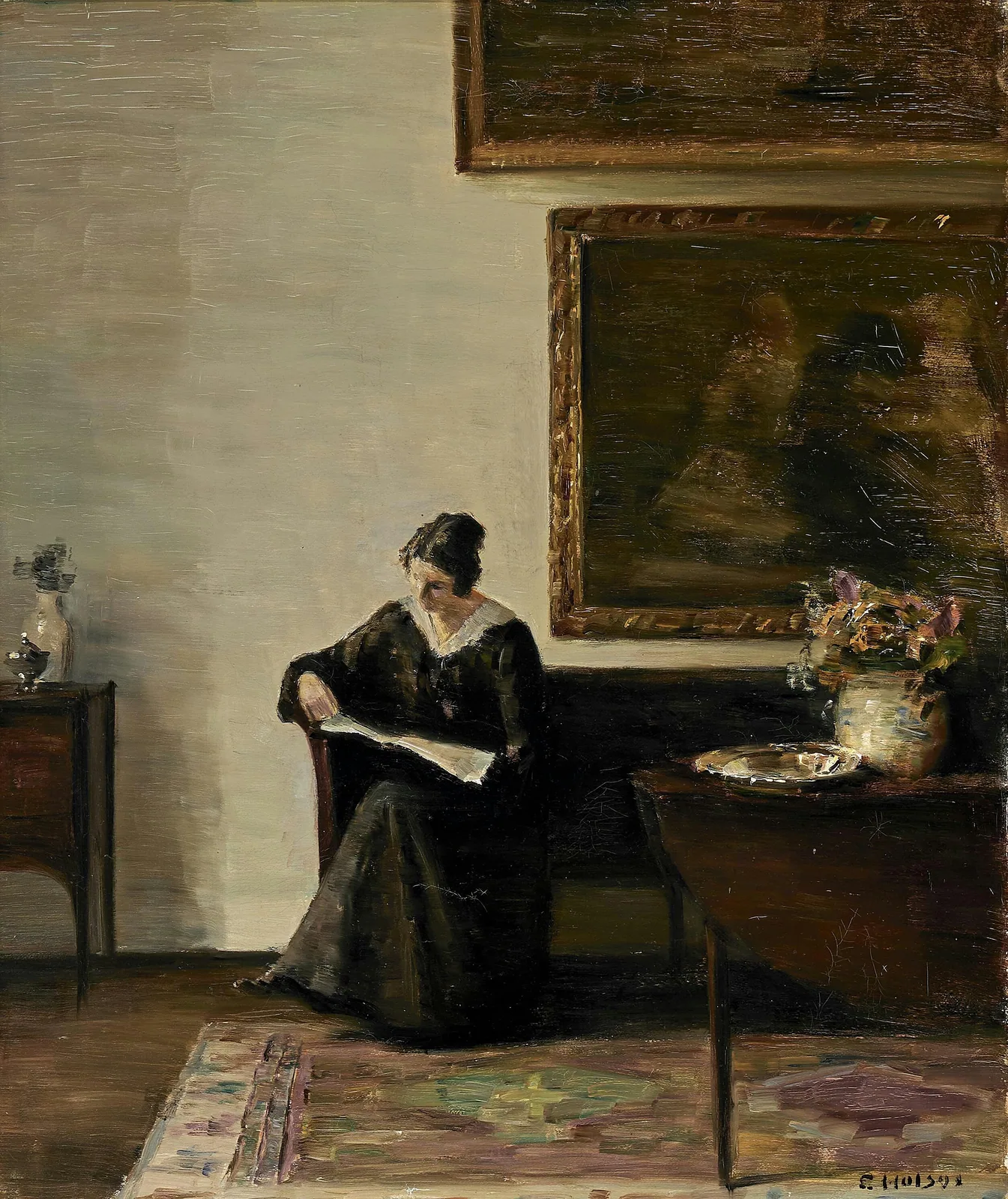
A tall wall can take its art a little higher, especially one large piece. One guide suggests the center at 60 inches under a 9-foot ceiling, 62 under a 10-foot one and 63 under anything taller; another suggests 60 inches or more for a single big piece on a 10- or 12-foot wall. Don’t go further than that. Art hung near the ceiling is art nobody looks at.
Gallery walls and groups
Treat the whole group as one picture. Find its overall height and width, gaps included, and hang it so the center of the group sits at 57 to 60 inches, or 6 to 10 inches above the furniture under it. Advice on spacing runs from 1 to 6 inches; 2 to 3 is the middle of the road, and the rule every guide shares is to keep every gap the same.
- Trace each frame on kraft paper, cut the shapes out and tape them up with painter’s tape. Live with them for a day.
- Mark where each nail falls on its paper, using the wire measurement above.
- Hang the largest or middle piece first and work outward, nailing straight through the paper, then tear it away.
Our sets of three are planned this way: three pieces of the same height, hung 3 inches apart and centered as one. Matching frames help a mixed group read as one.
Up the stairs
On a staircase the floor keeps rising, so measure from the steps. Center each frame 57 to 60 inches above the stair tread directly below it. Do that for every piece and the frames climb at the same angle as the stairs, parallel to the handrail. Keep the spacing even, 2 to 3 inches, and hang the middle frame first.
Stairs are tight, and people brush the wall with a shoulder or a laundry basket. A shallow piece is kinder there: our slim wood frames stand 0.875 in off the wall, a canvas on slim bars 0.75 in, while the deep box frames stand out 2.25 in. On a landing, it’s a floor again: 57 to 60 inches from the landing.
Keep it on the wall
Large pictures are steadier on two hooks than on one. Over a bed or a sofa, or anywhere people sit, use good hardware into a stud or a proper wall anchor. In earthquake country, take the advice of the home-safety group FLASH: it says not to hang heavy objects over beds, sofas or anywhere people sit, and to secure frames with closed hooks or earthquake putty so they can’t jump off the wall. Our framed prints arrive with a hanging wire fitted, and you can choose corner sawtooth hangers that hang level on two nails or three-point security hardware that locks to the wall. Our frames have acrylic in front, never glass. See all the hanging hardware.
Questions people ask
Is the 57 inches to the top or to the center?
To the center of the art. The top of the frame goes at 57 plus half the frame’s height.
Should every picture in the room be at the same height?
Their centers, yes, for pieces hung on their own. Pieces over furniture follow the furniture instead.
What about very tall art?
Keep the center at 57 to 60 inches if the bottom still clears the floor and the furniture comfortably. If it doesn’t, the piece is big enough to rest close above whatever is under it, 6 to 10 inches up.
I’m tall. Should I hang art higher?
A little, within the band: 60 inches rather than 57. Go much higher and everyone else in the house has to look up at it.
What about a dining room or a study?
Where people mostly sit, go to the low end of the band, about 57 inches, so the art is easy to see from a chair. Over a sideboard or a desk, the gap rule takes over again.
For halls, stairs and gallery walls
All portrait-shaped prints





Sources
- Hunker: How to calculate the proper height for hanging pictures on your wall
- Hunker: What’s the best height to hang a picture over a sofa?
- Tidbits&Twine: How high to hang pictures
- Livingetc: How high should you hang art? An art advisor’s answer
- Love & Renovations: How to hang pictures on stairs
- Federal Alliance for Safe Homes (FLASH): Secure items that hang on walls
More from the Journal
 Guide · 8 min
Winter and Christmas art prints worth hanging
Snow scenes that can stay up until March, Nativity paintings for December, the sizes and frames that suit them, and when to order for Christmas. Guide · 7 min
Art as a gift: how to choose a print they’ll keep
Choose for their walls, not yours: safe sizes and frames, ideas by occasion, the gift note in the box, and how early to order for the holidays. Guide · 7 min
Art gifts for mom and dad: ideas by what they love
Art gift ideas for parents, by what they love: gardens, the sea, books, travel, home. Safe sizes, a personal line of words, and when to order for Christmas. Guide · 6 min