
Guide
Framed print or canvas? How to choose, with real prices
What you get with each, when each one wins, and real prices for one Van Gogh in four formats at four sizes, side by side.
The short answer: a framed print suits works on paper, fine detail and a finished, traditional look, and it keeps dust and fingers off the picture. A canvas suits oil paintings, big walls and bright rooms, and at the same size it usually costs less. The longer answer depends on the painting, the room and how big you want to go. Below are both, side by side, with real prices for one painting: Van Gogh’s Green Wheat Fields, Auvers.
Framed print, 24 × 19 in picture, black frame and white mat.
Canvas at the same 24 × 19 in, on 1.5 in deep bars.
Canvas at 30 × 24 in: about the wall space the framed print takes.
What you get with each
A framed print
The painting is printed with pigment inks on 100% cotton paper (330 gsm, smooth and matte, with no shine), dry-mounted flat to foam board, and set behind a 2-inch white mat cut from 4-ply board with a beveled window. In front is optical-grade acrylic: clear like glass, but lighter and safe to ship. Around it is a solid wood frame, black unless you choose one of the other 25 mouldings, with the hanging wire fitted. You can swap the mat color or width, the paper and the hardware. All the frames, measured.
A canvas
The painting is printed on a 360 gsm poly-cotton canvas, coated with a soft semi-gloss finish (or matte, if you prefer no sheen at all), and hand-stretched over solid wood bars 1.5 inches deep, folded at the corners and stapled on the back. There is no frame and no glazing. The sides show, so by default the edge of the picture is mirrored onto them and the whole painting stays on the front. It arrives with a sawtooth hanger fitted. The canvas, depths and edges.
Both are made to order and ship free to the lower 48 states, ready to hang.
What they cost, size for size
The size of a framed print is the size of the picture; the mat and frame add to it. The size of a canvas is the whole canvas. Here is Green Wheat Fields, Auvers in each format, at the sizes the listing sells:
| Size | Framed print | Canvas | Framed canvas | Art print, unframed |
|---|---|---|---|---|
| 16 in long side | $109 16 × 13 in | $79 16 × 13 in | $129 16 × 13 in | $34 16 × 13 in |
| 24 in long side | $184 24 × 19 in | $99 24 × 19 in | $164 24 × 19 in | $59 24 × 19 in |
| 30 in long side | $214 30 × 24 in | $104 30 × 24 in | $219 30 × 24 in | $79 30 × 24 in |
| 36 in long side | $254 36 × 28 in | $149 36 × 28 in | $289 36 × 28 in | $99 36 × 28 in |
At every size the canvas costs less than the framed print, because a frame, a mat and a sheet of acrylic all cost money to make and ship. The unframed art print is the least expensive way in, if you already own a frame or want to choose one in person; on cotton paper it ships flat.
Same wall, two prices
Comparing by the size label hides something. A framed print with a 24 × 19 in picture is 30.5 × 25.5 in with frame and mat, so it fills about as much wall as a canvas one size up. That is the fairer comparison, and it is the one the room photos below show.
When a framed print wins
The original was made on paper. Woodblock prints, etchings, engravings and watercolors are thin, flat works, and they look most like themselves printed on smooth paper behind a mat. A canvas weave under Hokusai’s Red Fuji is a texture the original never had.
Fine detail. Smooth cotton paper holds hairlines, small type and botanical detail crisply, which is why we would frame a natural-history plate or an old map.
A finished, traditional look. A mat gives a picture room to breathe, and a frame can carry the color of the room: oak beside oak floors, gold with older paintings, black almost anywhere. More on that in How to choose a frame color.
Gallery walls. Pieces of different sizes and subjects hang together when they share a frame and a mat.
Busy places. The acrylic keeps dust, fingers and the odd splash off the print. A canvas has nothing in front of it.
When a canvas wins
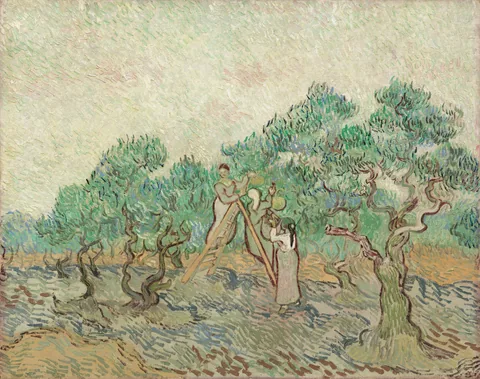
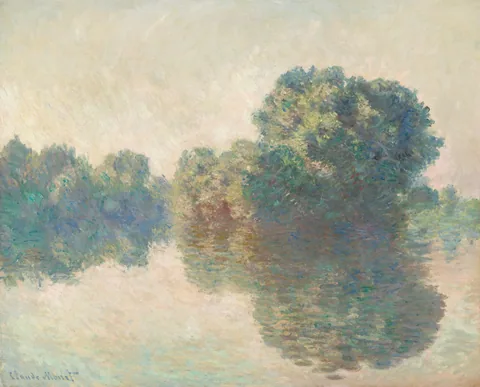
The original is an oil painting. Canvas replaced wooden panels as the usual support for oil painting from the 16th century in Italy and the 17th in northern Europe. Green Wheat Fields, Auvers itself is oil on canvas. Printed on canvas, the weave sits under the brushwork the way it does on the original.
Big walls. Canvas costs less at every size, and it has no frame to add width, so the size you buy is the size you see. On canvas, Green Wheat Fields, Auvers goes up to 40 × 31 in. With no acrylic, mat or moulding, a canvas is also the lighter of the two, which helps on old plaster and over a bed.
Bright rooms. Any clear glazing reflects a window or a lamp at some angles. A canvas has none, and the matte finish has no sheen at all, so it is the choice for a wall opposite a big window.
Modern rooms. A gallery-wrapped canvas is just the painting, with clean sides and no border. It suits plain walls and simple furniture.
The in-between: framed canvas
A framed canvas is the same stretched canvas set in a wood frame. At 24 inches it is $164 in the black floating frame. A floating frame holds the canvas with a narrow gap all round so it seems to float, and comes in 9 finishes, from black and white to gold, silver and walnut. A traditional frame holds a slimmer 0.75-inch canvas with its lip over the edge. You get the texture of canvas with a finished border, and still no glazing. Framed canvas, measured.
Kitchens, bathrooms and wear
Neither is happy in a steamy bathroom: damp air can ripple paper inside a frame and slacken a canvas on its bars. For a bathroom, or a kitchen wall near the sink, a metal print is the better choice. The picture is fused into a glossy aluminum panel that resists water and wipes clean.
Everywhere else, think about knocks. A framed print’s acrylic takes the fingerprints and the bumps, and wipes clean. A canvas face is the picture itself, so a dent from a chair back or a scuff from a toy stays. In a hallway or a playroom, that tips the choice toward a frame.
Questions people ask
Is canvas cheaper than a framed print?
For this painting, yes, at every size we compared: $99 for a 24 × 19 in canvas against $184 framed. Even a canvas one size up costs less than the framed print. The unframed art print at the same size is $59.
Does a canvas need a frame?
No. A gallery-wrapped canvas is finished on all four sides and arrives with its hanger fitted. A floating frame is an extra you can add for a more formal look.
Which lasts longer?
Kept out of direct sun and damp, both last for many years. The framed print has the edge in a busy home, because the acrylic takes the knocks and keeps dust off the paper.
Is there glass in a framed print?
No glass: optical-grade acrylic, which is lighter and safer to ship. You can also order a frame with no glazing at all, if you prefer no reflections and don’t mind dust.
Which looks more like a real painting?
For an oil painting, canvas. For a print, a drawing or a watercolor, a framed print on smooth or textured cotton paper.
Can I see both on my wall first?
Yes. Every painting’s page shows the piece you choose, framed or on canvas, to scale in a choice of rooms, and you can turn it in 3D to see the edges and depth. In the Studio you can crop a detail and see it framed before you order.
Oil paintings that suit canvas
Impressionists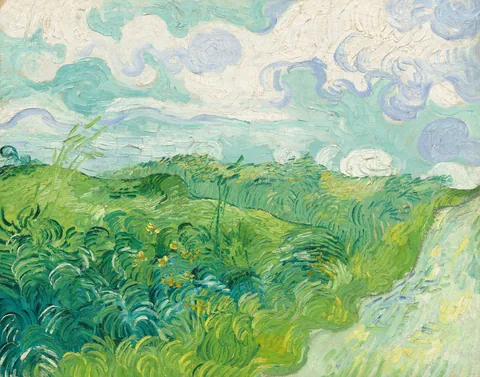

Prints and watercolors: best framed
Japanese woodblock prints



Sources
More from the Journal
 Guide · 8 min
Winter and Christmas art prints worth hanging
Snow scenes that can stay up until March, Nativity paintings for December, the sizes and frames that suit them, and when to order for Christmas.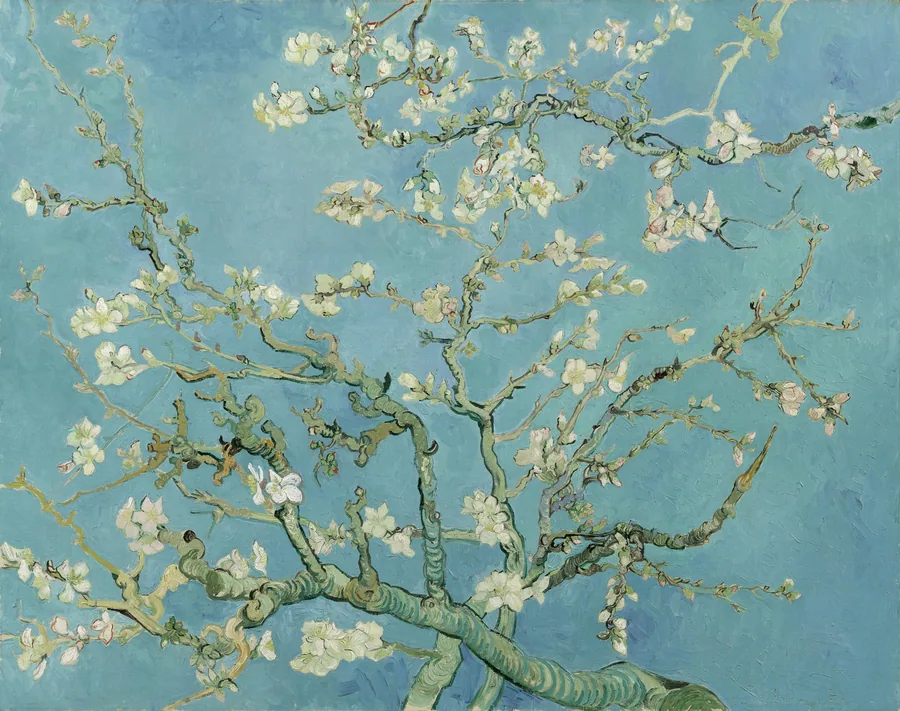 Guide · 7 min
Art as a gift: how to choose a print they’ll keep
Choose for their walls, not yours: safe sizes and frames, ideas by occasion, the gift note in the box, and how early to order for the holidays. Guide · 7 min
Art gifts for mom and dad: ideas by what they love
Art gift ideas for parents, by what they love: gardens, the sea, books, travel, home. Safe sizes, a personal line of words, and when to order for Christmas. Guide · 6 min