
Guide
Mid-century modern wall art: Kandinsky, Klee, Mondrian
Wall art for a mid-century modern home from the painters who invented abstraction: which works suit the style, the sizes each is sold in, and the frames.
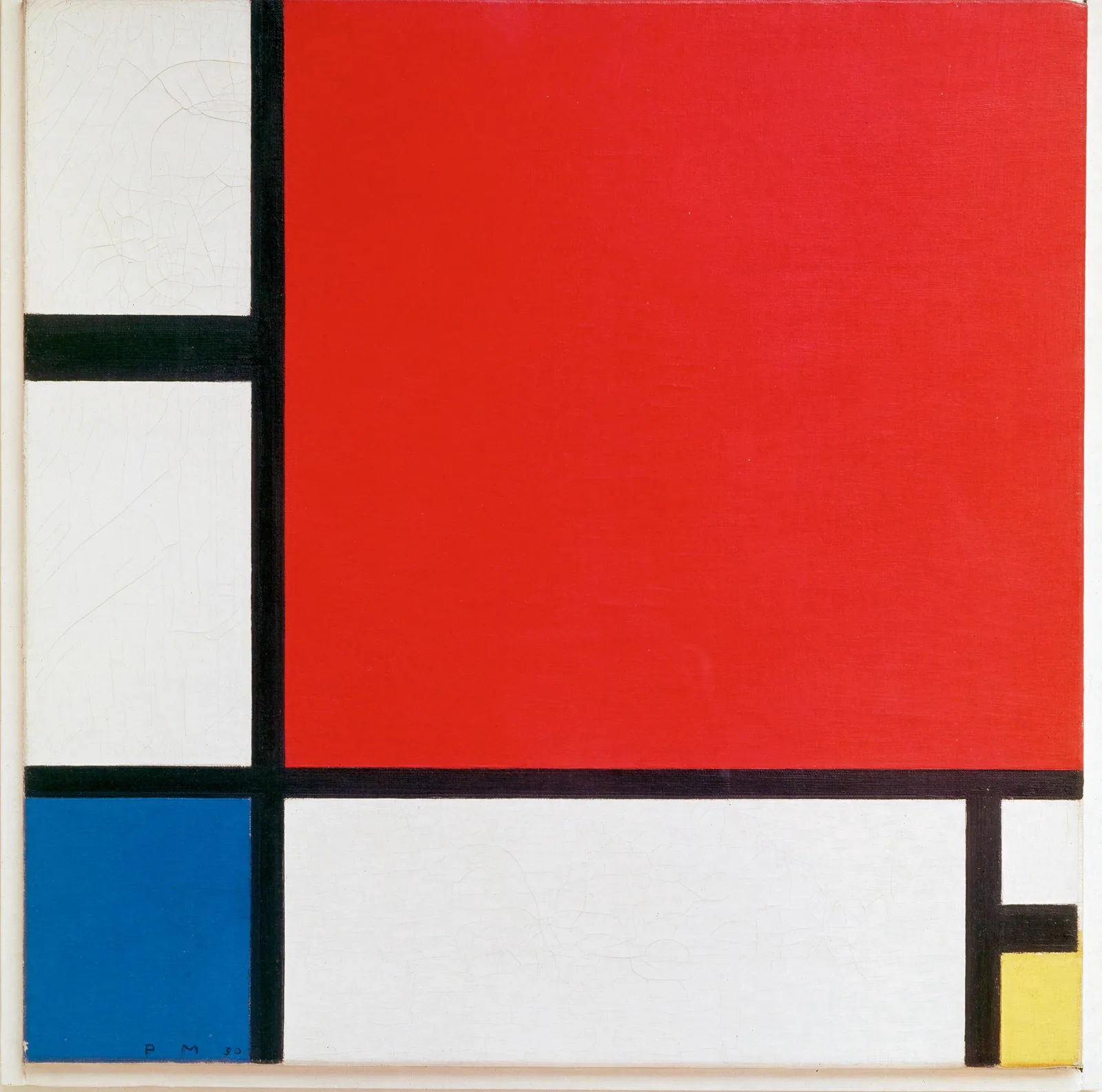
Mid-century modern is the design style that peaked from about 1945 to 1970: clean, simple lines, honest materials, no decorative embellishment, open floor plans and big windows. It has been back in fashion since the late 1990s. The art that suits it best is a little older than the furniture. The painters who pioneered abstraction in the 1910s and 1920s, Kandinsky, Klee and Mondrian, share its love of clean shapes and pure color, and because all three died more than seventy years ago, their work is now in the public domain in the US.
Mondrian: the straight line
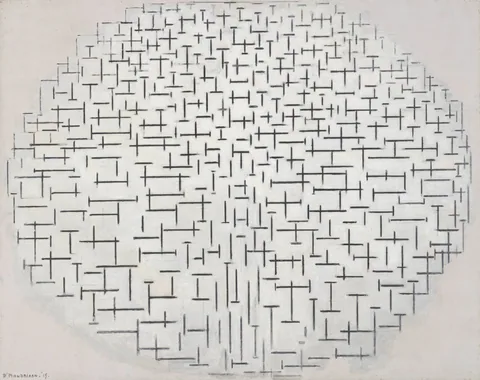
Piet Mondrian co-founded the De Stijl movement with Theo van Doesburg and called his abstract style Neoplasticism. He limited himself to the three primary colors, black, white and gray, and horizontal and vertical lines. Composition II in Red, Blue, and Yellow of 1930, in the Kunsthaus Zürich, is the classic: black grid lines with a large red rectangle and smaller blocks of blue, yellow and white, about 18 inches square in the original. Its influence on design is everywhere; Yves Saint Laurent’s Fall 1965 collection put it on shift dresses. It is square, which suits a sideboard, a narrow wall or a grid of two. His earlier Composition 10 in Black and White of 1915, an oval field of short black lines, is the quieter choice for a white room.
Kandinsky: color as music
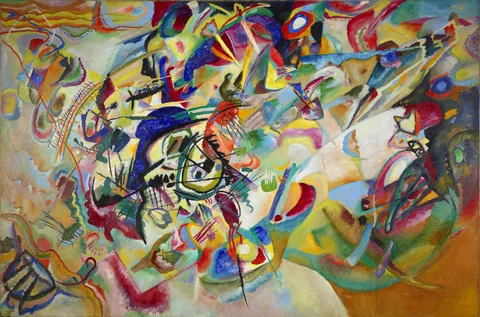
Wassily Kandinsky (1866 to 1944) is generally credited as one of the pioneers of abstraction in Western art. He likened painting to composing music, and taught at the Bauhaus, the German school of art and design, from 1922 until the Nazis closed it in 1933. Composition VII of 1913, in the Tretyakov Gallery, was in his own view the most complex piece he ever painted: a storm of color for a large wall over a sofa. The Bauhaus years are more geometric, circles, triangles and lines in Composition VIII of 1923 and Yellow-Red-Blue of 1925, and they sit perfectly over a low credenza.
Klee: small, witty, warm
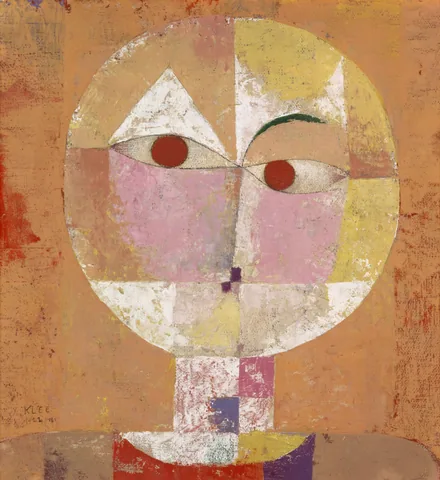
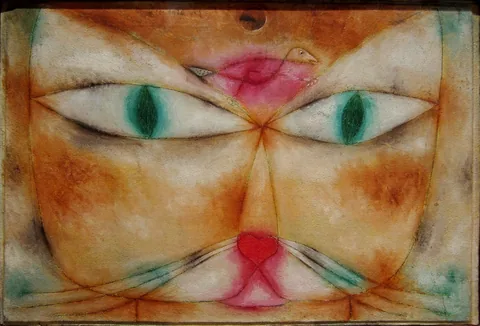
Paul Klee (1879 to 1940), the Swiss-born German painter, also taught at the Bauhaus, from 1921 to 1931, and explored color theory deeply. His pictures are smaller and friendlier than Kandinsky’s. Senecio of 1922, in the Kunstmuseum Basel, is a round geometric face on an orange ground, and Cat and Bird of 1928 is a cat’s face with a small bird perched near its head. Both suit a hallway, a home office or a reading corner, at a modest size; Cat and Bird is sold up to 16 × 11 in framed.
Others that work
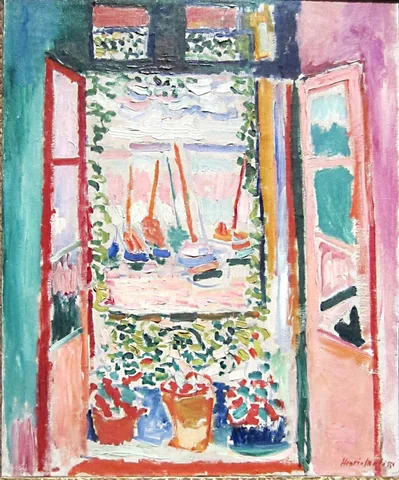
Matisse’s Open Window, Collioure of 1905 is a burst of pure color framed by a window, a perfect bridge between a modern room and a view. Japanese woodblock prints, with their clean outlines and flat color, sit well with mid-century design: Hokusai’s Great Wave and Red Fuji look completely at home over a teak sideboard. And Ernst Haeckel’s plates from Kunstformen der Natur, which influenced Art Nouveau, such as his desmids, add natural pattern to a graphic wall.
Sizes
| Work | Framed in slim oak | Largest canvas |
|---|---|---|
| Composition II in Red, Blue, and Yellow | 20 × 20, $124 | 36 × 36 |
| Composition VII | 20 × 13, $119 | 40 × 26 |
| Composition VIII | 20 × 14, $114 | 20 × 14 |
| Yellow-Red-Blue | 20 × 13, $119 | 30 × 19 |
| Senecio | 18 × 20, $124 | 22 × 24 |
| Cat and Bird | 16 × 11, $104 | 16 × 11 |
| Open Window, Collioure | 13 × 16, $109 | 13 × 16 |
Some of these scans are smaller than others, so a few works, such as Cat and Bird, stop at a modest size. We only sell the sizes each image can print sharply.
Mixing in something older
A mid-century room doesn’t have to stop at abstraction. Clean, open rooms are good at showing off contrast, and one older painting can give the whole space depth: a Dutch still life over a teak sideboard, a Hammershøi interior in a quiet bedroom, a Hiroshige print in the hall. The trick is to keep the frame modern, slim and simple, even when the picture is three hundred years old, so it reads as a choice and not as an inheritance. Let the abstracts carry the color and the older piece carry the mood, and give each one its own wall rather than mixing them in a single group.
Frames and formats for a mid-century room
Mid-century furniture is about warm wood and thin lines, so the frame should be the same. A slim natural oak frame matches teak and walnut furniture without competing with it; a slim black frame suits black steel legs and a white wall. A white mat gives the bold abstracts air; for the most graphic pieces you can also leave the mat off and let the picture run to the frame. A canvas with no frame at all, in the matte finish, is the most minimal option, and a metal print suits the flat, bright color of a Mondrian.
Where to hang it
- Over a low credenza or sideboard: mid-century furniture sits low, so hang the art low too, its bottom 6 to 10 inches above the top, and let a horizontal Kandinsky echo the long line of the furniture.
- Over the sofa: one large abstract, about two-thirds of the sofa’s width. What size art over a sofa.
- A pair: two square Mondrians or two Klees side by side make a set that suits the style’s love of order.
- A large window wall: with big windows, the art goes on the solid walls opposite, where the light falls on it.
Questions people ask
What art goes with mid-century modern decor?
Early abstract art by Kandinsky, Klee and Mondrian, Japanese woodblock prints, and simple, graphic pieces, in slim wood or black frames.
Is Kandinsky’s or Mondrian’s work public domain?
In the US, the works we sell are public domain. What public domain art is explains how a painting gets there.
What frame suits mid-century modern?
A slim natural oak frame to match wood furniture, or slim black for a more graphic look.
Early modern art for a mid-century home
Kandinsky


Sources
More from the Journal
 Guide · 8 min
Winter and Christmas art prints worth hanging
Snow scenes that can stay up until March, Nativity paintings for December, the sizes and frames that suit them, and when to order for Christmas. Guide · 7 min
Art as a gift: how to choose a print they’ll keep
Choose for their walls, not yours: safe sizes and frames, ideas by occasion, the gift note in the box, and how early to order for the holidays. Guide · 7 min
Art gifts for mom and dad: ideas by what they love
Art gift ideas for parents, by what they love: gardens, the sea, books, travel, home. Safe sizes, a personal line of words, and when to order for Christmas. Guide · 6 min