
Guide
Art for a home office: over the desk and on camera
What to hang over a desk and behind you on video calls: sizes for every desk, how to avoid glare on camera, and calm paintings you can work under.
A home office has two walls that matter. One is the wall you face, which you will look at between emails for years. The other is the wall behind you, which everyone on your video calls looks at instead. They want different things: the first should give your eyes somewhere calm to go, the second should look tidy and deliberate on a small screen without stealing the attention.
Over the desk: what and how big
If your desk faces a wall, the art goes above it, and the rule is the one designers use over a sofa or a console: about two-thirds as wide as the furniture, frame included. Hang it so the bottom of the frame clears the top of your monitor by a few inches; if the desk is clear, about 8 inches above the desktop (6 to 10 is the usual range). Choose a picture with depth, a horizon, a sea or a long view, so that when you look up your eyes can travel somewhere.
| Desk | Aim for | Framed | Canvas |
|---|---|---|---|
| 48 in | about 32 in | 24 × 15 in, 31 in across, $129 | 30 × 19 in, $109 |
| 60 in | about 40 in | 36 × 23 in, 43 in across, $229 | 40 × 25 in, $149 |
| 72 in | about 48 in | 40 × 25 in, 47 in across, $254 | 48 × 30 in, $244 |
Not every desk faces a wall. If yours sits in the middle of the room or faces a window, hang the art where you look when you lean back: the wall opposite or beside you, at the normal 57 to 60 inches to its center. How high to hang art covers the measuring.
Behind you on video calls
The wall behind your chair is the one the world sees, at the size of a postage stamp. A few things make it work on camera.
- Kill the glare. Anything shiny behind you reflects your screen, a window or a lamp straight into the camera. A canvas has nothing in front of it, and in the matte finish it shows almost no glare. A framed print normally comes behind clear acrylic, which can reflect like glass, so for the wall behind your desk you can order the frame with no glazing (nothing in front of the paper: no glare, but no protection from dust or touch). Metal prints are glossy, so keep them out of the shot.
- Keep it off your head. A frame edge or a busy patch right behind your head is distracting. Put the art a little to one side of where you sit, or hang one wide piece high enough that its bottom edge sits above your head in the shot.
- One piece, not a crowd. On a small screen a gallery wall reads as clutter. One strong picture, or a neat pair, looks deliberate. Simple, bold shapes survive video compression better than fine detail.
- Check it in the camera preview. Sit down, open your camera at the time of day you take most calls, and look at what the camera sees before you put a nail in the wall. Keep the main light in front of you, behind the camera, not behind you.
- Mind what it says. Family photos are too personal for a client call; a painting isn’t. A landscape or a seascape is a safe, friendly background for almost any meeting.
Paintings that work in an office
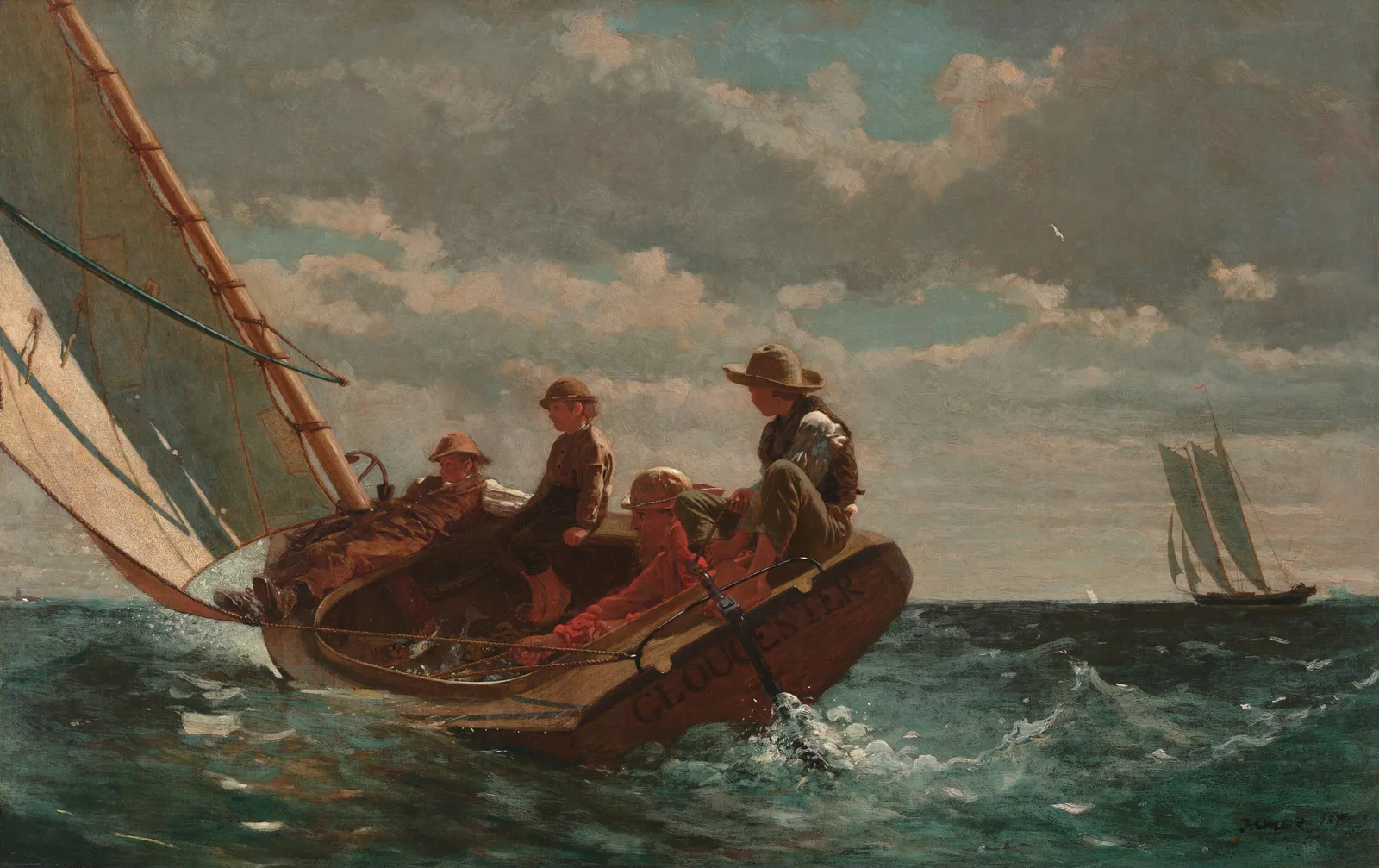
Long views for the wall you face. Winslow Homer’s Breezing Up is four people in a small sailboat heeling over on a choppy sea, all open water and moving sky. Corot’s Forest of Fontainebleau is the opposite mood, a woman reading by a stream in deep woods. John Frederick Kensett’s Beach at Beverly is quieter still: a calm shore and a lot of sky.
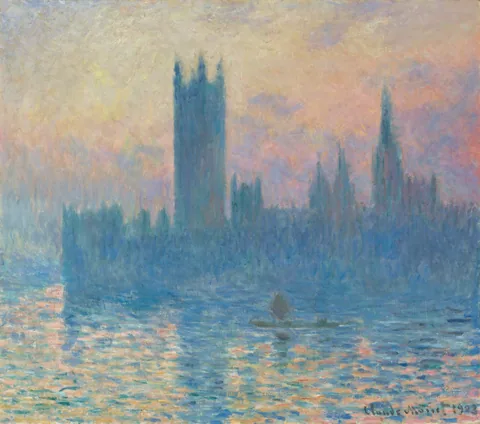
Simple shapes for the wall behind you. Hokusai’s Red Fuji is one mountain, one sky and a few clouds: readable at any size on any screen, and as canvas it goes up to 48 × 33 in. Monet’s Houses of Parliament, Sunset is a soft silhouette in pink and blue that sits back behind you instead of competing. A long panel of Water Lilies over a credenza does the same over a wide wall.
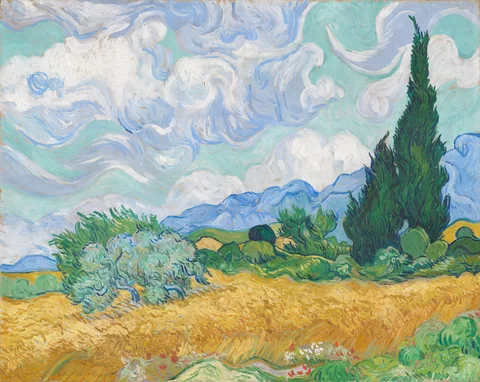
Something to think by. Vermeer’s A Lady Writing is a woman writing with a quill at a table draped in blue: a small, quiet painting for a study. Van Gogh’s Wheat Field with Cypresses gives an office energy without noise.
A map of your own place. An office is a good home for an old topographic map: a U.S. Geological Survey sheet of the town you grew up in, the city where the company started, or the hills you hike on weekends. It is detailed enough to reward a close look, and it starts conversations on calls.
Space. If your work runs on data, a telescope picture such as the Cosmic Cliffs in Carina from the James Webb Space Telescope fills a wall with color and depth. The rest are in Space.
A small office, or a desk in the corner of a room
Many home offices are a spare bedroom, a landing or a desk in the corner of the living room. There, the art has a second job: to mark the desk as a place for work. One framed piece over the desk, sized to the desk rather than the wall, does that better than anything else, because it turns a corner into a defined spot. Keep it simple and keep it to one, and if space is very tight, use a small framed print on a shelf above the desk, leaning against the wall, which needs no nails and moves when the desk does.
If the office is also a guest room, choose something that suits sleeping as well as working: a calm landscape or a quiet seascape, rather than a busy city or a stormy sea. What to hang over a bed has the sizes for the other wall.
Frames for an office
Match the furniture. A black frame suits a modern desk and dark metal; a natural oak or maple frame suits a wood desk and bookshelves; espresso looks right in a study with leather and dark wood. A white mat makes a small picture look more important on a big wall. How to choose a frame color has more.
Questions people ask
What art is good for a home office?
Calm pictures with depth for the wall you face, a landscape or a seascape, and one simple, bold piece for the wall behind you on calls.
How big should art be over a desk?
About two-thirds of the desk’s width, frame included: around 40 inches across over a 60-inch desk.
How do I stop art glaring on Zoom?
Choose a canvas in the matte finish, or a framed print with no glazing, and keep lamps and windows from shining straight at it.
Where should art go behind me on video calls?
Slightly to one side of your head, or high enough to clear it. Look at the camera preview before you hang it.
Paintings for a home office
Landscapes





Sources
More from the Journal
 Guide · 8 min
Winter and Christmas art prints worth hanging
Snow scenes that can stay up until March, Nativity paintings for December, the sizes and frames that suit them, and when to order for Christmas. Guide · 7 min
Art as a gift: how to choose a print they’ll keep
Choose for their walls, not yours: safe sizes and frames, ideas by occasion, the gift note in the box, and how early to order for the holidays. Guide · 7 min
Art gifts for mom and dad: ideas by what they love
Art gift ideas for parents, by what they love: gardens, the sea, books, travel, home. Safe sizes, a personal line of words, and when to order for Christmas. Guide · 6 min