
Guide
The best Audubon bird prints to hang, and where
The best of Audubon’s Birds of America for a home: the flamingo, parrots, owls, herons and ducks, the room each suits, the sizes, and how to group them.
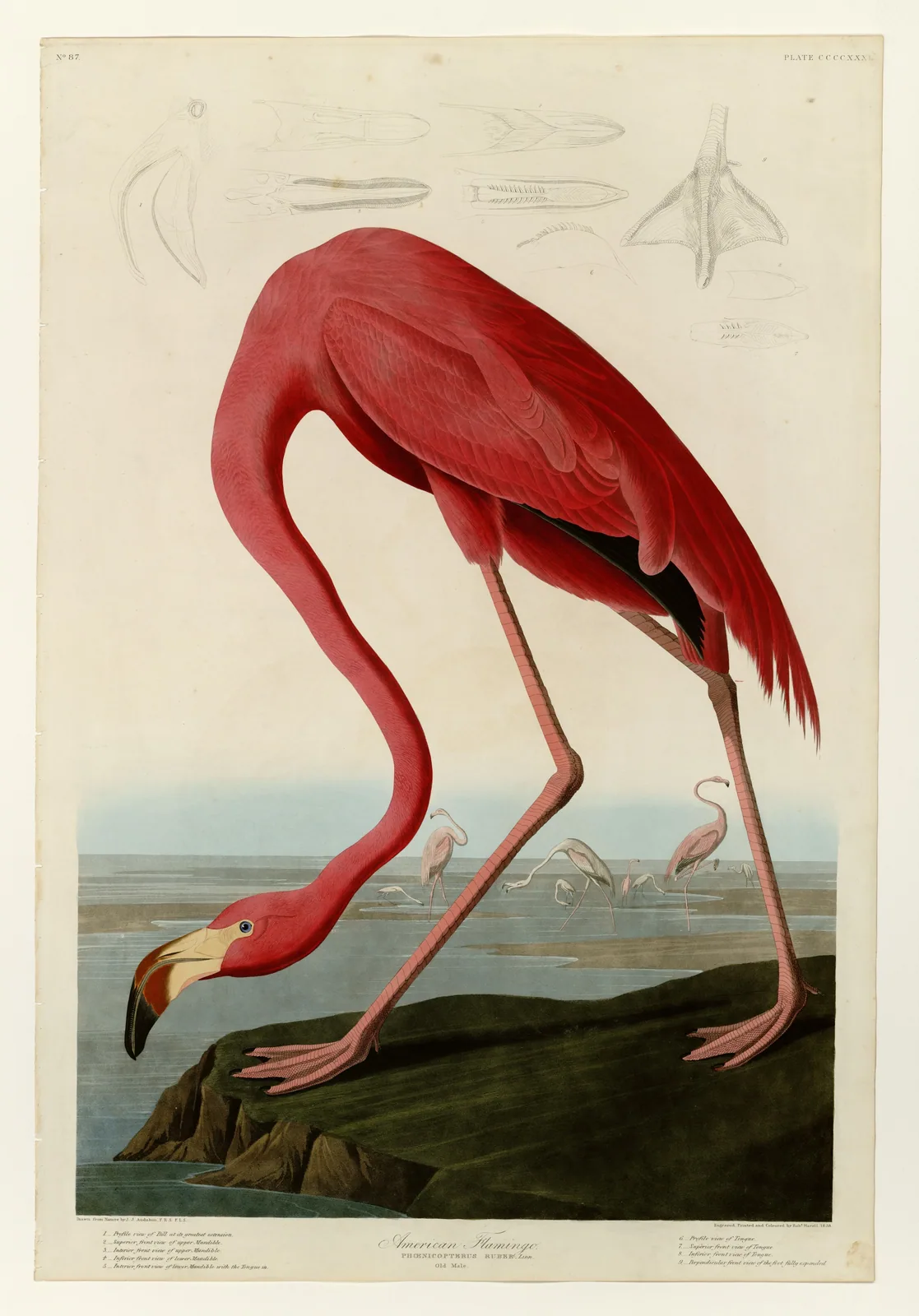
John James Audubon’s The Birds of America was published in parts from 1827 to 1838: 435 hand-colored plates, every bird drawn life-size, on sheets about 39 by 26 inches. To get dead specimens into living poses, Audubon held them up with wires and threads, and the result is birds that strut, stoop, fight and feed. The plates were etched, engraved and aquatinted on copper, most of them under Robert Havell Jr. and his father, and colored by hand by more than fifty colorists. About 120 complete sets are known to survive. We have 91 Audubon works, most of them printed from impressions of the original plates. This guide picks the ones that hang best and says where.
A note on credit: the plates were engraved by the Havells from Audubon’s originals, and our listings say so, as “Robert Havell after John James Audubon.” That is how every original plate was made.
The showpieces
American Flamingo, 1838. The most famous plate: a pink flamingo bending its long neck to feed, with smaller birds in the distance. It is tall, vivid and unmistakable, and our scan holds up at size. In a living room it is a statement; in a white bathroom, a joke that never gets old. Framed prints go up to 25 × 36 in, canvas up to 34 × 48 in and unframed art prints up to 34 × 48 in.
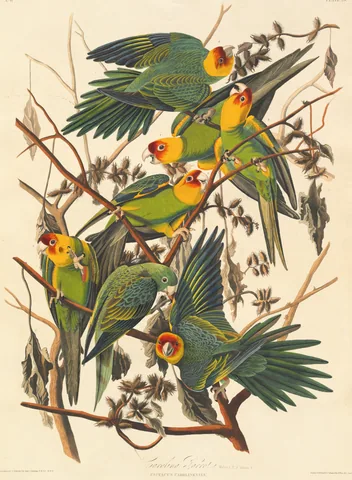
Carolina Parrot, 1827. Seven green parrots with yellow and red heads crowd a branch. The Carolina parakeet is extinct now, one of several birds in the book that are gone, which gives the plate a weight beyond its color. It suits a study or a living room, especially with green walls. Framed prints go up to 26 × 36 in, canvas up to 29 × 40 in and unframed art prints up to 29 × 40 in.
Ivory-billed Woodpecker, 1829. Two woodpeckers, one with a red crest, on lichen-covered branches. The ivory-billed woodpecker is possibly extinct. Pair it with the parrot for a quiet lesson in what has been lost.
Owls for a bedroom or a winter wall
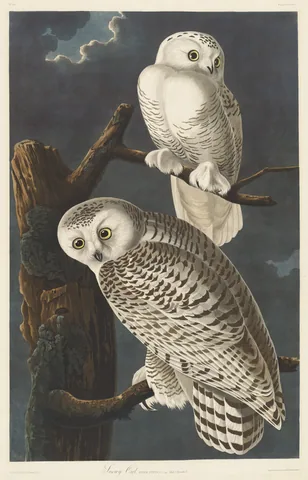
Snowy Owl (1831), two white owls with yellow eyes on a gnarled branch against a dark night sky, is the best winter print in the book and calm enough for a bedroom; it stays up long after the holidays. Barn Owl (1833), two owls on a bare branch above a river at night, is darker. One of them holds prey, so keep it out of a child’s room.
Herons and water birds: tall prints for tall walls
Because Audubon drew every bird life-size, the big wading birds had to stand tall, and their plates suit narrow, tall spaces: beside a door, a hallway, the end of a bookcase.
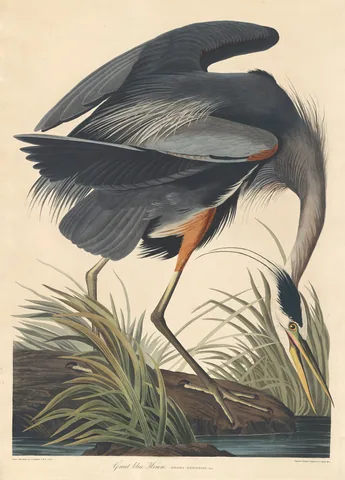
- Great Blue Heron (1834), neck bent toward the water among tall grasses: the classic heron for a hallway.
- Great White Heron (1835), with a fish in its beak and a calm sea behind, and Louisiana Heron (1834), a blue heron in a green wetland. Both are landscape, for over a console or a bed.
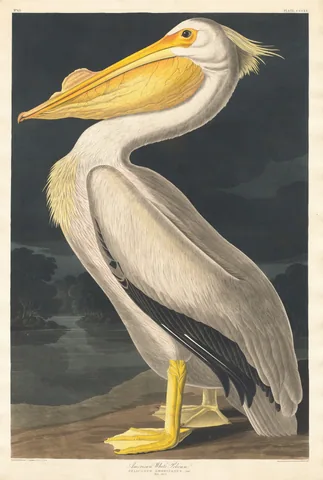
- American White Pelican (1836), white against dark water and a cloudy night sky: dramatic in a coastal room or a bathroom. Coastal wall art has more for a room by the sea.
Ducks and geese for a den or a cabin
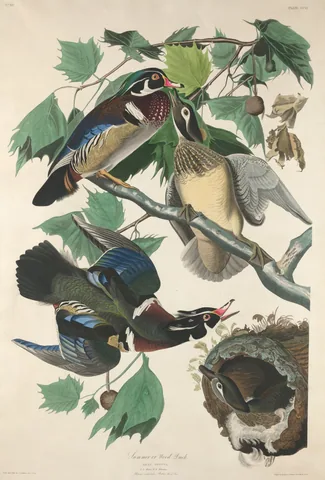
The waterfowl plates are the traditional choice for a den, a lodge or a study with wood paneling. Summer or Wood Duck (1834), wood ducks among leafy branches, one in a hollow nest, is the most colorful; Mallard Duck (1834), a pair among marsh grass and yellow flowers, and Canada Goose (1834) are the most familiar.
Songbirds for a kitchen and small walls
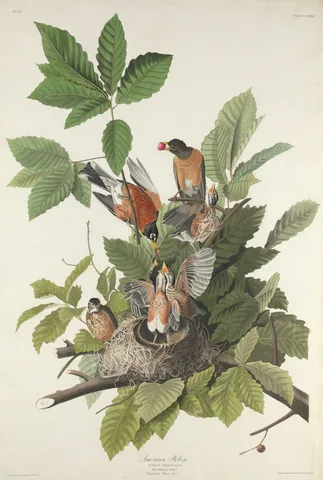
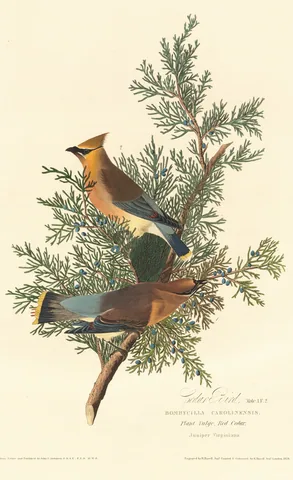
The small birds are the friendliest plates of all. American Robin (1832) shows robins and their chicks in a nest among beech leaves, perfect for a kitchen or a breakfast room. Cedar Bird (1828), two cedar waxwings on a juniper branch with blue berries against a pale ground, is small, soft and easy anywhere. Pileated Woodpecker (1831), four woodpeckers on a grapevine heavy with dark grapes, suits a dining room.
Where each one works
| Plate | Room | Largest framed | Largest canvas |
|---|---|---|---|
| American Flamingo | Living room, bathroom | 25 × 36 | 34 × 48 |
| Carolina Parrot | Living room, study | 26 × 36 | 29 × 40 |
| Snowy Owl | Bedroom, winter wall | 19 × 30 | 19 × 30 |
| Great blue Heron | Hallway, beside a door | 22 × 30 | 22 × 30 |
| American White Pelican | Coastal room, bathroom | 24 × 36 | 32 × 48 |
| Summer or Wood Duck | Den, cabin | 20 × 30 | 20 × 30 |
| American Robin | Kitchen, breakfast room | 16 × 24 | 16 × 24 |
| Cedar Bird | Small wall, entry | 24 × 40 | 24 × 40 |
Hanging Audubon in a group
The plates were made as one great book, and they still look best together. 60 of our 91 Audubon works are upright, so a row of three or a grid of four is easy to make, with every frame and mat the same. Cedar Bird, American Robin and two woodpeckers make a good grid to start from. Choose by color, all greens or all blues and whites, or by theme: owls, water birds, the birds of your state. Gallery wall layouts has the spacing, and botanical prints mix in well, since both come from the same tradition of natural history plates.
The smaller edition
In the 1840s J. T. Bowen published a smaller, cheaper edition, in seven volumes completed in 1844, with the plates redrawn as lithographs. A few of ours come from it, such as Boat-Tailed Grackle (1840); the listing says “lithograph by John T. Bowen after Audubon.” They are lovely, but they were printed small, so check the sizes.
Audubon also painted in oils. Farmyard Fowls, about 1827, a white rooster and two hens beside a nesting box, is a painting, not a plate, and it suits a farmhouse kitchen; farmhouse wall art has more.
Frames and mats
Natural history plates look most like themselves with a wide mat: a cream or off-white mat picks up the tone of the old paper. Natural oak is the easy, traditional choice; a thin gold frame looks like a library; slim black makes a set look modern. In a bathroom, our framed prints come with acrylic rather than glass.
Questions people ask
What is the most famous Audubon print?
The American Flamingo, from The Birds of America, along with the Wild Turkey, which was plate 1.
How big were the original Audubon prints?
About 39 by 26 inches, on sheets about 39½ by 28½ inches, with every bird drawn life-size.
Are these the original prints?
No. They are new prints made from high-resolution scans of original plates, most of them engraved by Robert Havell after Audubon’s originals.
Which birds in The Birds of America are extinct?
The Carolina parakeet, the passenger pigeon, the Labrador duck, the great auk and the heath hen; the ivory-billed woodpecker is possibly extinct.
Are Audubon prints public domain?
Yes. He died in 1851. What public domain art is.
All of them are on the John James Audubon page.
Audubon prints to start with
All Audubon
Sources
More from the Journal
 Guide · 8 min
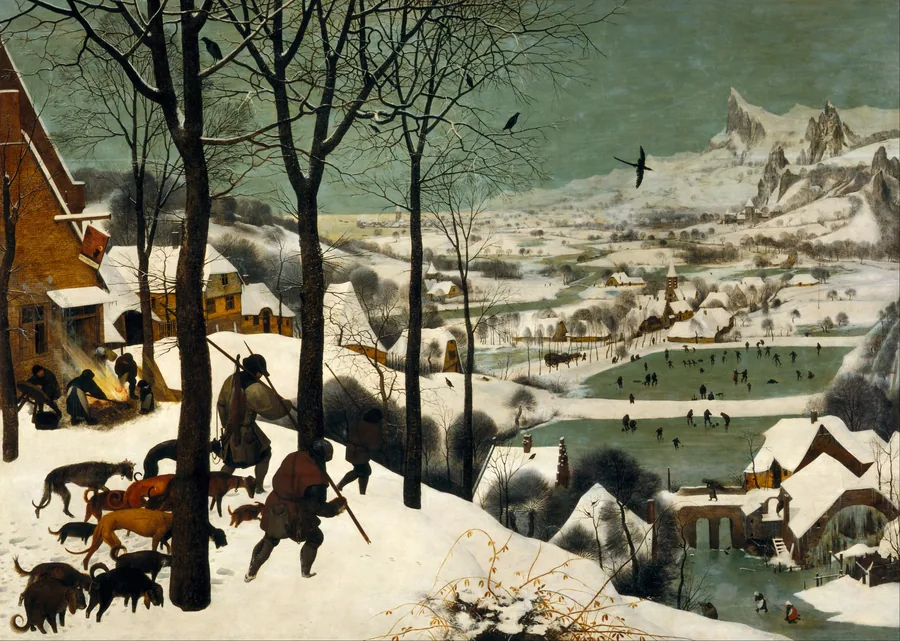
Winter and Christmas art prints worth hanging
Snow scenes that can stay up until March, Nativity paintings for December, the sizes and frames that suit them, and when to order for Christmas.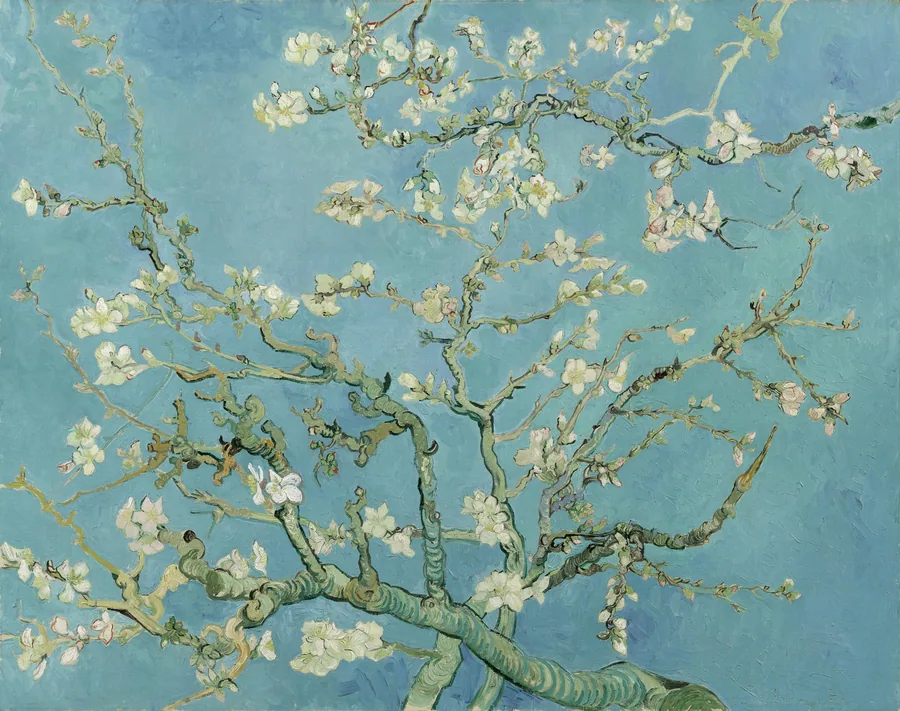 Guide · 7 min
Art as a gift: how to choose a print they’ll keep
Choose for their walls, not yours: safe sizes and frames, ideas by occasion, the gift note in the box, and how early to order for the holidays.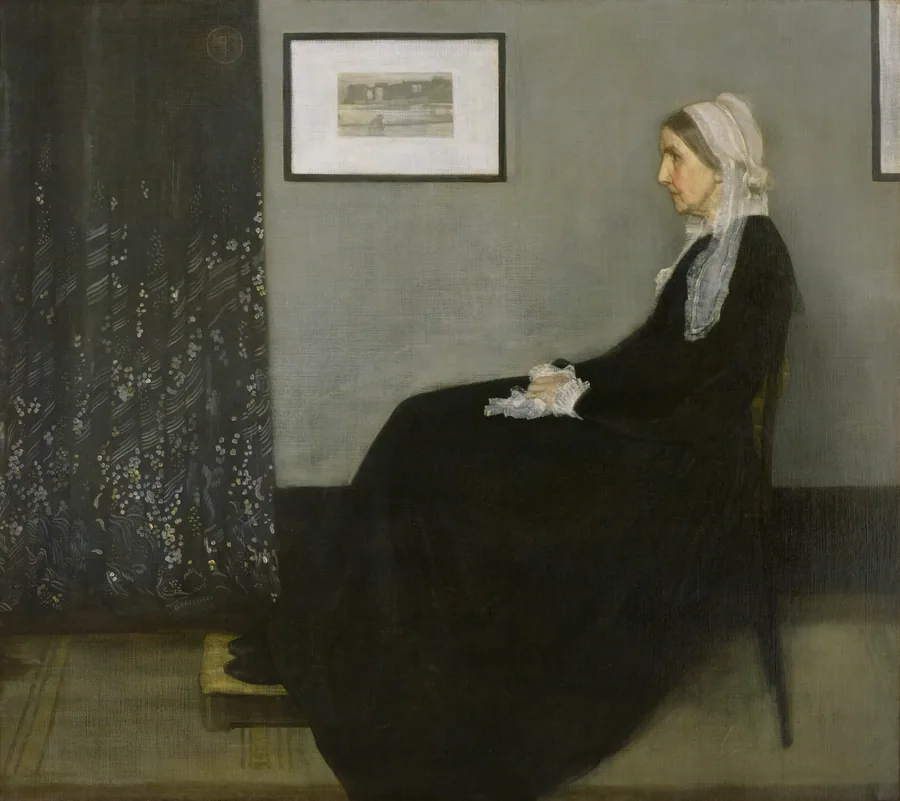 Guide · 7 min
Art gifts for mom and dad: ideas by what they love
Art gift ideas for parents, by what they love: gardens, the sea, books, travel, home. Safe sizes, a personal line of words, and when to order for Christmas. Guide · 6 min