
Guide
Gallery wall layouts that work, with measurements
Four gallery wall layouts drawn to scale with real frame sizes: the spacing, the height, how wide to go over a sofa, and how to hang it with no extra holes.
A gallery wall looks planned when three things are true: every gap between frames is the same, the whole group is hung as if it were one big picture, and the pieces share something, a frame color, a mat or a subject. Get those right and the layout itself is almost a matter of taste. Below are four layouts that work, each drawn to scale with real works from our catalog at sizes we sell, framed the way they would arrive, with the measurements you need to hang them.
between frames, the same gap everywhere.
floor to the center of the group on a bare wall (57 to 60 is the range).
of the furniture’s width when the group hangs over a sofa or a bed.
The rules every layout shares
Spacing. Advice runs from about 1 to 5 inches between frames, and 2 to 3 is the middle of the road. Small frames look best close together, nearer an inch or two; larger pieces nearer 3. Spread them too far apart and the group stops reading as one. Whatever you choose, keep it the same everywhere: an uneven gap is the thing the eye catches first. Cut a scrap of card to the gap and use it as a spacer for every frame.
Height. Treat the group as one picture. On a bare wall, its center goes 57 to 60 inches from the floor, the same as a single piece (how high to hang art explains why). Over furniture, forget the center and measure from the top of the furniture: the bottom row sits 6 to 10 inches above a sofa back or a sideboard.
Width. Over a sofa, a bed or a console, the whole group should be about two-thirds as wide as the furniture, frames and gaps included. On a bare wall, leave some empty wall at each side so the group doesn’t crowd a corner or a door frame.
Count the frame. The space a framed print takes is bigger than the picture. Our standard black frame is 1.25 in wide and the white mat 2 in, so each piece is 3.25 inches bigger than its picture on every side. All the measurements below include it.
1. The grid
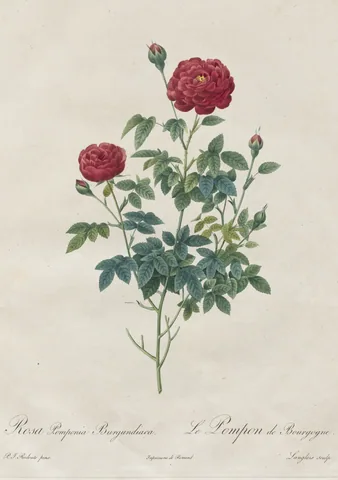
Identical frames in even rows and columns: the most formal layout, and the easiest to plan, because every measurement repeats. It suits a dining room, a long hallway or the wall over a sideboard, and it rewards a series, prints made to belong together. Redouté’s roses are the classic choice, each flower on a pale ground, so six of them read as one calm block of color. Here, six at 11 × 16 in make a group 56.5 in wide and 47 in tall, which also suits a sideboard or sofa about 85 inches wide.
Because every edge lines up, a grid shows any frame that is off level, so check the level across the whole row, not one frame at a time.
2. The row
Three or more pieces of the same height in a line, centered over the furniture. It is the simplest way to fill the long wall over a sofa or a bed, and it works with almost any three pictures that share a shape. Hiroshige’s Fifty-three Stations of the Tokaido are made for it: the lake at Hakone, Evening Snow at Kambara and the Tenryu River near Mitsuke are three stops on the same road.
Over an 84 inch sofa the row should be about 56 inches across. Three prints with a 16 in long side come to 73.5 in, frames and gaps included, and as a set of three they cost $269 instead of $312. Our sets are planned exactly this way: three pieces of the same height, 3 inches apart, 15% less than three single prints. For a different sofa, the sofa size guide has a calculator.
3. The anchor and its satellites
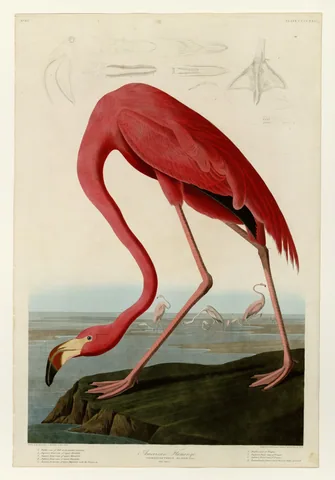
One large piece in the middle and smaller ones around it. This is the layout that looks collected rather than bought as a set, and it is the one that fills a big bare wall or a stair landing. Start with the largest piece as the focal point and work from the center out. Here it is American Flamingo from Audubon’s birds, with Yellow Warbler, Sharp-tailed Finch, Cedar Bird and Hermit Thrush stacked two to a side.
The trick is to make the side columns about as tall as the anchor, so the outer edges form a clean rectangle. Two small birds at 7 × 12 in stack to 40 in, gap included, and the flamingo at 25 × 36 in stands 42.5 in tall in its frame, so the edges are within 1.5 in of each other at the top and the bottom. The whole group is 64.5 in wide and 42.5 in tall.
The freer version of this layout, the salon wall, mixes many sizes and orientations around the anchor. It takes more planning, so lay it out on the floor first, and spread the dark frames across the group instead of bunching them on one side.
4. The column
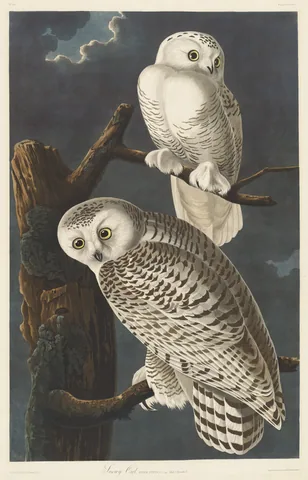
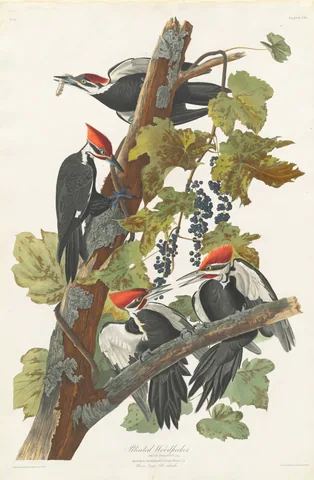
Two or three pieces stacked, for the narrow walls a row can’t use: beside a door, between two windows, at the end of a hall. Tall pictures suit it best. Audubon’s Snowy Owl and Pileated Woodpecker are both portrait-shaped, and at 10 × 16 in the pair stands 47 in tall, so its center can sit at 58 inches with the bottom frame still well clear of the floor. Keep a column to one width, and center it on the wall space, not on the furniture beside it.
The four layouts in numbers
| Layout | Pieces | Overall | Price | Where |
|---|---|---|---|---|
| Grid | 6 at 11 × 16 in | 56.5 × 47 in | $624 | Bare wall, dining room, over a long sideboard |
| Row | 3, 16 in on the long side | 73.5 × 16.5 in | $269 | Over a sofa or a bed (set price, 15% off) |
| Anchor | 1 at 25 × 36 in, 4 at 7 × 12 in | 64.5 × 42.5 in | $615 | A big bare wall, a stair landing |
| Column | 2 at 10 × 16 in | 16.5 × 47 in | $208 | Beside a door, between two windows |
To size your own, add up the frames and the gaps: the width of a row is the frames’ widths plus one gap fewer than the number of frames. Three pieces 22.5 inches wide with 3 inch gaps make 73.5 inches.
How to choose pieces that belong together
A gallery wall needs one thread running through it, and one is usually enough. Frames of a similar style are the easiest way to tie a mixed collection together.
- One frame color. The strongest thread. Black holds very different pictures together; natural oak is softer. How to choose a frame color goes through each.
- One mat. The same white mat around every picture helps mixed sizes look like a set.
- One artist or series. Redouté’s flowers, Hiroshige’s road, Audubon’s birds: prints made as a series already share a size, a palette and a hand.
- One color. Pictures of different subjects that share a color, blue water and blue robes and a blue sky, read as a set. Tying a room together with art shows how to pick it.
How to hang a gallery wall without extra holes
- Lay it out on the floor. Mark the wall space on the floor with painter’s tape and arrange the frames inside it until the spacing looks right.
- Make paper templates. Trace each frame on kraft paper and cut it out. Our framed prints arrive with a hanging wire fitted: pull the wire up tight, measure from the top of the frame to the wire, and mark that point on the template.
- Tape the templates to the wall. Use your card spacer for the gaps, check the level across each row, stand back, and live with it for a day.
- Nail through the paper. Hang the middle or the largest piece first and work outward. On a wide frame, two hooks a few inches apart keep it level. Then tear the paper away.
The nail calculator works out where the nail goes for any frame and wire, and hanging and hardware lists what comes fitted on each format.
Questions people ask
How far apart should gallery wall frames be?
2 to 3 inches, and the same everywhere. Use 2 inches for small frames and formal grids, 3 for larger or mixed pieces.
How high should a gallery wall be?
Center the whole group 57 to 60 inches from the floor on a bare wall. Over a sofa or a sideboard, put the bottom row 6 to 10 inches above it.
How wide should a gallery wall be over a sofa?
About two-thirds of the sofa’s width, frames and gaps included: around 56 inches over an 84 inch sofa.
How many frames do I need?
Three is the smallest group that reads as a gallery wall. Odd numbers are easier to balance around a center; a grid can be any even count.
Do the frames have to match?
No, but something should: a frame color, a mat, an artist or a color in the pictures. Spacing matters more than identical frames.
Prints made for groups
Sets of three



Sources
More from the Journal
 Guide · 8 min
Winter and Christmas art prints worth hanging
Snow scenes that can stay up until March, Nativity paintings for December, the sizes and frames that suit them, and when to order for Christmas. Guide · 7 min
Art as a gift: how to choose a print they’ll keep
Choose for their walls, not yours: safe sizes and frames, ideas by occasion, the gift note in the box, and how early to order for the holidays. Guide · 7 min
Art gifts for mom and dad: ideas by what they love
Art gift ideas for parents, by what they love: gardens, the sea, books, travel, home. Safe sizes, a personal line of words, and when to order for Christmas. Guide · 6 min