
Guide
The best Hiroshige prints to hang, season by season
The best Hiroshige prints for a home: Edo views, the Tokaido road, wide triptychs for a sofa and tall prints for narrow walls, with rooms and sizes.
Utagawa Hiroshige (1797 to 1858) was born in Edo, the city that is now Tokyo, into a samurai family; his father was a fire warden, and Hiroshige took the post over as a young man. He became the great landscape printmaker of his age, with thousands of designs, and he was the Japanese artist Van Gogh, Monet and Whistler learned from. Where Hokusai is bold and dramatic, Hiroshige is weather and mood: rain, snow, mist, dusk and moonlight. That makes him wonderfully easy to live with. We have 177 of his works; this guide picks the best for a home, by series and by shape.
Three of his most famous prints, the Sudden Shower over Shin-Ōhashi Bridge, Plum Park in Kameido and Evening Snow at Kambara, are covered in Japanese woodblock prints for the home, along with sizes and mats. The Sudden Shower is often called his masterpiece, and Van Gogh copied the Plum Park as a painting. Here is the rest.
One Hundred Famous Views of Edo: his last and best series
Published from 1856 to 1859, the series has 119 prints of his home city, arranged by season, and Hiroshige II finished it after his death. It is in an upright format, which suits most walls in a modern home, and the seasons make it easy to choose.
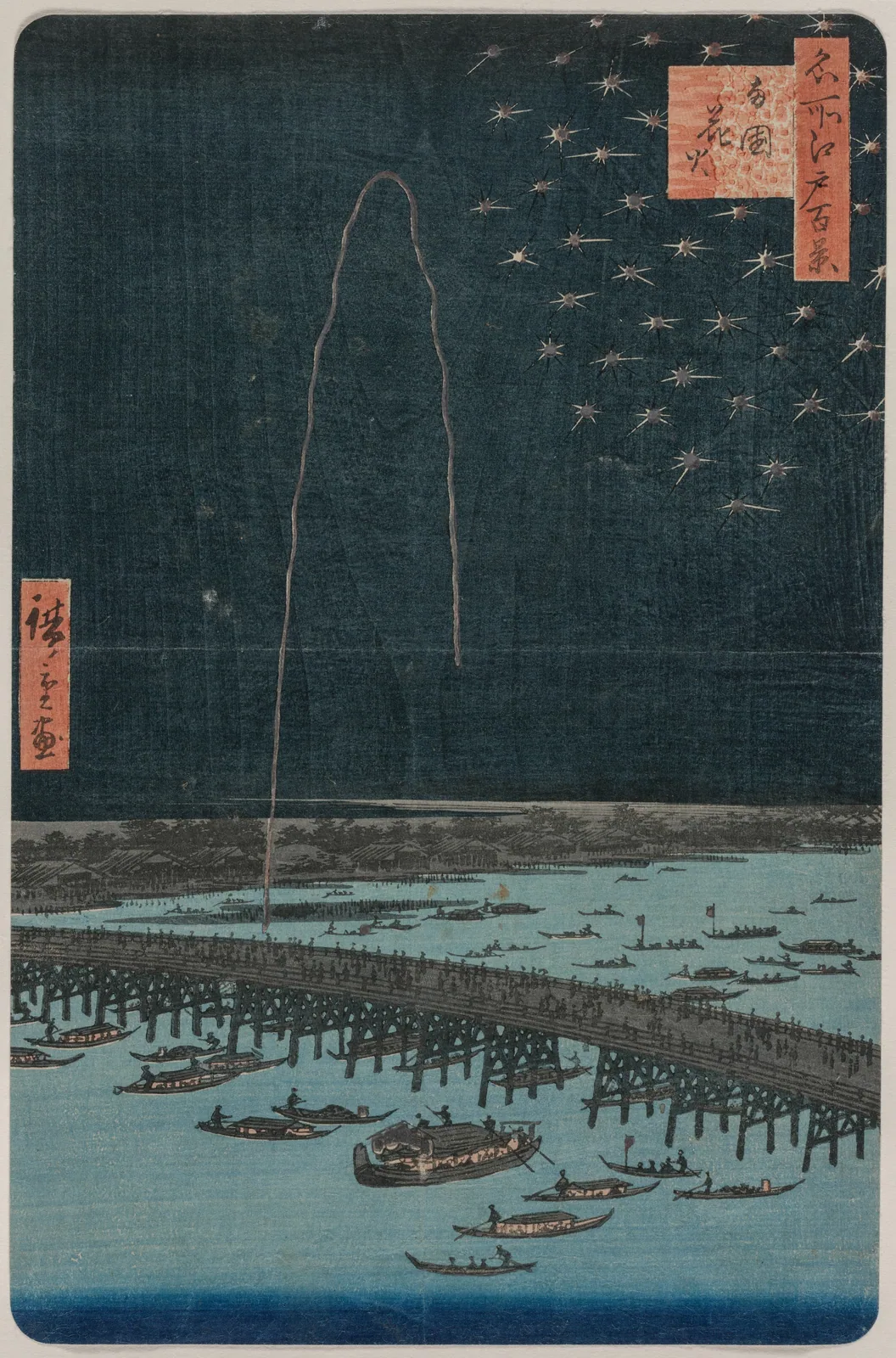
- Fireworks at Ryōgoku, 1858. A single firework bursting over the black Sumida River, with boats crowding the water and people on the long bridge. It is the most modern-looking print in the series, and a dark wall makes it glow. Framed prints go up to 26 × 40 in, canvas up to 32 × 48 in and unframed art prints up to 32 × 48 in.
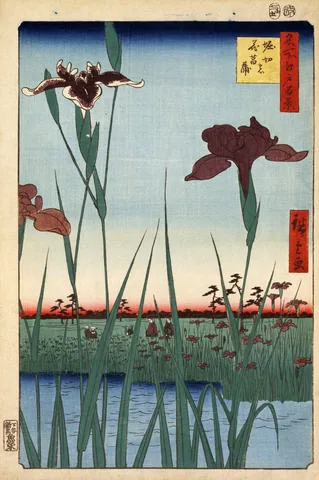
- Horikiri Iris Garden, 1857. Tall purple irises fill the foreground, the marsh garden behind at dusk. It is counted among the prints that influenced European Art Nouveau, and it is the loveliest choice for a bedroom.
- The Moon-Viewing Promontory. A veranda looking out over a moonlit bay with sailboats. A calm print for a bedroom or a reading corner.
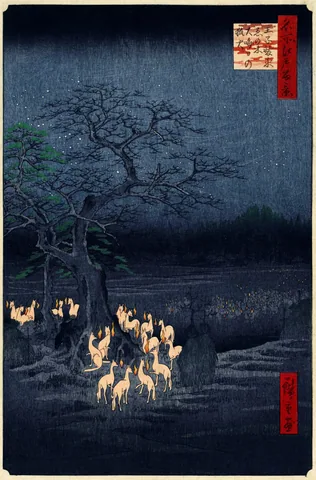
- Kitsunebi on New Year’s Night under the Enoki Tree. Glowing foxes gather under a bare tree on a dark field beneath the stars. It is the most magical print Hiroshige made, and a good one for the holidays that is not about Christmas.
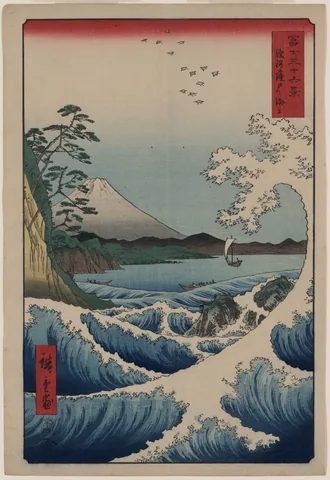
The Edo views are nearly all the same tall shape, so three in a row make an easy set. Fireworks, the Moon-Viewing Promontory and the Iris Garden make a good set to start from. From 1858, the year he died, The Sea at Satta in Suruga Province has foaming waves that invite comparison with Hokusai’s Great Wave. It is a natural for a coastal room or a bathroom.
The Tokaido and Kisokaido: the road prints
In 1832 Hiroshige traveled the Tokaido, the road from Edo to Kyoto, with an official procession and sketched the route, and from 1833 to 1834 he published The Fifty-three Stations of the Tōkaidō, the series that made his name. These prints are landscape, so they suit the wall over a desk, a console or a bench. The Lake at Hakone is a steep wooded mountain over a still blue lake; Yokkaichi is a man fighting the wind past a windswept willow, one of the liveliest prints in the series. Later he made forty-six of the seventy Stations of the Kisokaidō with Keisai Eisen; Shimosuwa shows travelers eating at an inn while a man bathes behind them, a natural for a dining room.
The wide triptychs: Hiroshige for over a sofa
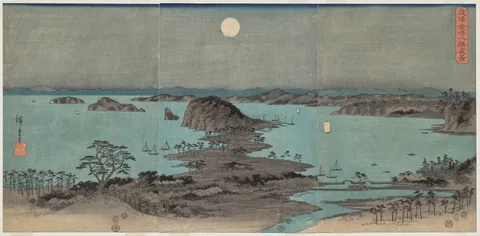
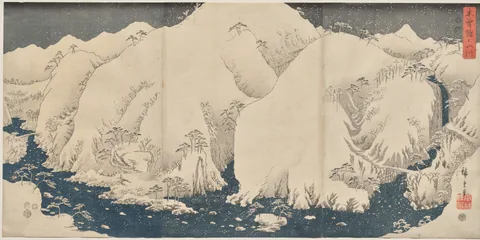
A triptych is three sheets printed to be seen side by side, and in 1857 Hiroshige made several great ones. Mountain and River on the Kiso Road is a deep snowy gorge with pines and falling snow; Eight Views of Kanazawa at Night is a moonlit coast of islands and sailing boats under a full moon; The Whirlpools of Awa, in the woodblock guide, is the sea at its wildest. They are twice as wide as they are tall, made for the long wall over a sofa, a bed or a sideboard, and our scans of them go large: Kanazawa at Night is sold as a canvas up to 48 × 24 in. Hang one alone; they do not need company.
Tall prints for narrow walls
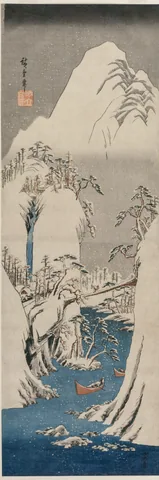
Hiroshige also made very tall, narrow designs. The Fuji River in the Snow (1841) is a snowy gorge with boats on dark blue water, printed nearly three times as tall as it is wide; it is made for the strip of wall beside a door, between windows or on a stairway. Framed prints, canvas and unframed art prints all go up to 16 × 48 in. Night Scene on the Sumida River, a painting rather than a print, is a moon over a misty river and a long bridge, equally tall and narrow.
Birds and flowers
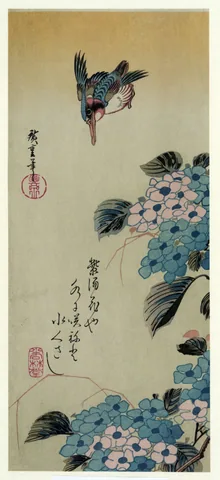
Hiroshige also made bird-and-flower prints, many of them in narrow formats. Hydrangea and Kingfisher (1832), a kingfisher diving above blue hydrangeas, is the best of ours and goes surprisingly large. Canary and Wisteria, a yellow bird under hanging blue blossoms, and Mandarin Ducks and Flowering Plants, a pair on blue water, are gentle enough for a bedroom or a bathroom. Full Moon over Takanawa, geese crossing a full moon over a bay, is the landscape version of the same calm.
Where each one works
| Room | Largest framed | Largest canvas | |
|---|---|---|---|
| Fireworks at Ryōgoku | Living room, a dark wall | 26 × 40 | 32 × 48 |
| Horikiri Iris Garden | Bedroom, garden room | 24 × 36 | 32 × 48 |
| The Sea at Satta in Suruga Province | Coastal room, bathroom | 25 × 36 | 33 × 48 |
| Yokkaichi: View of the Mie River | Hallway, office | 40 × 25 | 48 × 30 |
| Mountain and River on the Kiso Road | Over a sofa or bed | 40 × 20 | 48 × 24 |
| Eight Views of Kanazawa at Night | Over a sofa or bed | 40 × 20 | 48 × 24 |
| The Fuji River in the Snow | Narrow wall, stairway | 16 × 48 | 16 × 48 |
| Hydrangea and Kingfisher | Narrow wall, bathroom | 22 × 48 | 22 × 48 |
Hiroshige through the year
Because so many of his prints are tied to a season, Hiroshige is the easiest artist for a wall you change through the year: plum blossom and irises, fireworks on a summer night, moonlight over the bay, and in winter the foxes, the Kambara snow or Snow at the Gion Shrine, women with parasols in falling snow. Winter and Christmas art prints has more for December.
Frames and mats
Like all woodblock prints, Hiroshige looks best in a plain frame with a generous mat. Slim black sharpens the night prints, Fireworks and the foxes above all; natural oak warms the road prints and the birds. A cream or off-white mat suits the old paper. For the wide triptychs, a canvas with no frame at all lets the long picture run.
Questions people ask
What is Hiroshige’s most famous print?
Sudden Shower over Shin-Ōhashi Bridge and Atake, from One Hundred Famous Views of Edo, is often called his masterpiece.
What is the difference between Hiroshige and Hokusai?
Both made great landscape series. Hokusai’s are bold and graphic; Hiroshige’s are quieter and full of weather. See the best Hokusai prints.
Is there a Hiroshige wide enough for over a sofa?
Yes: the 1857 triptychs, Mountain and River on the Kiso Road, Eight Views of Kanazawa at Night and The Whirlpools of Awa.
Did Hiroshige influence Van Gogh?
Yes. Van Gogh painted copies of two prints from One Hundred Famous Views of Edo, the Plum Park among them.
Are Hiroshige prints public domain?
Yes. He died in 1858. What public domain art is.
All his work is on the Utagawa Hiroshige page.
Hiroshige prints to start with
All Hiroshige
Sources
More from the Journal
 Guide · 8 min
Winter and Christmas art prints worth hanging
Snow scenes that can stay up until March, Nativity paintings for December, the sizes and frames that suit them, and when to order for Christmas. Guide · 7 min
Art as a gift: how to choose a print they’ll keep
Choose for their walls, not yours: safe sizes and frames, ideas by occasion, the gift note in the box, and how early to order for the holidays. Guide · 7 min
Art gifts for mom and dad: ideas by what they love
Art gift ideas for parents, by what they love: gardens, the sea, books, travel, home. Safe sizes, a personal line of words, and when to order for Christmas. Guide · 6 min