
Guide
The best Hokusai prints to hang, beyond the Great Wave
Hokusai past the Great Wave: the best of his Fuji views, tall waterfalls, poem prints and birds and flowers, with the room each suits and the sizes sold.
Katsushika Hokusai lived from about 1760 to 1849 and had a long career as a painter, a printmaker and an illustrator of books. He used at least thirty names in that time, more than any other major Japanese artist, and each change of name tends to mark a change of style. His best-known prints came late, in his seventies, and that is where most of the best prints for a home come from too. We have 100 of his works. This guide picks the ones that hang best, apart from the two everyone already knows, and says which room each suits and how large it can go.
First, the famous two
The Great Wave off Kanagawa and South Wind, Clear Sky, the red Fuji, are the most recognized Japanese prints in the world, and they deserve their place. If you want one of them, our stories on the Great Wave and why Hokusai painted Fuji red tell you what you are looking at. Our Great Wave is printed from a 20th-century reprint by the Adachi workshop, recut from Hokusai’s design, and its listing says so; everything else in this guide is printed from an impression of Hokusai’s own time. For how woodblock prints work in a room, sizes and mats included, start with Japanese woodblock prints for the home, which also covers the Ono waterfall, the Brocade Bridge and the storm print Rain below the Mountain. Here is the rest.
Beyond the Wave: the rest of the Fuji views
The Great Wave belongs to Thirty-six Views of Mount Fuji, made from about 1830 to 1832 and published by Nishimura Yohachi. It sold so well that ten more prints were added, 46 in all. Prussian blue, a pigment newly arrived from Europe, runs through the series, and the earliest prints were made largely in blue tones. That blue is why the series looks so good in a modern room: it sits with gray, white, navy and natural wood.
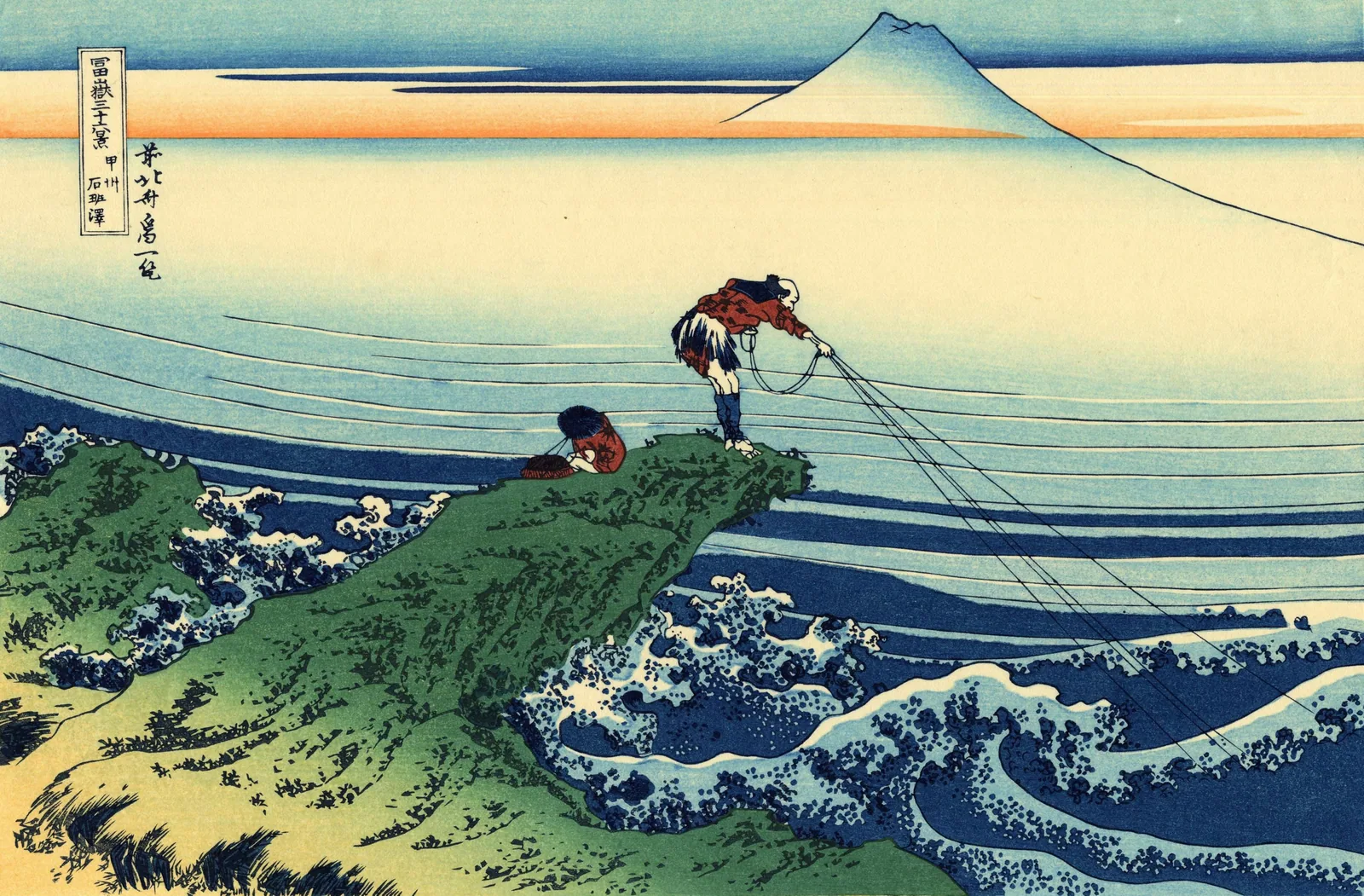
Kajikazawa in Kai Province. A lone fisherman on a headland casts his line into rolling blue water, with snowy Fuji far behind. Less famous than the Wave, it is also considered one of the series’ best works, and it is the one we would hang first: almost all blue, quiet and strong at once. It suits a living room or an office, and a navy room especially. Framed prints, canvas and unframed art prints all go up to 24 × 16 in.
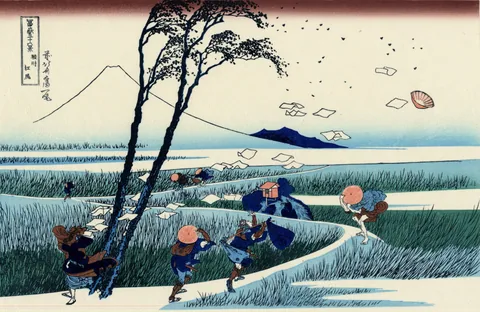
Ejiri in Suruga Province. A gust of wind tears through a line of travelers, bending the pines and sending sheets of paper flying across the fields. It is the liveliest print in the series, all movement, and good where people pass: a hallway or an office. Framed prints, canvas and unframed art prints all go up to 24 × 16 in.
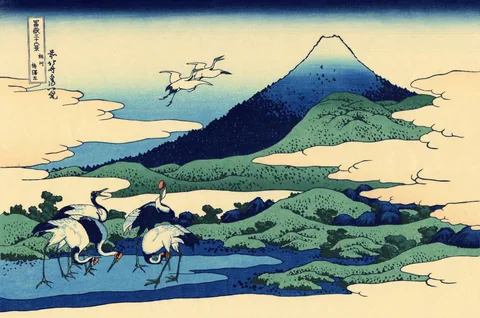
Umezawa Manor in Sagami Province. Red-crowned cranes wade in a river below a dark blue Fuji. Calm, almost empty, and a good choice over a bed. Framed prints, canvas and unframed art prints all go up to 30 × 20 in.
Morning After a Snowfall at Koishikawa. A white village on a snowy morning, figures on a balcony looking out at the mountain. It is a winter print that does not shout Christmas, so it can stay up all season.
Fujimigahara in Owari Province and Under the Mannen Bridge at Fukagawa are the playful ones: in the first, a man bends over a huge round wooden frame with Fuji small in the distance; in the second, Fuji is seen far off beneath the arch of a tall bridge. They reward a second look, which makes them good near a desk or a reading chair.
Many of these come from scans of about the size of the original sheet, so check each listing: Fujimigahara is sold up to 30 × 20 in framed: a good size for a desk wall or a hallway, though not a big piece over a sofa.
Tall prints for narrow walls
Most of the Fuji views are landscape. When the wall is tall and narrow, beside a door, between two windows or on a stairway, turn to the series Hokusai made in an upright format.
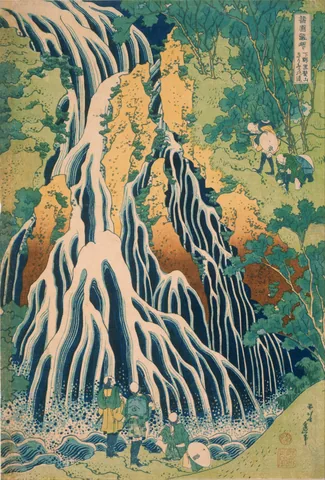
- Waterfalls. A Tour of the Waterfalls of the Provinces is a set of eight prints, all vertical. Kirifuri Waterfall at Mount Kurokami pours down in many channels like something alive, with tiny pilgrims at its foot; The Yoshitsune Horse-Washing Falls at Yoshino shows two men washing a red horse in the spray. The Kirifuri is sold up to 20 × 30 in framed; the horse falls is a small scan, so it suits a small wall.
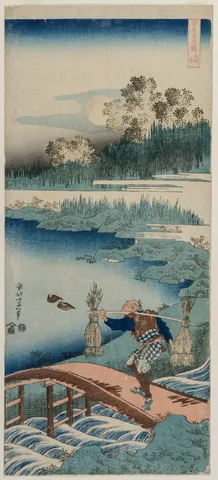
- Poetry prints. From the series A True Mirror of Chinese and Japanese Poetry, The Rush Gatherer carries his bundles across a bridge under an autumn moon, and A Chinese Official Pausing on a Bridge rides through snow under a laden pine. They are very tall and narrow, a little over twice as tall as wide, and The Minister Toru makes a third. Two side by side flank a doorway or a bed well. Framed prints, canvas and unframed art prints all go up to 22 × 48 in.
Bridges
Hokusai also made Curious Views of Famous Bridges in the Provinces, and two of ours are among the easiest Hokusais to live with. The Eight-Part Bridge zigzags over marshy water; The Boat Bridge at Sano is a bridge of boats under snow, with a horse and travelers crossing. Both are landscape, both are printed from fine scans with room to go large, and both pair with any of the Fuji views. Framed prints go up to 36 × 24 in, canvas up to 48 × 32 in and unframed art prints up to 48 × 32 in.
The poem prints: the largest Hokusais we sell
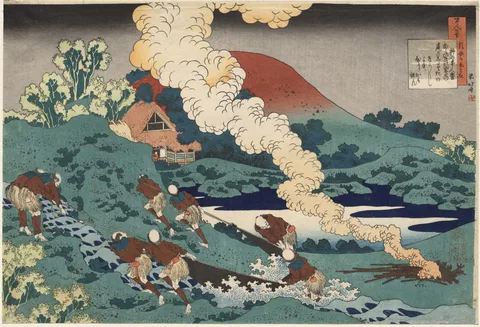
Hokusai’s last print series, One Hundred Poems Explained by the Nurse, made in 1835 and 1836, illustrates classical Japanese poems, and it was never published in full. The prints that exist are some of his most beautiful, and because our scans come from fine impressions, they go bigger than anything else of his: the poem by Kakinomoto no Hitomaro, fishermen hauling a net through a rushing river, is sold up to 36 × 25 in framed. That makes it the Hokusai for a big wall over a sofa or a bed. The poem by Minamoto no Muneyuki, hunters by a fire beside a snowy waterfall, is the winter choice, and the poem by Emperor Tenchi, farmers carrying rice through autumn fields, is the one for a kitchen or a dining room.
Flowers, birds and fish
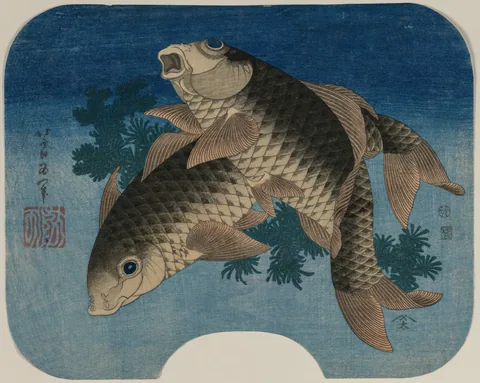
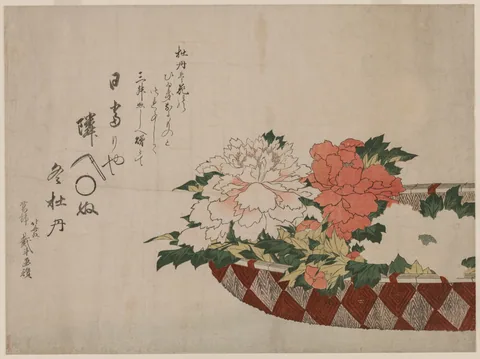
Hokusai drew everything, and his small nature prints are the gentlest of all. Carp Swimming by Water Weeds (1831) is printed on a fan-shaped sheet, two carp among green weeds on a blue ground, and it is a natural for a bathroom or a kitchen. Basket of Peonies, pink and white flowers spilling from a basket beside a poem, suits a dining room or an entry. Dragonfly and Bellflower and Rooster, Hen and Chicken with Spiderwort are small and bright: a pair of them makes a cheerful group for a kitchen or a child’s room.
For October, Hokusai also drew ghosts. The Lantern Ghost Iwa, a pale face rising from a paper lantern, is not for a nursery, but it is a memorable print for a dark study or a reading corner.
Where each one works
| Room | Largest framed | Largest canvas | |
|---|---|---|---|
| Kajikazawa in Kai province | Living room, office | 24 × 16 | 24 × 16 |
| Ejiri in Suruga province | Hallway, office | 24 × 16 | 24 × 16 |
| Umezawa Manor in Sagami Province | Bedroom | 30 × 20 | 30 × 20 |
| Morning after a Snowfall at Koishikawa | Bedroom, winter wall | 24 × 17 | 24 × 17 |
| Pilgrims at Kirifuri Waterfall on Mount Kurokami in Shimotsuke Province | Narrow wall, stairway | 20 × 30 | 20 × 30 |
| The Rush Gatherer | Beside a door | 22 × 48 | 22 × 48 |
| Poem by Kakinomoto no Hitomaro | Over a sofa or bed | 36 × 25 | 48 × 33 |
| Carp Swimming by Water Weeds | Bathroom, kitchen | 36 × 29 | 40 × 32 |
| Basket of Peonies | Dining room, entry | 36 × 27 | 48 × 36 |
Hanging Hokusai in a group
The Fuji views are nearly all the same landscape shape, which makes them easy to group: three in a row over a sofa or a console reads as one calm band of blue. Kajikazawa, Umezawa and the Koishikawa snow make a good set to start from. Keep the frames and mats identical and the gaps even; gallery wall layouts has the spacing. The tall poetry prints work the other way, as a pair either side of something, and they should not be mixed into a row of landscapes.
Frames and mats
Woodblock prints look most like themselves in a plain frame with a generous mat. A slim black frame sharpens the blue prints; natural oak warms them and suits the flower and bird prints. A soft white or cream mat keeps the pale paper tones from looking dirty against a bright white wall. Leave the gold frames for Klimt: they fight with Hokusai’s blues. If a print is going near a window or in a bathroom, framed prints come with acrylic, not glass.
Questions people ask
What is Hokusai’s most famous print?
The Great Wave off Kanagawa, from Thirty-six Views of Mount Fuji, made about 1830 to 1832.
What is the best Hokusai print besides the Great Wave?
The red Fuji, South Wind, Clear Sky, is the usual answer. For a print fewer of your guests will know, Kajikazawa in Kai Province, the lone fisherman in blue, is also considered one of the best in the series.
Which Hokusai print can go the largest?
Of ours, the poem prints from One Hundred Poems Explained by the Nurse, which are printed from fine, large scans.
Is there a tall Hokusai for a narrow wall?
Yes: the waterfall series, all vertical, and the very narrow poetry prints such as The Rush Gatherer.
Are Hokusai prints public domain?
Yes. He died in 1849. What public domain art is.
All his work is on the Katsushika Hokusai page.
Hokusai prints to start with
All Hokusai
Sources
More from the Journal
 Guide · 8 min
Winter and Christmas art prints worth hanging
Snow scenes that can stay up until March, Nativity paintings for December, the sizes and frames that suit them, and when to order for Christmas. Guide · 7 min
Art as a gift: how to choose a print they’ll keep
Choose for their walls, not yours: safe sizes and frames, ideas by occasion, the gift note in the box, and how early to order for the holidays. Guide · 7 min
Art gifts for mom and dad: ideas by what they love
Art gift ideas for parents, by what they love: gardens, the sea, books, travel, home. Safe sizes, a personal line of words, and when to order for Christmas. Guide · 6 min