
Guide
Japanese woodblock prints for the home
Hokusai and Hiroshige for every room: which prints to choose, the sizes and frames that suit them, and what a print of a woodblock print really is.
In Edo, the city that became Tokyo, a color woodblock print was an everyday thing. Records from the 1800s show prints selling for as little as 16 mon, the price of a bowl of soba noodles. A designer such as Hokusai or Hiroshige drew the picture, a carver cut it into blocks of wood, often ten or more for a full-color print, and a printer printed each color onto the paper, while a publisher paid for it all and sold the sheets. They were made for ordinary people to buy and enjoy, which is exactly why they still suit a home so well.
This guide covers the prints worth hanging, where each kind looks best, the sizes and frames that suit them, and, honestly, what you are buying when you buy a print of one.
Hokusai: Fuji, waves and waterfalls
Katsushika Hokusai was in his seventies when he made Thirty-six Views of Mount Fuji, around 1830 to 1832. The series was a hit, and the publisher added ten more prints, forty-six in all. Hokusai used a lot of Prussian blue, a pigment then newly arrived in Japan from Europe, and that deep blue is much of the series’ appeal.
- The Great Wave off Kanagawa. Probably the most famous Japanese print of all, and the one to choose if you want a single strong piece over a sofa or a desk; framed, it goes up to 36 × 25 in. Be aware that the impression we print from is a 20th-century reprint by the Adachi workshop, recut from Hokusai’s design, and the listing says so. Our Great Wave story explains what that means.
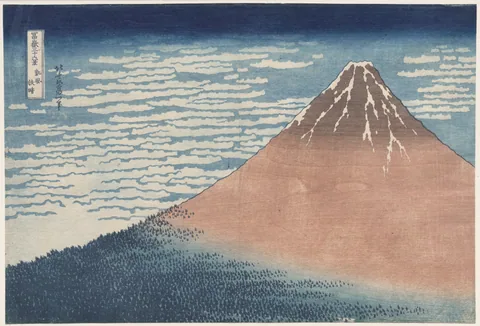
- South Wind, Clear Sky, the Red Fuji. Just the mountain, red against a blue sky streaked with cloud. It is the calmest of the series and works anywhere, a bedroom included. Why Hokusai painted Fuji red.
- Rain Below the Mountain. The same red peak above a storm, with lightning striking below it: the Red Fuji’s stormy twin. Hung as a pair they make a natural set.
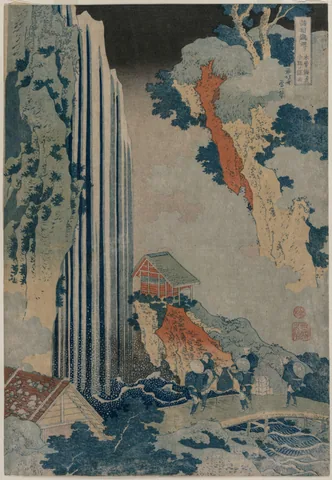
- Ono Waterfall on the Kiso Road and The Brocade Bridge in Suo Province, from his series of waterfalls and of bridges, early 1830s. Both are upright, so they suit a narrow wall or a hallway.
Hiroshige: rain, snow and the city
Utagawa Hiroshige, a generation younger, is the poet of weather. His Fifty-three Stations of the Tōkaidō (1833 to 1834) follows the great road between Edo and Kyoto, and his last series, One Hundred Famous Views of Edo, published from 1856, has 119 prints in an upright format; it was hugely popular and much reprinted.
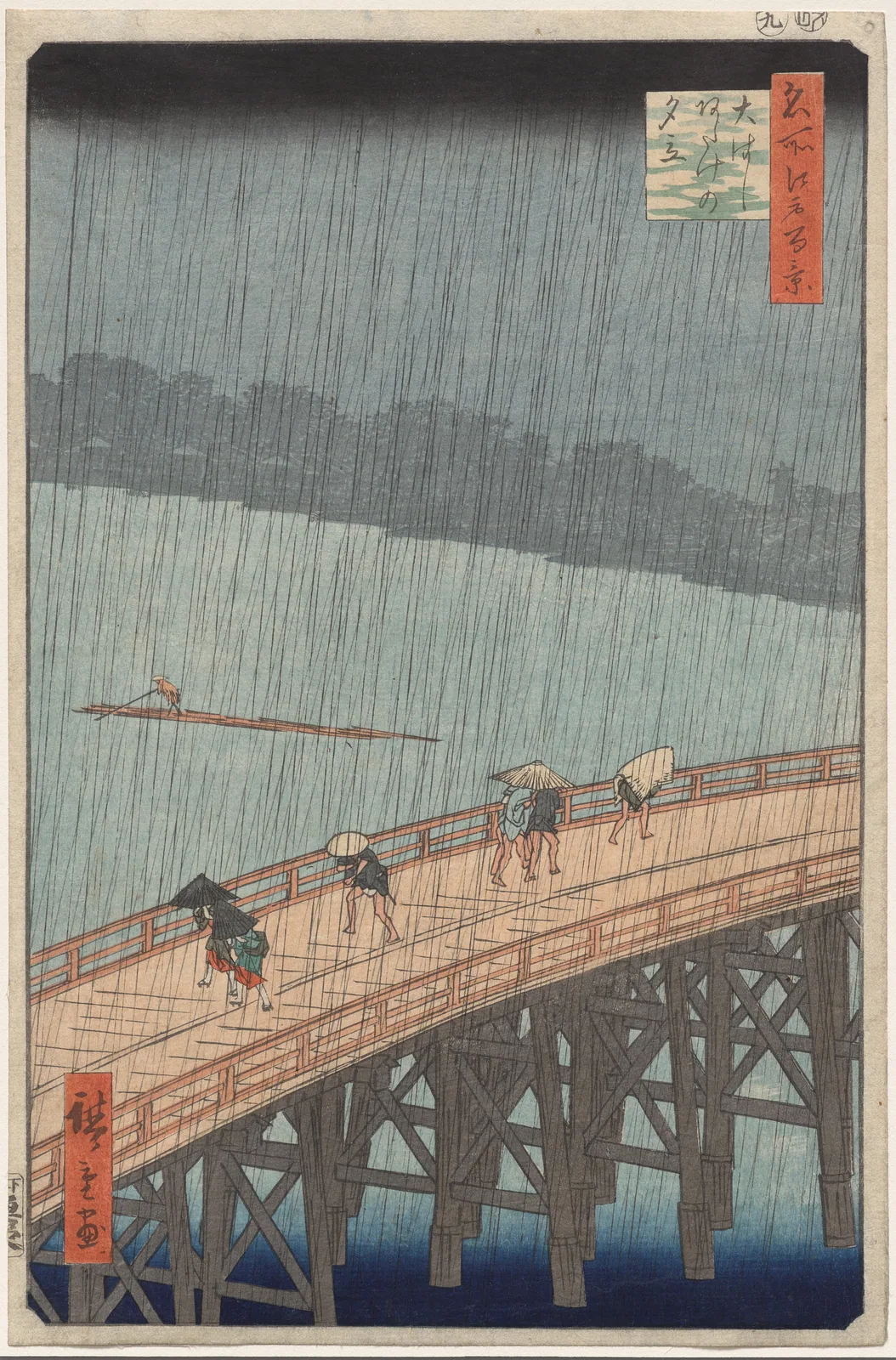
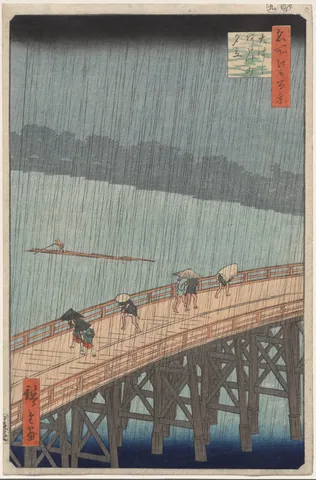
- Sudden Shower over Shin-Ōhashi Bridge and Atake, 1857. People run for cover across a bridge as the rain comes down in fine dark lines. Van Gogh copied it in oil. It is upright and spare, good beside a door or in a hall; at close to its true size, 11 × 16 in, $104.
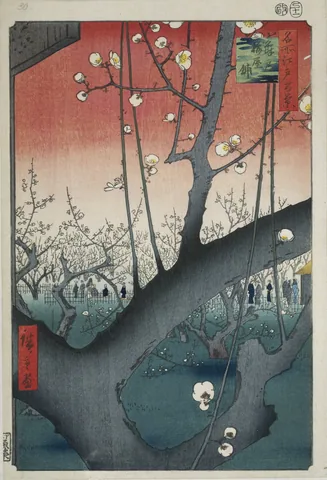
- Plum Park in Kameido, 1857. A plum tree in the foreground with blossom against a red sky; Van Gogh copied this one too. The image we print from is smaller than most, so it is sold up to 14 × 20 in framed.
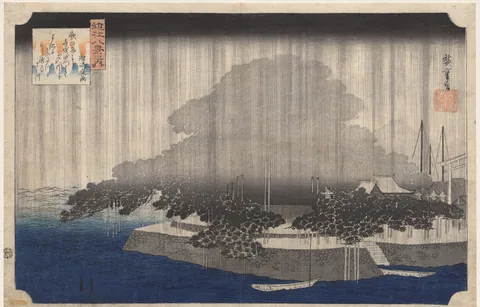
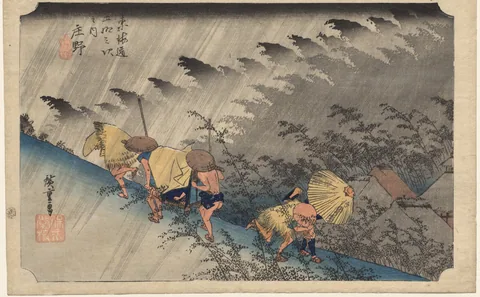
- Driving Rain at Shōno, Evening Snow at Kambara and Night Rain at Karasaki. Rain, snow and more rain, in the long landscape shape of his Tokaido and Ōmi series: they hang well in a row over a sofa or a bed.
- The Whirlpools of Awa, 1857. A triptych of three sheets showing whirlpools and pine-topped rocks, so the picture is very wide, up to 48 × 24 in as canvas. A rare Japanese print that can fill a long wall alone.
- Meguro Drum Bridge and Sunset Hill, 1857. Snow falling on an arched stone bridge at dusk, a quiet winter print for a bedroom.
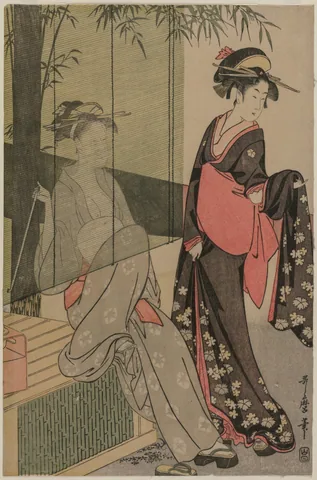
For people rather than places, Kitagawa Utamaro’s Two Women by a Bamboo Blind and Suzuki Harunobu’s gentle Young Woman Admiring a Snow Rabbit suit a bedroom or a dressing room. The whole range is in Japanese Woodblock Prints, and on the Hokusai and Hiroshige pages.
Which room for which print
- Living room. One strong image, the Great Wave or a wide triptych, or a row of three landscapes over the sofa.
- Bedroom. The Red Fuji, a snow scene or a quiet figure print. Avoid the busiest storm pictures over a bed.
- Hallway and stairs. The upright prints, Hiroshige’s Edo views and Hokusai’s waterfalls, in a line at the same height.
- Home office. A Fuji over the desk: a big shape, few details, easy to look at between calls.
- Bathroom. Rain and water prints, framed behind acrylic, which keeps splashes off the paper.
Size: small is true to the original
Most of these prints were made on the standard ōban sheet, about 15 by 9 inches (38 by 23 cm), and the impressions we print from measure close to that. A framed print with a 16-inch picture and a white mat shows one very nearly at its real size, which is how they look best in a hallway, over a desk or beside a bed. Our scans of museum impressions are sharp enough to go much bigger (a framed Sudden Shower at 20 × 30 in, $204), and a large Great Wave or Red Fuji does work as a single statement piece. Just know that at that size the paper fibers and the edges of each color show far more than they do in the hand.
Japanese prints also make some of the best groups. Three from one series share a shape, a palette and a hand, and line up without effort: Shōno, Kambara and Karasaki as a set of three cost 15% less than three single prints. Gallery wall layouts has the spacing and the measurements.
Paper, mat and frame
These were printed on paper, and they look truest on paper: an art print, matted and framed. Smooth cotton paper keeps the fine lines of the rain and the carved outlines crisp; the velvet paper adds a soft texture that suits the snow scenes. A generous mat in white or a warm off-white gives a small print room to breathe. For the frame, a slim blackor slim natural oak frame keeps it light; heavy gold looks wrong on a print that was sold for the price of noodles. Canvas works for the big statement sizes, but fine lines stay crisper on smooth paper than on the canvas weave.
What you are buying: impressions and reprints
A woodblock print exists in many copies, called impressions, pulled from the same blocks. Publishers reprinted popular designs, and carvers sometimes changed the colors from one edition to the next, so no two impressions match exactly. Later still came new blocks recut from the old designs, some sold honestly as reproductions and some passed off as originals. Collectors pay far more for an early impression than for even a good later one.
Our prints are not woodblock prints. Each is printed with pigment inks from a photograph of one particular impression, almost always a sheet in a museum such as the Cleveland Museum of Art, and the listing names that museum and gives its date for the sheet. Where the impression is a later reprint, the listing says so, as it does for our Great Wave. So you always know whose sheet you are looking at.
Questions people ask
What is the most famous Japanese woodblock print?
Hokusai’s Great Wave off Kanagawa, from Thirty-six Views of Mount Fuji, made around 1830 to 1832.
Are these original woodblock prints?
No. They are fine-art prints made from photographs of the originals, and each listing names the museum that holds the impression we print from. Early impressions are collectors’ pieces, priced accordingly.
What size should a Japanese print be?
Close to the original, about 15 by 9 inches, for a hall or a bedroom; larger only as a single statement piece.
Did Van Gogh really copy Hiroshige?
Yes. He collected Japanese prints and painted copies in oil of two of Hiroshige’s Edo views: Plum Park in Kameido and Sudden Shower over Shin-Ōhashi Bridge.
Which prints go together?
Prints from one series: Hokusai’s Fuji views, Hiroshige’s Tokaido stations, or his Edo views, at the same size.
Woodblock prints to start with
All Japanese prints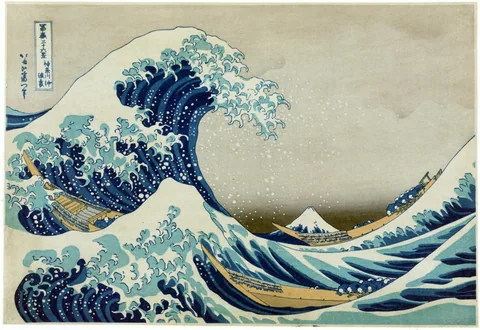
Sources
More from the Journal
 Guide · 8 min
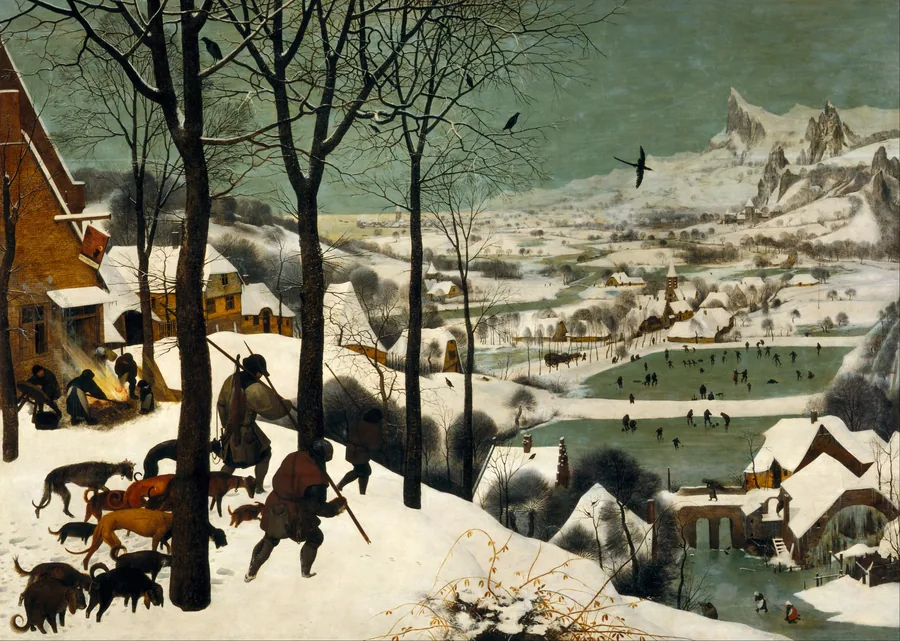
Winter and Christmas art prints worth hanging
Snow scenes that can stay up until March, Nativity paintings for December, the sizes and frames that suit them, and when to order for Christmas.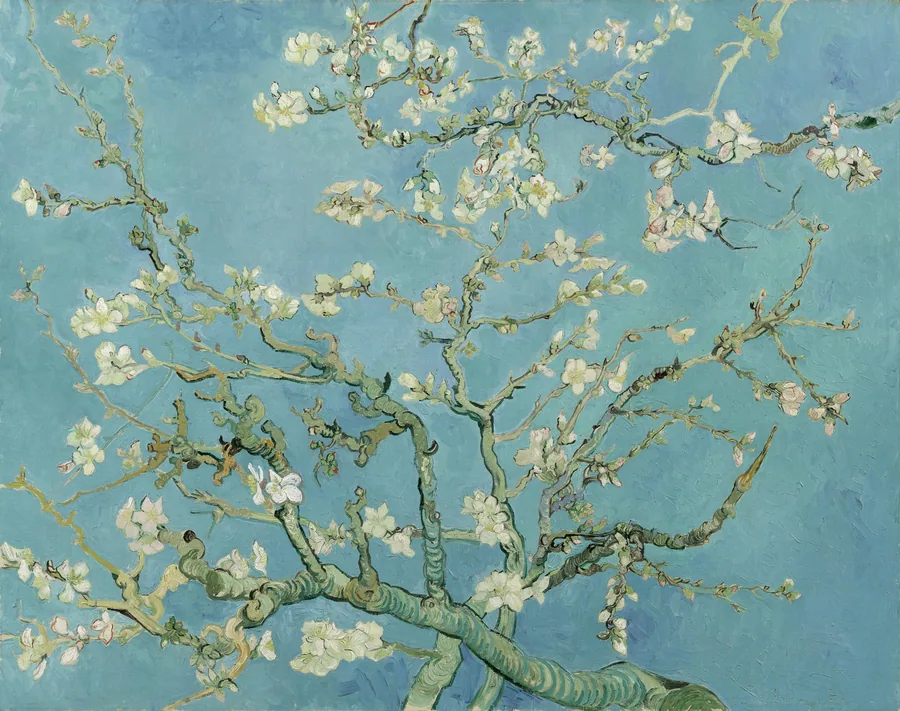 Guide · 7 min
Art as a gift: how to choose a print they’ll keep
Choose for their walls, not yours: safe sizes and frames, ideas by occasion, the gift note in the box, and how early to order for the holidays.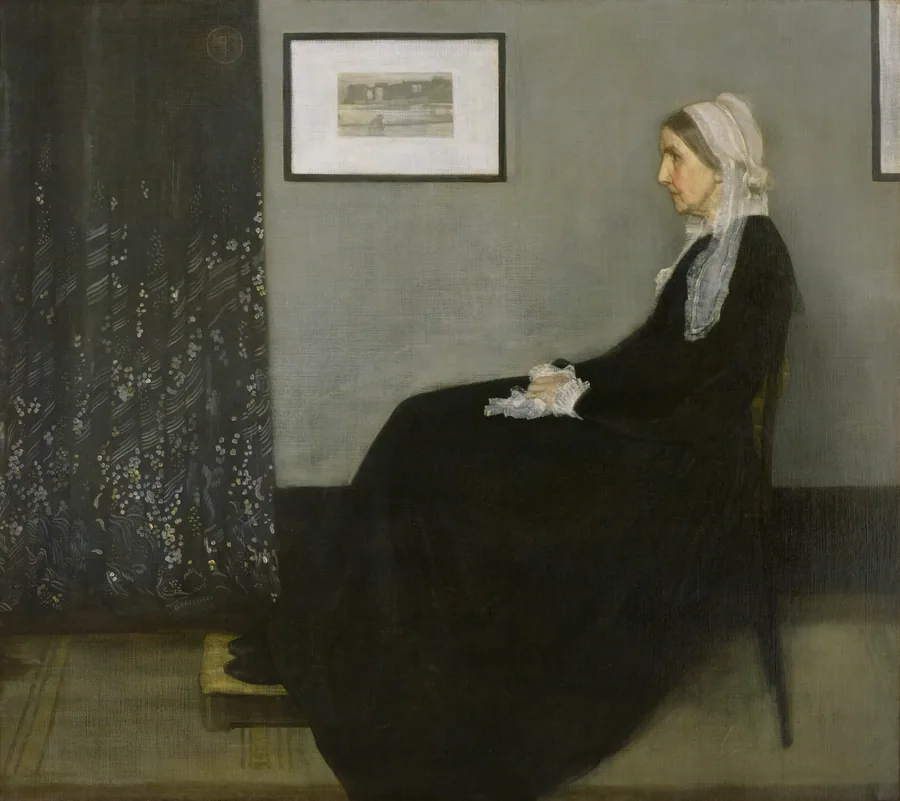 Guide · 7 min
Art gifts for mom and dad: ideas by what they love
Art gift ideas for parents, by what they love: gardens, the sea, books, travel, home. Safe sizes, a personal line of words, and when to order for Christmas. Guide · 6 min