
Guide
Dark academia: Vermeer, Turner and candlelight
Dark academia wall art from the old masters: scholars, Gothic ruins, moonlit rivers and fire, with the frames, mats and warm light that make a study glow.
Dark academia started on Tumblr around 2014 and 2015, among fans of Donna Tartt’s novel The Secret History, and grew into an aesthetic of its own during the pandemic years. It romanticizes the life of the mind: Gothic and collegiate architecture, classic literature, ancient art, libraries, candlelight, dark wood, tweed. Its colors are dark and muted, black, cream, browns and deep green.
The old masters painted that world before it had a name. This guide picks the paintings that suit a dark academia room, a study, a library corner or a bedroom with too many books, and shows how to frame and light them so they glow instead of disappearing into a dark wall.
Vermeer: scholars and letters
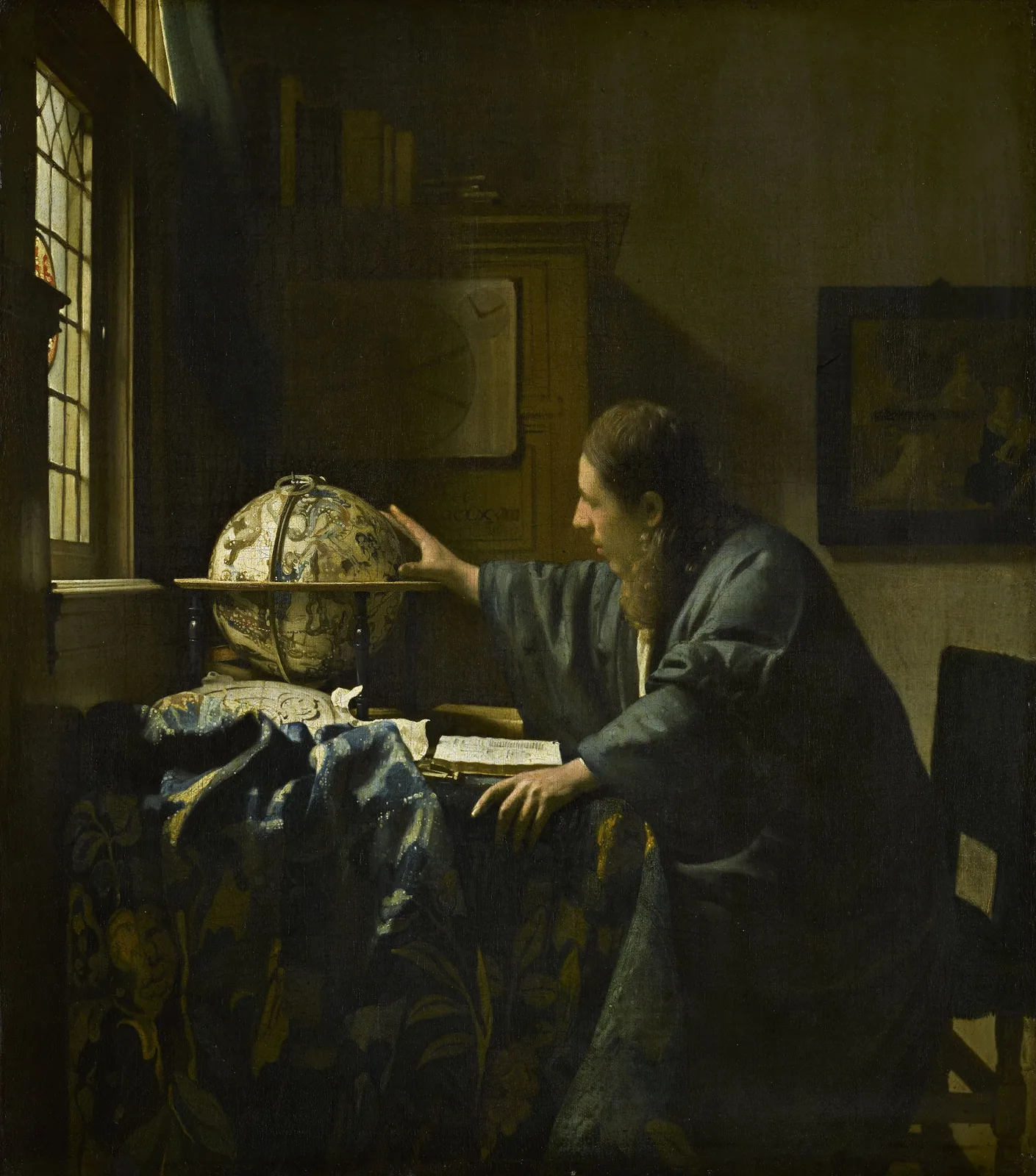
The Astronomer is the dark academia painting. A scholar in a long robe sits by a leaded window studying a celestial globe by the mapmaker Jodocus Hondius, with an astronomy book by Adriaan Metius open on the table. Its companion, The Geographer, shows the same man, possibly the scientist Antonie van Leeuwenhoek. The painting has its own dark story: the Nazis seized it from the Rothschild family in Paris in 1940 and marked it for Hitler’s collection; it came back after the war and has been in the Louvre since 1983. Hang it over a desk or a reading chair: 18 × 20 in framed in espresso with an antique mat, $134.
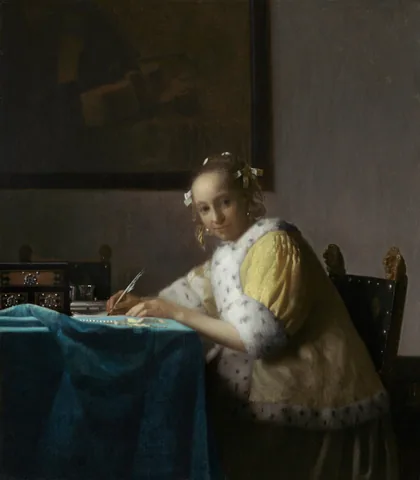
Vermeer’s women at their letters belong here too: A Lady Writing, quill in hand at a table draped in blue; Woman in Blue Reading a Letter; and Woman Holding a Balance. They are small, quiet and full of shadow, and they suit a bookshelf wall, hung between the shelves or above them.
Turner: fire, fog and moonlight
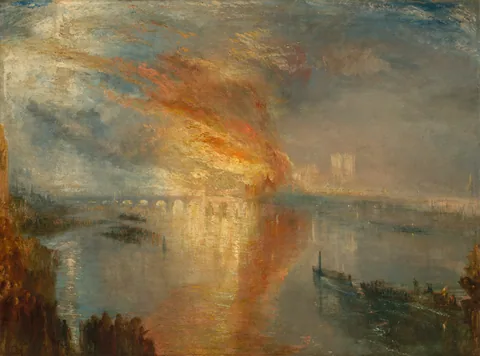
On the evening of 16 October 1834 the Houses of Parliament in London caught fire. J. M. W. Turner watched from the south bank of the Thames, sketching, and painted two versions of the blaze. The Burning of the Houses of Lords and Commons in the Cleveland Museum of Art is the second, shown at the Royal Academy in 1835: the river, a bridge and boats lit by the flames. It is the one big, dramatic picture for over a fireplace or a leather sofa, up to 48 × 36 in as canvas.
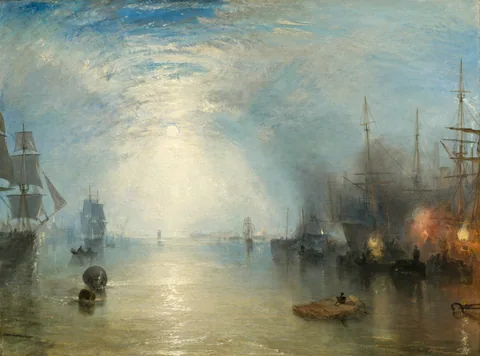
For something quieter, Keelmen Heaving in Coals by Moonlight is a harbor at night under a glowing moon, ships and small boats in silhouette: Turner in his most nocturnal mood, perfect for a bedroom.
Friedrich: Gothic ruins and lonely figures
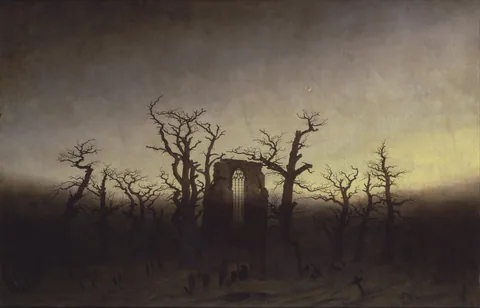
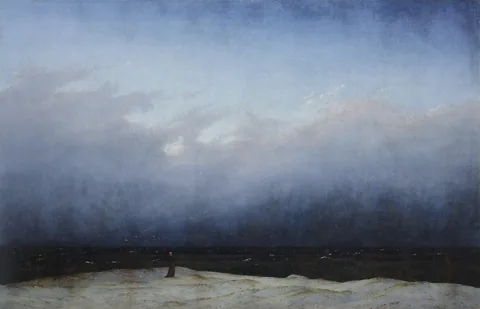
Caspar David Friedrich is the painter of dark academia’s Gothic side. The Abbey in the Oakwood, 1809 to 1810, shows a procession of monks, some carrying a coffin, toward the gate of a ruined Gothic church among bare oaks. At his request it was first hung beneath The Monk by the Sea, a lone figure on a dune before a dark sea, and the King of Prussia bought both; they are in the Alte Nationalgalerie in Berlin. They make a natural pair, one above the other or side by side.
His Wanderer above the Sea of Fog, a man in a dark coat on a rocky peak, is one of his best-known paintings; the image we print from is small, so it is sold up to 13 × 16 in framed, right for a desk wall or a bookshelf.
Nocturnes: the night itself
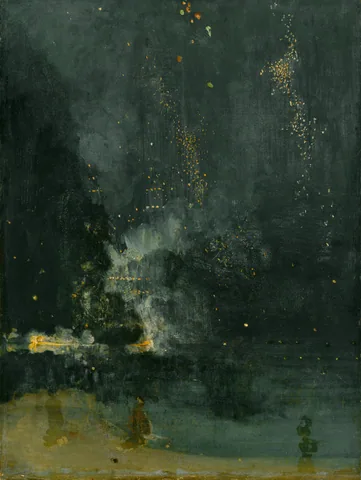
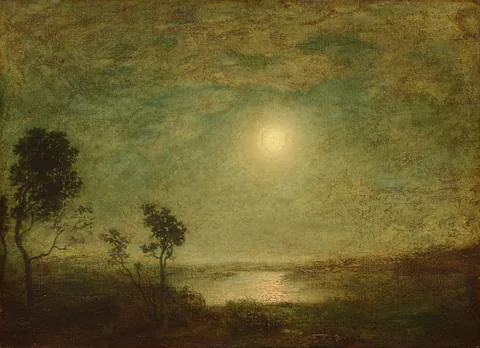
Whistler’s Nocturne in Black and Gold: The Falling Rocket, about 1875, is fireworks falling over a dark river, almost abstract. John Ruskin accused Whistler of flinging a pot of paint in the public’s face; Whistler sued him for libel in 1878, won, and was awarded one farthing, and the costs bankrupted him. It is a picture with a story for a room full of books. Ralph Albert Blakelock’s Moonlight, trees black against a green sky, and J. C. Dahl’s Frederiksborg Castle by Moonlight bring the same mood in landscape form. For a touch of the macabre, Van Gogh’s early Head of a Skeleton with a Burning Cigarette was painted in 1886.
What size for a study
Vermeer’s paintings are small: The Astronomer is about 20 by 18 inches. A print near that size, framed with a wide mat, looks like the real thing on a bookshelf wall, and it suits the close, private feel of a study. Save the large sizes for the Turner fire or a Friedrich over a fireplace or a sofa, where the art is seen across the room. Over a desk, aim for about two-thirds of the desk’s width; art for a home office has a size table for common desks.
Frames and mats that glow
Dark academia frames are dark wood and old gold. Espresso is the study frame, the color of an old bookcase; black with a gold lip gives the gallery look of a college hall; the Plein Air espresso and gold and Concerto mouldings are the most ornate, for one statement piece. For mats, skip bright white, which glares in a dark room: an antique white or cream mat looks like old paper, and a deep green or black mat makes a small Vermeer look like a window into another room.
On a dark painted wall, dark paintings can disappear. Lift them with a lighter mat or a gold frame, or choose the canvas in the matte finish so lamplight doesn’t bounce off it.
Candlelight, safely
The look depends on warm, low light: a desk lamp, a reading lamp, a picture light over the main piece. Use warm white bulbs and aim them at the art from above, not straight on, so the frame’s acrylic doesn’t reflect them. Real candles are part of the mood, but keep them well away from the art, where their heat and soot can’t reach it.
Arranging a dark academia wall
This is the one style where a crowded wall is right. A salon-style hang of mixed sizes, frames all in dark wood and gold, between and above bookshelves, looks like a scholar’s collection gathered over years. Anchor it with one large piece, the Turner fire or the Friedrich abbey, and build out with small Vermeers and nocturnes, keeping the gaps even. Gallery wall layouts has the measurements.
Questions people ask
What art fits dark academia?
Old master paintings of scholars, books and letters (Vermeer), Gothic ruins (Friedrich), night scenes and moonlight (Turner, Whistler), framed in dark wood or gold.
What colors are dark academia?
Dark and muted: black, cream, beige, browns and deep green.
Which frame suits dark academia?
Espresso wood or black with a gold lip, with an antique white, cream or deep green mat.
Can I put art on a dark wall?
Yes. Use a lighter mat or a gold frame to separate it from the wall, and light it from above with a warm lamp.
For more, see Old Masters, Moody Landscapes and our story on Vermeer’s Girl with a Pearl Earring.
Paintings for a dark academia room
Moody Landscapes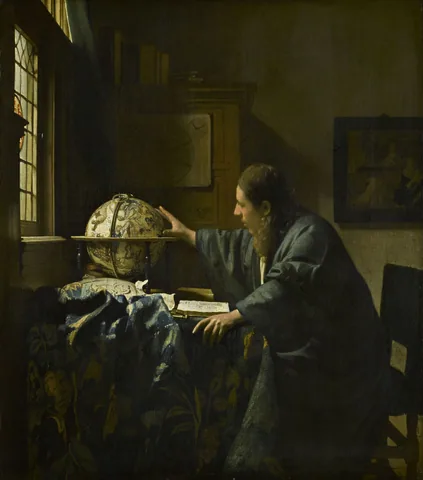
Sources
More from the Journal
 Guide · 8 min
Winter and Christmas art prints worth hanging
Snow scenes that can stay up until March, Nativity paintings for December, the sizes and frames that suit them, and when to order for Christmas. Guide · 7 min
Art as a gift: how to choose a print they’ll keep
Choose for their walls, not yours: safe sizes and frames, ideas by occasion, the gift note in the box, and how early to order for the holidays. Guide · 7 min
Art gifts for mom and dad: ideas by what they love
Art gift ideas for parents, by what they love: gardens, the sea, books, travel, home. Safe sizes, a personal line of words, and when to order for Christmas. Guide · 6 min