
Story
Girl with a Pearl Earring: the story, and choosing a print
Not a portrait but a tronie, with a pearl painted in two strokes. What the 2018 study found, who she might be, and how to choose a print.
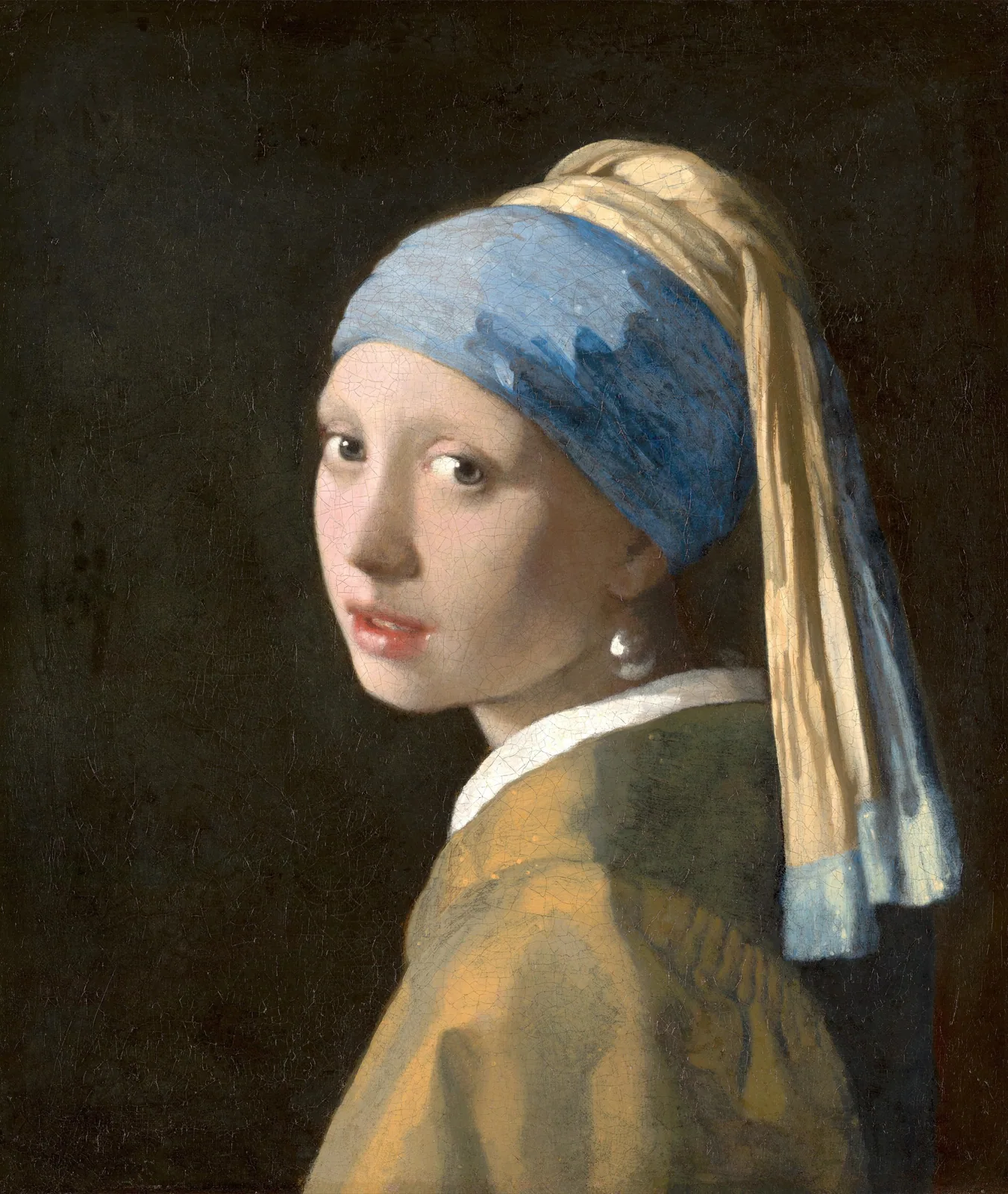
She looks back over her shoulder, lips parted, a large pearl catching the light. It is Johannes Vermeer’s most famous painting, made around 1665, and it hangs in the Mauritshuis in The Hague. It is small, about 17½ by 15 inches. And it is not a portrait of anyone.
A tronie, not a portrait
The Mauritshuis is clear about this: it is not a portrait but a tronie, “a painting of an imaginary figure.” Tronies were a kind of Dutch picture of the 1600s, a head that showed a type or a character rather than a real sitter. In the inventory made after Vermeer’s death it seems to have been listed as a tronie “painted in a Turkish style,” and the exotic turban, made of blue and yellow scarves, is part of the costume. In the museum’s words, it came straight out of Vermeer’s well-stocked dressing-up box.
The pearl was not even in the name for most of the painting’s museum life. After it arrived at the Mauritshuis it was known as Girl with a Turban, and the present title only took over in the 1990s.
Who she was is still unknown. People have put forward candidates: some writers have proposed Vermeer’s eldest daughter, Maria, though other historians reject the idea, and the art historian Andrew Graham-Dixon believes she was Magdalena, the 12-year-old daughter of Vermeer’s patron Pieter van Ruijven. The novelist Tracy Chevalier imagined a whole life for her in her 1999 novel, which became a film in 2003. After a full scientific study in 2018, the museum still had to say that “the question of who exactly the Girl was still remains a mystery.”
How he paints her
The museum calls Vermeer “the master of light,” and up close you can see how little he needed. The bridge of her nose is painted in the same pink as her right cheek, with no line between them, so the face seems to turn in soft light rather than being drawn. The corners of her large, wet eyes are left undefined, which is why her mood is so hard to pin down. Her full red lips are slightly parted, and a few small glimmers of white make them look moist. Her jacket is the kind the fashionable women of Delft wore. He signed the picture with his initials.
The pearl
The Mauritshuis calls it “an improbably large pearl,” too big to be real and probably an imitation. Look closely and it is barely there. Vermeer painted it with only two strokes of white paint, and nothing more, “not even a silver hook” to hang it from her ear. The 2018 study confirmed it: the pearl is an illusion, built from translucent and opaque touches of white. In 2014 an astrophysicist, Vincent Icke, even argued that it looks more like polished tin.
What the 2018 study found
In February 2018 an international team led by Abbie Vandivere began a project called The Girl in the Spotlight. It was an examination, not a restoration (the last restoration was in 1994). Using imaging and scanning that never touch the paint, digital microscopy and the analysis of tiny paint samples, they looked at how Vermeer had built the picture up, layer by layer. The results, announced in April 2020, included:
- Eyelashes. Vermeer painted tiny hairs around both eyes. They are too fine to see with the naked eye, so she seems to have none.
- A green curtain. The dark background was not empty. She sat in front of a green curtain, which has faded over the centuries to near black; traces of its folds survive in the upper right corner.
- Changes of mind. Vermeer moved her ear, the top of her scarf and the nape of her neck as he worked.
- Costly blue. The blue of the turban is ultramarine, made from lapis lazuli brought from Afghanistan, a pigment that was more precious than gold in the 1600s.
“The girl hasn’t revealed the secret of her identity yet,” said the museum’s director, Martine Gosselink, “but we got to know her a little better.”
Two guilders and thirty cents
In 1881 a collector, Arnoldus Andries des Tombe, bought the painting at an auction in The Hague for two guilders, plus a thirty-cent buyer’s premium. He left it to the Mauritshuis. During the Second World War it was hidden in a bunker under the museum, then in caves near Maastricht, until May 1945.
Look closer
These details come from the scan we print from, 14,550 pixels on the long side. You can see the fine network of cracks in the old paint, and a print keeps them. Pick a detail, or zoom in and drag to look around.
Two touches of white paint and nothing more. There is no hook holding it to her ear.
Choosing a print
Life size, or a little bigger. The painting is small, and part of its pull is how close it asks you to stand. At 14 × 16 in she is just under life size; at 17 × 20 in she is a little larger, which reads better across a room. Framed prints go up to 25 × 30 in, canvas up to 34 × 40 in and unframed art prints up to 41 × 48 in.
Hang her at eye level. She looks straight at you, so put the center of the picture 57 to 60 inches from the floor or, over furniture, the bottom of the frame 6 to 10 inches above it. Our hanging-height guide has the details.
Mind the dark background. Most of the picture is near black, and dark pictures turn clear acrylic into a mirror if they face a window. A framed print on smooth cotton paper gives the deepest darks and the finest detail; hang it on a wall that does not face the light. Canvas has nothing in front of it, and our matte canvas finish has no shine at all, so it is the safe choice for a bright room. See our papers and canvas.
Frames. A gold frame gives the old-master look and picks up the yellow of the turban; a wide one, like our Gold Plein Air, makes a small picture look important. A slim black frame and a white mat make her look modern, almost like a photograph. See all our frames.
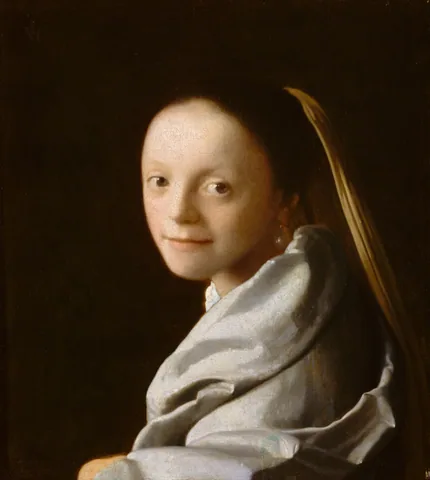
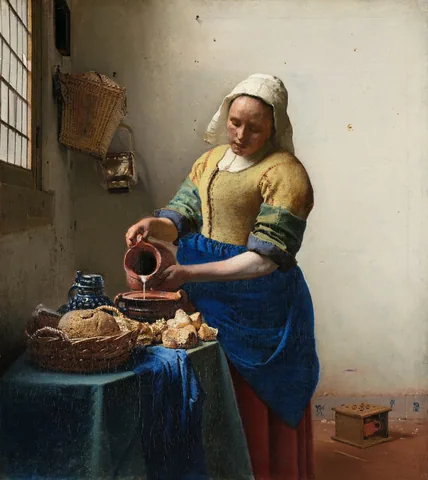
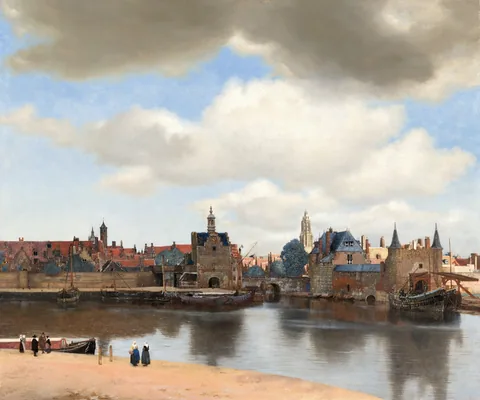
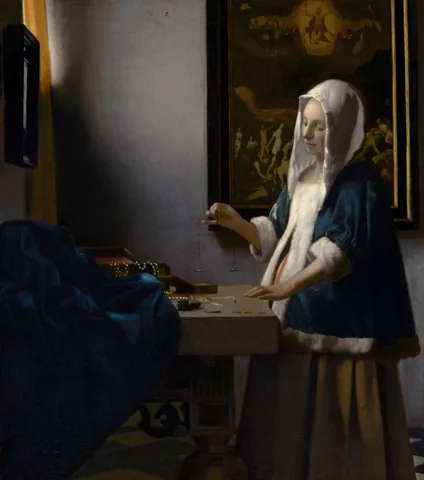
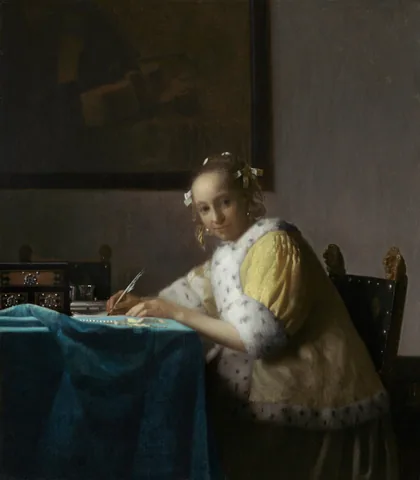
A trio of faces. We sell two other Vermeer pictures of young women who look out at you, the National Gallery of Art’s Girl with the Red Hat and Portrait of a Young Woman. Open the three as a set, with the pearl in the middle.
Questions
Who is the girl with the pearl earring?
Nobody knows. The painting is a tronie, a study of an imaginary figure, not a portrait of a named sitter, and even the 2018 study could not say who posed for it.
Is the pearl real?
Probably not. The museum thinks it is too large to be real and was likely an imitation. In paint it is only two strokes of white, with no hook.
Where is the original?
At the Mauritshuis in The Hague, in the Netherlands.
How big is it?
About 44.5 × 39 cm, or 17½ × 15 in. Oil on canvas.
Was it restored in 2018?
No. The 2018 project was a scientific examination. The painting’s last restoration was in 1994.
Can it be printed legally?
Yes. It was painted more than 350 years ago and is in the public domain, which is why we can print it. What public domain means.
More Vermeer
All Vermeer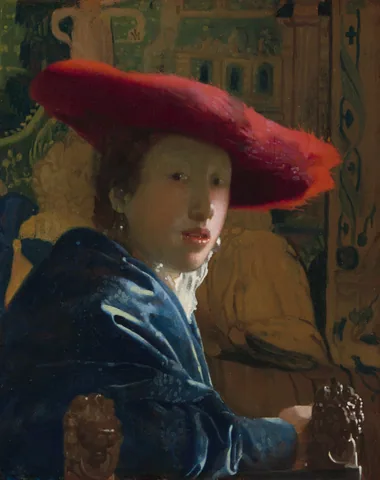
More in Dutch and Flemish Masters and Old Masters.
Sources
- Mauritshuis: Girl with a Pearl Earring, Johannes Vermeer (on Google Arts & Culture)
- Mauritshuis: Girl with a Pearl Earring, a close look (story on Google Arts & Culture)
- CODART: New discoveries and insights from the examination of Vermeer’s Girl with a Pearl Earring (2020)
- DutchNews.nl: Vermeer’s Girl with the Pearl Earring had eyelashes (2020)
- Gulf Today (AFP): New research reveals more of Vermeer’s Girl with a Pearl Earring (2020)
- Wikipedia: Girl with a Pearl Earring
More from the Journal
 Story · 7 min
Van Gogh’s Starry Night: the facts, and choosing a print
Painted in June 1889 at an asylum in Provence: the view from his window, plus a village he made up. What is real, what it means, and which print to choose. Story · 7 min
The Great Wave off Kanagawa: meaning, history and prints
A woodblock print, not a painting, and a storm wave, not a tsunami. What it shows, why no two impressions match, and how to choose a print.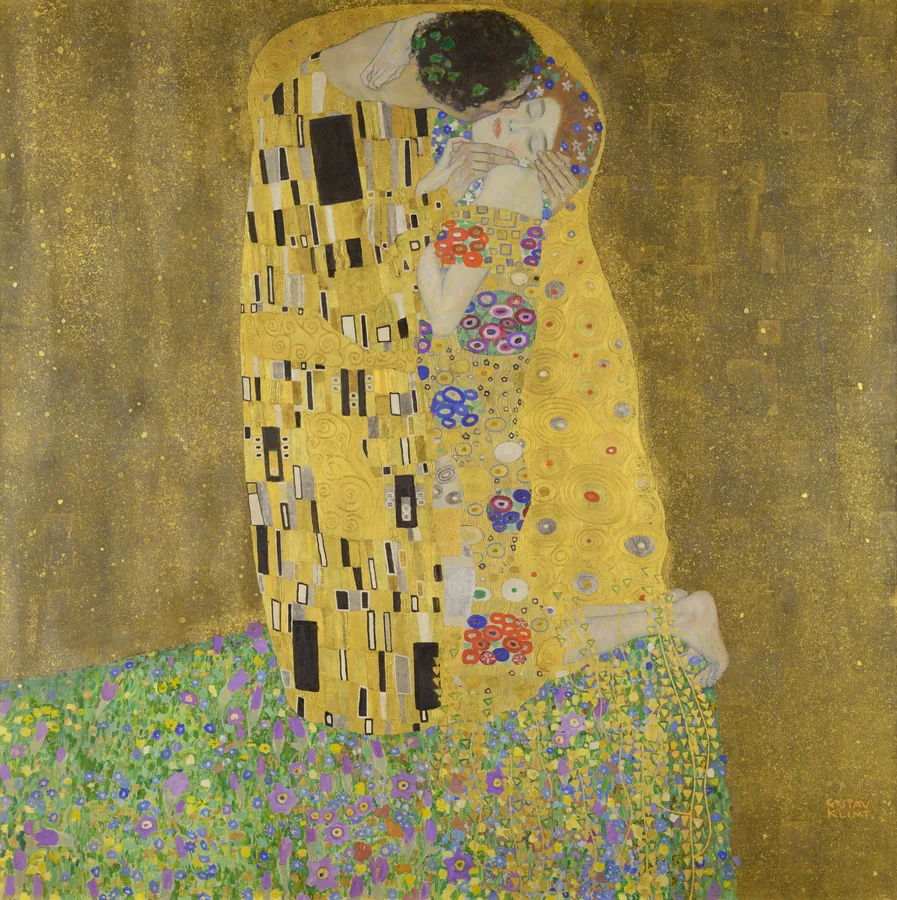 Story · 7 min
Klimt’s The Kiss: gold leaf, meaning and choosing a print
Real gold leaf on canvas, finished in 1909. The story of Klimt’s lovers, what a print can and can’t reproduce, and which size to choose. Story · 7 min