
Guide
Japandi walls: Hiroshige, Hokusai and a lot of calm
Japandi wall art that keeps the calm: ink scrolls, quiet Japanese prints and Hammershøi’s gray rooms, how to hang them with space, and the frames that suit.
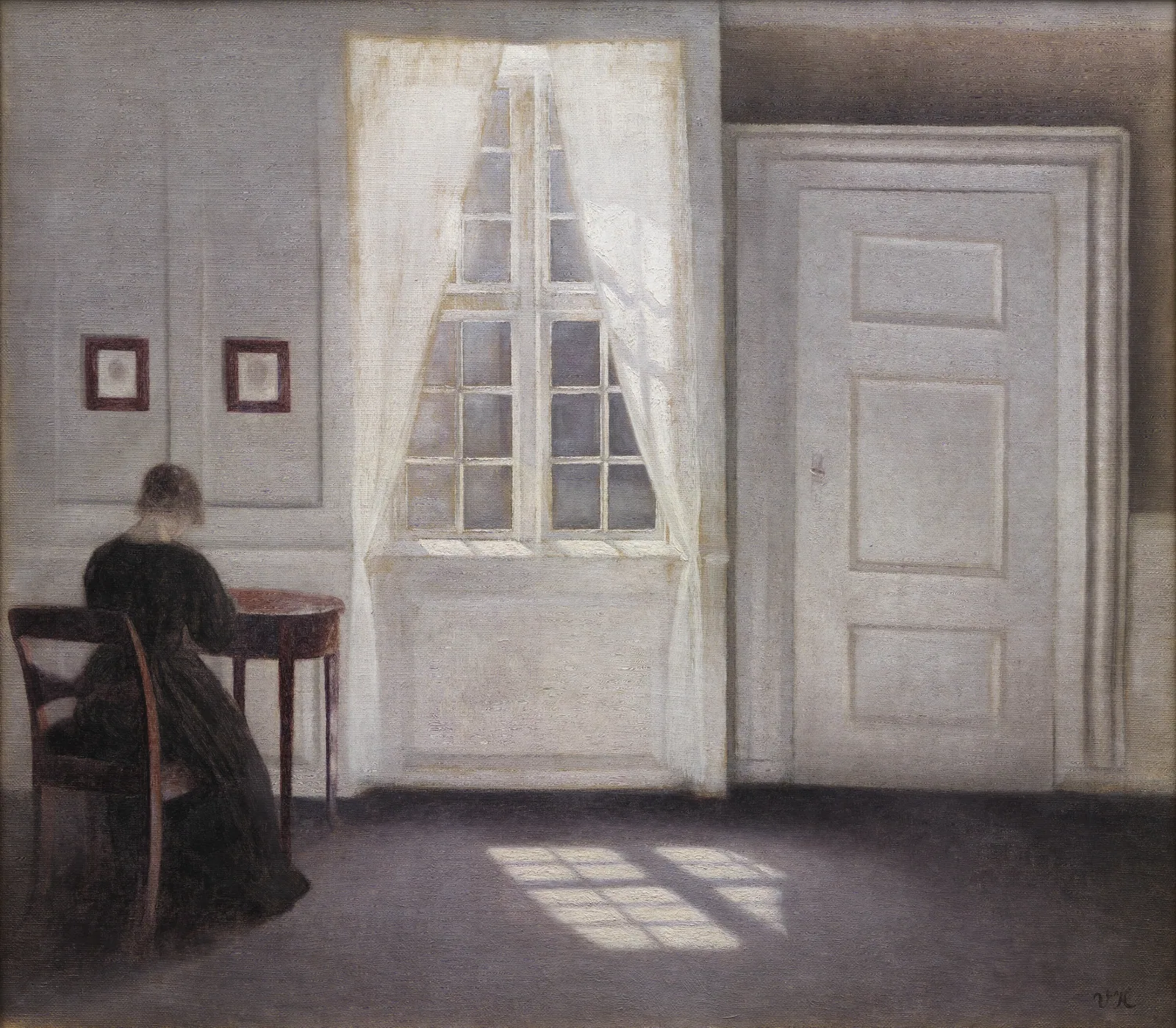
Japandi is a blend of Japanese minimalism and Scandinavian simplicity; the name, Japan plus Scandi, appeared around 2016. It means natural materials such as wood, stone, paper and bamboo, muted light colors on the walls, and very little clutter. It borrows from two ideas: the Danish hygge and the Japanese wabi-sabi, which finds beauty in things that are imperfect, impermanent and incomplete, and values simplicity, asymmetry and natural objects.
That makes art the hardest part of a Japandi room to get right. A picture that is too bright or too busy breaks the calm, and a wall with nothing on it can feel unfinished rather than serene. The answer is a few pieces, chosen slowly and given a lot of space.
The rules for Japandi wall art
- One piece per wall. Let the empty wall around it do half the work. Gallery walls belong to other styles.
- Muted color. Ink, gray, cream, soft green and the faded red of an old print. One quiet accent of color is plenty.
- Simple subjects. A mountain, a branch, bamboo, a window of light. Nothing that needs explaining.
- Off-center is fine. A tall picture hung to one side of a low bench or sideboard is more Japanese than one dead center over it.
- Natural frames. Pale wood and a soft mat, or a canvas with no frame at all.
From Japan: ink, snow and Fuji
Snow Landscape, Yosa Buson, mid-1770s. Buson is ranked with Bashō and Issa among the greatest poets of the Edo period, and he earned his living as a painter. This hanging scroll shows snowy mountains and trees, with birds coming down toward a small retreat. The original is almost 6 feet tall and more than two and a half times as tall as it is wide, a shape made for a narrow space: hang it beside a window, a door or a tall plant; framed in oak it goes up to 19 × 48 in.
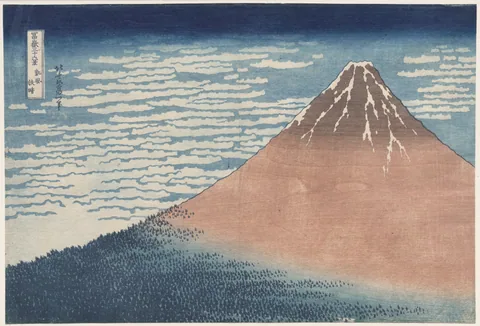
Red Fuji, Katsushika Hokusai, early 1830s. From Hokusai’s Thirty-six Views of Mount Fuji: one mountain, red against a blue sky streaked with cloud. It is one of the simplest great images in Japanese art, and one of the easiest to live with. It works over a low sofa or a platform bed, the one wide picture in this list. Why Hokusai painted Fuji red.
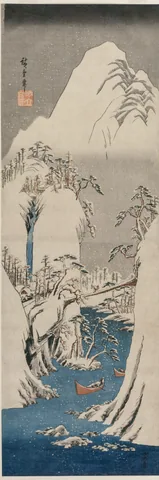
The Fuji River in the Snow, Utagawa Hiroshige, 1841. A snowy gorge, a river and small red boats, in a print three times as tall as it is wide. Paired with Buson’s scroll, it makes a winter wall. Hiroshige II’s Stork, Sun and Pine has the same tall shape, with a white crane before a red sun.
From China: the ink tradition
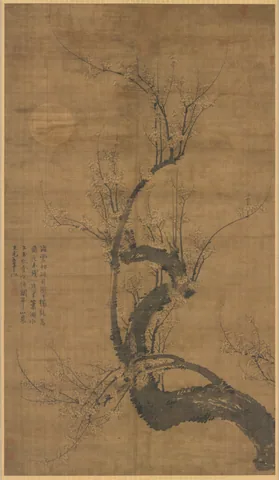
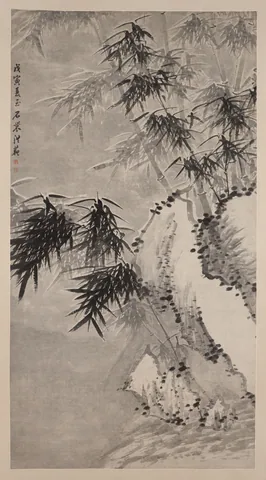
Chinese ink painting may be the purest Japandi art there is: black ink on paper or silk, a lot of empty ground, a single subject. Wang Mian’s A Prunus in the Moonlight, from the 1300s, is a blossoming plum branch under a pale moon, with a line of calligraphy. Hong Fan’s Bamboo in Snow, 1818, is bamboo bending over rocks in a misty wash. Peng Xu’s Ink Plum is a gnarled branch of white blossom on gray silk. All three are hanging scrolls in the Cleveland Museum of Art, tall and quiet, and they look best with plenty of mat around them. More in Chinese Painting.
From Scandinavia: Hammershøi’s quiet rooms
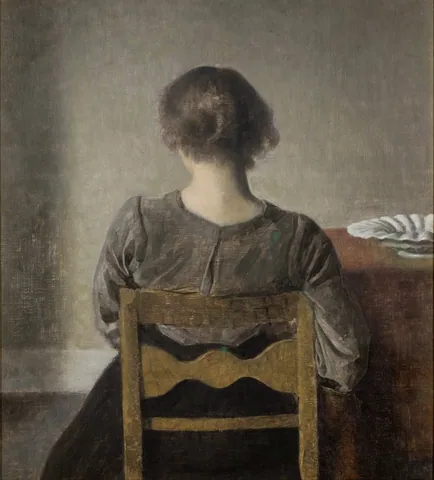
The Danish painter Vilhelm Hammershøi (1864 to 1916) is the Scandi half of the look. He painted the rooms of his Copenhagen apartment at Strandgade 30, where he lived with his wife, Ida, from 1898 to 1909, in a narrow range of grays with muted yellows and greens. Ida often appears from behind, absorbed in something we can’t see.
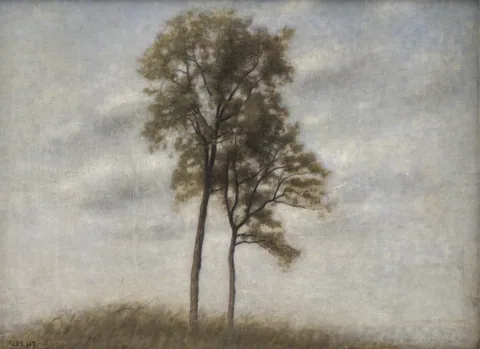
Interior in Strandgade, Sunlight on the Floor, 1901, is the essential one: a woman at a small table, a window and a patch of sun on bare boards. It is in the National Gallery of Denmark. Rest, 1905, is Ida from behind on a wooden chair in a pale room; the image we print from is smaller, so it is sold up to 18 × 20 in framed, right for a bedroom. Young Oaks, 1907, is two slender trees on a hill under a pale sky. Hammershøi with Hokusai or Buson is the whole Japandi idea on two walls.
Shapes and sizes
| Work | Shape | Framed in oak | Largest canvas |
|---|---|---|---|
| Snow Landscape | Tall and narrow, like a scroll | 10 × 24, $119 | 19 × 48 |
| The Fuji River in the Snow | Tall and narrow, like a scroll | 8 × 24, $109 | 16 × 48 |
| A Prunus in the Moonlight | Tall | 14 × 24, $124 | 28 × 48 |
| Bamboo in Snow | Tall | 13 × 24, $129 | 27 × 48 |
| South Wind, Clear Sky | Wide | 24 × 16, $134 | 48 × 33 |
| Interior in Strandgade, Sunlight on the Floor | Close to square | 24 × 21, $199 | 40 × 35 |
| Young Oaks | Wide | 24 × 17, $134 | 48 × 35 |
How to hang it
Give each piece more empty wall than feels natural, at least its own width on each side. Hang a single piece at the usual height, its center 57 to 60 inches from the floor, or lower over the low furniture Japandi rooms tend to have: over a low bench or a platform bed, keep the bottom of the frame 6 to 10 inches above it so the two read together. A tall scroll can stand to one side of the furniture rather than over it. How high to hang art has the measurements.
If you want more than one picture on a wall, make it a pair of the same shape with a generous gap, Buson’s scroll beside Hiroshige’s gorge, rather than a cluster.
Frames, mats and formats
Natural wood is the Japandi frame: natural oak or maple, or the slim natural oak for a lighter line. For a modern edge, the deep box frame in maple stands off the wall like a shallow shelf. Choose a soft mat, off-white or cream, instead of bright white; it sits better against plaster, linen and pale wood. A black frame can work too, in a room with black metal or dark wood, as one accent.
For paper originals, the ink scrolls and the woodblock prints, a matted print on paper looks truest; smooth cotton paper keeps the brushwork crisp. Hammershøi painted in oil on canvas, so his interiors also work as a canvas with no frame, in the matte finish, which suits the plain look.
Questions people ask
What art goes with Japandi decor?
Quiet, muted pictures with simple subjects: Japanese prints such as Hokusai’s Red Fuji, Chinese ink paintings of bamboo and plum, and Hammershøi’s gray interiors.
How many pieces should a Japandi wall have?
Usually one, with plenty of empty wall around it. Two of the same shape can work; a gallery wall usually doesn’t.
What frame color suits Japandi?
Natural oak or maple with an off-white or cream mat. Black works as an accent in a room with dark metal or wood.
Is Japandi the same as Japanese style?
No. It mixes Japanese minimalism with Scandinavian simplicity, which is why a Danish interior can sit beside a Japanese print.
More Japanese prints are in Japanese Woodblock Prints, and Japanese woodblock prints for the home covers them in depth.
Quiet pictures for a Japandi room
Japanese prints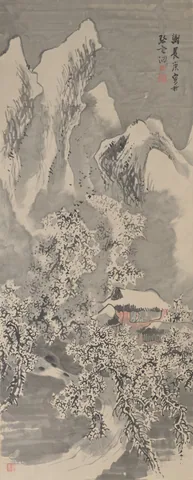
Sources
More from the Journal
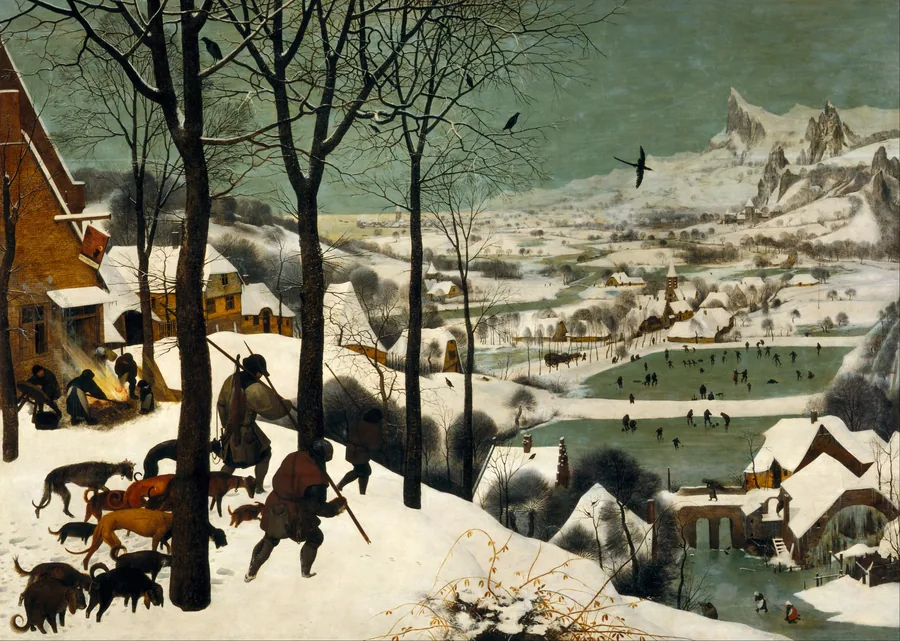 Guide · 8 min
Winter and Christmas art prints worth hanging
Snow scenes that can stay up until March, Nativity paintings for December, the sizes and frames that suit them, and when to order for Christmas.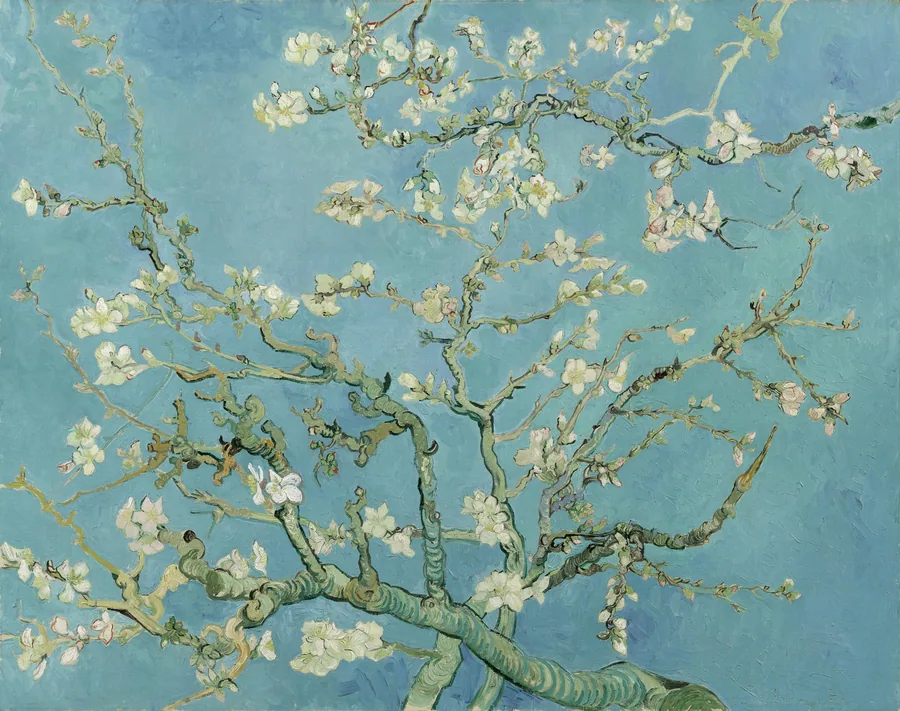 Guide · 7 min
Art as a gift: how to choose a print they’ll keep
Choose for their walls, not yours: safe sizes and frames, ideas by occasion, the gift note in the box, and how early to order for the holidays.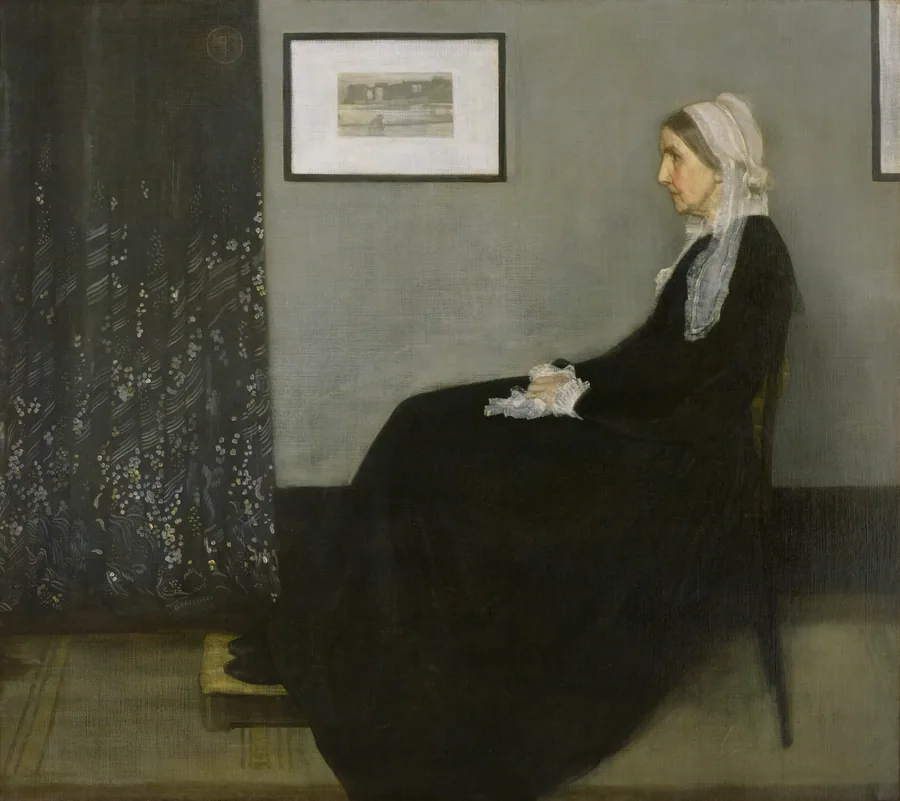 Guide · 7 min
Art gifts for mom and dad: ideas by what they love
Art gift ideas for parents, by what they love: gardens, the sea, books, travel, home. Safe sizes, a personal line of words, and when to order for Christmas. Guide · 6 min