
Story
Why is Hokusai’s Mount Fuji red? The story of Red Fuji
A season, a south wind and the rising sun. The story of Red Fuji, why no two impressions match, and how to choose a print.
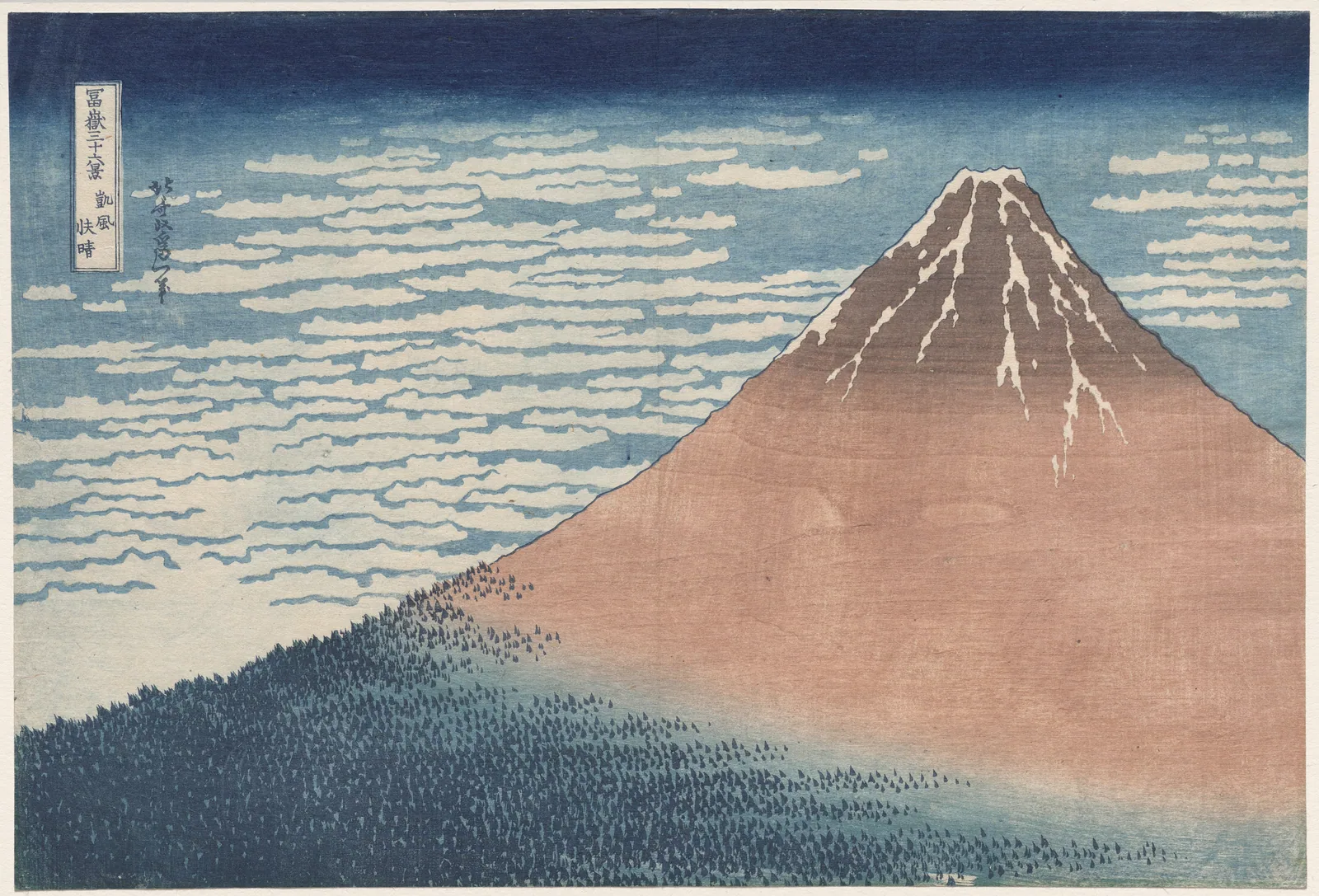
Mount Fuji is red because Hokusai shows it at one particular moment. In late summer and early autumn, when the wind blows from the south and the sky is clear, the rising sun can turn the mountain red. The print’s Japanese title, Gaifū kaisei, says exactly that: South Wind, Clear Sky. Most people call it Red Fuji.
A season, a wind and the sunrise
The title is translated a few ways. In English it is also called Fine Wind, Clear Morning, and in Japanese it is known as Akafuji, Red Fuji. The Cleveland Museum of Art, which owns the impression in these pictures, places the scene between late summer and early autumn, when the mountain takes on a reddish hue. The snow is almost gone from the summit, only a few streaks remain, and that is part of the clue: this is Fuji at the end of summer, at dawn. No particular viewpoint is named, so nobody knows where Hokusai imagined himself standing.
Three blues and a mountain to match
There is almost nothing in it: a mountain, a sky and a few clouds. The Hokusai scholar Gian Carlo Calza has called it “one of the simplest and at the same time one of the most outstanding of all Japanese prints.” The sky is printed in three shades of deepening blue, and they mirror three hues in the mountain. Snow at the peak and dark forest at the foot pin the scene in time. Fuji’s solid, symmetrical shape fills the right of the picture, and the delicate clouds on the left balance it.
A woodblock print, not a painting
Hokusai did not paint Red Fuji; he designed it, and a team made it. A carver cut his design into woodblocks, one for each color, and a printer inked them and pressed them onto paper one color at a time. You can still see the evidence. In the red slope of the Cleveland impression, the natural grain of the cherry-wood block was pressed into the paper along with the red. For more on how these prints were made, and why there are so many of them, see our story of the Great Wave.
Look closer
These details come from the museum’s open-access scan of its impression, 12,067 pixels on the long side. Pick a detail, or zoom in and drag to look around.
Rows of small white clouds streak across the left of the sky, balancing the great slope on the right.
Thirty-six views, and a new blue
Red Fuji belongs to Thirty-six Views of Mount Fuji, which Hokusai made around 1830 to 1832, in his seventies, for the publisher Nishimura Yohachi. Each print shows the mountain from a different place, season or weather. The series was such a success that ten more prints were added, and it stopped at forty-six. Its most famous print is The Great Wave off Kanagawa. Hokusai used Prussian blue extensively in the series, a pigment that had not long before come to Japan from Europe, and his use of it helped make the series popular.
Pink Fuji, red Fuji: why no two impressions match
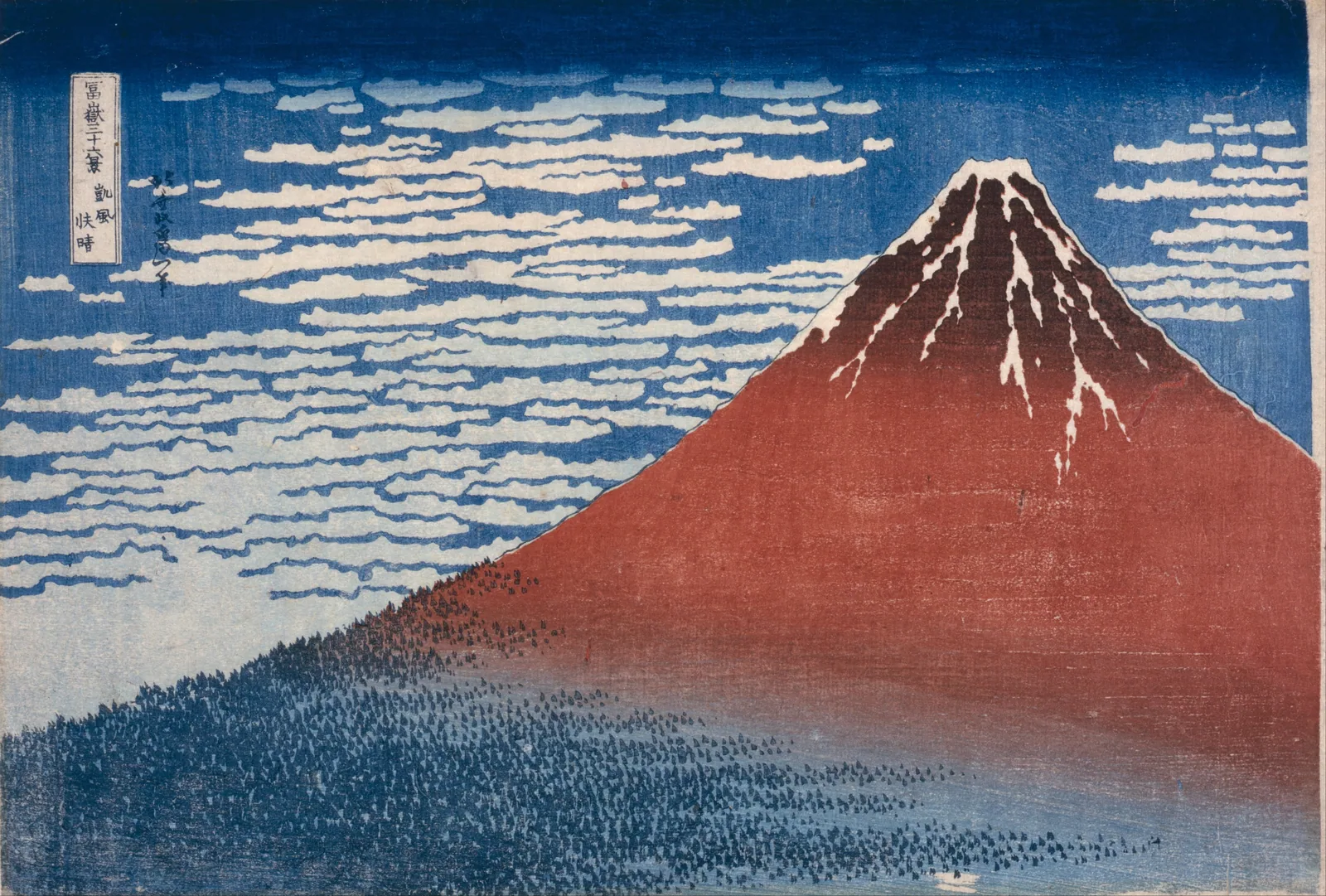
A woodblock print was printed again and again, and blocks were recut, so impressions differ. The earliest ones of Red Fuji look muted next to the version most people know. They are called Pink Fuji, they are very rare, and their blue sky is deliberately uneven, which makes it look brighter and gives the clouds movement. Later impressions have a strong, even blue. The printer added a new block that overprints the white clouds on the horizon with light blue, and used a strong red pigment, benigara or Bengal red, which gave the print its nickname. Even the green block was recut, lowering the line where forest meets slope.
Which came first was settled by science as much as by eye. In 2019 Capucine Korenberg, a conservation scientist at the British Museum, compared the museum’s own impression with a muted Pink Fuji at the Smith College Museum of Art, printed from the same set of blocks. The pink one showed fewer signs of block wear, used more orpiment, an expensive yellow pigment, and shaded the mountain from green at its foot to dark brown at the summit with a printing technique too fussy for mass production. She concluded it was very likely a first edition.
We sell two impressions, and you can see the difference side by side. In the Cleveland Museum of Art’s, the mountain is a soft, pinkish red with the wood grain showing, and the sky darkens to deep blue only at the very top. In the Indianapolis Museum of Art’s, the red is a strong brick red and the whole sky is a deep, even blue. We don’t try to date them; specialists compare details like these, and choosing between them is a matter of taste.
Where to see it
Impressions are held by museums around the world, including the British Museum, the Metropolitan Museum of Art, the Museum of Fine Arts, Boston, and the Indianapolis Museum of Art. Cleveland’s came to the museum as a bequest of Edward L. Whittemore. Works on paper are not always on display, so check before you go. Originals do come up for sale: in March 2019 one sold at auction in New York for $507,000. The print also inspired “Mount Fuji in Red,” a part of Akira Kurosawa’s 1990 film Dreams.
Choosing a Red Fuji print
Pick your red. The Cleveland impression is calmer and warmer, and its scan is large enough for very big prints: framed prints go up to 36 × 24 in, canvas up to 48 × 33 in and unframed art prints up to 48 × 33 in. The Indianapolis impression is bolder and more graphic; framed prints, canvas and unframed art prints all go up to 36 × 24 in.
Give it space. The original sheet is only about 10 × 14¾ in, and the picture is mostly sky, so it likes room around it and a calm wall: white, greige, or a pale blue taken from its own sky. A black frame with a white mat keeps it crisp; natural oak warms it up. Japanese prints also look good with no mat at all, the picture right up to the frame. See our frames and mats.
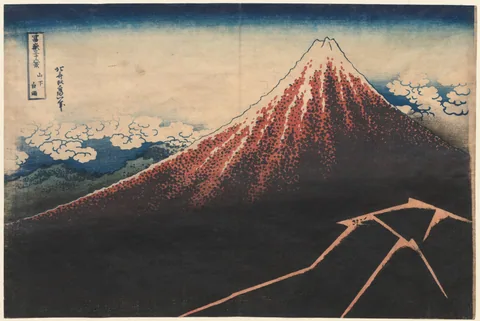
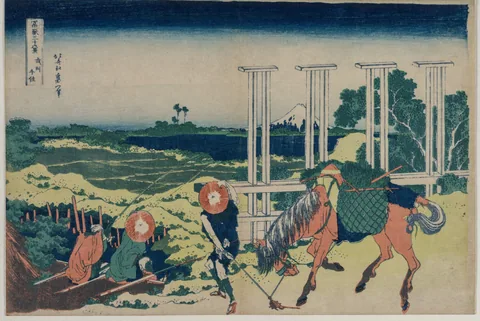
Make it a pair or a set. Red Fuji and The Great Wave are the classic pair, and our Great Wave story shows them over a sofa. For three, hang it between Rain Below the Mountain and The Weir at Senju, two more views from the same series: open the set.
Questions
Is Red Fuji the same print as Fine Wind, Clear Morning?
Yes. Gaifū kaisei is translated as South Wind, Clear Sky or Fine Wind, Clear Morning, and the print is nicknamed Red Fuji (Akafuji).
Is it from the same series as The Great Wave?
Yes. Both are from Hokusai’s Thirty-six Views of Mount Fuji, made around 1830 to 1832.
How big is the original?
The Cleveland sheet is 25.6 × 37.5 cm, about 10 × 14¾ in.
Did Hokusai paint it?
No. He designed it. It is a color woodblock print, cut into blocks by a carver and printed from one block per color.
Can it be printed legally?
Yes. Hokusai died in 1849, and the print is in the public domain. What public domain means.
More Hokusai and Hiroshige
Japanese woodblock prints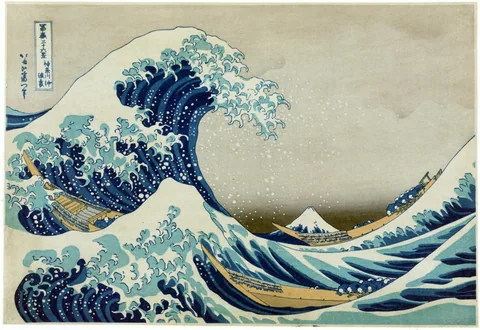
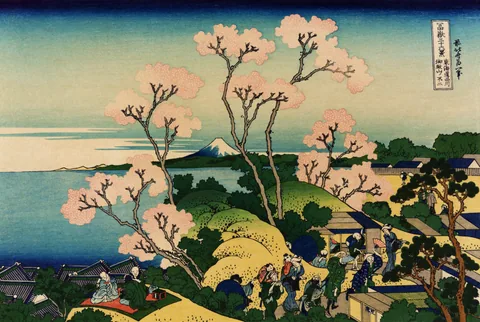
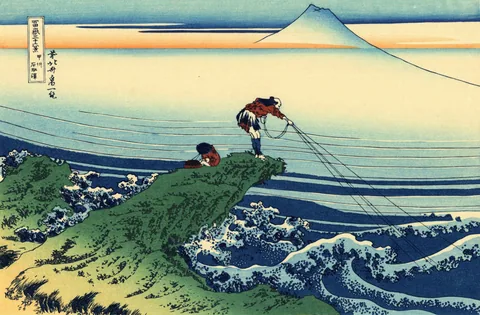
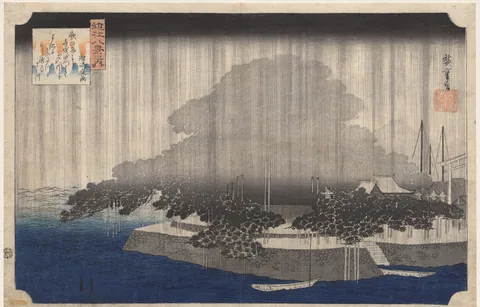
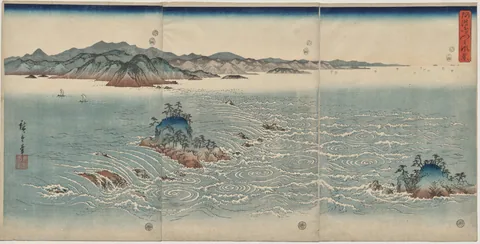
More in all Hokusai.
Sources
- Cleveland Museum of Art: South Wind, Clear Sky, from Thirty-Six Views of Mount Fuji (1930.189)
- Wikimedia Commons: Fine Wind, Clear Morning (Gaifū kaisei), Indianapolis Museum of Art (60.12)
- Wikipedia: Fine Wind, Clear Morning
- Wikipedia: Thirty-six Views of Mount Fuji
- Wikipedia: The Great Wave off Kanagawa (how the prints were made, and Prussian blue)
- Capucine Korenberg (British Museum): What is an original? Determining the sequence of impressions of the Red Fuji (2019)
More from the Journal
 Story · 7 min
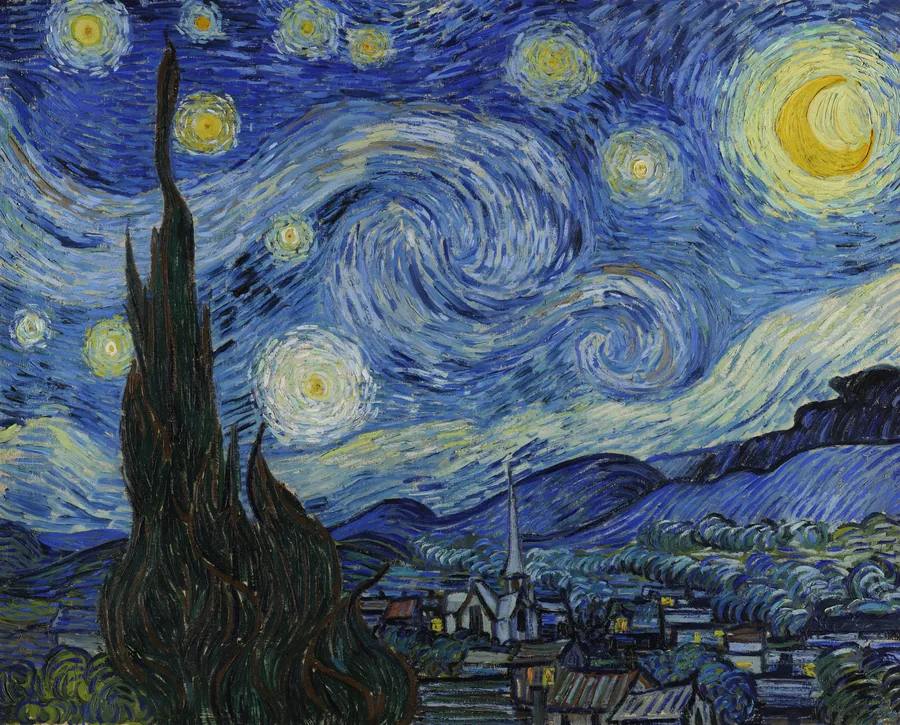
Van Gogh’s Starry Night: the facts, and choosing a print
Painted in June 1889 at an asylum in Provence: the view from his window, plus a village he made up. What is real, what it means, and which print to choose.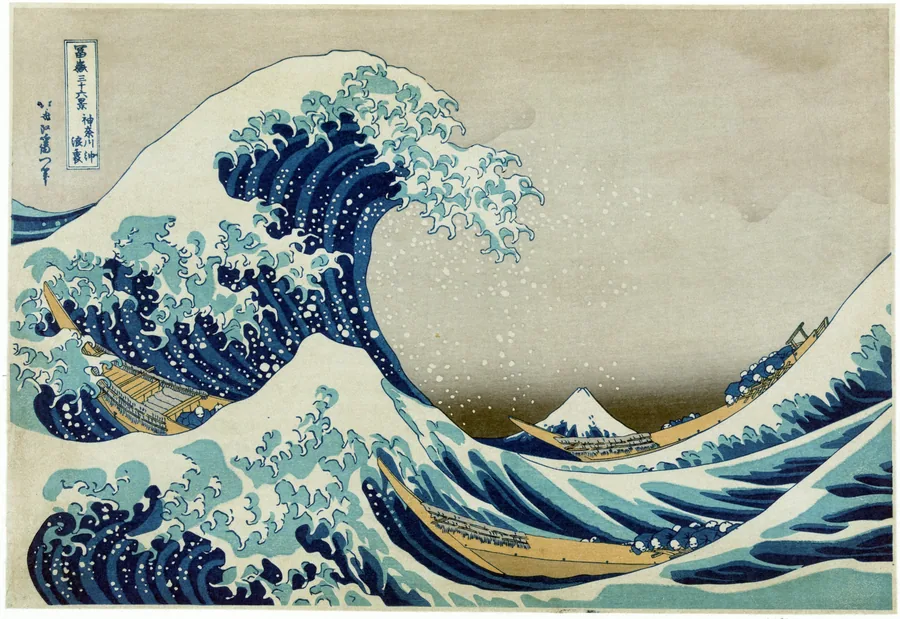 Story · 7 min
The Great Wave off Kanagawa: meaning, history and prints
A woodblock print, not a painting, and a storm wave, not a tsunami. What it shows, why no two impressions match, and how to choose a print. Story · 7 min
Klimt’s The Kiss: gold leaf, meaning and choosing a print
Real gold leaf on canvas, finished in 1909. The story of Klimt’s lovers, what a print can and can’t reproduce, and which size to choose. Story · 7 min