
Story
The Great Wave off Kanagawa: meaning, history and prints
A woodblock print, not a painting, and a storm wave, not a tsunami. What it shows, why no two impressions match, and how to choose a print.
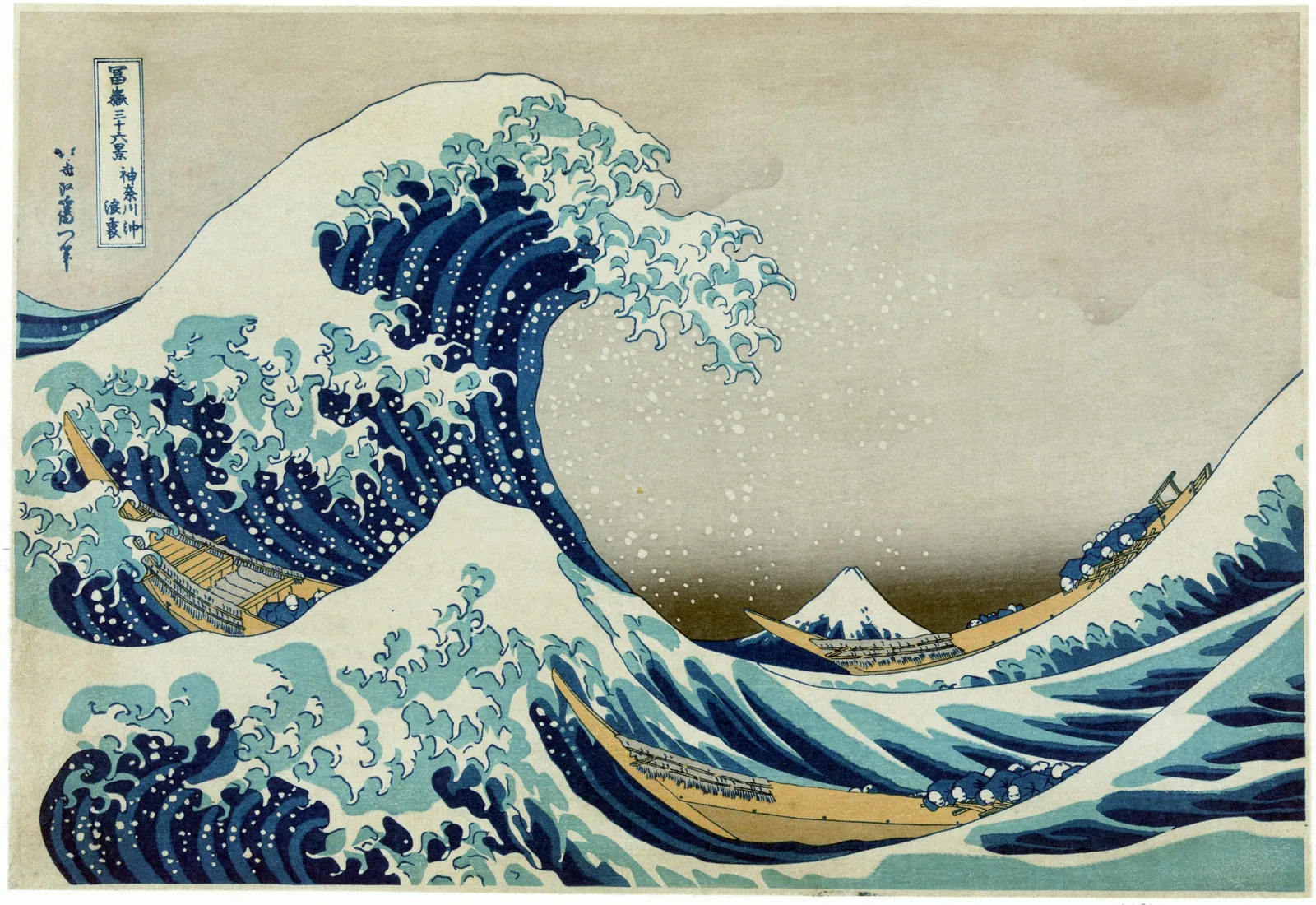
The Great Wave is not a painting. It is a color woodblock print, designed by Katsushika Hokusai around 1831, when he was in his early seventies, and published by Nishimuraya Yohachi. Thousands were printed, and more than a hundred early impressions survive in museums around the world. That is why there are so many Great Waves, and why no two are quite the same.
What you are looking at
The Japanese title, Kanagawa-oki nami ura, means “Under the Wave off Kanagawa.” A wave towers over three long boats. Its crest tears into droplets that the French critic Edmond de Goncourt saw as “in the form of an animal’s claws.” The boats are oshiokuri-bune, fast boats that rushed live fish to the markets of Edo, each with eight rowers and two more in reserve at the front. Far away, framed by the dip between the waves, sits Mount Fuji, Japan’s highest mountain, snow-capped and tiny.
At the top left a rectangle holds the title: “Thirty-six views of Mount Fuji / On the high seas in Kanagawa / Under the wave.” The column of smaller characters beside it is the signature, which reads “from the brush of Hokusai, who changed his name to Iitsu.” Some people say the print is best read from right to left, the way Japanese is traditionally read. The bow of the top boat points left, which supports that reading.
A storm wave, not a tsunami
The wave is often called a tsunami, but it is out at sea, not rushing onto a shore. In 2009 two scientists, Julyan Cartwright and Hisami Nakamura, studied its shape and concluded it is a huge storm wave, most likely a rogue wave. The title makes no more of it than that: a wave off the coast of Kanagawa.
What it means
Hokusai sets the most violent thing in the picture against the stillest. The wave fills the frame and is about to break; Fuji, Japan’s sacred mountain, sits small and calm in the distance, and a little peak of water in the foreground echoes its shape. Writers have read that contrast as a kind of yin and yang, and the boatmen caught between the two as a reminder, in the spirit of Buddhism, that human affairs pass and nature endures.
Thirty-six views of one mountain
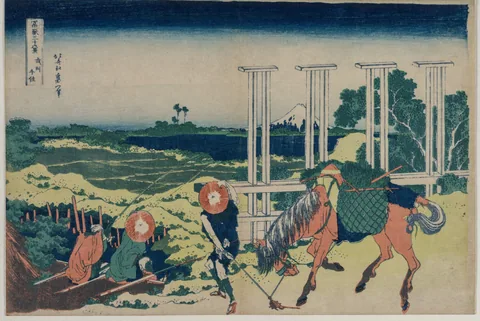
The wave belongs to a series, Thirty-six Views of Mount Fuji, made around 1830 to 1832. Each print shows the mountain from a different place, season or kind of weather: sometimes huge, sometimes a speck behind a wave. The series sold so well that ten more prints were added, and it stopped at forty-six. Its most famous sibling is Red Fuji, a mountain glowing red under a sky full of small clouds.
A blue from Europe
Much of what makes the wave so striking is its blue. Prussian blue, known in Japan as “Berlin indigo,” is a pigment that came from Europe. It reached Japan in quantity around 1829, and unlike the indigo printers had used before, it resisted fading. Hokusai used it heavily throughout the series, his publisher advertised the new blue in January 1831, and it helped make the series a hit.
Why there are so many Great Waves
A woodblock print is made in an edition, and by a team. Artists rarely cut their own blocks: Hokusai designed the picture, a carver cut the blocks, a printer inked them and pressed them onto handmade paper, and the publisher paid for it all and sold the prints. Hokusai’s drawing was pasted onto a block of wood and carved away, so the drawing itself was lost. Each color needed a block of its own, and each sheet was printed one color at a time. About 1,000 were printed at first, and one estimate puts the total at around 8,000.
The blocks wore down as they printed. The first signs show in the pink and yellow of the sky; in later impressions the clouds fade away, the sky turns flatter and more even, and the thin lines around the title box begin to break. Some surviving sheets have also faded in the light, because the colors of the time were sensitive to it. So every museum’s Great Wave is a slightly different object, and specialists read details like these to place an impression early or late in the run. The Museum of Fine Arts, Boston, has seven; the Metropolitan Museum of Art has four; the British Museum and the Art Institute of Chicago have three each.
Early impressions still come up for sale. In 2023 one sold at auction for a record $2.8 million.
The sheet we print from
Our print is made from the Library of Congress’s scan of its Great Wave, and the library’s own record catalogs that sheet as an “Adachi modern reprint (Showa)”. The Adachi workshop in Tokyo, founded in 1928, recreates ukiyo-e prints by the old method, with carvers cutting new blocks and printers pressing them by hand. So the sheet is a 20th-century woodblock copy of Hokusai’s design, not one of the sheets printed in the 1830s. In its scan the outlines are crisp and the color clean and even: the sky a plain tan, a band of darker color behind Fuji, and the title box sharp at the top left.
From Edo to Europe
After Japan opened up in the second half of the 1800s, its prints had a deep influence on European art, a fashion known as Japonisme. Goncourt called the Fuji series “the album which inspires the landscapes of the impressionists of the present moment.” The composer Claude Debussy kept a Great Wave in his studio while he wrote La Mer, and asked for it on the cover of the score when it was published in 1905.
Choosing a Great Wave print
Size. The original sheet is only about 10 × 14½ in, so a 16 × 11 in print is close to life size. The scan holds up well beyond it: framed prints go up to 36 × 25 in, canvas up to 48 × 33 in and unframed art prints up to 48 × 33 in. At 24 × 17 in it is big enough to read the boats from across a room and small enough for a hallway, a desk wall or a bathroom.
Paper is closest to the real thing. The original is ink on paper, so a framed print on our smooth cotton paper feels the most like it: flat, even color and crisp outlines, with no shine. An off-white mat picks up the paper-colored sky; a plain white one makes the blues look cooler. Woodblock prints also look good with no mat at all, the picture right up to the frame. Black frames keep it graphic; natural oak warms it up, which suits a Japandi room. See our papers and mats.
Canvas and metal. Canvas makes sense at the largest sizes, beyond the ones we frame, but its weave adds a texture the original never had. For a bathroom or a kitchen, a metal print is the practical choice: it is water resistant and wipes clean.
Hang it as a pair. The print is wide and low, so it pairs naturally with another view from the same series. Two prints of the same size, hung side by side, fill a sofa wall better than one big one.
Questions
Is The Great Wave a painting?
No. It is a color woodblock print. Hokusai drew the design; a carver cut it into woodblocks, one for each color, and a printer pressed them onto paper.
Is The Great Wave a tsunami?
No. It is a giant wave out at sea, which scientists who studied the print read as a storm wave, probably a rogue wave. Nothing in the title or the picture points to a tsunami.
How big is the original?
About 25 × 37 cm, or roughly 10 × 14½ in, the standard large Japanese print sheet called ōban. Surviving sheets vary slightly in size.
Where can I see one?
Many museums own an early impression, among them the Metropolitan Museum of Art, the Museum of Fine Arts, Boston, the British Museum, the Art Institute of Chicago and the Los Angeles County Museum of Art. Works on paper are not always on display, so check before you go.
Why does my Great Wave look different from another one?
Each is made from a different sheet. Thousands were printed as the blocks wore, some sheets have faded since, and later reprints were cut on new blocks, so skies, clouds and outlines vary from one to the next.
Which Fuji print goes with it?
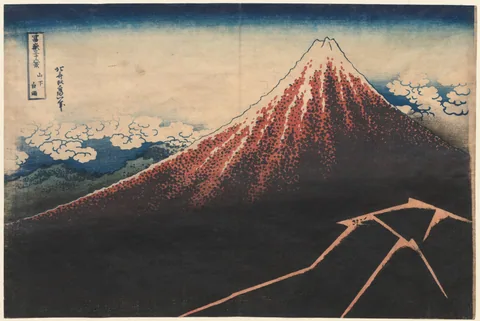
Red Fuji is the classic partner. We sell two impressions of it, one with a soft pink mountain and one with a strong brick red; for a set of three, add Rain Below the Mountain.
Is it in the public domain?
Yes. Hokusai died in 1849, and his prints are free for anyone to reproduce. What public domain means.
More Hokusai, Hiroshige and Kuniyoshi
All Hokusai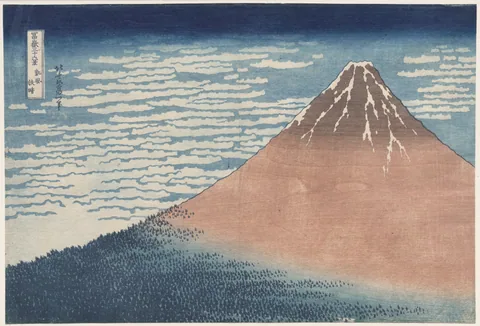
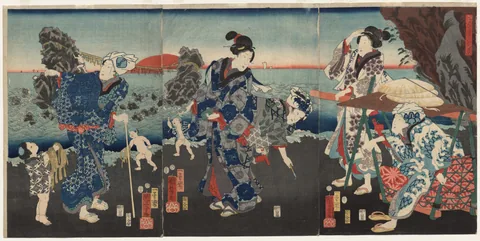
More in Japanese woodblock prints and The Sea and Ships.
Sources
- Harvard Art Museums: Under the Wave off Kanagawa (Kanagawa oki nami ura), also known as The Great Wave
- Museum of Fine Arts, Boston: Under the Wave off Kanagawa (on Google Arts & Culture)
- Cleveland Museum of Art: South Wind, Clear Sky (Red Fuji), from Thirty-Six Views of Mount Fuji (1930.189)
- Wikipedia: The Great Wave off Kanagawa
- Wikipedia: Thirty-six Views of Mount Fuji
- Wikimedia Commons: Kanagawa oki nami ura (Library of Congress, LCCN 2008660568, catalogued as an Adachi modern reprint), the scan we print from
- Cartwright and Nakamura: What kind of a wave is Hokusai’s Great wave off Kanagawa? Notes and Records of the Royal Society (2009)
More from the Journal
 Story · 7 min
Van Gogh’s Starry Night: the facts, and choosing a print
Painted in June 1889 at an asylum in Provence: the view from his window, plus a village he made up. What is real, what it means, and which print to choose. Story · 7 min
Klimt’s The Kiss: gold leaf, meaning and choosing a print
Real gold leaf on canvas, finished in 1909. The story of Klimt’s lovers, what a print can and can’t reproduce, and which size to choose. Story · 7 min
Monet’s Water Lilies: the series, and which print to choose
About 250 paintings of one pond at Giverny. How the series grew from a garden bridge to giant panels, and which Water Lilies suits your wall. Story · 7 min