
Story
The Ninth Wave by Aivazovsky: meaning and a print
Shipwreck survivors, a huge wave and a rising sun. What the ninth wave means, how Aivazovsky painted the sea from memory, and choosing a print.
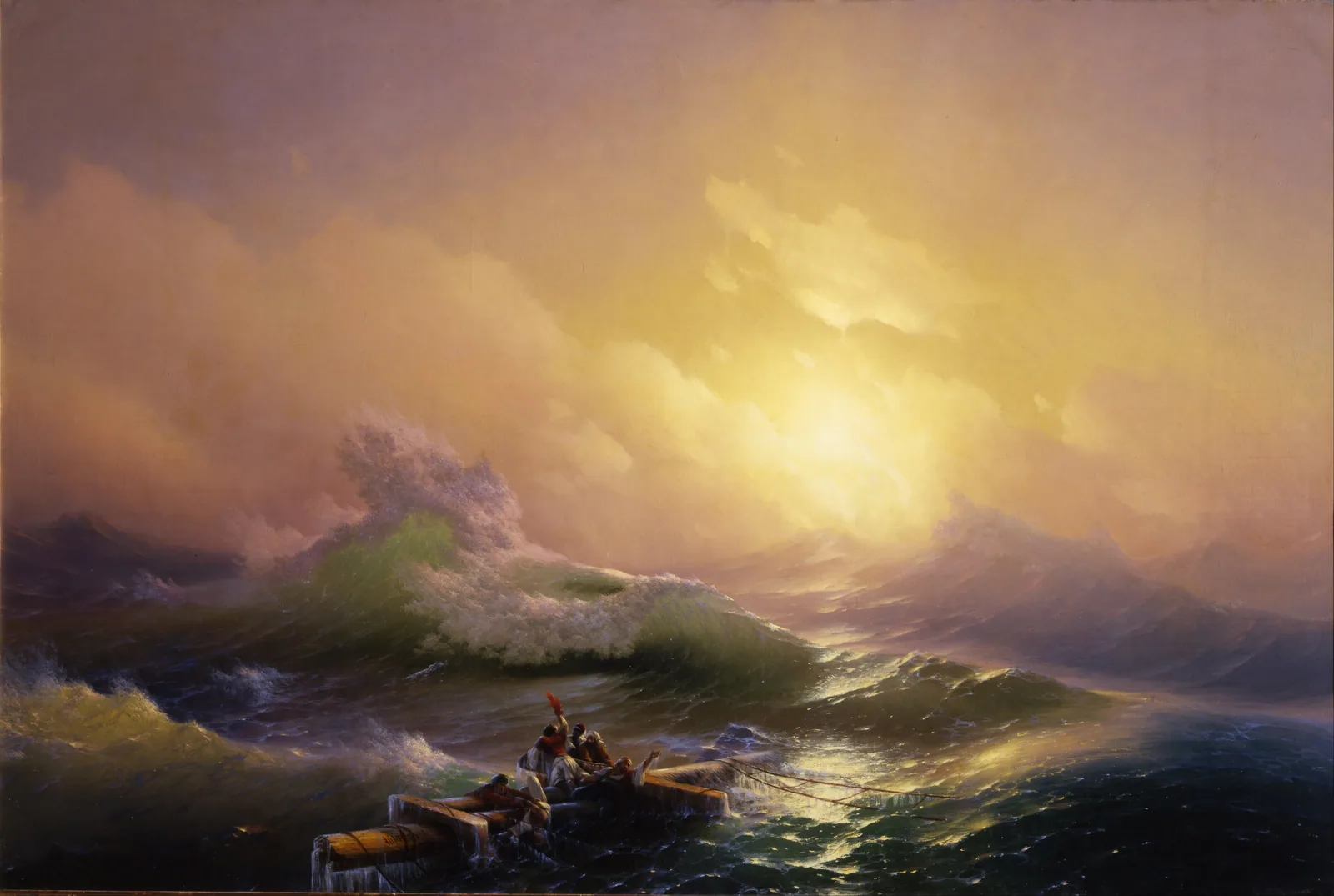
A storm has passed in the night, and a ship has gone down. A few survivors cling to its broken mast in a heaving sea, and behind them a huge wave rises, green and glassy, about to break. But the sky is turning gold, and the sun is coming through. Ivan Aivazovsky painted it in 1850, and it became his most famous work.
What does “the ninth wave” mean?
It comes from an old sailors’ saying: waves come in sets, each a little bigger than the last, until one of incredible size arrives, the ninth wave. So the title tells you what the survivors are facing, and the picture holds the moment before the wave falls.
Will they survive?
Aivazovsky leaves it open, but he tilts it toward hope. The wreckage they cling to is shaped like a cross, an old Christian image of rescue. And the color is warm. The sea and sky glow yellow, pink and green in the morning sun, which takes some of the menace out of the water. Looking at it, survival seems possible. The painting holds both things that the sea meant to him, its violence and its beauty.
Look for the man waving a red cloth toward the light. Whether he is signaling to a ship nobody can see, or simply holding on to hope, is up to you.
Painted from memory
Aivazovsky did not paint at sea, or even in front of it. The writer Rosa Newmarch said he never painted his pictures from nature, always from memory, far away from the shore. His memory was famous: he could reproduce a scene he had seen only briefly, without drawing sketches first. His seas are not records of a particular day but of what the sea felt like.
He was enormously productive, with around 6,000 paintings in a career of almost sixty years. He was born in 1817 in Feodosia, on the Crimean coast, to an Armenian family, studied at the Imperial Academy of Arts in St. Petersburg, and was named an official painter of the Russian Navy. Anton Chekhov helped popularize a Russian saying for anything lovely: “worthy of Aivazovsky’s brush.”
Where is The Ninth Wave?
In the State Russian Museum in St. Petersburg. It is huge, about 7 feet tall and 11 feet wide, so in the gallery the wave is bigger than you are.
Look closer
These details come from the scan we print from, 5,090 pixels on the long side. Pick a detail, or zoom in and drag to look around.
A handful of men clinging to wreckage. One waves a red cloth toward the light.
Choosing a print
Size. Our scan of this painting prints sharply up to 30 × 20 in, and we don’t sell it bigger than that. Framed prints, canvas and unframed art prints all go up to 30 × 20 in. It is wide, so it suits the space over a sofa, a desk or a sideboard. At 24 × 16 in it fits a narrower wall.
Where it works. A sea picture with a glowing sky warms a cool room, and its drama suits a study, a den or a hallway. For anyone who sails, or comes from a coast, it is a natural choice.
Which material. The glow of the sky is the point, and smooth paper in a frame keeps the soft gradations of light. Canvas, with its matte finish, gives the waves a painted feel and has no cover to reflect light. See our papers and canvas.
Frames. A gold frame matches the sunlit sky and suits a grand 19th-century seascape; black wood sharpens the dark water. See all our frames. For another famous wave, read the story of the Great Wave.
Questions
What is the ninth wave?
In an old sailors’ saying, the biggest wave, which comes after a run of ever larger ones.
What does The Ninth Wave painting mean?
It shows shipwreck survivors facing a huge wave, but the warm light and the cross-shaped wreckage suggest hope. It is about both the violence and the beauty of the sea.
Where is The Ninth Wave?
In the State Russian Museum in St. Petersburg. It is 221 × 332 cm, about 7 × 11 ft.
Did Aivazovsky paint from life?
No. He painted from memory, away from the sea.
Can it be printed legally?
Yes. Aivazovsky died in 1900, and his paintings are in the public domain. What public domain means.
More Aivazovsky
All Aivazovsky
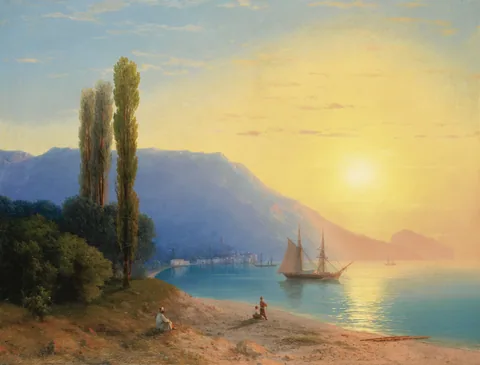
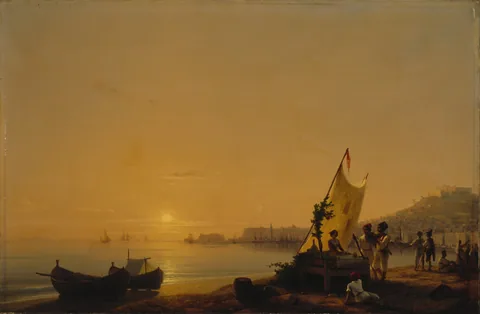
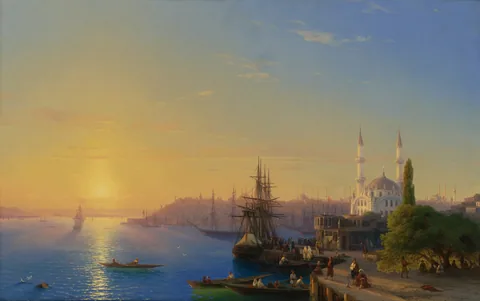
More in Sea and Ships and Moody Landscapes.
Sources
More from the Journal
 Story · 7 min
Van Gogh’s Starry Night: the facts, and choosing a print
Painted in June 1889 at an asylum in Provence: the view from his window, plus a village he made up. What is real, what it means, and which print to choose. Story · 7 min
The Great Wave off Kanagawa: meaning, history and prints
A woodblock print, not a painting, and a storm wave, not a tsunami. What it shows, why no two impressions match, and how to choose a print. Story · 7 min
Klimt’s The Kiss: gold leaf, meaning and choosing a print
Real gold leaf on canvas, finished in 1909. The story of Klimt’s lovers, what a print can and can’t reproduce, and which size to choose. Story · 7 min