
Story
Klimt’s The Kiss: gold leaf, meaning and choosing a print
Real gold leaf on canvas, finished in 1909. The story of Klimt’s lovers, what a print can and can’t reproduce, and which size to choose.
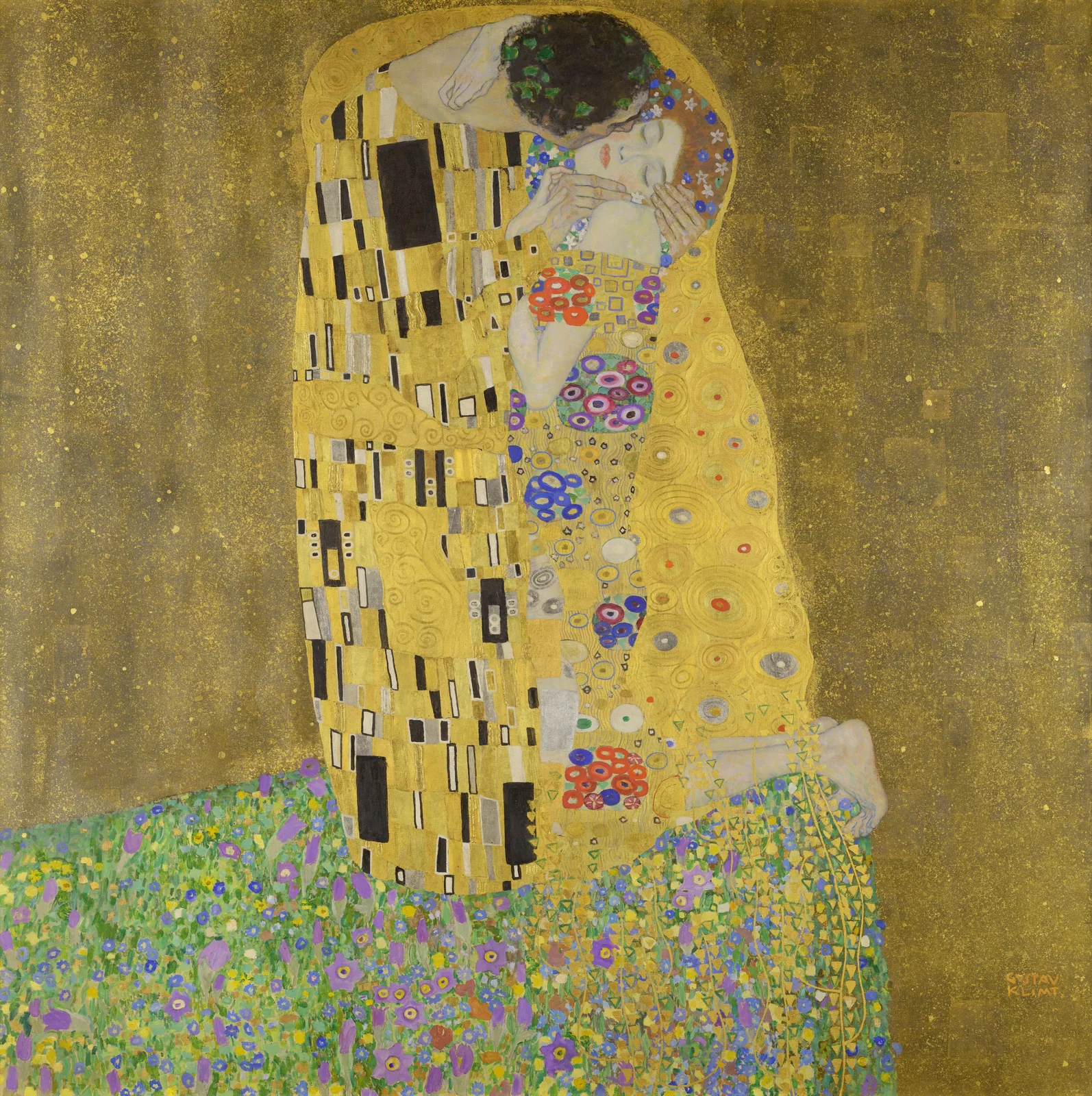
The Kiss is the high point of what is called Gustav Klimt’s Golden Phase. He probably began it in 1907, showed it in Vienna in the summer of 1908 under the title Liebespaar (Lovers), and went on changing it until about 1909. The Austrian Ministry of Education bought it while that first exhibition was still running, for 25,000 kronen, and it belongs to the Belvedere in Vienna today. By 1911, when it was shown in Rome, it had its present name.
Real gold on canvas
The gold is not paint. Klimt laid real, wafer-thin gold leaf onto the canvas and added fine flakes of silver in places, working the leaf and his bronze-gold color together into one shimmering surface. The idea goes back to 1903, when he traveled to Ravenna to see its Byzantine mosaics, whose flat, brilliant gold inspired his own gold and silver leaf. Metal was in the family, too: his father was a gold engraver.
The Belvedere reads the painting as a coded program of ornament, about existence, love and fulfillment through art, with motifs drawn from many cultures, above all ancient Egypt.
What is in the picture
A pair of lovers kneels at the edge of a meadow of flowers, wrapped in gold robes. Their patterns tell them apart: his robe is made of black-and-white rectangles, her dress of round, colorful shapes and flowers. Flowers are woven into her hair; he wears a crown of vine leaves. Behind them there is no room and no sky, only what the Belvedere calls “an infinite cosmos of golden fog.”
Look at the right-hand side and the meadow simply stops. Her feet curl over its edge, with nothing below them but gold. The museum connects that sudden edge to the shore of the Attersee, the Austrian lake in several of Klimt’s landscapes. An early photograph shows the picture was changed as Klimt worked on it: the lovers’ lower legs were shorter, and the creeping vines that now cover them came later.
Who are they? Nobody knows, and Klimt never said. Many people suspect a self-portrait with his companion Emilie Flöge, whose portrait he painted in 1902. The Belvedere points out that there is no biographical evidence for it.
An embrace he kept coming back to
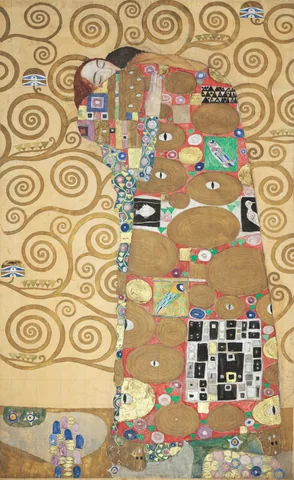
Klimt had painted a kissing couple before. His Beethoven Frieze of 1902, still on show at the Vienna Secession, ends with a choir and a pair of lovers locked in an embrace: his picture of the kiss for all humanity in the Ode to Joy that Beethoven set in his Ninth Symphony. A few years later he came back to the embrace in his designs for the Stoclet Frieze, a mosaic for a mansion in Brussels; that couple is our Fulfillment. The Kiss takes the same embrace and makes it private.
Klimt’s other gold
The other landmark of the Golden Phase is the Portrait of Adele Bloch-Bauer I, finished in 1907 in oil and gold leaf, and often called the Woman in Gold. The Nazis took it from the Bloch-Bauer family. In 2006, after a seven-year legal fight that reached the United States Supreme Court, an arbitration panel in Vienna ruled that it had been stolen and should go back to Adele’s niece, Maria Altmann. Ronald Lauder bought it that June for $135 million, a record for a painting at the time, and it now hangs at the Neue Galerie in New York.
Look closer
These details come from the scan we print from, 7,401 pixels on the long side. In the photograph the gold and silver leaf show as color, which is exactly how they print. Pick a detail, or zoom in and drag to look around.
His face is turned away; hers, eyes closed, rests against his hands. Flowers are woven into her hair, and vine leaves into his.
What a print can and can’t reproduce
This matters more for The Kiss than for almost any other painting. Gold leaf is metal. It catches the light and changes as you walk past it. No print can do that. Every print, whether on paper, canvas or aluminum, reproduces the gold as color: the warm ochres and yellows the camera recorded. It will look golden. It will not shine like metal, and neither will the silver.
Two of our materials add some sparkle. Metallic photo paper has a pearly sheen that makes the light colors shimmer (art prints up to 40 × 40 in). A metal print on the silver base lets the bare aluminum show through where the picture is light, up to 20 × 20 in for this square painting. Both get closer to the feeling of the original than a matte surface does, but the shimmer they give is pearly or silvery, not gold, and neither is gold leaf.
Our own choice is simpler: a matte print on smooth cotton paper, and let the frame do the shining. Our gold frame has a brushed gold finish, so there is real metallic color right beside the printed gold, and it is made up to 30 × 30 in. See it in the gold frame at 24 × 24 in.
Choosing a size
The original is about 71 inches square, so any print you hang is smaller than the real thing. That is fine: the shape matters more. A square picture suits the places a long one cannot go, like a stair landing, the wall above a chest of drawers, a narrow space between two windows, or over a bed.
The patterns are small, and they need size to read. At 12 or 16 inches the robes become a golden texture, lovely on a desk or a shelf. From 24 inches up you can see the rectangles and circles from across the room. Framed prints go up to 30 × 30 in, canvas up to 40 × 40 in and unframed art prints up to 48 × 48 in.
Canvas or framed? Canvas has nothing in front of it, so there is no glare, and it goes bigger than a frame. A framed print behind clear acrylic gives sharper detail in the patterns, and a white mat around all that gold looks crisp. Black frames make the gold glow by contrast; gold frames make the whole thing richer. See our canvas and mats.
Hang it with his landscapes
Klimt painted landscapes on square canvases too, and most of the ones we sell are square, like Water Castle, Cottage Garden and Sunflower. So The Kiss sits easily in a row or a grid of squares, with his greens on either side of all that gold. Open it between Water Castle and Cottage Garden as a set of three.
Questions
Is The Kiss painted with real gold?
Yes. Klimt used real gold leaf, with flakes of silver in places, together with oil paint.
Will my print have gold leaf on it?
No. Any print reproduces the gold as color, so it looks golden but does not shine like metal. Metallic paper and silver-based metal prints add a shimmer; a gold frame adds real metallic color around it.
Where is the original?
At the Belvedere in Vienna. The Austrian state bought it in 1908, while it was first on show.
How big is the original?
180 × 180 cm, about 71 inches square.
Who are the lovers?
No one knows. A self-portrait of Klimt with Emilie Flöge is the favorite guess, but there is no evidence for it, and Klimt never said.
Can The Kiss be printed legally?
Yes. Klimt died in 1918, and the painting is in the public domain, which is why we can print it. What public domain means.
More Klimt
All Klimt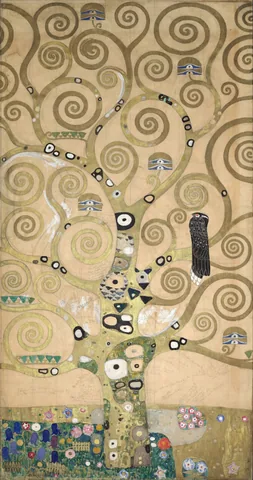
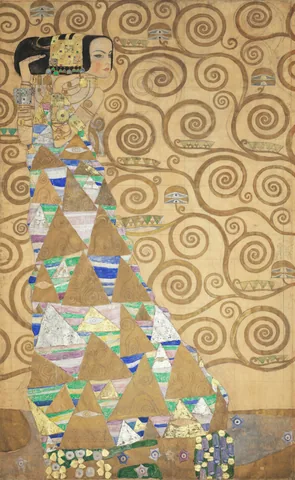
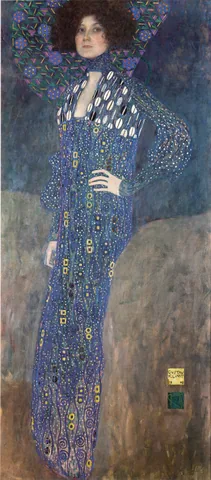
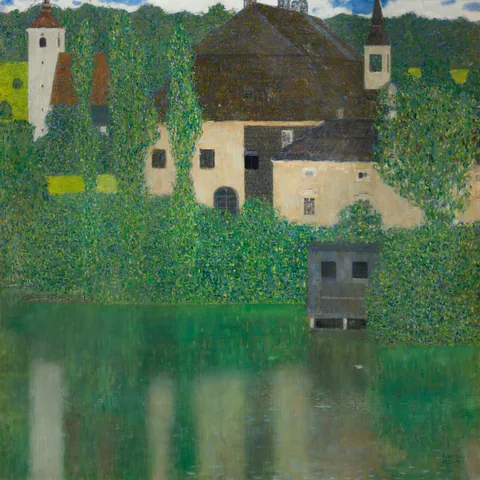
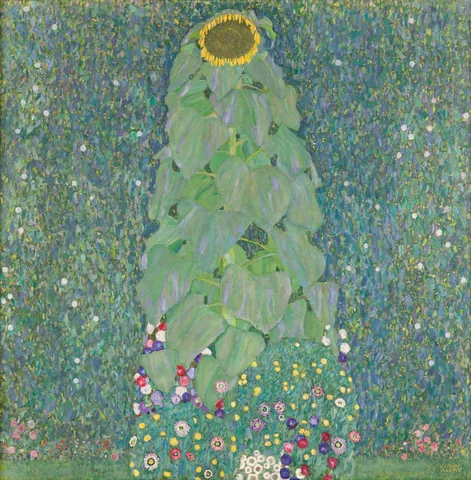
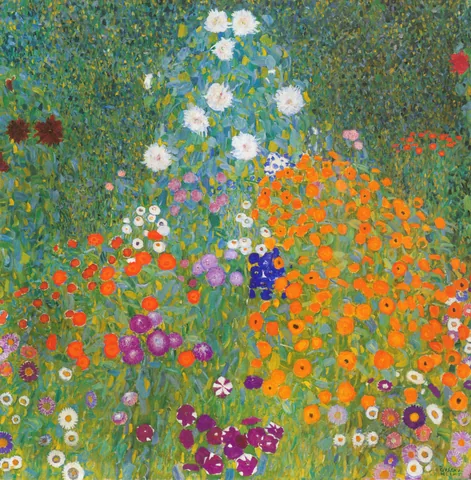
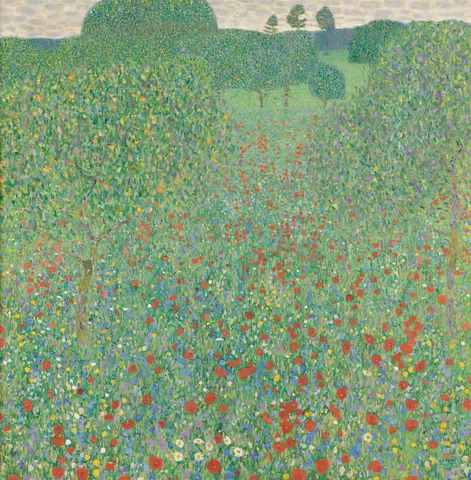
More in Quiet Interiors and Portraits.
Sources
- Belvedere, Vienna: The Kiss (on Google Arts & Culture)
- Belvedere, Vienna: The Kiss, the story of a painting (on Google Arts & Culture)
- Wikipedia: The Kiss (Klimt)
- Wikipedia: Portrait of Adele Bloch-Bauer I
- Wikipedia: Beethoven Frieze
- Wikipedia: Stoclet Frieze
- Wikimedia Commons: Umarmung (the embrace), cartoon for the Stoclet Frieze, 1910
More from the Journal
 Story · 7 min
Van Gogh’s Starry Night: the facts, and choosing a print
Painted in June 1889 at an asylum in Provence: the view from his window, plus a village he made up. What is real, what it means, and which print to choose. Story · 7 min
The Great Wave off Kanagawa: meaning, history and prints
A woodblock print, not a painting, and a storm wave, not a tsunami. What it shows, why no two impressions match, and how to choose a print. Story · 7 min
Monet’s Water Lilies: the series, and which print to choose
About 250 paintings of one pond at Giverny. How the series grew from a garden bridge to giant panels, and which Water Lilies suits your wall. Story · 7 min