
Story
Monet’s Water Lilies: the series, and which print to choose
About 250 paintings of one pond at Giverny. How the series grew from a garden bridge to giant panels, and which Water Lilies suits your wall.
There is no single Water Lilies. For the last three decades of his life, from the late 1890s until he died in 1926, Claude Monet painted the pond in his own garden at Giverny, in Normandy, about 250 times. The Musée de l’Orangerie in Paris, which holds the grandest of them, counts almost 300 paintings in the cycle, more than 40 of them large. They run from nearly square views of a footbridge to canvases 14 feet long with no bank, no sky and no horizon at all.
A garden built to be painted
Monet moved to Giverny with his family in 1883, renting the house, and bought it in 1890. In 1893 he bought a plot of land on the other side of the railway line and set about diverting the Ru, a small branch of the River Epte, to feed a pond. Local farmers objected, afraid the strange water plants would poison their water, and he won permission only after a struggle. In his application he gave two reasons for the pond: it would be a pleasure to look at, and it would give him subjects to paint. He chose his water lilies from a nursery catalog (“simply chose at random,” he said) and built a Japanese-style bridge across one end, painted green rather than the red traditional in Japan.
The house and gardens were restored in the late 1970s and are open to visitors for much of the year, so you can still walk round the pond.
From the bridge to the water
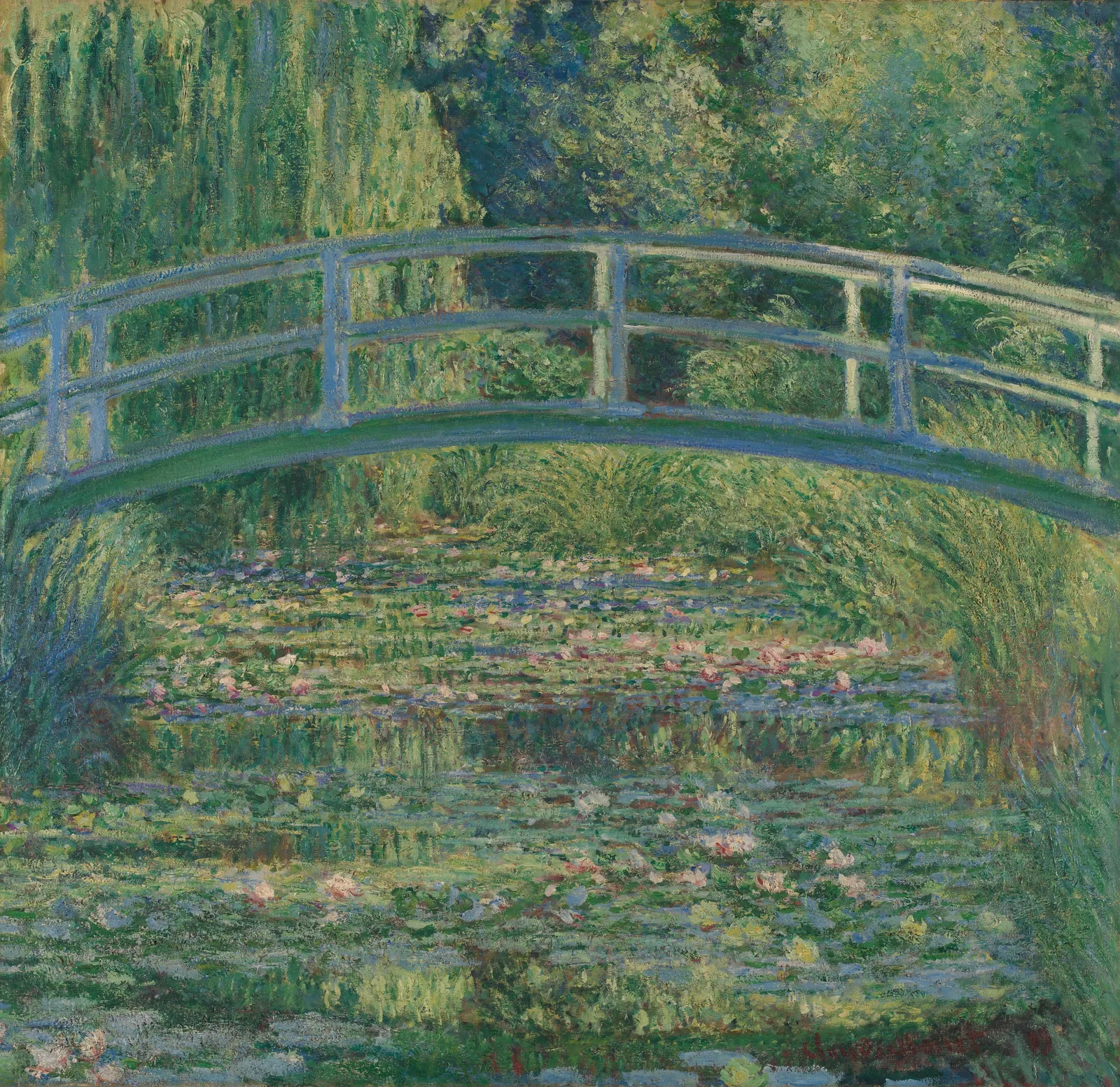
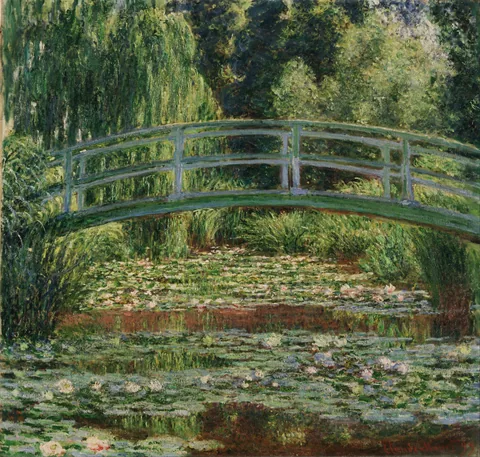
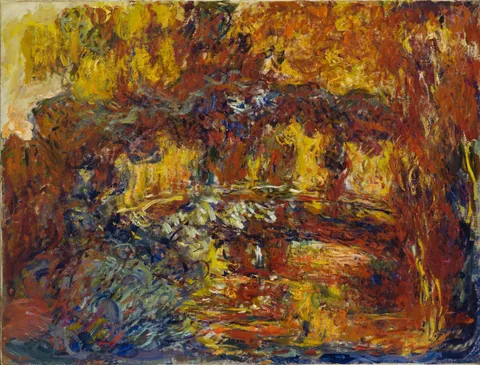
The garden pictures Monet showed first were mostly of the bridge. In 1899 he painted it many times, an arch floating over the pads, and in December 1900 he showed twelve paintings of it at the Durand-Ruel gallery in Paris. In the National Gallery’s Water-Lily Pond of 1899, as the museum puts it, “it is as though we are looking up at the bridge but down on the water lilies.”
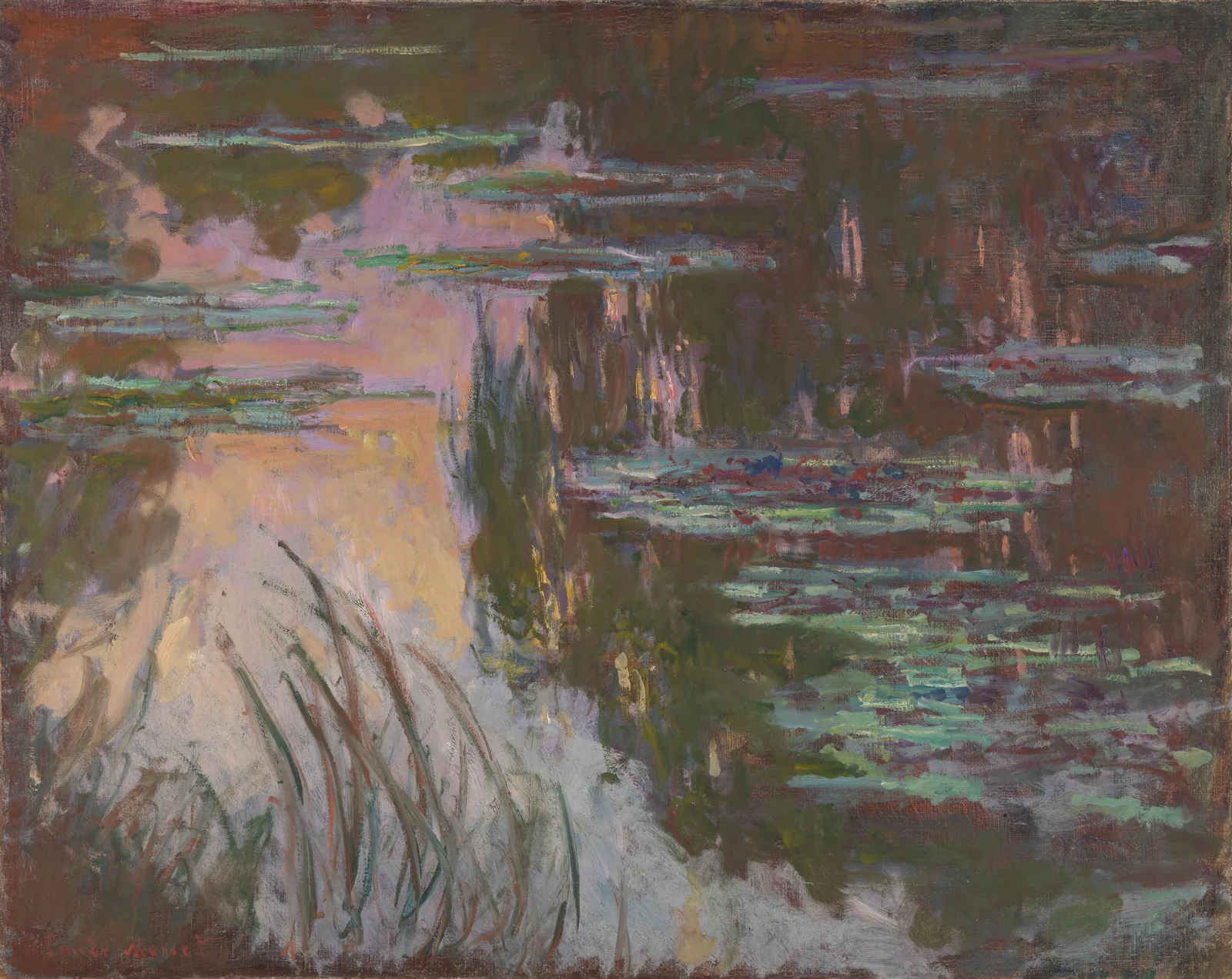
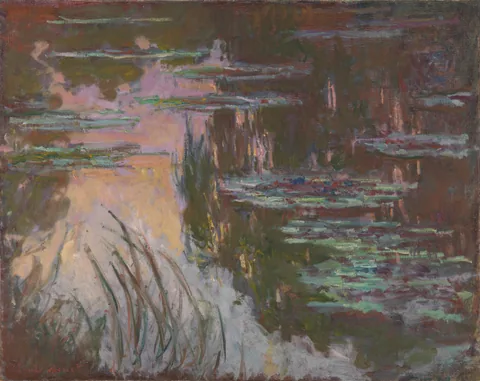
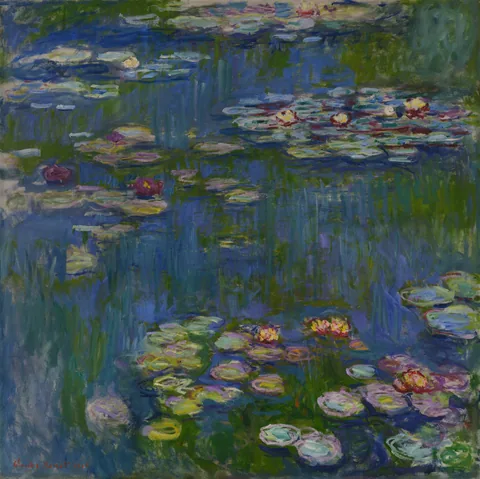
Then he moved in closer. In Water-Lilies, Setting Sun, from about 1907, the only sign of the shore is a clump of plants in the bottom left corner. Everything else is the surface of the water: lily pads lying flat, the dark reflections of willows dropping straight down through them, and pink and yellow light from the setting sun.
The giant panels
By 1914 Monet had settled on what he called his “great decoration”: water lilies on a scale to surround the viewer. He had a new studio built big enough to paint them, finished by 1916. The panels from those years are about 6½ feet tall and 14 feet long, and they leave out everything but the water. The Cleveland Museum of Art describes its panel this way: “By zeroing in on the water and omitting its horizon and surrounding banks, Monet infers a limitless expanse.”
The day after the armistice of 11 November 1918, Monet wrote to his friend Georges Clemenceau, then France’s prime minister, offering two panels to the nation. The gift grew: a contract signed in April 1922 covered nineteen panels. He kept them in his studio until he died, and in May 1927, a few months after his death, twenty-two panels in eight compositions were installed to his design in two oval rooms at the Orangerie, lit by daylight from above. Monet had described what he was after as “the illusion of an endless whole, of a wave with no horizon and no shore.”
The public was not enthusiastic at first, and for years few visitors came. Interest returned after the Second World War. In 1952 the painter André Masson called the rooms the Sistine Chapel of Impressionism, in 1955 the Museum of Modern Art in New York bought one of the large canvases, and critics began to see in late Monet a forerunner of the big abstract canvases of Jackson Pollock and Mark Rothko.
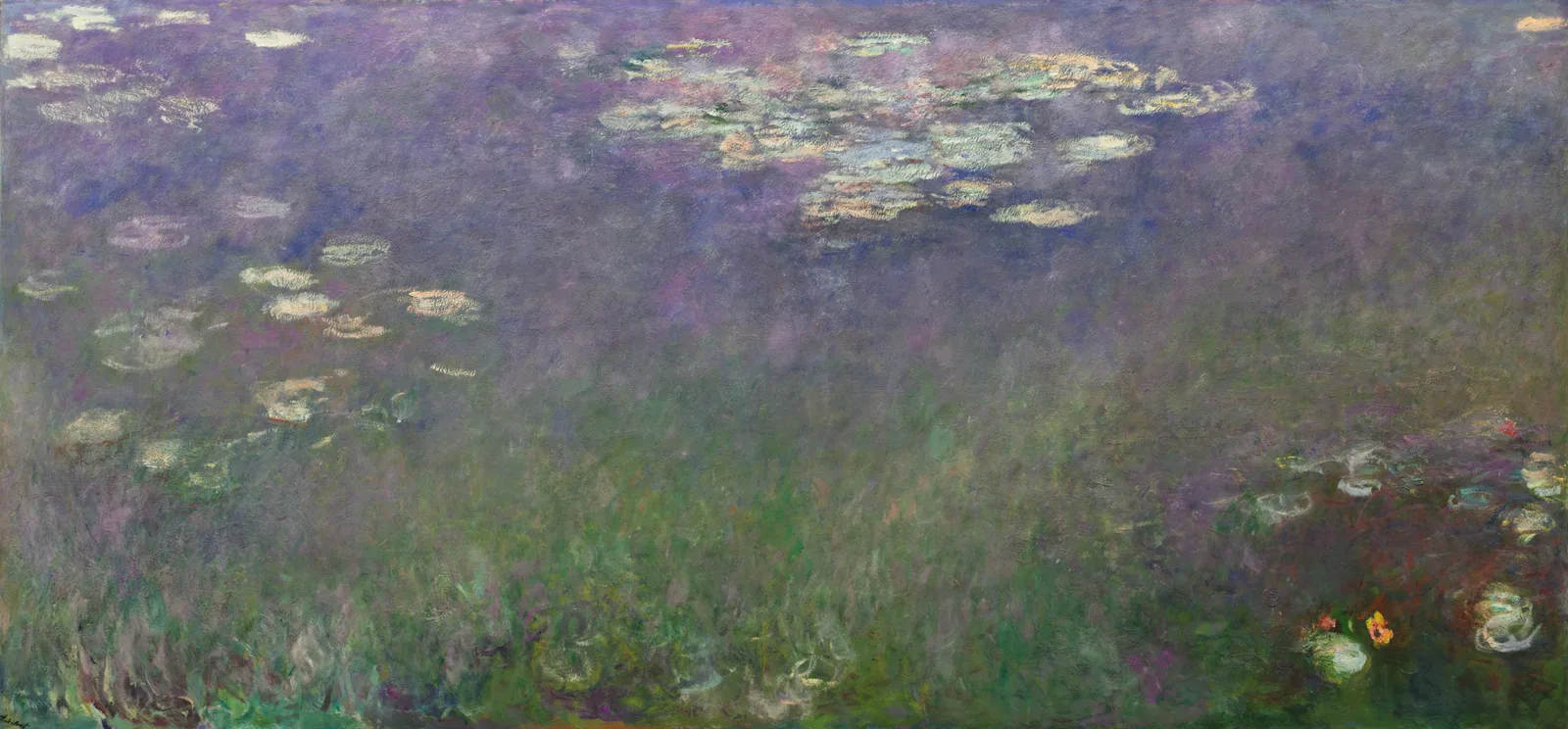
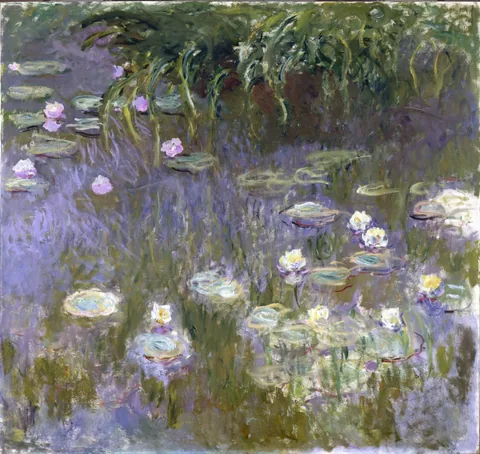
Not every panel went to Paris. The one in our picture above is the left third of a triptych Monet called Agapanthus, worked on for more than a decade. A photograph from 1921 shows a different picture from the one we see now: he later painted out the agapanthus plant on the left bank, and kept the name. The three panels went to three museums between 1956 and 1960: the left to Cleveland, the center to Saint Louis and the right to Kansas City. Another panel stayed at Giverny until after the Second World War and is now in the National Gallery, London: a shimmering surface of green, ochre, violet, yellow, sky blue and pink.
Monet painted much of this late work with failing eyes. Cataracts dimmed his sense of color for years, and in 1923 he finally had them operated on.
Which Water Lilies to choose
The bridge, for a garden in the room. The 1899 pictures, like the National Gallery of Art’s Japanese Footbridge and London’s Water-Lily Pond, are the most recognizable and the most like a view. They are close to square, or a gentle landscape shape, so they suit a bedroom wall, a stair landing or a pair either side of a window.
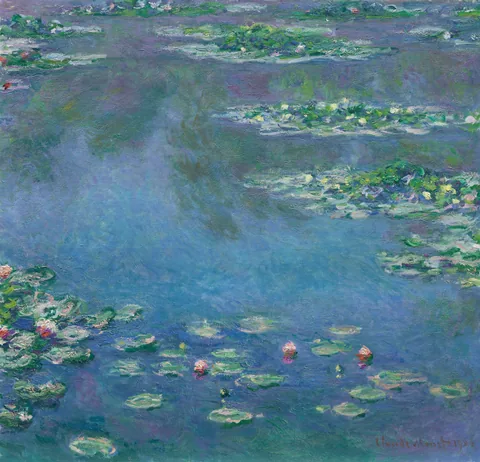
The water, for calm. The pond-surface pictures from the 1900s, like Setting Sun or the Art Institute of Chicago’s Water Lilies of 1906, have no horizon to anchor them. They read as color and light, which makes them easy to live with in a bedroom or a quiet office.
The panels, for a long wall. The great panels are a little more than twice as wide as they are tall, which suits the space over a sofa, a bed or a sideboard. London’s panel goes up to 48 × 22 in framed, about 54.5 in across with a 2 in mat and our black wood frame, which is close to the two-thirds of an 84-inch sofa that our sofa guide recommends.
Framed or canvas. Monet’s late surfaces are thick, broken strokes of color. A semi-gloss canvas keeps the violets and greens rich and has no glass to reflect a window; a matte canvas has no sheen at all. A framed print on smooth cotton paper gives crisper detail, and a white or off-white mat calms the busier pictures. Natural oak or gold suits the garden; black makes the panels look modern. See our canvas and frames.
Two thirds of one triptych
We sell two of the three Agapanthus panels: the left, from Cleveland, and the center, from Saint Louis. Hung side by side in that order, as Monet arranged them, they read as one long stretch of the pond.
Questions
How many Water Lilies paintings did Monet make?
About 250 by the usual count. The Musée de l’Orangerie counts almost 300 paintings in the cycle, more than 40 of them large.
Where can I see them?
The eight great compositions at the Musée de l’Orangerie in Paris are the heart of it. Others are spread across the world, among them the National Gallery, London, the Museum of Modern Art in New York, the Musée Marmottan Monet and the Musée d’Orsay in Paris, the Art Institute of Chicago, and Cleveland, Saint Louis and Kansas City for the Agapanthus triptych.
Did he paint them outdoors?
Not the giant panels. They were painted indoors, in the studio he built for them at Giverny; the Agapanthus triptych was worked on there for more than a decade.
Why do the late ones look almost abstract?
He took away the banks, the bridge and the sky, so nothing tells you where you are standing. And for years he was painting with cataracts, until an operation in 1923. After the Second World War, critics saw in them an early taste of the abstract painting of the New York School.
More of Monet’s pond
Impressionists
More in all Monet and Botanical and Flowers.
Sources
- Cleveland Museum of Art: Water Lilies (Agapanthus), about 1915 to 1926 (1960.81)
- Saint Louis Art Museum: Close Look, Claude Monet’s Water Lilies
- Musée de l’Orangerie: History of the Water Lilies cycle
- The National Gallery, London: Water-Lilies, after 1916 (NG6343)
- The National Gallery, London: The Water-Lily Pond, 1899 (NG4240)
- The National Gallery, London: Water-Lilies, Setting Sun, about 1907 (NG6608)
- Claude Monet’s house and gardens, Giverny: The water lily pond
- NBC News: Claude Monet’s water lily paintings almost never existed (the 1893 permit)
- University of Portsmouth: the National Gallery book Monet, The Water-Lily Pond (One Painting, One Story)
- Wikipedia: Claude Monet
- Wikipedia: Water Lilies (Monet series)
More from the Journal
 Story · 7 min
Van Gogh’s Starry Night: the facts, and choosing a print
Painted in June 1889 at an asylum in Provence: the view from his window, plus a village he made up. What is real, what it means, and which print to choose. Story · 7 min
The Great Wave off Kanagawa: meaning, history and prints
A woodblock print, not a painting, and a storm wave, not a tsunami. What it shows, why no two impressions match, and how to choose a print. Story · 7 min
Klimt’s The Kiss: gold leaf, meaning and choosing a print
Real gold leaf on canvas, finished in 1909. The story of Klimt’s lovers, what a print can and can’t reproduce, and which size to choose. Story · 7 min