
Story
Van Gogh’s Starry Night: the facts, and choosing a print
Painted in June 1889 at an asylum in Provence: the view from his window, plus a village he made up. What is real, what it means, and which print to choose.
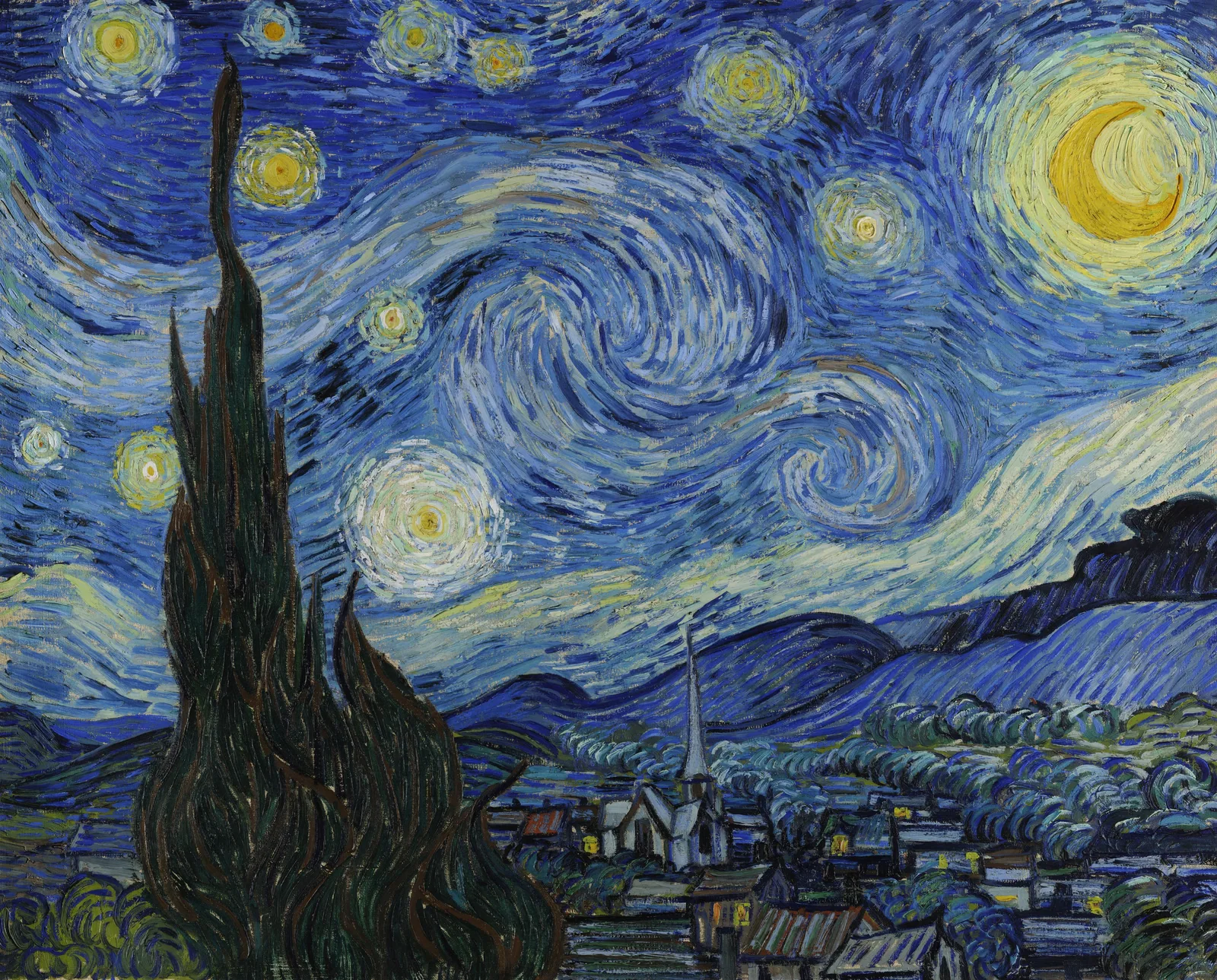
Van Gogh painted The Starry Night in June 1889, a few weeks after he entered an asylum in the south of France. It shows the view east from his bedroom window just before sunrise, with a village he made up and a sky that seems to move. The Museum of Modern Art in New York has owned it since 1941.
Where he painted it
In late December 1888 Van Gogh had the breakdown in which he cut off his left ear, or part of it. On 8 May 1889 he went, of his own accord, to the asylum of Saint-Paul-de-Mausole, a former monastery outside Saint-Rémy-de-Provence. He was given a bedroom on the second floor and a room on the ground floor to paint in. From the bedroom, which faced east, he wrote to his brother Theo that through the iron-barred window he could watch the sun rise “in all its glory.”
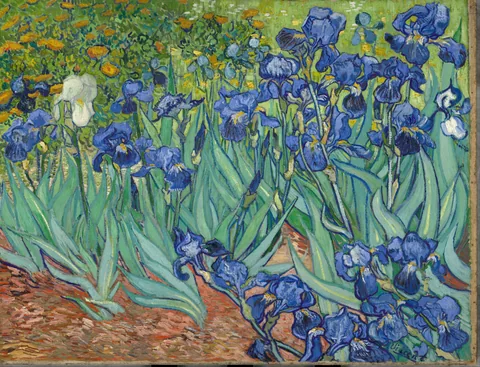
He was not allowed to paint in his bedroom, so he drew there in ink and charcoal and painted downstairs. That means The Starry Night was painted in the studio, by day, not out under the stars. Around 18 June he told Theo he had a new study of a starry sky. He painted Irises at the asylum too, a few weeks earlier, in May.
What is real, and what he made up
The morning star is real. In early June he told Theo he had watched the countryside from his window a long time before sunrise, “with nothing but the morning star, which looked very big.” The morning star is the planet Venus, which was close to its brightest in the dawn sky over Provence that spring. MoMA suggests it may be the large white star just left of center, beside the cypress.
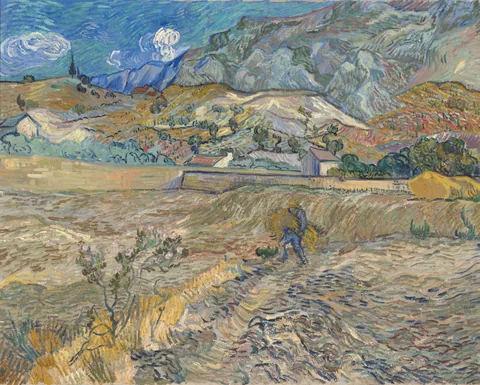
The view is real. It is the one from his east-facing window, over a walled wheat field to the low hills of the Alpilles. He painted that view again and again while he was there, and this is the only version set at night.
The village is not. It cannot be seen from that window. It is based on a sketch he made from a hillside above Saint-Rémy, and its tall, thin church spire recalls the Netherlands, where he grew up, more than Provence.
The moon is not either. At the time the real moon was waning gibbous, more than half full. The glowing crescent is his.
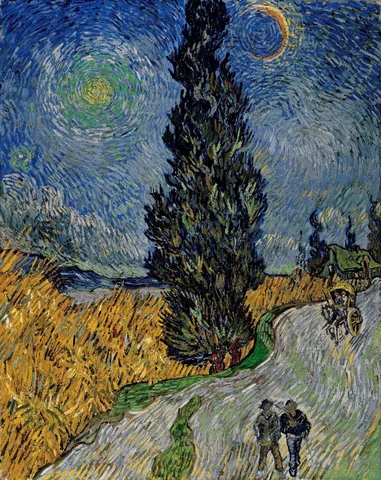
The cypress is somewhere in between. Historians still disagree about whether cypresses could be seen from his window. Either way, he enlarged them and brought them close, so the tree rises from the bottom edge to the top of the sky. MoMA sums it up: the painting is “rooted in imagination and memory.”
What Van Gogh thought of it
Less than you might expect. He held it back when he first sent new work to Theo, then shipped it to Paris on 28 September 1889 with a batch of other canvases. Theo had doubts too: in October he wrote that “the search for style takes away the real sentiment of things.” And in late November, writing to the painter Émile Bernard, Van Gogh counted it among his failures. He had let himself be led, he said, into “reaching for stars that are too big.”
Why it moves people
MoMA’s own description puts it simply. The sky is “a field of roiling energy,” and below it the village is “a place of quiet order.” Between them the cypress, a tree long tied to graveyards and mourning, rises like a flame and joins earth to sky.
For Van Gogh that was not a gloomy idea. In a letter from Arles in July 1888 he wrote that the stars set him dreaming, and wondered why the shining dots of the sky should be harder to reach than the black dots of towns on a map of France. We take a train to get to Tarascon or Rouen, he reasoned, and we take death to reach a star. That is part of why the painting lands the way it does. The sky is wild, but nothing in it is frightening: the village sleeps with its windows lit, and above it the night is enormous and alive. MoMA calls it a touchstone for all the Expressionist painting that followed.
Look closer
These details come from the high-resolution scan we print from, 43,426 pixels across. Pick a detail, or zoom in and drag to look around.
The biggest, whitest star, just right of the cypress. MoMA suggests it may be the morning star Van Gogh saw from his window before dawn: the planet Venus.
Choosing a Starry Night print
Go life size if you have the wall. The painting is 29 × 36¼ in. Our 36 × 29 in canvas and framed print are a hair smaller than the real thing, so you see every stroke at the scale he painted it. With a 2 in mat and our black wood frame, the framed one is about 42.5 × 35.5 in on the wall: a good size over a loveseat, a console, a bed or a mantel.
Every size we sell. The scan is sharp enough for big prints, so the limits come from what we can make and ship, not from the picture. Framed prints go up to 36 × 29 in, canvas up to 40 × 32 in and unframed art prints up to 48 × 39 in. For a desk wall, a hallway or beside a bed, 20 × 16 in is enough to read the swirls from across the room.
Framed print or canvas? The painting is mostly deep blue, with small, hot yellows in the stars and the moon. A framed print on our smooth cotton paper keeps those darks deep and the strokes crisp, behind clear acrylic. The one catch is the acrylic itself: a dark picture turns any glazing into a mirror if it faces a window or a bright lamp. Canvas has nothing in front of it, so there is no glare, and our matte canvas finish has no sheen at all; the semi-gloss finish keeps the blues a little richer. Choose canvas for a bright living room, a framed print for a study or a bedroom. See our canvas and our frames.
What a print can and can’t show. The original’s paint is thick. A print reproduces it as the photograph records it, as light and shadow on each stroke, not as raised texture. On canvas the weave of the fabric shows through, which suits the picture, but the surface is still flat.
Frames. A black or espresso frame disappears into the night sky and keeps the look modern. A gold frame looks more traditional and picks up the yellow of the stars. A white mat gives the dark painting a bright edge to sit in.
Its daytime companion
MoMA pairs it with The Olive Trees, its daytime companion. Van Gogh painted the olive grove at the asylum in June 1889, on a canvas almost exactly the same size, and the museum owns both. Hung side by side they make a day and a night in Provence. Over a long sofa they also solve a problem: even our largest single Starry Night is less than the two-thirds of a sofa’s width that our sofa guide recommends, and a pair is not.
Questions
Where is the original Starry Night?
At the Museum of Modern Art in New York, which acquired it in 1941 through the Lillie P. Bliss Bequest. The museum rarely lends it. It is not for sale, so any price you see quoted for it is a guess.
How big is the original?
29 × 36¼ in (73.7 × 92.1 cm), oil on canvas.
Was it painted from memory?
Partly. He painted it by day in his ground-floor studio, not under the night sky, so it combines a view he knew well, a sketch of the village made elsewhere, and invention. MoMA describes its imagery as rooted in imagination and memory.
Is the village in The Starry Night real?
No. It cannot be seen from the window he painted from. He based it on a sketch made from a hillside above Saint-Rémy.
Is it the same painting as Starry Night Over the Rhône?
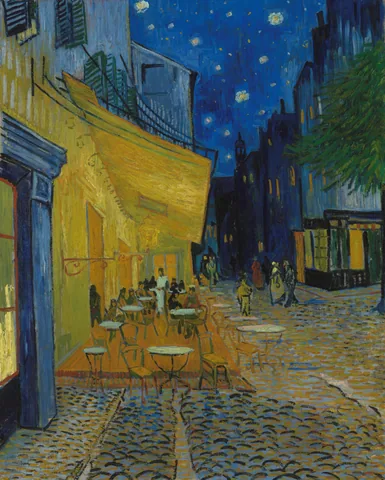
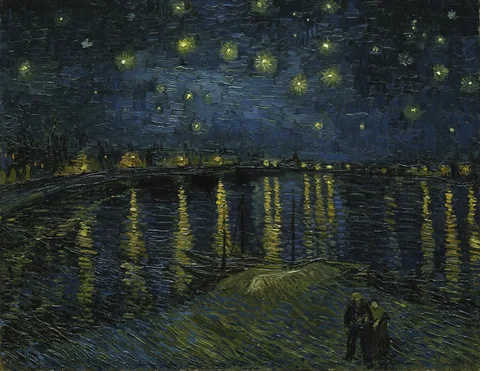
No. Starry Night Over the Rhône is an earlier night scene, painted in Arles in 1888, soon after Café Terrace at Night. We sell all three.
Can The Starry Night be printed legally?
Yes. Van Gogh died in 1890 and the painting is in the public domain, which is why we can print it. What public domain means.
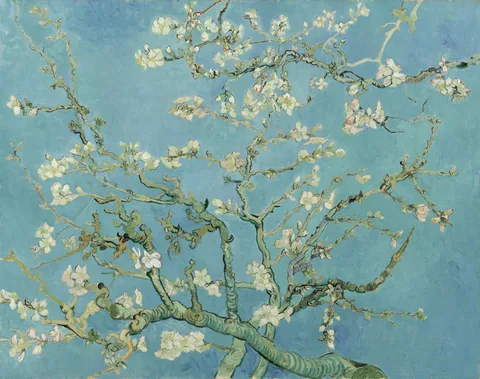
Van Gogh to hang beside it
All Van Gogh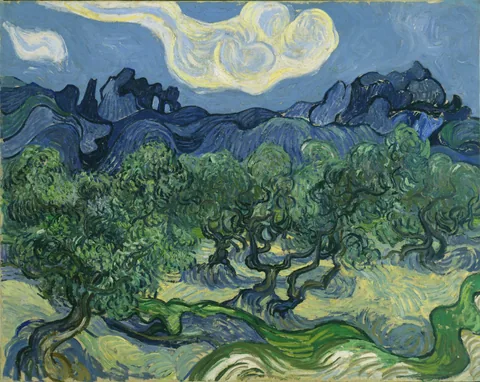
Sources
More from the Journal
 Story · 7 min
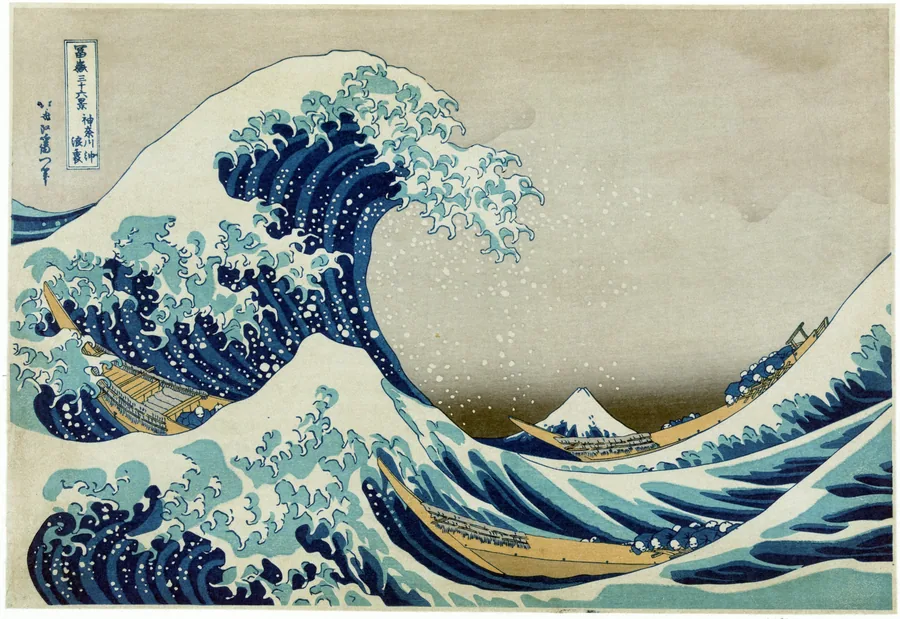
The Great Wave off Kanagawa: meaning, history and prints
A woodblock print, not a painting, and a storm wave, not a tsunami. What it shows, why no two impressions match, and how to choose a print.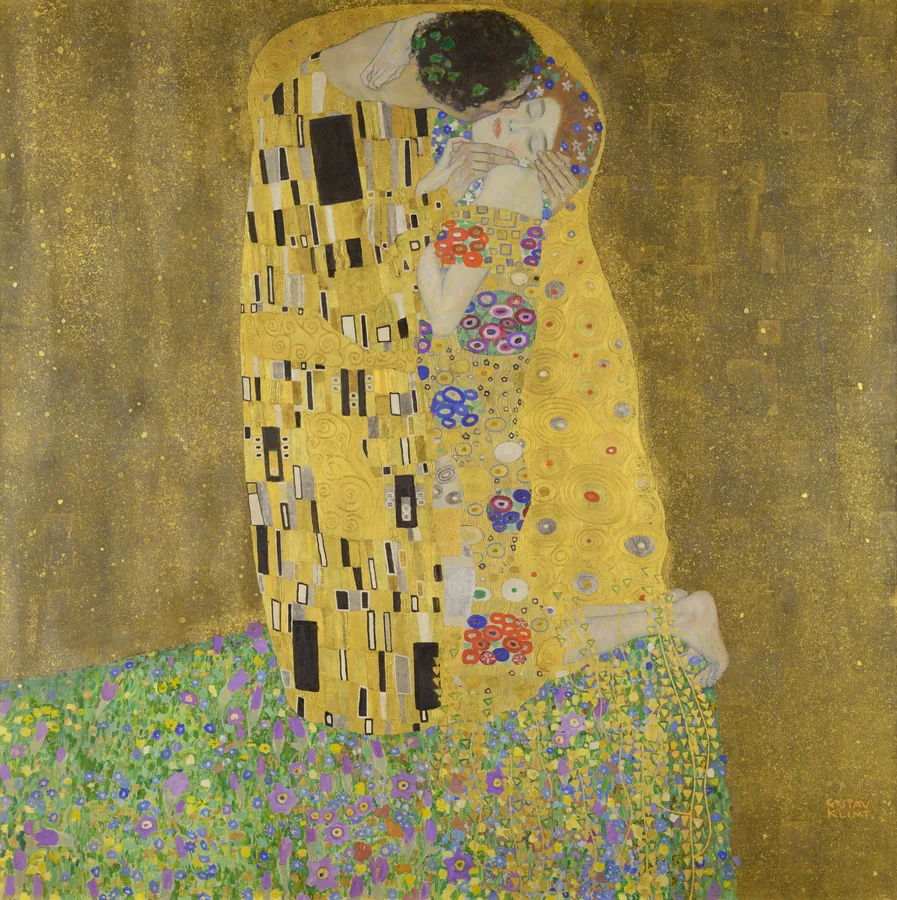 Story · 7 min
Klimt’s The Kiss: gold leaf, meaning and choosing a print
Real gold leaf on canvas, finished in 1909. The story of Klimt’s lovers, what a print can and can’t reproduce, and which size to choose.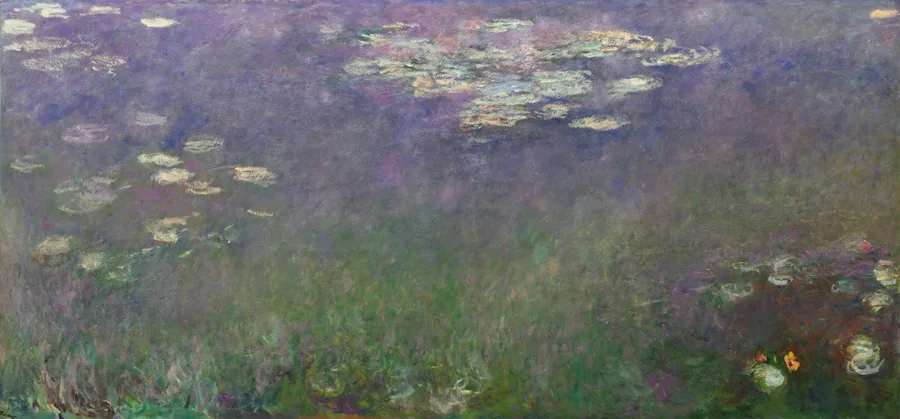 Story · 7 min
Monet’s Water Lilies: the series, and which print to choose
About 250 paintings of one pond at Giverny. How the series grew from a garden bridge to giant panels, and which Water Lilies suits your wall. Story · 7 min