
Story
Netherlandish Proverbs: how to read Bruegel’s painting
About 126 sayings in one village, from a roof tiled with tarts to the blue cloak. A guide to finding them, and choosing a print.
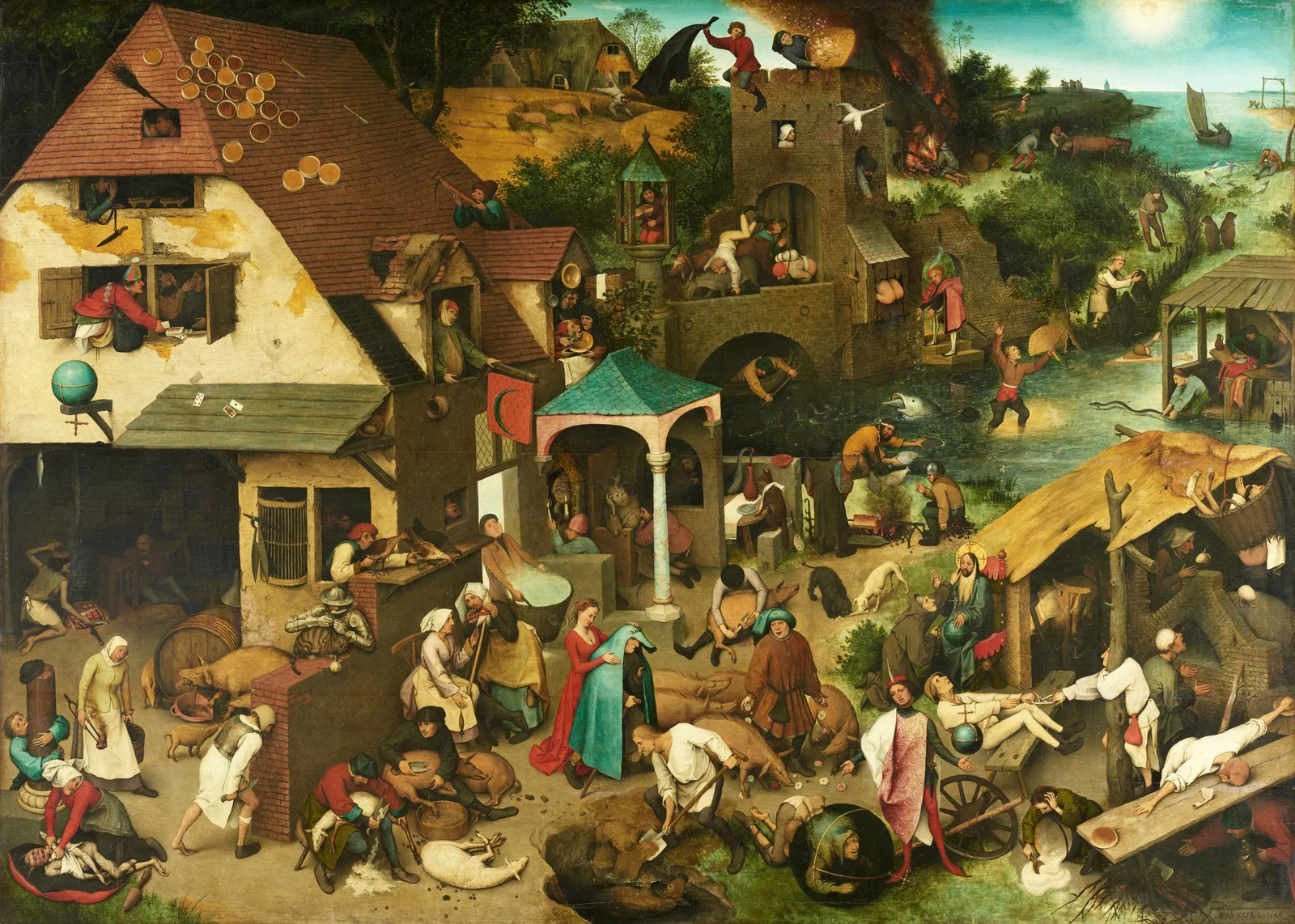
A village by the sea has gone mad. A man bangs his head against a wall. A woman ties the devil to a cushion. Someone has tiled a roof with tarts, a globe hangs upside down, and in the middle a woman in red wraps a man in a blue cloak. Pieter Bruegel the Elder painted it in 1559, and every one of these odd scenes is a saying people used every day in the Low Countries. Scholars have found about 126 of them.
What is the painting about?
Human foolishness. Each little scene acts out a proverb or a figure of speech literally, so that the whole village is a catalog of stupidity, waste, deceit and bad luck. The painting’s old title says it plainly: The Blue Cloak, or The Folly of the World. Bruegel’s viewers would have known most of the sayings and enjoyed spotting them, the way you might enjoy a picture that showed someone literally “spilling the beans.”
Some sayings still exist in English. Others have died out, and a few may now be impossible to read, because language has changed in four and a half centuries. That is part of the fun: it is a puzzle with no answer key.
The blue cloak
The scene that gave the painting its first title is near the center. A woman in a red dress drapes a blue cloak over her husband. To hang a blue cloak on your husband meant to cheat on him, to deceive him behind his back. It is the anchor of the picture, and the rest of the folly spreads out around it.
Eleven proverbs to find
Start with these. Each one is listed with where to look and what it meant.
- To tie even the devil to a pillow (lower left): stubbornness can overcome anything.
- To bang your head against a brick wall (lower left): to waste effort on the impossible. This one survives in English.
- Armed to the teeth (lower left): heavily armed. Also still in use.
- One shears sheep, the other shears pigs (lower left): one person gets every advantage and the other gets none.
- The world turned upside down (upper left): the hanging globe; everything is the opposite of what it should be.
- A roof tiled with tarts (upper left): to be very rich.
- To piss against the moon (middle left): to waste time on something futile.
- To fall from the ox onto the rear end of an ass (upper middle): to fall on hard times.
- To cast roses before swine (lower middle): to waste good things on people who can’t value them, like our “pearls before swine.”
- To fill the well after the calf has drowned (lower middle): to act only after the disaster.
- The blue cloak (lower middle): a wife deceiving her husband.
A painting copied many times
It was a hit. Bruegel’s son, Pieter Brueghel the Younger, painted at least sixteen copies of it. The original, by the father, is the one in Berlin, and it is the one we print.
Where is Netherlandish Proverbs?
In the Gemäldegalerie in Berlin. It is painted on an oak panel about 46 by 64 inches, big enough that the small figures are clear from a few steps away.
Look closer
These details come from the scan we print from, 4,000 pixels on the long side. Pick a proverb, or zoom in and drag to hunt for the rest.
A wife puts a blue cloak on her husband: she is deceiving him. The painting’s first title came from this pair.
Choosing a print
A medium print, honestly. Our scan of this painting is good but not huge, and we only sell sizes a file can print sharply, so this one goes up to 24 × 17 in. Framed prints, canvas and unframed art prints all go up to 24 × 17 in. At that size the figures are small, so hang it where people stand close and look: a hallway, a study, a stair wall, the space beside a bookshelf.
A picture for company. It is a game as much as a painting. In a dining room or a family room, guests end up hunting for proverbs. Print the list above and tuck it into a drawer nearby. At 20 × 14 in it suits a smaller wall.
Which material. Detail is everything here, so a framed print on smooth cotton paper is the best choice. Canvas softens fine detail a little. See our papers and framed canvas.
Frames. Black wood suits a Flemish panel and keeps the busy picture contained; a white mat gives it room to breathe. See all our frames and mats. For more Bruegel, read the story of The Hunters in the Snow.
Questions
How many proverbs are in Netherlandish Proverbs?
About 126 have been identified. A few may be impossible to read now because the language has changed.
What does the blue cloak mean?
A wife putting a blue cloak on her husband is deceiving him. It gave the painting its first title, The Blue Cloak.
Where is Netherlandish Proverbs?
In the Gemäldegalerie in Berlin. It is oil on an oak panel, 117 × 163 cm.
Who painted the copies?
His son, Pieter Brueghel the Younger, who made at least sixteen.
Can it be printed legally?
Yes. It was painted in 1559 and is in the public domain. What public domain means.
More Bruegel
All Bruegel
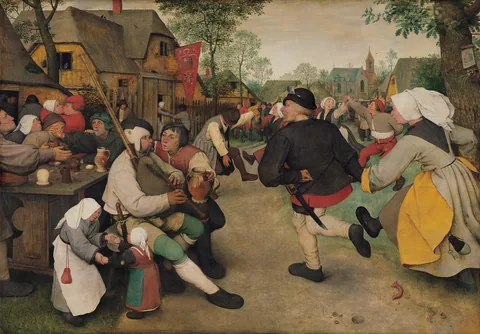
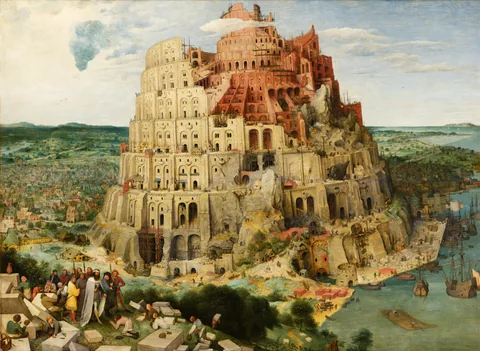
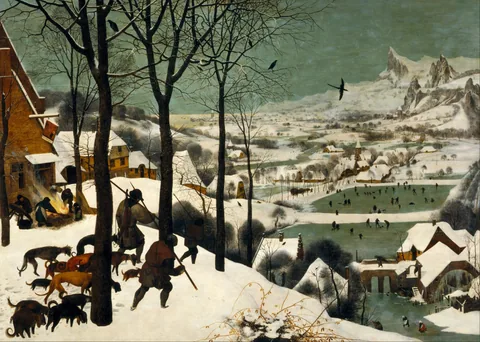
More in Dutch and Flemish Masters and Old Masters.
Sources
More from the Journal
 Story · 7 min
Van Gogh’s Starry Night: the facts, and choosing a print
Painted in June 1889 at an asylum in Provence: the view from his window, plus a village he made up. What is real, what it means, and which print to choose. Story · 7 min
The Great Wave off Kanagawa: meaning, history and prints
A woodblock print, not a painting, and a storm wave, not a tsunami. What it shows, why no two impressions match, and how to choose a print. Story · 7 min
Klimt’s The Kiss: gold leaf, meaning and choosing a print
Real gold leaf on canvas, finished in 1909. The story of Klimt’s lovers, what a print can and can’t reproduce, and which size to choose. Story · 7 min