
Story
Bruegel’s The Harvesters: lunch in the wheat, and a print
A late-summer harvest, lunch under a pear tree and a valley in the haze. What to look for in Bruegel’s Harvesters, its series, and choosing a print.
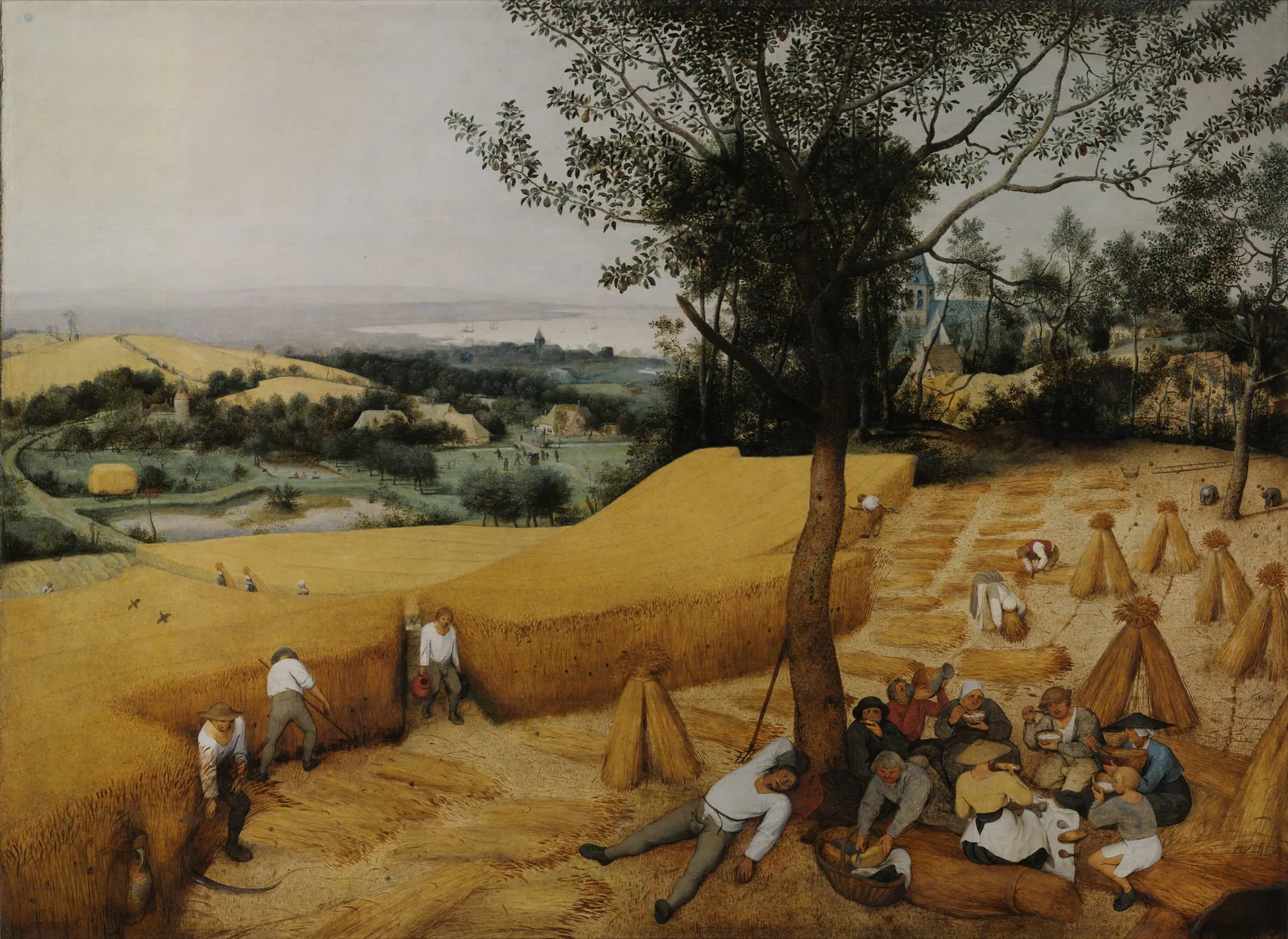
It is a hot late-summer day. In a golden field of wheat, some peasants keep cutting while others have stopped for lunch in the shade of a pear tree, eating bread and pears and passing round a jug. One man has fallen asleep. Beyond them the land drops away to a village, a pond and a bay with ships, all softened by haze. Pieter Bruegel the Elder painted it in 1565.
A painting of a season
The Harvesters belongs to a series Bruegel painted for an Antwerp merchant banker and collector, Nicolaes Jonghelinck. Each picture showed a different time of the year, and this one stands for late summer, August and September. There were six, or perhaps twelve; five survive:
- The Hunters in the Snow, December to January, in Vienna.
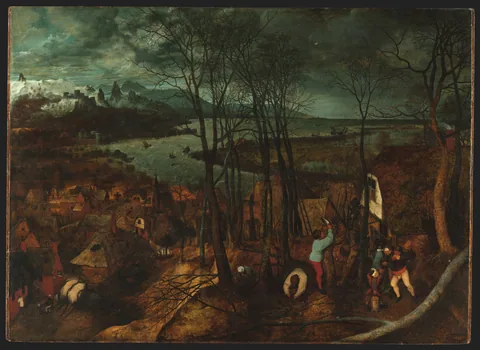
- The Gloomy Day, February to March, in Vienna.
- The Hay Harvest, June to July, in Prague.
- The Harvesters, August to September, in New York.
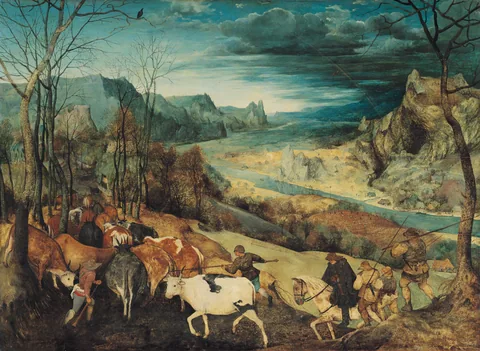
- The Return of the Herd, October to November, in Vienna.
The April to May picture is missing.
What to look for
The painting shows both the making and the eating of food. In the foreground, the harvesters’ lunch: a woman sitting upright eats bread and cheese, with pears laid out on a white cloth. A man sprawls asleep against the tree. To the left, others are still reaping, and one comes up a path cut through the wheat carrying jugs. In the stubble on the right, women tie the cut wheat into sheaves.
Look into the distance and the day goes on. Someone up a tree is picking pears; another shakes apples down. In the middle distance, villagers play at cock throwing, a cruel game of the time. People bathe in a pond, children play, and far away ships sail on the bay.
The first modern landscape?
The Metropolitan Museum calls it a watershed in the history of Western art, and the first modern landscape. Until then, most landscapes were backdrops for religious stories. Here the subject is the land itself and the ordinary people who work it. Bruegel pulls you in along the paths, from the shade of the tree out across the fields to the far-off haze, and you feel the distance and the heat. The filmmaker Hayao Miyazaki drew on it for his short film Mr. Dough and the Egg Princess.
Where is The Harvesters now?
In the Metropolitan Museum of Art in New York, since 1919. It is the only painting of the series outside Europe.
Look closer
These details come from the scan we print from, 30,000 pixels on the long side. Pick a detail, or zoom in and drag to explore the valley.
Harvesters eating under a pear tree: bread and cheese, pears on a white cloth, and a jug passed round.
Choosing a print
Wide and large. The panel is about 47 by 64 inches, and the joy is in the details. Our largest framed print is 36 × 26 in, and unframed art prints go to 48 × 35 in. Framed prints go up to 36 × 26 in, canvas up to 48 × 35 in and unframed art prints up to 48 × 35 in. The wide shape suits a dining room or a kitchen wall, where its lunch scene feels at home.
Where it works. A farmhouse kitchen, a dining room, a country living room. At 24 × 17 in it fits over a sideboard or a desk. See what size art over a sofa.
Which material. Smooth cotton paper in a frame keeps the tiny figures in the distance sharp. Canvas, with its matte finish and no cover, suits a sunny kitchen. See our papers and canvas.
Frames. Natural oak suits the wheat and the country subject; gold warms it. See all our frames.
Four seasons. Open four of Bruegel’s seasons as a set, winter to autumn. Read the story of The Hunters in the Snow.
Questions
What season is The Harvesters?
Late summer, August to September, in Bruegel’s series of the times of the year.
Where is The Harvesters?
In the Metropolitan Museum of Art in New York, since 1919.
How many of the series survive?
Five: three in Vienna, one in Prague and this one in New York.
How big is it?
119 × 162 cm, about 47 × 64 in, on wood.
Can it be printed legally?
Yes. It was painted in 1565 and is in the public domain. What public domain means.
More Bruegel and harvests
All Bruegel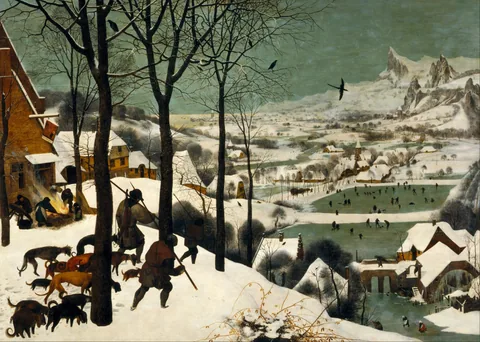
More in Landscapes and Dutch and Flemish Masters.
Sources
More from the Journal
 Story · 7 min
Van Gogh’s Starry Night: the facts, and choosing a print
Painted in June 1889 at an asylum in Provence: the view from his window, plus a village he made up. What is real, what it means, and which print to choose. Story · 7 min
The Great Wave off Kanagawa: meaning, history and prints
A woodblock print, not a painting, and a storm wave, not a tsunami. What it shows, why no two impressions match, and how to choose a print. Story · 7 min
Klimt’s The Kiss: gold leaf, meaning and choosing a print
Real gold leaf on canvas, finished in 1909. The story of Klimt’s lovers, what a print can and can’t reproduce, and which size to choose. Story · 7 min