
Story
Constable’s The Hay Wain: the place, the story, a print
Flatford Mill in Suffolk, a farm cart in the river and a gold medal in Paris. The story of Constable’s Hay Wain and how to choose a print.
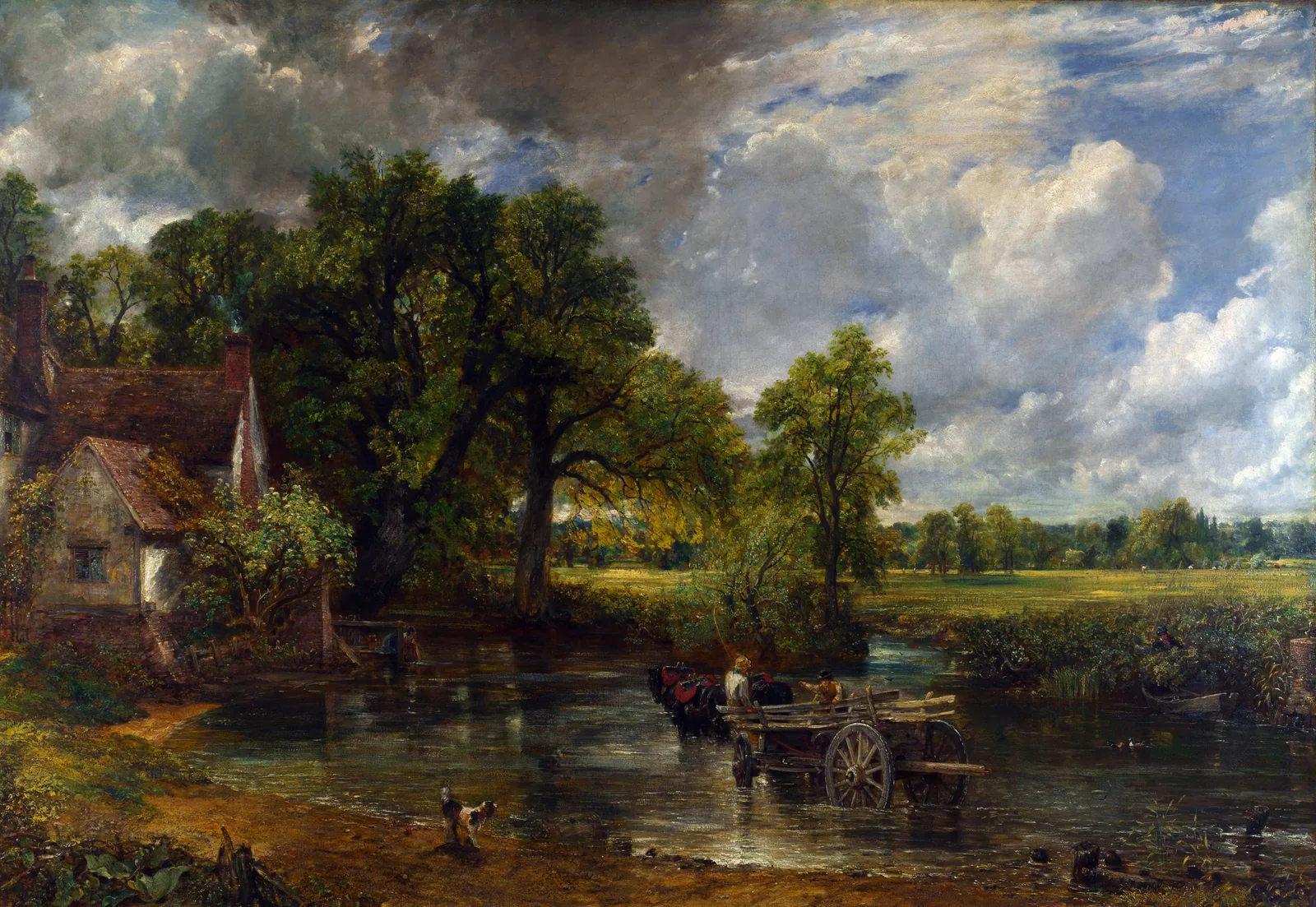
A farm cart stands in the shallow water of a millpond while a dog watches from the bank. Behind it a farmhouse sits under tall trees, and beyond, haymakers work in a sunlit meadow under a sky full of moving clouds. John Constable painted The Hay Wain in 1821, and it is one of the best-known pictures of the English countryside.
Where is the Hay Wain scene?
At Flatford, on the River Stour near East Bergholt in Suffolk. Constable knew it from childhood: Flatford Mill is about a mile from where he was born. The mill itself is just out of sight, with only the edge of its red brick wall showing at the far right. The house on the left belonged to a tenant farmer, Willy Lott. The cart is heading for the ford, the “flat ford” that gave Flatford its name.
What is happening?
A working afternoon in summer. The wagon, or wain, is empty, crossing the water. On the right, a man with a fishing rod is pushing through the reeds toward a boat. And in the distance, in the bright field, haymakers are at work: one sharpens his scythe, others pitchfork hay onto a wagon that is already loaded. The painting is full of small, ordinary jobs, which is the point. Constable painted the country he knew as a place where people lived and worked.
Painted in London, from sketches
Although it looks painted on the spot, it was not. Constable made it in his studio in London, working from sketches he had made outdoors over several years. Before the final picture he even made a full-size oil sketch, the same size as the finished painting, to work out the composition.
And he did not call it The Hay Wain. When he showed it at the Royal Academy in 1821, its title was Landscape: Noon. The nickname came from his friend Archdeacon Fisher.
Unsold in London, a sensation in Paris
Reviewers in London liked it; one wrote that it came nearer to the real look of the country than any modern landscape. But it did not sell. In 1824 Constable agreed to sell it to an Anglo-French dealer, Arrowsmith, for £250, and it was shown at the Paris Salon, where it caused a sensation. Constable was amused: “Think of the peaceful farm houses of Suffolk, forming a scene of exhibitions to amuse the gay and frivolous Parisians.” King Charles X gave him a gold medal, chiefly for this picture. The painter Eugène Delacroix reported that Géricault had come back to France quite stunned by it.
Where is The Hay Wain now?
In the National Gallery in London, in room 40, still in a 19th-century English frame. It was given to the gallery by Henry Vaughan in 1886. It is big, just over a meter high and nearly two meters wide.
Look closer
These details come from the scan we print from, 6,128 pixels on the long side. Pick a detail, or zoom in and drag to look around: Constable’s little flecks of white make the water and leaves sparkle.
An empty farm wagon pulled by horses, crossing the shallow water to the ford.
Choosing a print
Wide, for a long wall. The original is about 51 by 73 inches, and the picture’s wide shape suits a sofa, a sideboard or a mantel. Our largest framed print is 36 × 25 in, and canvas goes to 40 × 28 in. Framed prints go up to 36 × 25 in, canvas up to 40 × 28 in and unframed art prints up to 40 × 28 in. See what size art over a sofa.
Where it works. A country kitchen, a farmhouse dining room, a living room with wood and linen. The greens and browns are easy to live with and work with almost any wall color. At 24 × 17 in it fits over a desk or in a hallway.
Which material. Canvas suits a painting with this much texture in the trees and water, and has no cover to reflect light. Smooth cotton paper in a frame keeps the small figures crisp. See canvas and our papers.
Frames. The original still hangs in a 19th-century English frame, and a wide gold one like our Gold Plein Air gives the same effect. Natural oak is simpler and suits a cottage. See all our frames.
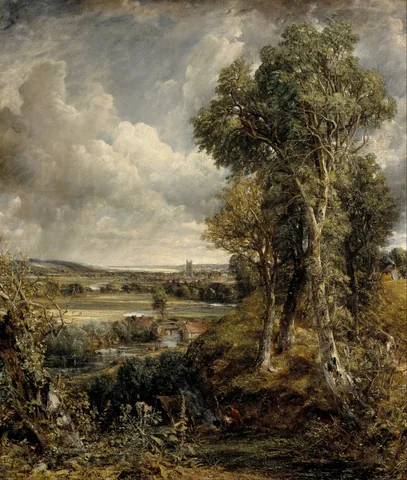
More of Constable country. Pair it with The Vale of Dedham, the valley of the same river. Open the two as a set.
Questions
Where was The Hay Wain painted?
It shows Flatford on the River Stour in Suffolk, but Constable painted it in his London studio from sketches.
What is a hay wain?
A wain is a farm wagon. The one in the painting is empty, crossing the water toward the ford.
Whose house is in The Hay Wain?
The tenant farmer Willy Lott’s.
Where is The Hay Wain now?
In the National Gallery in London. It is 130.2 × 185.4 cm, about 51 × 73 in.
Can it be printed legally?
Yes. It was painted in 1821 and is in the public domain. What public domain means.
More Constable
All Constable
More in Landscapes.
Sources
More from the Journal
 Story · 7 min
Van Gogh’s Starry Night: the facts, and choosing a print
Painted in June 1889 at an asylum in Provence: the view from his window, plus a village he made up. What is real, what it means, and which print to choose. Story · 7 min
The Great Wave off Kanagawa: meaning, history and prints
A woodblock print, not a painting, and a storm wave, not a tsunami. What it shows, why no two impressions match, and how to choose a print.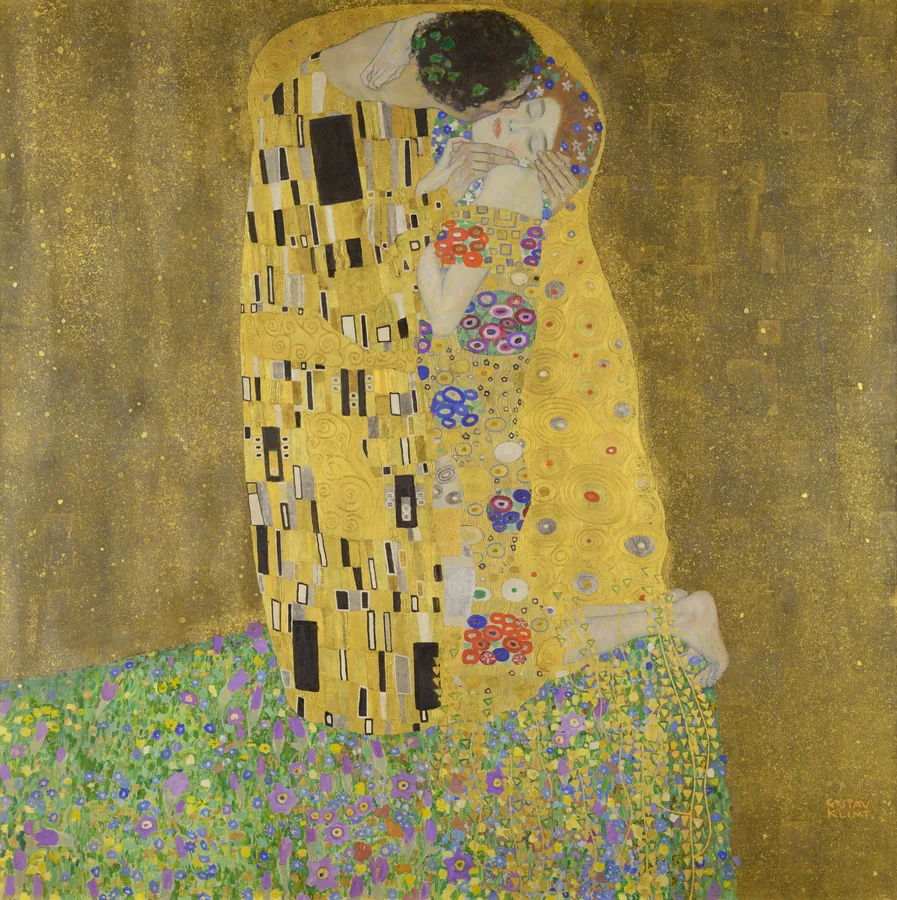 Story · 7 min
Klimt’s The Kiss: gold leaf, meaning and choosing a print
Real gold leaf on canvas, finished in 1909. The story of Klimt’s lovers, what a print can and can’t reproduce, and which size to choose. Story · 7 min