
Story
Degas’s L’Absinthe: the story behind the painting
Two figures alone in a Paris café, a glass of absinthe and a scandal in London. Who posed, what critics said, and how to choose a print.
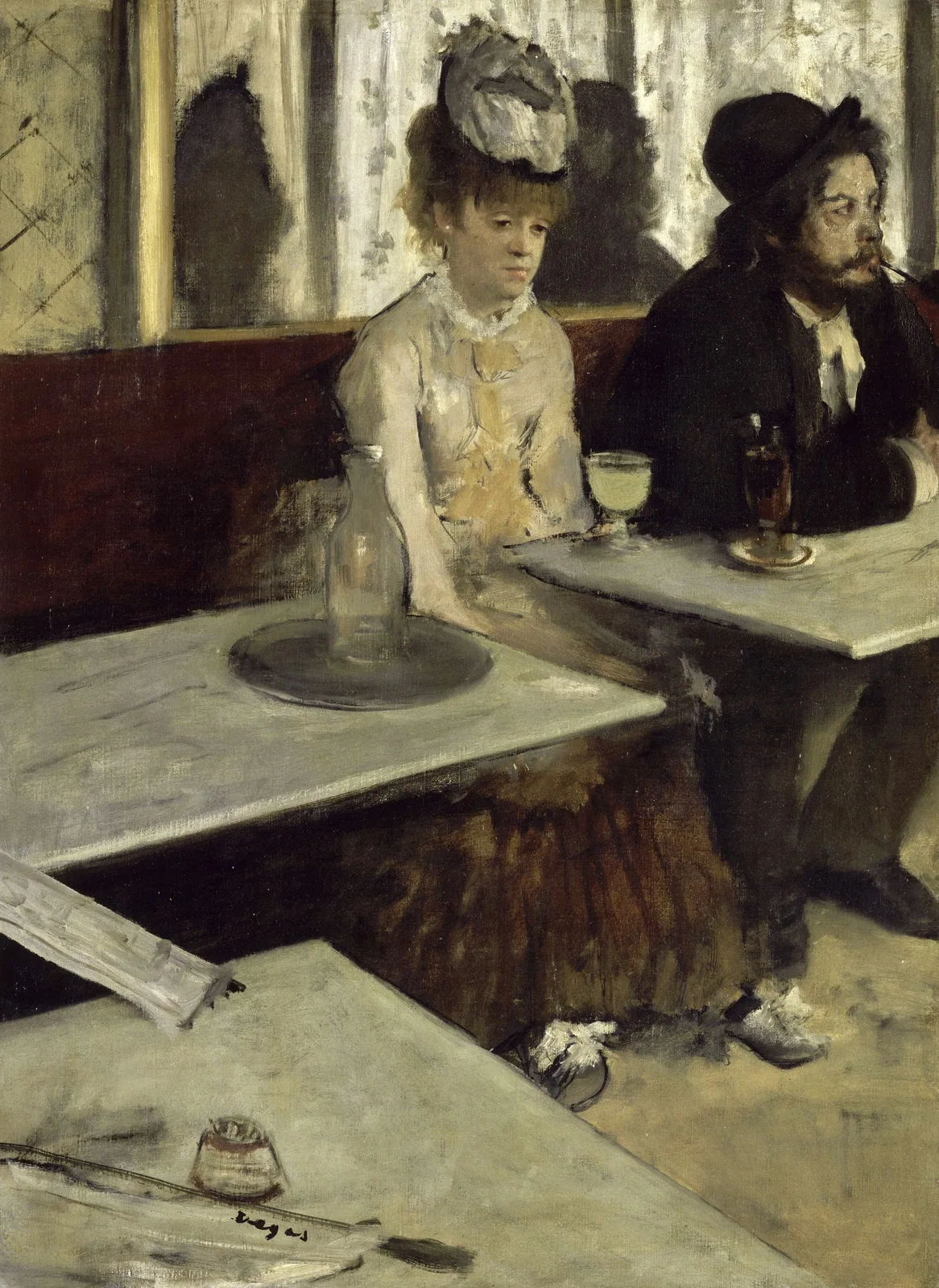
A woman sits at a café table with a glass of green absinthe in front of her, staring at nothing. Beside her, a man in a battered hat looks the other way. Neither speaks. Edgar Degas painted them in Paris in 1875 and 1876, and the picture later caused a scandal, not in Paris but in London.
Who are the two people?
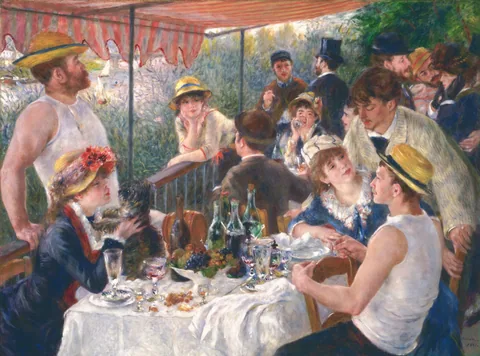
They were models, posing. The woman is Ellen Andrée, an actress, who also modeled for Manet and appears, drinking from a glass, in Renoir’s Luncheon of the Boating Party. The man is Marcellin Desboutin, a painter and etcher. They are not a couple of hopeless drinkers; they are acting a scene that Degas set up.
Where is the café?
The Café de la Nouvelle-Athènes in Paris. Degas shows it the way you would see it walking in: a zigzag of empty marble tabletops in the foreground pushes the two figures back toward the wall, and their blurred shadows show in the mirror behind them.
What is the painting about?
Loneliness, more than drink. The woman stares vacantly downward; the man looks out of the picture to the right, as if she were not there. Two people at the same table, completely alone. The absinthe is part of the scene, but the subject is the mood, a lethargy that settles over them both.
Why was L’Absinthe a scandal?
When it was first shown, in 1876, as Dans un café (“In a Café”), critics panned it. It was mocked again when it was sold at auction in 1892. But the real storm came in 1893, when it was shown at the Grafton Gallery in London under a new title, L’Absinthe. English critics found the figures, and the drink, shockingly degraded, and many Victorians saw the picture as an attack on morality.
The Irish writer George Moore defended it with a line that still holds: “the picture is merely a work of art, and has nothing to do with drink or sociology.” Degas, in other words, was painting what he saw, not preaching.
Where is L’Absinthe now?
In the Musée d’Orsay in Paris. Before it got there, it passed through several hands: a collector in Brighton bought it in 1876, and after the 1892 auction it went to Arthur Kay, who sold it to a Paris dealer in April 1893.
Look closer
These details come from the scan we print from, 5,400 pixels on the long side. Pick a detail, or zoom in and drag to look around.
Eyes lowered and empty, shoulders slumped. Ellen Andrée, an actress, posed for her.
Choosing a print
Size. The canvas is about 36 by 27 inches. Our largest framed print, 26 × 36 in, is almost exactly that. Framed prints, canvas and unframed art prints all go up to 26 × 36 in.
Where it works. A bar, a den, a café-style kitchen or a reading room. Its muted creams, browns and grays are calm and grown-up, and it is a natural choice for anyone who loves Paris, cafés or the theater. At 17 × 24 in it fits a narrow wall beside a bar cart.
Which material. Smooth matte paper in a frame keeps Degas’s quick, sketchy strokes crisp. Canvas, with its matte finish and no cover, gives it a painted feel. See our papers and canvas.
Frames. Black wood suits the dark coat and the café; a slim black frame with a white mat looks clean and modern. See all our frames and mats.
Questions
Who are the people in L’Absinthe?
The actress Ellen Andrée and the painter and etcher Marcellin Desboutin, posing for Degas.
Where is the café?
The Café de la Nouvelle-Athènes in Paris.
Why was it controversial?
When it was shown in London in 1893, critics found it shockingly degraded and many saw it as immoral. It had already been panned in 1876.
Where is L’Absinthe now?
In the Musée d’Orsay in Paris. It is 92 × 68 cm, about 36 × 27 in.
Can it be printed legally?
Yes. Degas died in 1917, and his paintings are in the public domain. What public domain means.
More cafés and company
All Degas
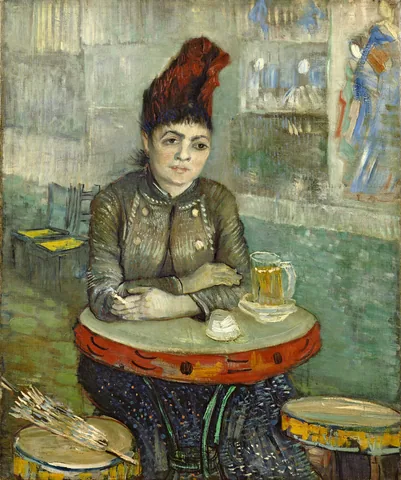
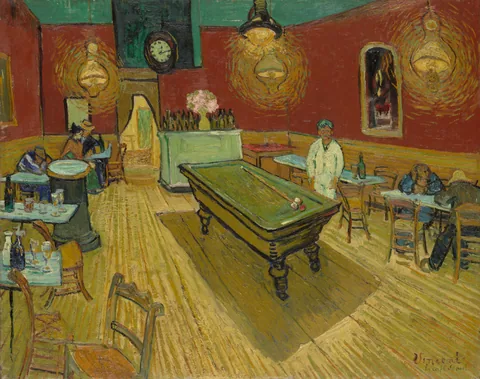
More in Impressionists and Interiors and Portraits.
Sources
More from the Journal
 Story · 7 min
Van Gogh’s Starry Night: the facts, and choosing a print
Painted in June 1889 at an asylum in Provence: the view from his window, plus a village he made up. What is real, what it means, and which print to choose. Story · 7 min
The Great Wave off Kanagawa: meaning, history and prints
A woodblock print, not a painting, and a storm wave, not a tsunami. What it shows, why no two impressions match, and how to choose a print. Story · 7 min
Klimt’s The Kiss: gold leaf, meaning and choosing a print
Real gold leaf on canvas, finished in 1909. The story of Klimt’s lovers, what a print can and can’t reproduce, and which size to choose. Story · 7 min