
Story
Gainsborough’s Mr and Mrs Andrews: the couple and the lap
A young squire, his wife, their land and a mysterious bare patch of canvas. The story of Gainsborough’s early masterpiece, and choosing a print.
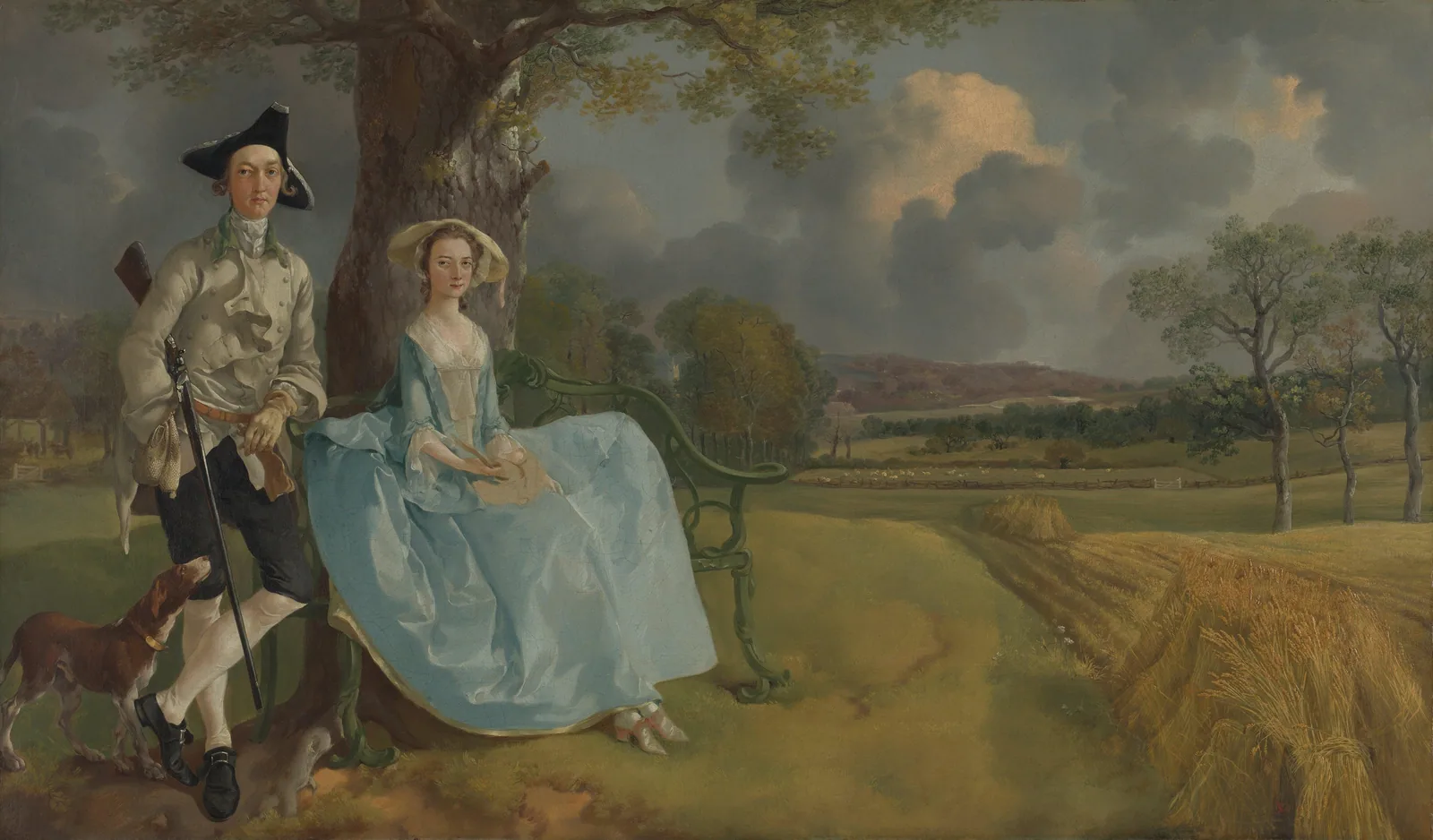
A young couple pose under an oak tree at the edge of their land. He stands with a shotgun under his arm and a dog at his feet; she sits on an elegant bench in a pale blue dress. Behind them, the rest of the picture belongs to the English countryside: a newly harvested field, hedges and woods, and a big, changeable sky. Thomas Gainsborough painted it around 1750, when he was in his early twenties.
Who were Mr and Mrs Andrews?
Robert Andrews (1725–1806) was a squire in Essex. He married Frances on 10 November 1748 at All Saints Church in Sudbury; she was 16. You can see the church between the trees in the distance. They went on to have nine children.
Their estate, Auberies, near Bulmer, had been owned jointly by their two fathers. In 1750 Robert became its sole owner, which may be what prompted the painting. By then he owned nearly 3,000 acres. The National Gallery calls it a “triple portrait”: of Robert Andrews, his wife and his land.
The mystery in her lap
Look closely at Frances’s lap. There is a patch of canvas that was never painted. No one knows what was meant to go there. Perhaps a cock pheasant; perhaps a baby, since their first child was born in 1751. Gainsborough never filled it in.
A painter of landscape
The picture follows the fashion for the “conversation piece”, a small group portrait in a real setting. But Gainsborough gives more than half the canvas to the land and the weather, painted under the influence of Dutch landscape art. The cut grain tells us it is late July or August. It is regarded as the masterpiece of his early career.
Where is Mr and Mrs Andrews?
In the National Gallery in London, which bought it in 1960 after it was sold at auction, with help from the government, charities and private donors.
Look closer
These details come from the scan we print from, 6,000 pixels on the long side. Pick a detail, or zoom in and drag to look around.
The young squire in a three-cornered hat, about 25, leaning on the tree.
Choosing a print
Wide, nearly life size. The canvas is about 27½ by 47 inches. Our scan prints sharply up to 40 × 23 in, close to the original. At 30 × 18 in it still reads clearly. Framed prints, canvas and unframed art prints all go up to 40 × 23 in.
Where it works. The long shape suits a wall over a sofa, a sideboard or a bed. It is a natural wedding or anniversary gift. See what size art over a sofa and what to hang over a bed.
Which material. Smooth cotton paper in a frame keeps the dress and the distant fields crisp; canvas, with its matte finish and no cover, suits the soft sky. See our papers and canvas.
Frames. A wide gold frame like our Gold Plein Air suits an 18th-century portrait; natural oak feels more country house. See all our frames.
Two couples. Pair it with Gainsborough’s Mr and Mrs William Hallett. Open the two as a set.
Questions
Why is Mr and Mrs Andrews unfinished?
A patch in Frances’s lap was never painted. It may have been meant for a pheasant or a baby; no one knows.
Who were Mr and Mrs Andrews?
Robert Andrews, an Essex squire, and Frances, whom he married in 1748 when she was 16.
Where is it?
In the National Gallery in London, since 1960.
How big is it?
69.8 × 119.4 cm, about 27½ × 47 in.
Can it be printed legally?
Yes. It is more than 250 years old and in the public domain. What public domain means.
More Gainsborough
All Gainsborough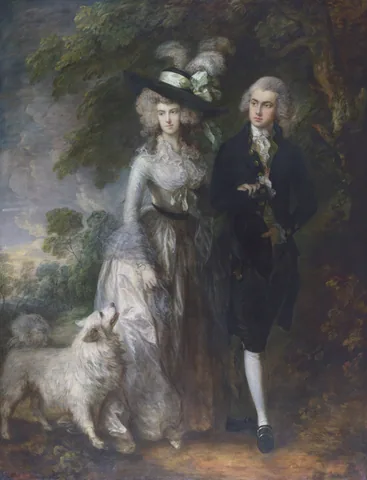
More in Landscapes and Old Masters.
Sources
More from the Journal
 Story · 7 min
Van Gogh’s Starry Night: the facts, and choosing a print
Painted in June 1889 at an asylum in Provence: the view from his window, plus a village he made up. What is real, what it means, and which print to choose. Story · 7 min
The Great Wave off Kanagawa: meaning, history and prints
A woodblock print, not a painting, and a storm wave, not a tsunami. What it shows, why no two impressions match, and how to choose a print. Story · 7 min
Klimt’s The Kiss: gold leaf, meaning and choosing a print
Real gold leaf on canvas, finished in 1909. The story of Klimt’s lovers, what a print can and can’t reproduce, and which size to choose. Story · 7 min