
Story
Pillars of Creation: the story of Hubble’s famous image
Towers of gas and dust in the Eagle Nebula where new stars are born. What the Pillars of Creation are, how the image was made, and a print.
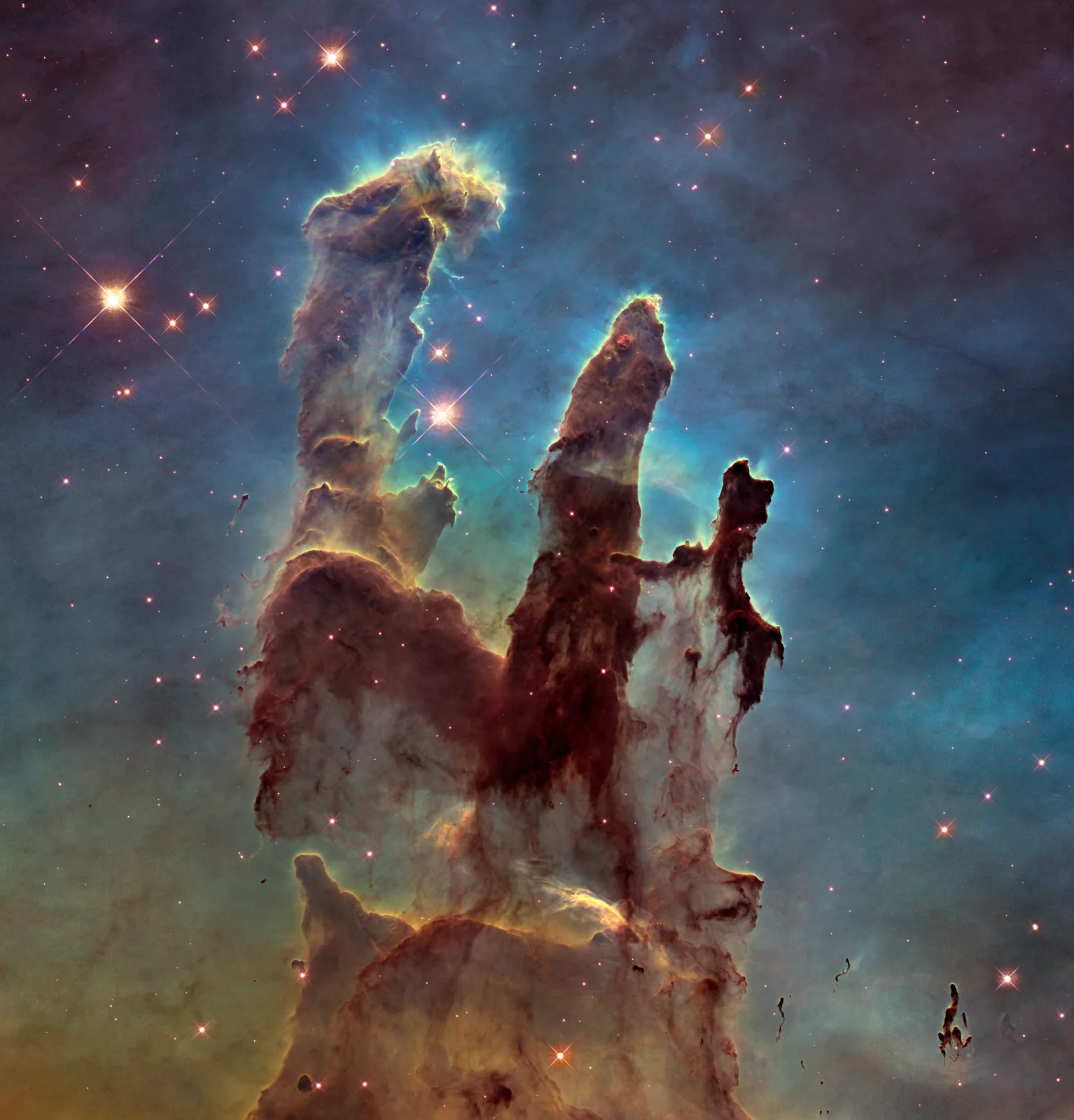
Three dark towers rise through a glowing cloud. Their edges are lit and ragged, their tips seem to smoke, and stars glitter all around them. They look like rock formations, or like something carved, but they are made of cold gas and dust, and the longest of them is about four light-years tall. These are the Pillars of Creation, in the Eagle Nebula, about 7,000 light-years from Earth. The Hubble Space Telescope first photographed them in 1995, and the picture became the most famous image Hubble ever made.
What are the Pillars of Creation?
The Eagle Nebula, also known as Messier 16 or M16, is a vast cloud of gas and dust in the constellation Serpens, where new stars are forming. Astronomers call structures like the pillars elephant trunks. They are columns of cool molecular hydrogen and dust, dense enough to survive for a while in a place where most of the cloud has already been blown away.
What blows it away is light. Nearby there are massive, very hot young stars, and their intense ultraviolet radiation slowly boils the gas off the surface of the pillars, a process called photoevaporation. Strong winds from those stars erode them too. The pillars are what is left: the densest parts of the cloud, standing like sandcastles as the tide wears them down. The glowing, wispy edges you see in the picture are material streaming off them.
And inside them, stars are being born. The gas and dust in the pillars is still collapsing into new stars, and some of them are emerging from small knots at the surface that astronomers call evaporating gaseous globules, or EGGs. That is the creation in the name.
Where the name comes from
The phrase is older than the photograph by well over a century. It comes from a sermon by the English preacher Charles Spurgeon, The Condescension of Christ, given in 1857. The astronomers borrowed it, and it stuck.
The pillars themselves were known long before Hubble. The astronomer John Charles Duncan first recorded them in 1920, on a photographic plate taken with the 60-inch telescope at Mount Wilson Observatory in California. But no one had seen them like this.
The 1995 photograph
On April 1, 1995, Jeff Hester and Paul Scowen of Arizona State University used Hubble’s Wide Field and Planetary Camera 2 to photograph the pillars. The final image was stitched together from 32 separate pictures taken through the camera’s four sensors. The colors were assigned to the light of different elements: green for hydrogen, red for sulfur and blue for oxygen. The result looked like nothing anyone had seen before, and it became Hubble’s defining image. Space.com has ranked it among the top ten Hubble photographs.
The 2015 view
The picture we print is a newer one. In 2014 Hubble went back to the pillars with its Wide Field Camera 3, and the new image was released on January 5, 2015. ESA/Hubble describes it as capturing the multicolored glow of gas clouds and wispy tendrils of dark cosmic dust. It was made through three filters, each picking out the light of a particular element: oxygen, hydrogen and sulfur. The new camera gave better contrast and a clearer view, and it lets astronomers compare the two images to see how the pillars are changing over time.
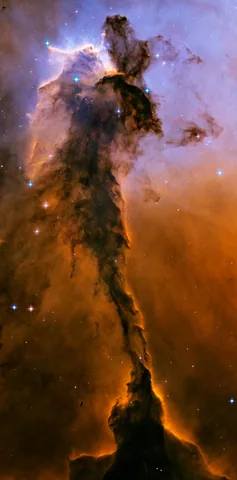
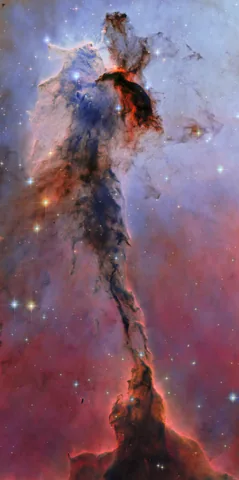
The pillars have since been photographed in infrared, which sees through the dust. The James Webb Space Telescope imaged them in October 2022 with its near-infrared camera, NIRCam, and the shop has that image too, as Pillars of Creation (NIRCam and MIRI). Hubble also made a famous close-up of another tower in the same nebula, the Stellar Spire, released in 2005.
Reading the picture
Start with the tallest tower, on the left. It is the one that measures about four light-years from base to tip, so the light that crosses it takes four years to get from one end to the other. Then look at the tips of the pillars. ESA/Hubble notes their rust color, and the glowing fringe around them is the surface being burned away by starlight. The thin, bright streamers that trail off the edges are gas being blown off into space. The dark parts are not empty: they are dust thick enough to block the light behind it, and somewhere inside, new stars are taking shape where we cannot see them.
The image covers a patch of sky only about four and a half arcminutes across, a tiny sliver of the night sky, yet it holds a region several light-years wide. The colors are not what your eye would see through a telescope. Each filter records the light of one kind of gas, and the three are combined into a single picture, so the colors work like a map of what the cloud is made of.
Seen in other light
Since 1995 the pillars have been photographed again and again, each time with a different kind of light. The Herschel Space Observatory looked at them in far-infrared light around 2010, which shows the cold dust itself. Hubble returned in 2014. Webb made its near-infrared view in 2022, which sees through much of the dust to the stars inside. In June 2024 NASA released a 3D visualization of the pillars that combines Webb and Hubble data. Each new view adds something, but the visible-light Hubble pictures remain the ones most people know.
Are the pillars still there?
Possibly not. Observations with the Spitzer Space Telescope suggested that a supernova shock wave may have destroyed the pillars about 6,000 years ago. The nebula is about 7,000 light-years away, so if that is true we would not see the destruction for about another thousand years. Other astronomers disagree, arguing that the winds of massive stars could explain the same observations with a slower erosion. Either way, the picture shows the pillars as they were when the light left them, 7,000 years ago.
Choosing a print
Size. This is a big file, 7,071 pixels on its long side, and it is almost square, a little taller than it is wide. It prints sharply up to 29 × 30 in framed, or 38 × 40 in on canvas. Framed prints go up to 29 × 30 in, canvas up to 38 × 40 in and unframed art prints up to 38 × 40 in. At a large size it fills a wall the way the original fills the telescope’s view. At 23 × 24 in it suits a desk wall or a bedroom.
Paper or canvas. The deep blacks and fine glowing edges are sharpest on smooth paper behind glazing. Canvas has no glass to reflect light, which helps in a bright room. See our papers and canvas.
Frames and rooms. A thin black frame keeps it modern and lets the image do the work. It suits an office, a study, a teenager’s room or anywhere a science lover will see it. See our frames.
Pairing. Hung side by side, the Hubble and Webb versions of the pillars show the same place in visible and infrared light, a good pair for anyone curious about how telescopes see.
Questions
What are the Pillars of Creation?
Towers of cool gas and dust in the Eagle Nebula, about 7,000 light-years away, where new stars are forming. The longest is about four light-years tall.
Who took the photo?
The Hubble Space Telescope. The famous 1995 image was made by Jeff Hester and Paul Scowen; this 2015 version was released by NASA, ESA and the Hubble Heritage Team.
Are the colors real?
Each color shows the light of a particular element, oxygen, hydrogen or sulfur, photographed through a separate filter.
Are the pillars still there?
Some astronomers think a supernova may already have destroyed them, but that its effects will not be visible from Earth for about a thousand years. Others disagree.
Can it be printed legally?
Yes. ESA/Hubble releases this image under a CC BY 4.0 license, which allows reuse with credit. The credit line is NASA, ESA/Hubble and the Hubble Heritage Team.
More nebulae
All space prints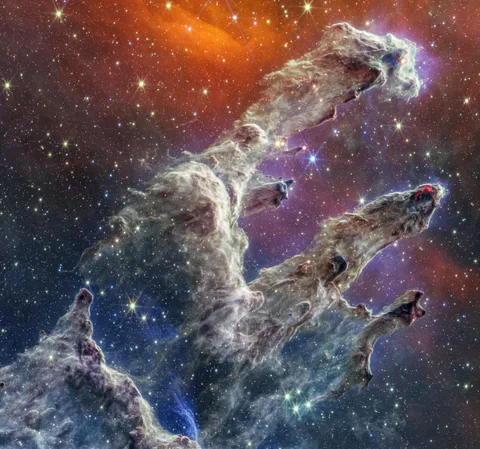
Sources
More from the Journal
 Story · 7 min
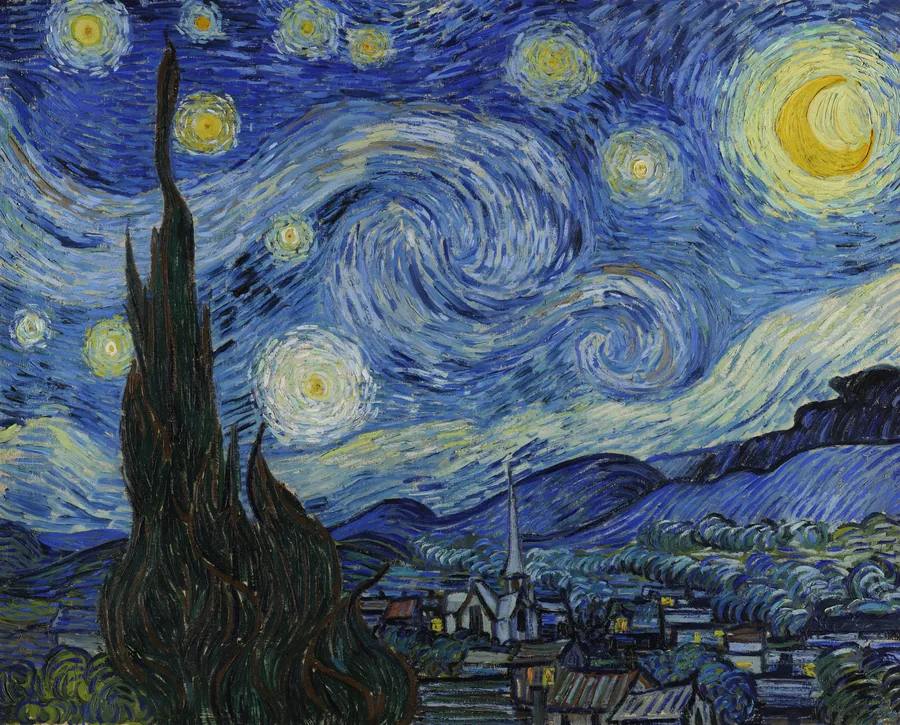
Van Gogh’s Starry Night: the facts, and choosing a print
Painted in June 1889 at an asylum in Provence: the view from his window, plus a village he made up. What is real, what it means, and which print to choose.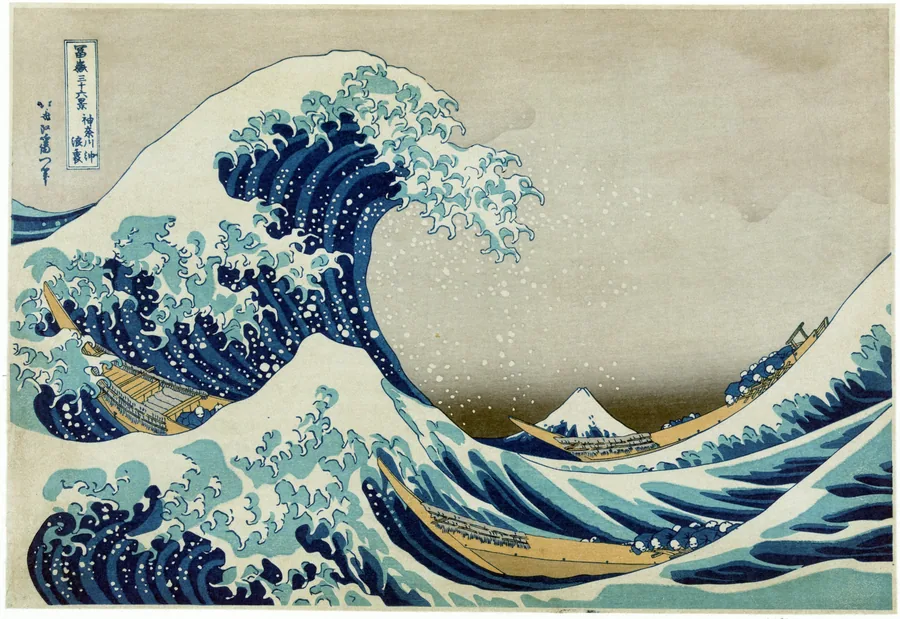 Story · 7 min
The Great Wave off Kanagawa: meaning, history and prints
A woodblock print, not a painting, and a storm wave, not a tsunami. What it shows, why no two impressions match, and how to choose a print. Story · 7 min
Klimt’s The Kiss: gold leaf, meaning and choosing a print
Real gold leaf on canvas, finished in 1909. The story of Klimt’s lovers, what a print can and can’t reproduce, and which size to choose. Story · 7 min