
Story
Manet’s The Balcony: who they are, and a print
Berthe Morisot, a violinist and a painter on a green balcony, mocked at the 1869 Salon. Who is who in Manet’s Balcony, and choosing a print.
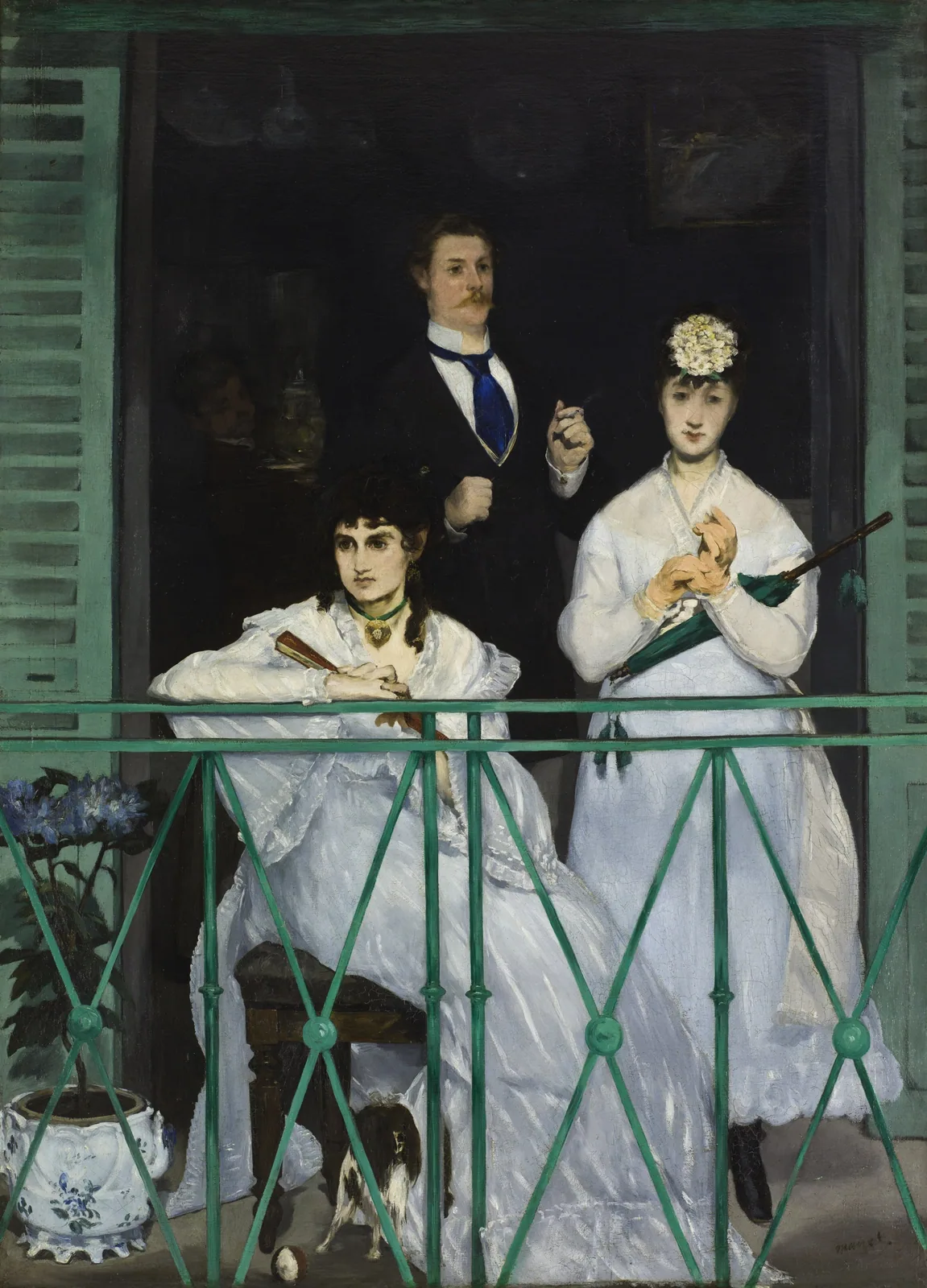
Three people stand on a balcony behind a bright green railing, framed by green shutters. Two women in white, a man in a dark suit, and behind them a dim room. Nobody looks at anyone else, and nobody seems to be doing anything. Édouard Manet painted it in 1868 and 1869, and when it was shown in Paris, critics did not know what to make of it.
Who are the people on the balcony?
All of them were people from Manet’s circle:
- Berthe Morisot, seated on the left, with a fan. She was a painter herself.
- Antoine Guillemet, a painter, standing in the middle.
- Fanny Claus, a violinist, standing on the right, pulling on her gloves.
- Léon Leenhoff, probably, the half-hidden figure in the shadows of the room behind. He was possibly Manet’s son.
A little dog plays with a ball under Morisot’s chair, and a blue hydrangea stands in a ceramic pot behind the railings.
Inspired by Goya
Manet took the idea from Francisco Goya’s Majas on a Balcony. But where Goya’s picture hints at a story, Manet’s refuses to tell one. His three figures are like strangers posing for a photograph, each lost in their own thoughts. That coolness is exactly what made the picture modern.
He painted it at the same time as another big picture, Luncheon in the Studio, and for the same purpose: to show at the Salon.
Mocked at the Salon of 1869
The critics were not kind. The press called the picture discordant. The critic Albert Wolff called it coarse art, at the level of house painters. The bright green of the railing and shutters particularly bothered people; the caricaturist Cham drew a cartoon sarcastically calling for “the shutters to be closed.”
Berthe Morisot, seeing herself in it, summed up her own portrait in a line that has become famous: “Je suis plus étrange que laide,” I look more peculiar than ugly.
Where is The Balcony now?
In the Musée d’Orsay in Paris. The painter and collector Gustave Caillebotte bought it in 1884 and left it to the French state in 1894, and it moved to the Orsay in 1986. It is big, about 67 by 49 inches.
Look closer
These details come from the scan we print from, 8,066 pixels on the long side. Pick a detail, or zoom in and drag to look around.
The painter Berthe Morisot, seated at the rail with a fan, dark eyes looking past us.
Choosing a print
Tall and bold. Our largest framed print is 26 × 36 in, and unframed art prints go to 35 × 48 in. Framed prints go up to 26 × 36 in, canvas up to 35 × 48 in and unframed art prints up to 35 × 48 in. The tall shape and the strong green make it a striking picture for a narrow wall, an entryway or beside a door, like a window of its own.
Where it works. A hallway, a living room or a modern apartment: the green, white and black are graphic and fresh. At 17 × 24 in it fits beside a bookcase.
Which material. The room behind the figures is very dark. Behind clear acrylic, dark areas reflect a facing window, so hang a framed print with side light, or choose canvas, with its matte finish and no cover. See our papers and canvas.
Frames. Black wood echoes the dark room and the man’s suit; a white frame picks up the dresses. See all our frames.
Berthe Morisot, again. Pair this with Berthe Morisot with a Bouquet of Violets. Open the two as a set.
Questions
Who is in Manet’s The Balcony?
Berthe Morisot (seated), Antoine Guillemet (center), Fanny Claus (right) and, in the shadows, probably Léon Leenhoff.
What inspired it?
Goya’s Majas on a Balcony.
Why was it criticized?
At the 1869 Salon critics called it discordant and coarse, and mocked the bright green shutters and railing.
Where is it?
In the Musée d’Orsay in Paris. It is 170 × 124 cm, about 67 × 49 in.
Can it be printed legally?
Yes. Manet died in 1883, and the painting is in the public domain. What public domain means.
More Manet
All Manet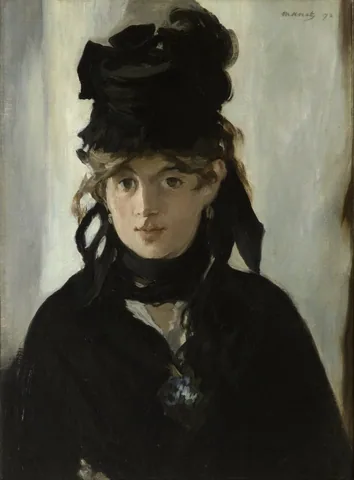
More in Impressionists and Interiors and Portraits.
Sources
More from the Journal
 Story · 7 min
Van Gogh’s Starry Night: the facts, and choosing a print
Painted in June 1889 at an asylum in Provence: the view from his window, plus a village he made up. What is real, what it means, and which print to choose. Story · 7 min
The Great Wave off Kanagawa: meaning, history and prints
A woodblock print, not a painting, and a storm wave, not a tsunami. What it shows, why no two impressions match, and how to choose a print. Story · 7 min
Klimt’s The Kiss: gold leaf, meaning and choosing a print
Real gold leaf on canvas, finished in 1909. The story of Klimt’s lovers, what a print can and can’t reproduce, and which size to choose. Story · 7 min