
Story
Monet’s Haystacks, End of Summer: the series
Two stacks of grain in a field at Giverny, one of 25 canvases Monet painted as the light changed. The story of the series, and choosing a print.
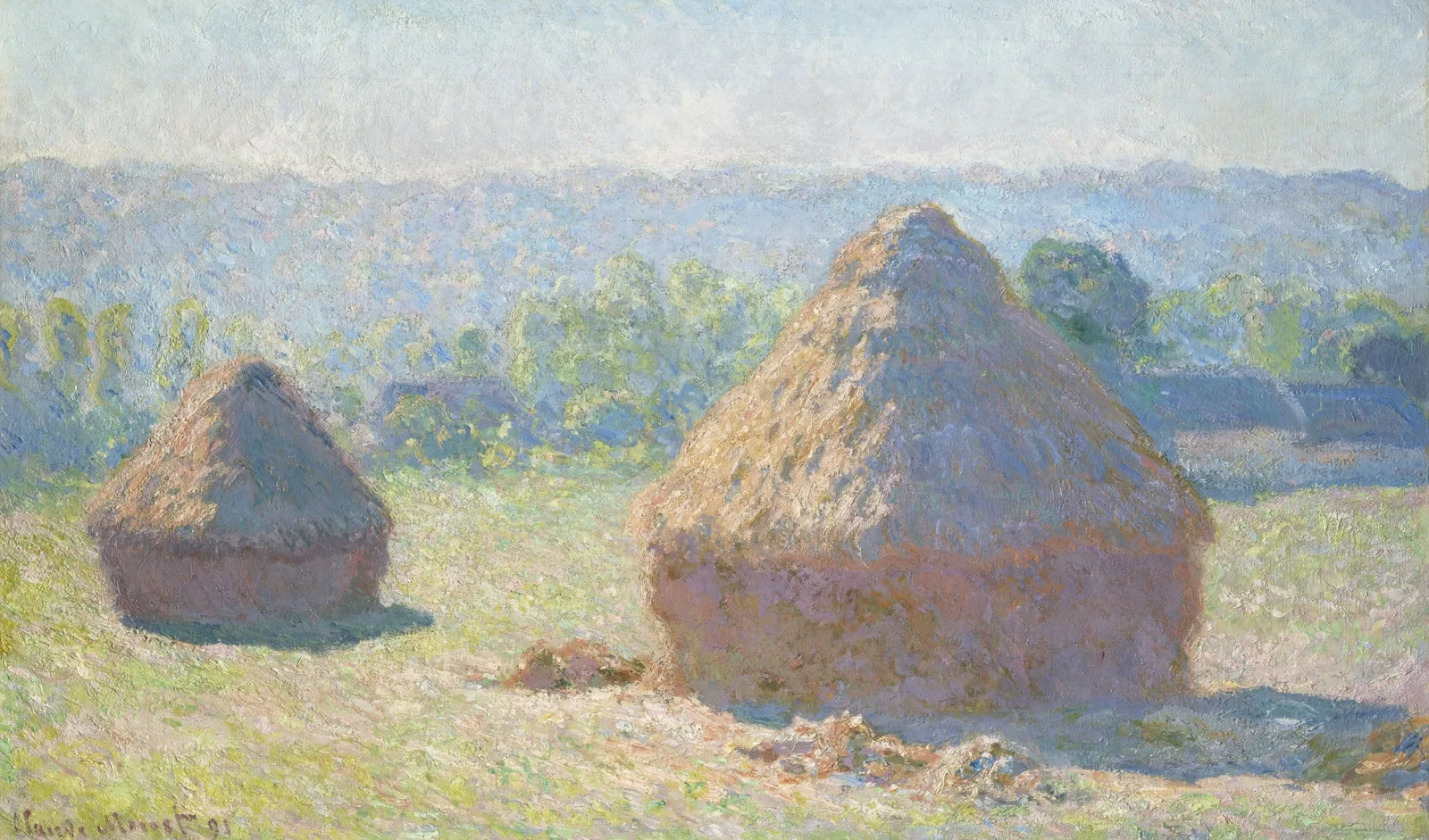
Two great stacks of grain stand in a field of stubble on a hazy summer day. The big one glows orange and pink where the sun hits it, and its shadow is blue. Behind, trees and hills fade into the warm air. Claude Monet painted it near his home at Giverny, and it belongs to a celebrated series: 25 canvases of the same stacks in different light.
Why paint the same haystack 25 times?
The stacks were not hay but harvested grain, wheat or perhaps barley or oats, piled 10 to 20 feet high to dry until threshing. They belonged to Monet’s neighbor, a farmer named Quéruel. Monet began painting them near the end of the summer of 1890 and kept going through the following spring.
His real subject was light. The story goes that he asked his stepdaughter Blanche Hoschedé to bring two canvases, one for sun and one for cloud, and soon found he needed many more, because the light changed so quickly. He worked on whichever canvas matched the moment, on some days as many as ten or twelve, then finished them in the studio. Some effects lasted only a few minutes.
A sell-out show
In May 1891 the dealer Paul Durand-Ruel showed fifteen of them, and most sold within a month. The painter Camille Pissarro wrote, “These canvases breathe contentment.” Monet’s prices rose so steeply that he was able to buy his house and land at Giverny and begin the water lily pond.
Wassily Kandinsky wrote about the series in his memoirs, and of “the unsuspected power of the palette.” In 2019 another canvas from the series sold for $110.7 million, then a record for a Monet.
Where is Haystacks, End of Summer?
In the Musée d’Orsay in Paris, which bought it in 1975 with an anonymous Canadian donation. Other paintings in the series are in Chicago, Boston, New York, Tokyo, London and elsewhere; the Art Institute of Chicago alone has six.
Look closer
These details come from the scan we print from, 7,424 pixels on the long side. Pick a detail, or zoom in and drag to see the colors in the straw.
The top of the big stack catching the sun in strokes of orange, pink and gold.
Choosing a print
Life size, or larger. The canvas is about 23½ by 39½ inches. Our 40 × 24 in framed print is about life size. Framed prints go up to 40 × 24 in, canvas up to 48 × 28 in and unframed art prints up to 48 × 28 in.
Where it works. The long, calm shape is made for the wall over a sofa or a bed, or a farmhouse kitchen. At 30 × 18 in it fits over a dresser. See what size art over a sofa.
Which material. Canvas, with its matte finish and no cover, suits Monet’s thick, broken strokes; smooth cotton paper in a frame keeps the soft colors clear. See canvas and our papers.
Frames. White wood keeps it light and airy; Gold Plein Air warms the straw. See all our frames.
Summer and winter. Pair it with Haystacks, Snow Effect from the same series. Open the two as a set.
Questions
How many Haystacks did Monet paint?
The main series is 25 canvases from 1890 to 1891, plus five earlier stack paintings from 1888.
Are they really haystacks?
They are stacks of harvested grain, probably wheat, left to dry until threshing. The French title means simply “stacks.”
Where is Haystacks, End of Summer?
In the Musée d’Orsay in Paris, since 1975.
How big is it?
60 × 100 cm, about 23½ × 39½ in.
Can it be printed legally?
Yes. Monet died in 1926, and his paintings are in the public domain. What public domain means.
More Monet and harvests
All Monet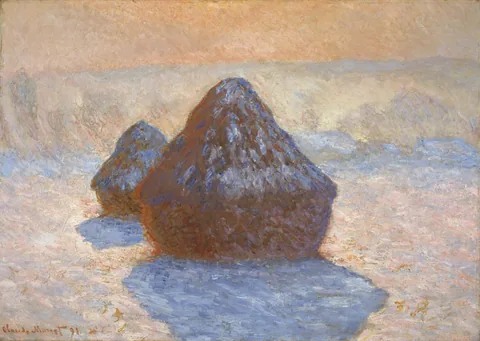
More in Impressionists and Landscapes.
Sources
More from the Journal
 Story · 7 min
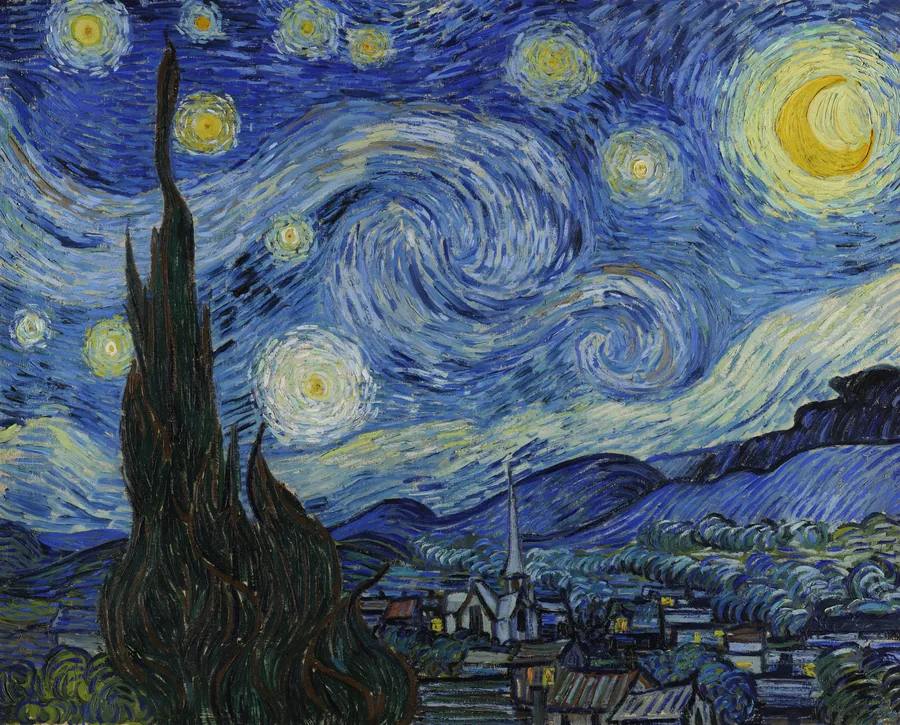
Van Gogh’s Starry Night: the facts, and choosing a print
Painted in June 1889 at an asylum in Provence: the view from his window, plus a village he made up. What is real, what it means, and which print to choose. Story · 7 min
The Great Wave off Kanagawa: meaning, history and prints
A woodblock print, not a painting, and a storm wave, not a tsunami. What it shows, why no two impressions match, and how to choose a print. Story · 7 min
Klimt’s The Kiss: gold leaf, meaning and choosing a print
Real gold leaf on canvas, finished in 1909. The story of Klimt’s lovers, what a print can and can’t reproduce, and which size to choose. Story · 7 min