
Story
The Night Watch: Rembrandt’s story and choosing a print
Not a night scene at all. Who is in Rembrandt’s Night Watch, why the girl carries a chicken, how it was cut down in 1715, and choosing a print.
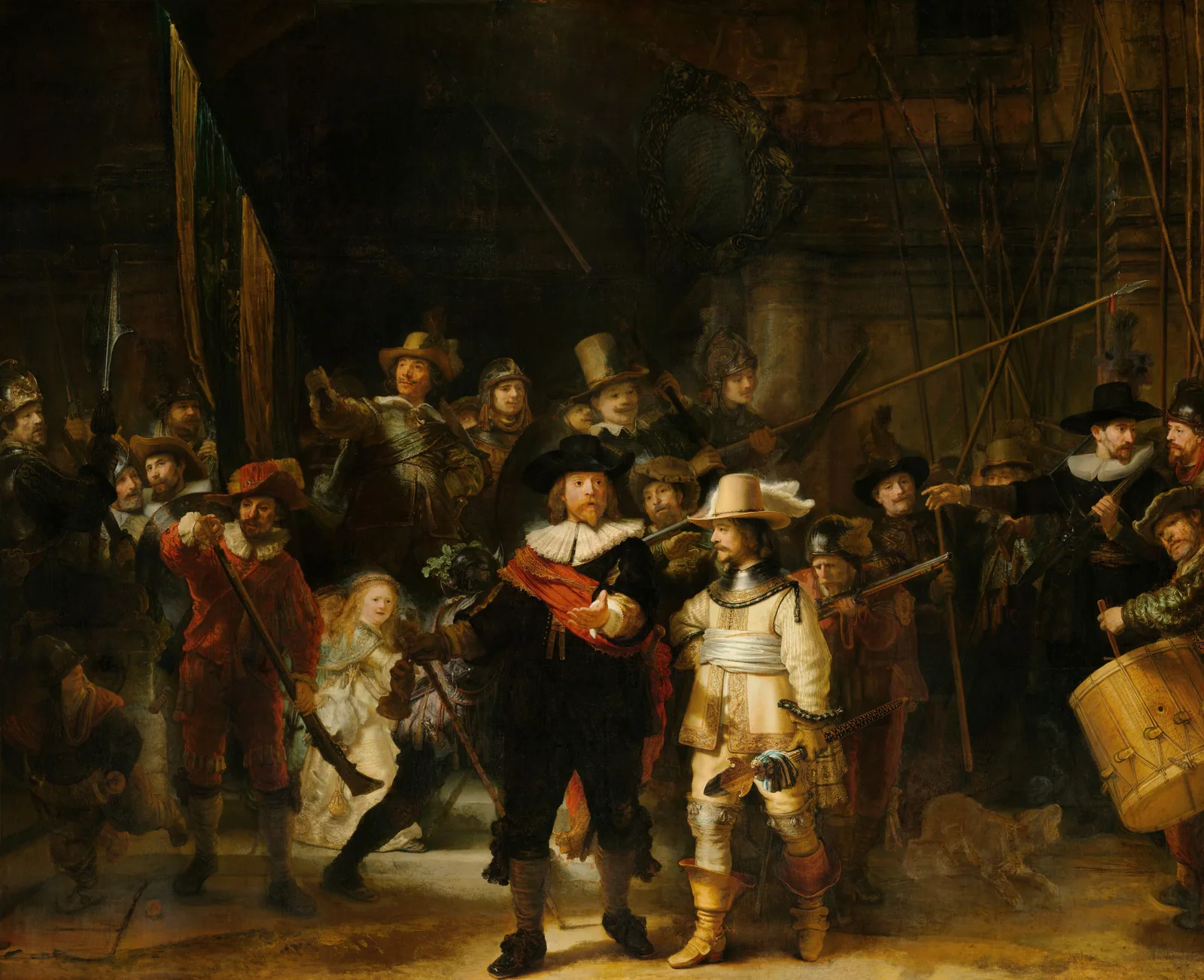
A captain in black takes a step toward you, his hand out, talking to the lieutenant beside him. Behind them a company of Amsterdam citizen soldiers is coming to life: a man loads his musket, a drummer beats a roll, a banner goes up, a dog barks. Rembrandt finished it in 1642, and it is one of the most famous paintings in the world. It is also not a night scene, and the soldiers were not keeping watch.
Why is it called The Night Watch?
The picture is set in daylight. For centuries it was covered in layers of varnish that darkened and trapped dirt, and by the early 1700s it looked so dark that people took it for a scene at night. The nickname stuck. The varnish was only taken off in the 1940s, and the painting has been lighter ever since, though the name never changed.
Its real title is a mouthful: Militia Company of District II under the Command of Captain Frans Banninck Cocq. Early on it was known as the company of Frans Banninck Cocq and Willem van Ruytenburch, the two officers in front.
Who is in the painting?
The men are members of one of Amsterdam’s civic militias, companies of armed citizens. Around 1639 the captain, Frans Banninck Cocq, and seventeen of his men commissioned a group portrait for the great hall of their headquarters, the Kloveniersdoelen. Rembrandt was paid 1,600 guilders, about a hundred from each man who appears.
Rembrandt did not line them up for a formal group portrait. He painted the company in motion, as if the captain has just given the order to march, and used light to pick out a few figures and let the rest fall into shadow. Banninck Cocq is in black with a red sash; his lieutenant, Willem van Ruytenburch, is in bright yellow with a white sash. Near them three men show the steps of handling a musket: one loads it, one fires, and one blows the leftover powder away.
The girl with the chicken
The brightest figure after the officers is a small girl in gold, with flowing fair hair. A dead chicken hangs from her belt, claws showing. The claws are a clue. A golden claw was the emblem of the kloveniers, the musketeers, so the girl is less a real child than a living badge of the company, something like a mascot.
Cut down to fit, in 1715
In 1715 the painting was moved to Amsterdam’s Town Hall. To make it fit its new place, most likely between two columns, it was trimmed on all four sides. The left side lost the most, including two figures; the top lost part of the arch, and the bottom lost the edge of the step and a balustrade. We know what was there because a smaller copy, painted in the 1600s by Gerrit Lundens, shows the whole scene. The oval shield over the arch, with eighteen names, was also added around then. There are eighteen names because a drummer, hired for the occasion, was put into the picture for free.
Attacks, and a war in a cave
The painting has been attacked three times. In 1911 a man tried to cut it with a shoemaker’s knife, but the thick varnish saved it. In 1975 a man slashed it with a bread knife, leaving cuts up to 30 cm long, and the repair took four years. In 1990 someone sprayed it with acid, which only reached the varnish. During the Second World War it was taken out of its frame in 1939, rolled around a cylinder and stored for years in caves near Maastricht.
Where is The Night Watch now?
In the Rijksmuseum in Amsterdam, on long-term loan from the Amsterdam Museum. Since July 2019 it has been at the center of Operation Night Watch, a study and restoration carried out inside a glass room in the gallery so visitors can watch. In 2020 the museum published a 44.8-gigapixel photograph made from 528 shots. In 2021 it hung computer-made versions of the missing strips beside the painting for a few months, rebuilt from the Lundens copy. The restorers are now removing old varnish, in public.
Look closer
These details come from the scan we print from, 14,168 pixels on the long side. The painting is twelve feet tall, so even a large print shrinks it: these views show what a small one hides. Pick a detail, or zoom in and drag to look around.
Frans Banninck Cocq in black, with a white lace collar and a red sash, his hand reaching out toward you.
Choosing a print
Go as big as the wall allows. The original is about 12 by 14 feet, and the drama comes from life-size figures stepping toward you. No print gets close, so the bigger the better. Our largest framed print is 36 × 29 in, and an unframed art print goes to 48 × 39 in. Framed prints go up to 36 × 29 in, canvas up to 40 × 33 in and unframed art prints up to 48 × 39 in.
Smaller sizes. At 24 × 20 in the captain and the girl still read clearly; the crowd in the dark becomes texture. It is a good size for a study or a dining room, where people sit and have time to look.
Mind the light. Most of the picture is dark brown and black. Behind clear acrylic, a dark picture facing a window turns into a mirror, so hang a framed one on a wall that does not face the light, or choose canvas, which has no cover and a matte finish. Smooth cotton paper holds the most detail in the shadows. See our papers and canvas.
Frames. A gold frame is the classic choice for a Dutch painting of the 1600s and picks up the yellow of the lieutenant’s coat; a wide one like our Gold Plein Air gives a big print real presence. Black wood keeps it plainer. See all our frames.
Questions
Is The Night Watch set at night?
No. It is a daytime scene that looked like night under darkened, dirty varnish, which gave it its nickname.
Who is in The Night Watch?
Captain Frans Banninck Cocq, Lieutenant Willem van Ruytenburch and members of their Amsterdam civic militia company, with a drummer and a girl who stands for the company’s emblem.
Why does the girl carry a chicken?
Its claws refer to the golden claw, the emblem of the musketeers’ guild the company belonged to.
Where is The Night Watch?
In the Rijksmuseum in Amsterdam, where a long restoration is going on in a glass room in front of visitors.
How big is The Night Watch?
363 × 437 cm, about 12 × 14 ft, after it was trimmed in 1715.
Can it be printed legally?
Yes. It was painted in 1642 and is in the public domain. What public domain means.
More Rembrandt
All Rembrandt
More in Dutch and Flemish Masters and Old Masters.
Sources
More from the Journal
 Story · 7 min
Van Gogh’s Starry Night: the facts, and choosing a print
Painted in June 1889 at an asylum in Provence: the view from his window, plus a village he made up. What is real, what it means, and which print to choose.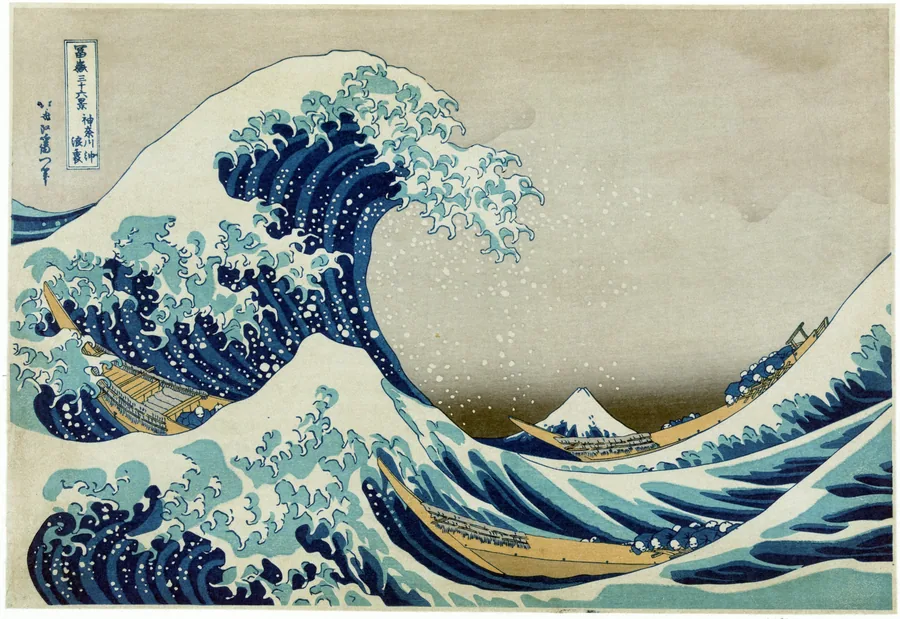 Story · 7 min
The Great Wave off Kanagawa: meaning, history and prints
A woodblock print, not a painting, and a storm wave, not a tsunami. What it shows, why no two impressions match, and how to choose a print.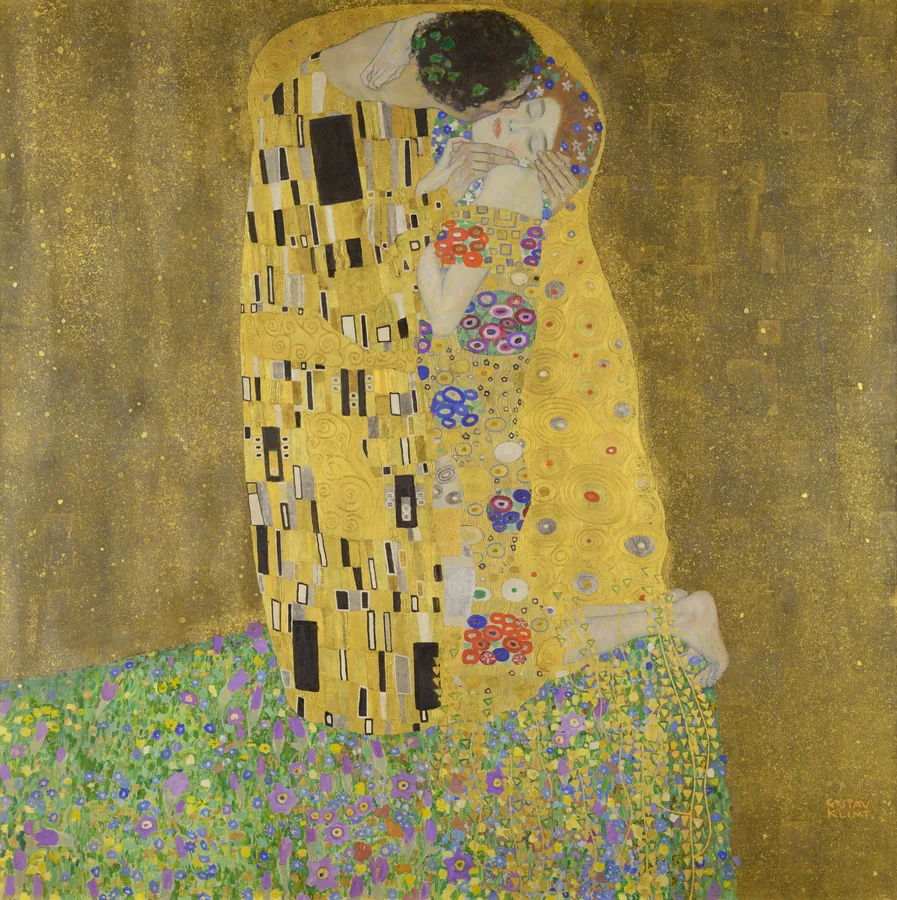 Story · 7 min
Klimt’s The Kiss: gold leaf, meaning and choosing a print
Real gold leaf on canvas, finished in 1909. The story of Klimt’s lovers, what a print can and can’t reproduce, and which size to choose. Story · 7 min