
Story
Bal du moulin de la Galette: Renoir’s Sunday dance
A Sunday afternoon dance in Montmartre, painted on the spot with Renoir’s friends as the crowd. Who is who, the two versions, and choosing a print.
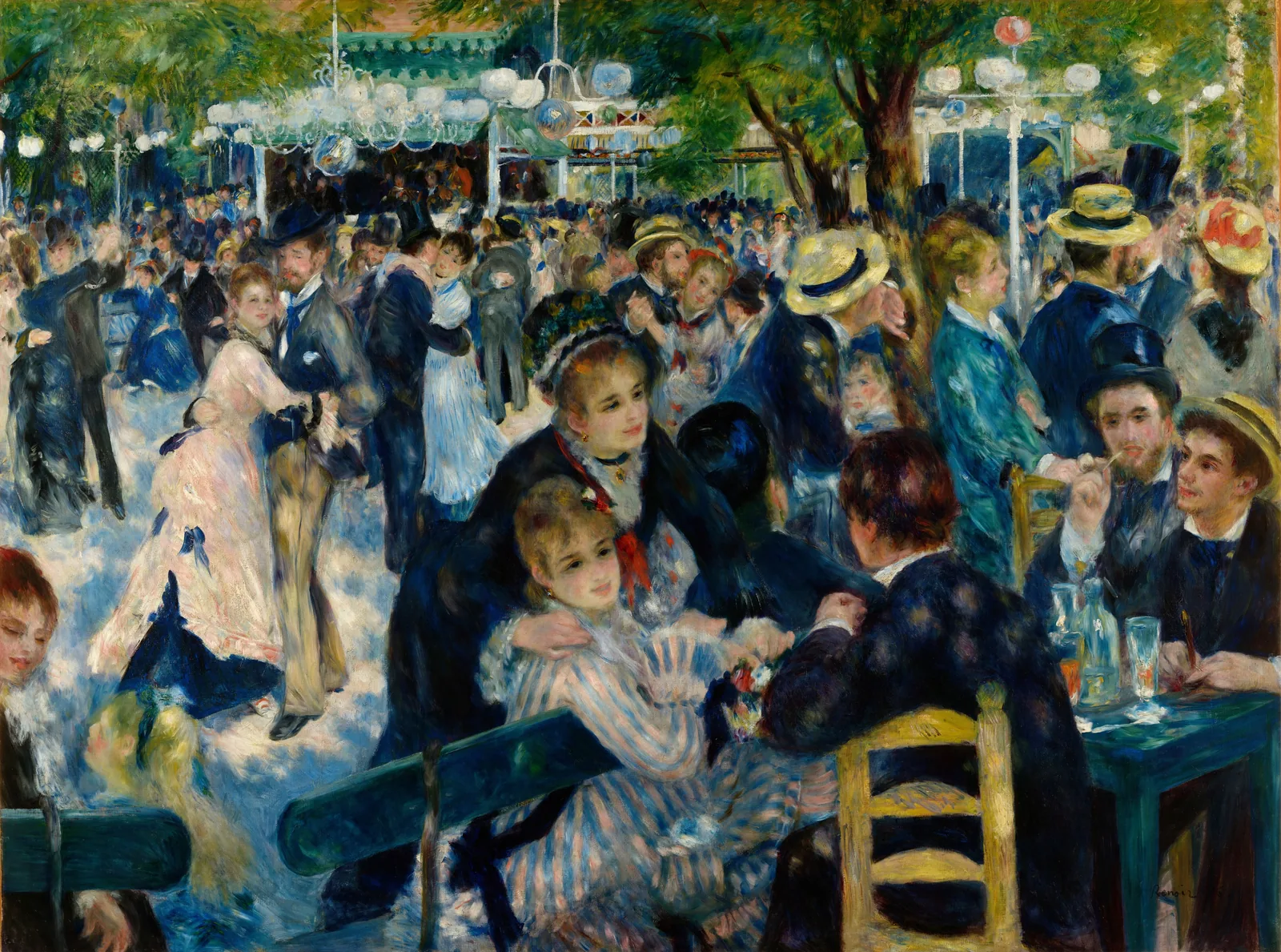
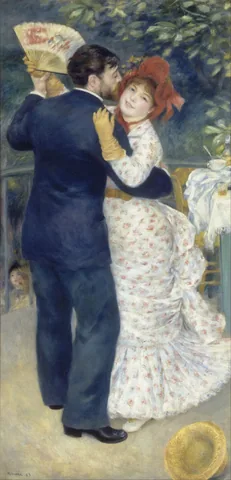
A Sunday afternoon in Montmartre. Couples dance in the shade of the trees, friends crowd round a table with glasses and cigarettes, a girl in a striped dress turns to listen, and sunlight falls through the leaves in bright patches on everyone. Pierre-Auguste Renoir painted it in 1876, and it is one of the happiest paintings ever made of a crowd.
What is the Moulin de la Galette?
The Moulin de la Galette was an open-air dance hall in Montmartre, on the hill in the north of Paris. A moulin is a windmill, and a galette a flat cake. On a Sunday afternoon people went there to dance, drink and eat galettes. Renoir painted it on just such an afternoon.
Painted on the spot
Renoir did not invent the scene in his studio. His friend Georges Rivière, who is in the picture, remembered that it was “executed on the spot and not without difficulty,” with the wind threatening to blow the big canvas away. That is part of why it feels so alive. Nothing is posed in rows; people are caught mid-turn, mid-step, mid-sentence.
The real subject is the light. Sun comes through the leaves and lands in pale patches on hats, jackets, the ground and the tabletop. Renoir paints those patches as dabs of pale pink, blue and yellow laid right over the darker colors, so the whole surface seems to flicker. Look at the dark jacket of the man with his back to us, at the center: it is speckled with light.
Who is in the painting?
Renoir filled the crowd with his friends, and Rivière later named many of them:
- Estelle, the sister of the actress Jeanne Samary, is the girl in the blue and pink striped dress on the bench. Jeanne herself did not pose.
- At the table on the right sit two painters, Pierre-Franc Lamy and Norbert Goeneutte, with Rivière himself.
- Among the dancers are the painter Henri Gervex, Eugène Pierre Lestringuez and Paul Lhote.
- On the left, Pedro Vidal de Solares y Cardenas, a Cuban painter, dances in striped trousers with Margot, Marguerite Legrand.
Margot’s story is the sad note in a bright picture. She died of typhoid two years later, and Renoir paid for her care and her funeral.
Two versions
Renoir painted the scene twice. The big one, about 52 by 69 inches, is the one in the Musée d’Orsay and the one we print. A smaller version, about 31 by 45 inches, is painted more loosely. On 17 May 1990 it sold at Sotheby’s in New York for $78 million to the Japanese businessman Ryoei Saito. It is now thought to be in a private collection in Switzerland, though no one says so for certain.
Which one Renoir showed in 1877, when critics gave it favorable attention, is not known: the catalog did not list sizes.
How it reached the museum
The big painting was bought by Gustave Caillebotte, a painter and a wealthy friend of the Impressionists, who owned it from 1879 until his death in 1894. It then passed to the French state, which took it as payment of death duties. It hung in the Louvre and moved to the new Musée d’Orsay in 1986, where it is now.
Look closer
These details come from the scan we print from, 40,869 pixels on the long side. Pick a detail, or zoom in and drag to look around: every face in the crowd is someone.
Estelle, in a dress of blue and pink stripes, on the bench in the middle. A friend leans over her shoulder.
Choosing a print
Go large. It is a crowd scene, nearly six feet wide in Paris, and the joy of it is in the faces. A small print turns them into specks, so this is a painting for a big wall: over a sofa, a dining table or a bed. Our largest framed print is 36 × 27 in, and canvas goes to 48 × 36 in. Framed prints go up to 36 × 27 in, canvas up to 48 × 36 in and unframed art prints up to 48 × 36 in. For the right width over furniture, see what size art over a sofa.
Smaller rooms. At 24 × 18 in it still reads as a lively crowd, and suits a dining nook or a hall. Hang it where people gather; it is a picture about company.
Which material. Canvas suits a painting this brushy and has no cover to reflect light, so it works in a sunny room. A framed print on smooth paper keeps every face crisp. See canvas and our papers.
Frames. A white frame keeps it fresh and summery; a gold frame picks up the straw hats and the sunlight. See all our frames.
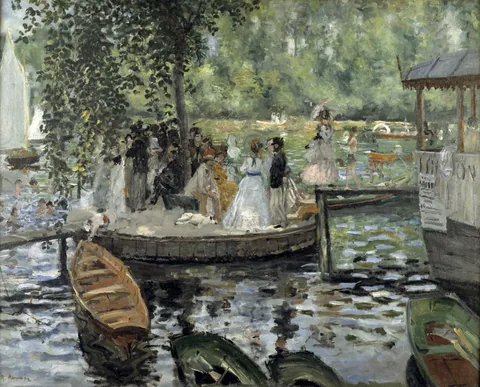
A pair. A few years later Renoir painted his friends again, at lunch on a terrace by the river, in Luncheon of the Boating Party. Open the two as a set.
Questions
What does Bal du moulin de la Galette mean?
“Dance at the Moulin de la Galette,” an open-air dance hall in Montmartre named after a windmill and the flat cakes, galettes, sold there.
Who are the people in the painting?
Mostly Renoir’s friends: Estelle in the striped dress, the painters Franc-Lamy, Goeneutte and Gervex, Renoir’s friend Georges Rivière, and Margot dancing with Pedro Vidal de Solares.
Where is the original?
In the Musée d’Orsay in Paris. A smaller version is in a private collection.
How big is it?
131 × 175 cm, about 52 × 69 in.
Can it be printed legally?
Yes. Renoir died in 1919, and his paintings are in the public domain. What public domain means.
More Renoir
All Renoir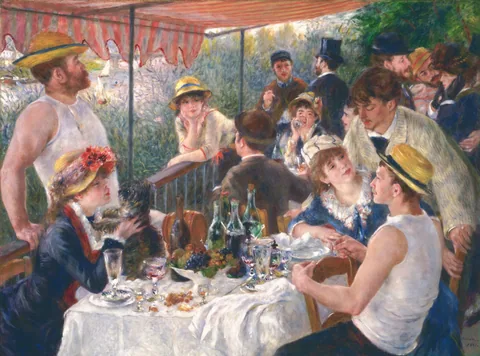
More in Impressionists and Cityscapes.
Sources
More from the Journal
 Story · 7 min
Van Gogh’s Starry Night: the facts, and choosing a print
Painted in June 1889 at an asylum in Provence: the view from his window, plus a village he made up. What is real, what it means, and which print to choose. Story · 7 min
The Great Wave off Kanagawa: meaning, history and prints
A woodblock print, not a painting, and a storm wave, not a tsunami. What it shows, why no two impressions match, and how to choose a print. Story · 7 min
Klimt’s The Kiss: gold leaf, meaning and choosing a print
Real gold leaf on canvas, finished in 1909. The story of Klimt’s lovers, what a print can and can’t reproduce, and which size to choose. Story · 7 min