
Story
Turner’s Rain, Steam and Speed: the story and a print
A steam train races at us through the rain on Brunel’s bridge. What Turner painted, the hare that vanished, and how to choose a print.
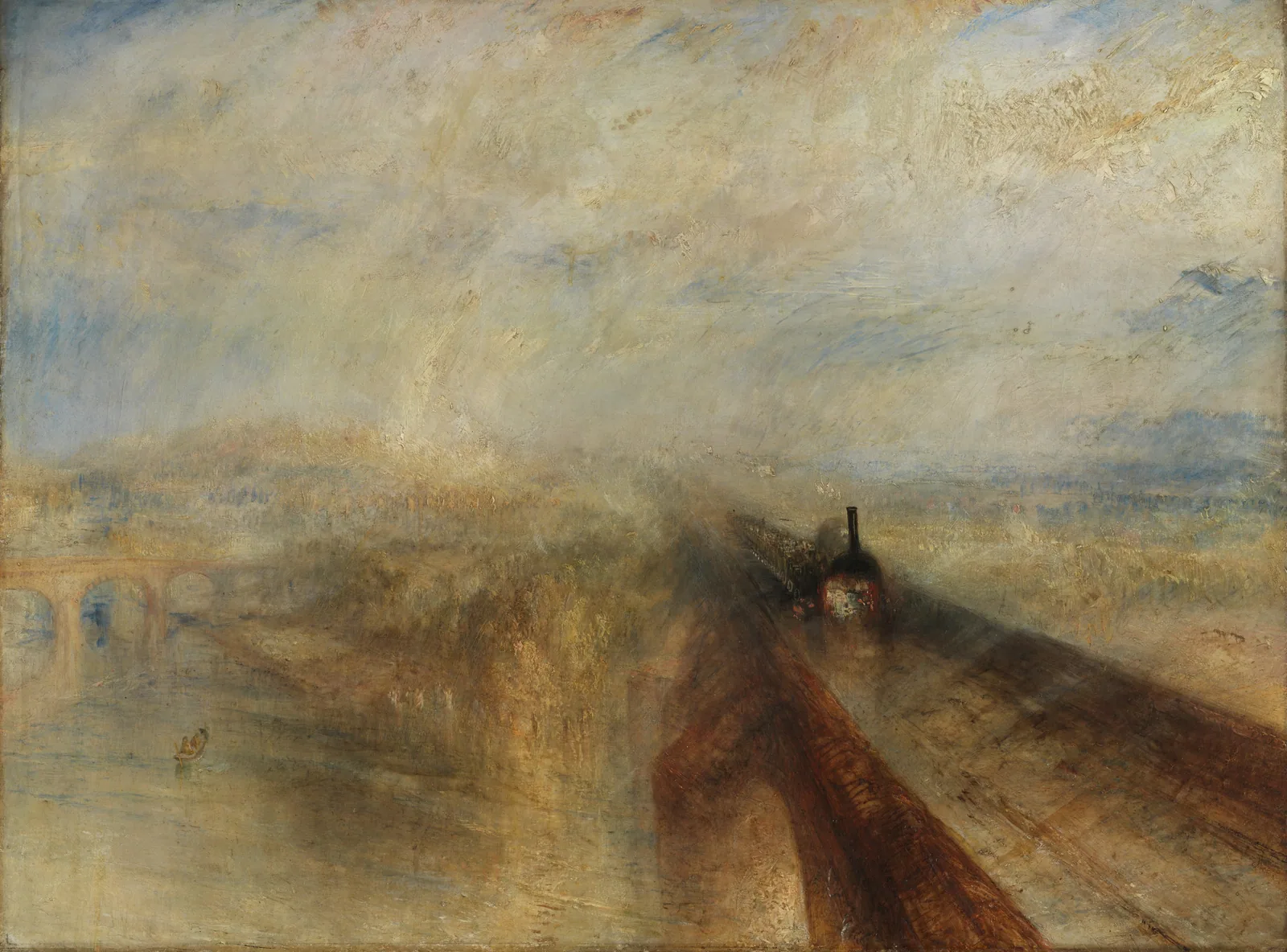
Out of a golden blur of rain and mist, a dark steam engine comes straight at you across a bridge. Everything else, river, fields, sky, dissolves around it. J.M.W. Turner painted it in 1844, when railways were new, and it is a painting about something brand new: modern speed.
Where is the bridge?
It is the Maidenhead Railway Bridge, the viaduct that carries the Great Western Railway over the Thames between Taplow and Maidenhead, west of London. It was designed by the engineer Isambard Kingdom Brunel, completed in 1838 and in use from July 1839. Turner’s viewpoint looks east toward London, and the train is heading west, toward us.
What is in the painting?
The train. The engine is a Firefly class locomotive, pulling open goods wagons in which the passengers on the cheapest fares could travel, exposed to the rain. Three small puffs of steam rise from the funnel.
The rain. It falls steadily but not so heavily that it hides the view. Turner paints rain, steam and light as one moving haze.
The speed. To make the train feel faster, Turner reduced the bridge’s double track to a single narrow line rushing out of the picture. In 1844 trains on the Great Western averaged 33 miles an hour, but on long, level stretches like this bridge they could reach 60, faster than any galloping horse.
The old world. A small boat drifts on the river on the left, and near the right edge, barely visible, a man drives a horse-drawn plough: the slow, old ways of moving, set against the new one.
The hare that disappeared
The best-known detail is one you can no longer see. Late in the work, Turner brushed a hare running along the track ahead of the train, lightly, over the paint that was already there. Over time that paint has become transparent, and the hare has vanished. We know it was there because it shows in an 1859 engraving of the picture by Robert Brandard. The painter George Leslie, who watched Turner put the final touches to the painting the day before it went on show, said that the hare, not the train, was meant to represent speed. Whether the hare is winning the race or about to be run down is up to you.
Where is Rain, Steam and Speed now?
In the National Gallery in London, in room 40. Turner first showed it at the Royal Academy in 1844, and it came to the nation in 1856 as part of the Turner Bequest, the paintings he left to the country.
Look closer
These details come from the scan we print from, 14,429 pixels on the long side. Pick a detail, or zoom in and drag to look around.
A dark locomotive coming straight at us out of the rain, its funnel black, its firebox glowing.
Choosing a print
Life size. The canvas is about 36 by 48 inches, and our largest framed print, 36 × 27 in, is a little smaller. Unframed art prints go up to 48 × 36 in, about life size. Framed prints go up to 36 × 27 in, canvas up to 48 × 36 in and unframed art prints up to 48 × 36 in.
Where it works. An office, a study or a living room: it is a picture about energy and modern life, and a classic gift for anyone who loves trains or engineering. At 24 × 18 in it fits over a desk. Its creams and golds sit easily with almost any wall.
Which material. The soft haze is the whole picture, and smooth matte paper in a frame keeps its gentle gradations. Canvas, with its matte finish and no cover, gives it a painted feel. See our papers and canvas.
Frames. Gold picks up the golden light; a white frame makes it look almost abstract and modern. See all our frames.
Steam on sea and land. Pair it with Turner’s Snow Storm, Steam-Boat off a Harbour’s Mouth. Open the two as a set.
Questions
Where is the bridge in Rain, Steam and Speed?
The Maidenhead Railway Bridge over the Thames, designed by Isambard Kingdom Brunel.
Is there a hare in the painting?
There was. Turner painted one running ahead of the train, but the paint has become transparent and it can no longer be seen.
Where is the painting?
In the National Gallery in London, part of the Turner Bequest of 1856.
How big is it?
91 × 121.8 cm, about 36 × 48 in.
Can it be printed legally?
Yes. Turner died in 1851, and the painting is in the public domain. What public domain means.
More Turner
All Turner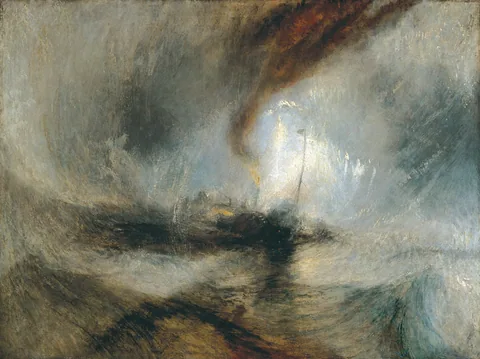
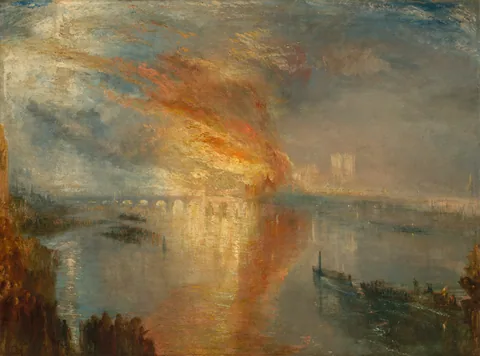
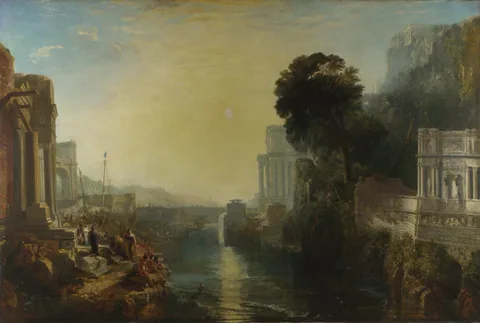
More in Moody Landscapes and Landscapes.
Sources
More from the Journal
 Story · 7 min
Van Gogh’s Starry Night: the facts, and choosing a print
Painted in June 1889 at an asylum in Provence: the view from his window, plus a village he made up. What is real, what it means, and which print to choose.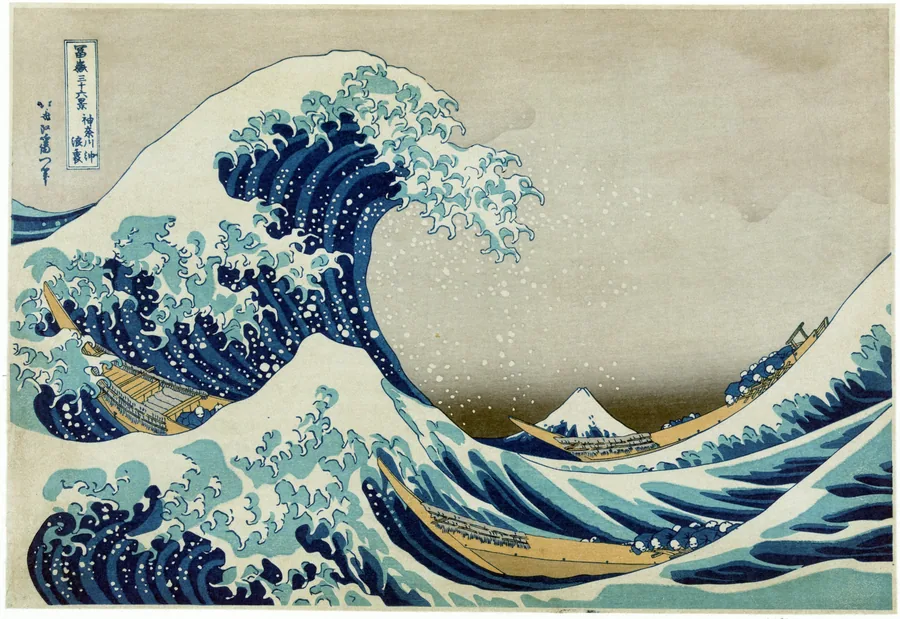 Story · 7 min
The Great Wave off Kanagawa: meaning, history and prints
A woodblock print, not a painting, and a storm wave, not a tsunami. What it shows, why no two impressions match, and how to choose a print. Story · 7 min
Klimt’s The Kiss: gold leaf, meaning and choosing a print
Real gold leaf on canvas, finished in 1909. The story of Klimt’s lovers, what a print can and can’t reproduce, and which size to choose. Story · 7 min