
Story
Van Gogh’s Agostina Segatori at the Café du Tambourin
The café owner Van Gogh fell for in Paris, a beer on two saucers and his Japanese prints on the wall. The story behind it, and choosing a print.
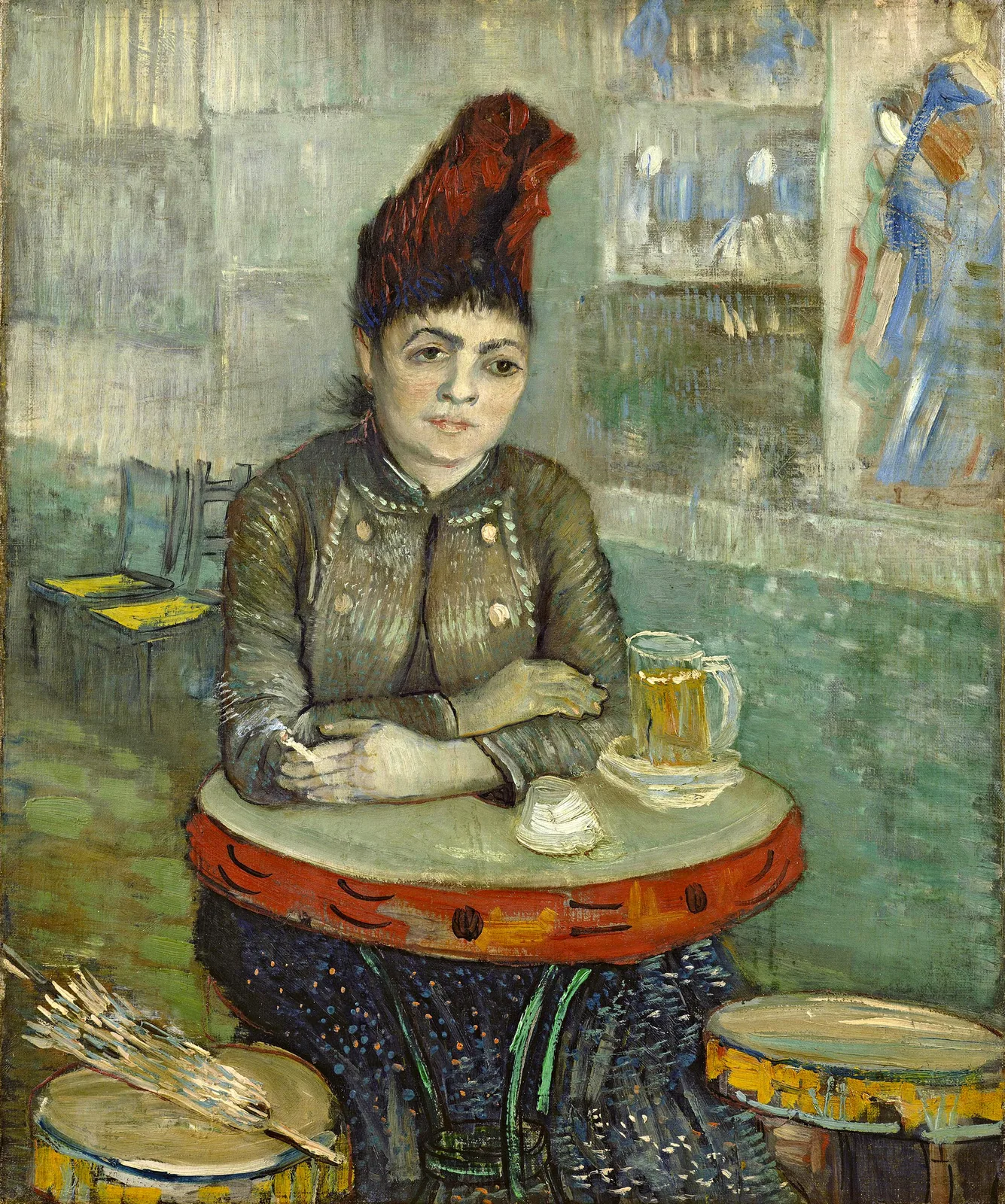
A woman in a tall red hat sits alone at a café table, a cigarette in her fingers and a glass of beer at her elbow. The table and the stools are shaped like tambourines. On the wall behind her hang Japanese prints. Vincent van Gogh painted her in Paris in 1887. She was Agostina Segatori, the owner of the café, and he was in love with her.
Who was Agostina Segatori?
Born in Naples, she worked as an artist’s model in Paris, posing for Corot, Manet and others, and saved what she earned. In 1885 she opened the Café du Tambourin, an Italian-themed café on the Boulevard de Clichy that catered to artists and showed their work on its walls. It was just around the corner from the apartment Van Gogh shared with his brother Theo. She was twelve years older than Vincent.
Paintings for dinners
Van Gogh could not pay cash for his meals, so he paid in paintings, which hung in the restaurant. In February 1887 he began showing his collection of Japanese prints there; you can see some of them on the wall behind her.
It ended badly. Agostina fell ill, and the café fell into debt and failed. According to the painter Émile Bernard, the paintings left there, mostly Van Gogh’s flower still lifes, were sold off as scrap canvas in bundles of ten, for 50 centimes to a franc a bundle.
A modern woman
Look at the details. Two saucers under her glass show she is on her second beer. She wears a fashionable hat, and her jacket does not match her dress. Her parasol lies on the stool beside her. Her clothes, her makeup and her hair are those of a modern woman, and the theme, a woman at a small café table, was one introduced by Impressionists such as Degas and Manet.
The painting also shows how much Van Gogh changed in Paris. The dark, heavy peasant pictures he had painted before give way to bright color, learned from the Impressionists and from Japanese prints.
Where is the painting?
In the Van Gogh Museum in Amsterdam. It is about 22 by 18 inches.
Look closer
These details come from the scan we print from, 4,794 pixels on the long side. Pick a detail, or zoom in and drag to look around.
Rouged cheeks and a far-off look: the café’s owner, in her forties.
Choosing a print
Life size, or larger. The canvas is about 22 by 18 inches. Our 20 × 24 in framed print is about life size, and framed prints go up to 25 × 30 in. Framed prints, canvas and unframed art prints all go up to 25 × 30 in.
Where it works. A kitchen, a bar corner, a café-style breakfast nook. It is a lovely gift for anyone who loves Paris, cafés or Van Gogh’s less familiar side.
Which material. The brushstrokes suit canvas, with its matte finish and no cover. A framed print on smooth paper keeps the soft greens clear. See canvas and our papers.
Frames. Black wood sets off the red hat; natural oak feels like a café table. See all our frames.
Two cafés. Pair it with The Night Café, painted in Arles the next year. Open the two as a set. Read its story too.
Questions
Who is the woman in the painting?
Agostina Segatori, a former artist’s model from Naples who ran the Café du Tambourin in Paris.
Were Van Gogh and Agostina Segatori together?
Van Gogh fell in love with her. She was twelve years older, and he paid for his meals at her café with paintings.
Where is it?
In the Van Gogh Museum in Amsterdam.
How big is it?
55.5 × 46.5 cm, about 22 × 18 in.
Can it be printed legally?
Yes. Van Gogh died in 1890, and his paintings are in the public domain. What public domain means.
More Van Gogh and cafés
All Van Gogh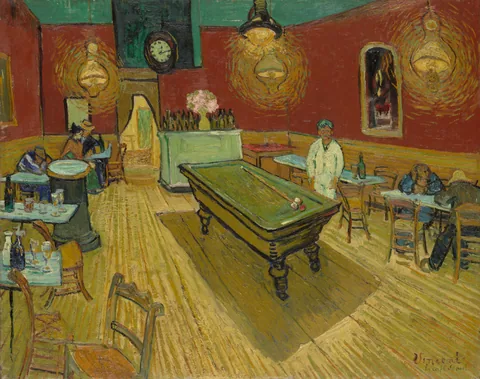
More in Impressionists and Interiors and Portraits.
Sources
More from the Journal
 Story · 7 min
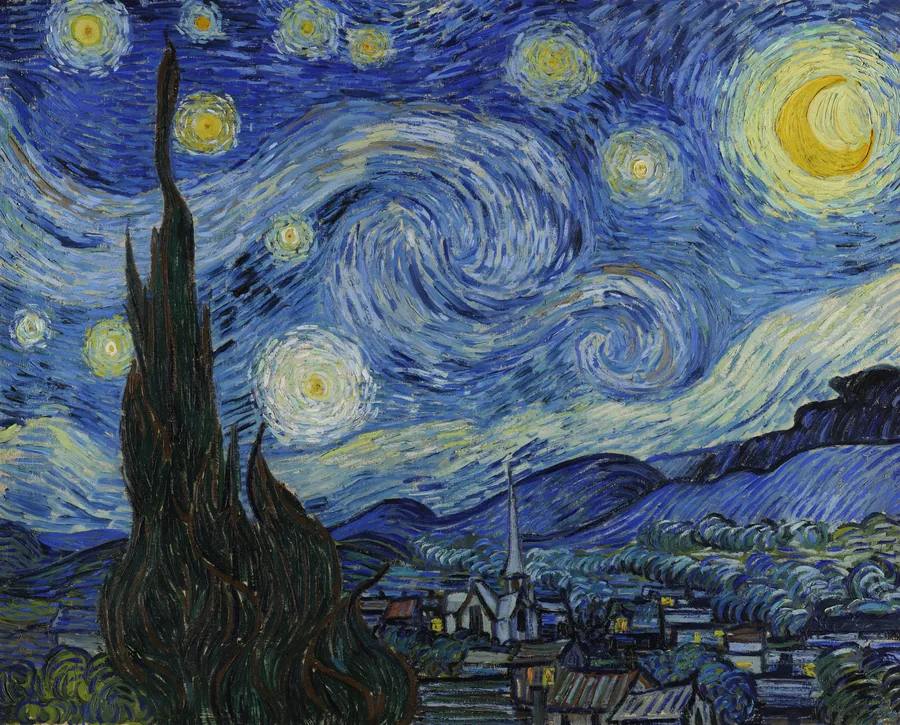
Van Gogh’s Starry Night: the facts, and choosing a print
Painted in June 1889 at an asylum in Provence: the view from his window, plus a village he made up. What is real, what it means, and which print to choose. Story · 7 min
The Great Wave off Kanagawa: meaning, history and prints
A woodblock print, not a painting, and a storm wave, not a tsunami. What it shows, why no two impressions match, and how to choose a print. Story · 7 min
Klimt’s The Kiss: gold leaf, meaning and choosing a print
Real gold leaf on canvas, finished in 1909. The story of Klimt’s lovers, what a print can and can’t reproduce, and which size to choose. Story · 7 min