
Story
Portrait of Dr. Gachet: the story of both versions
Van Gogh’s doctor in Auvers, the “heartbroken expression of our time”, the $82.5 million first version and the Orsay one we print.
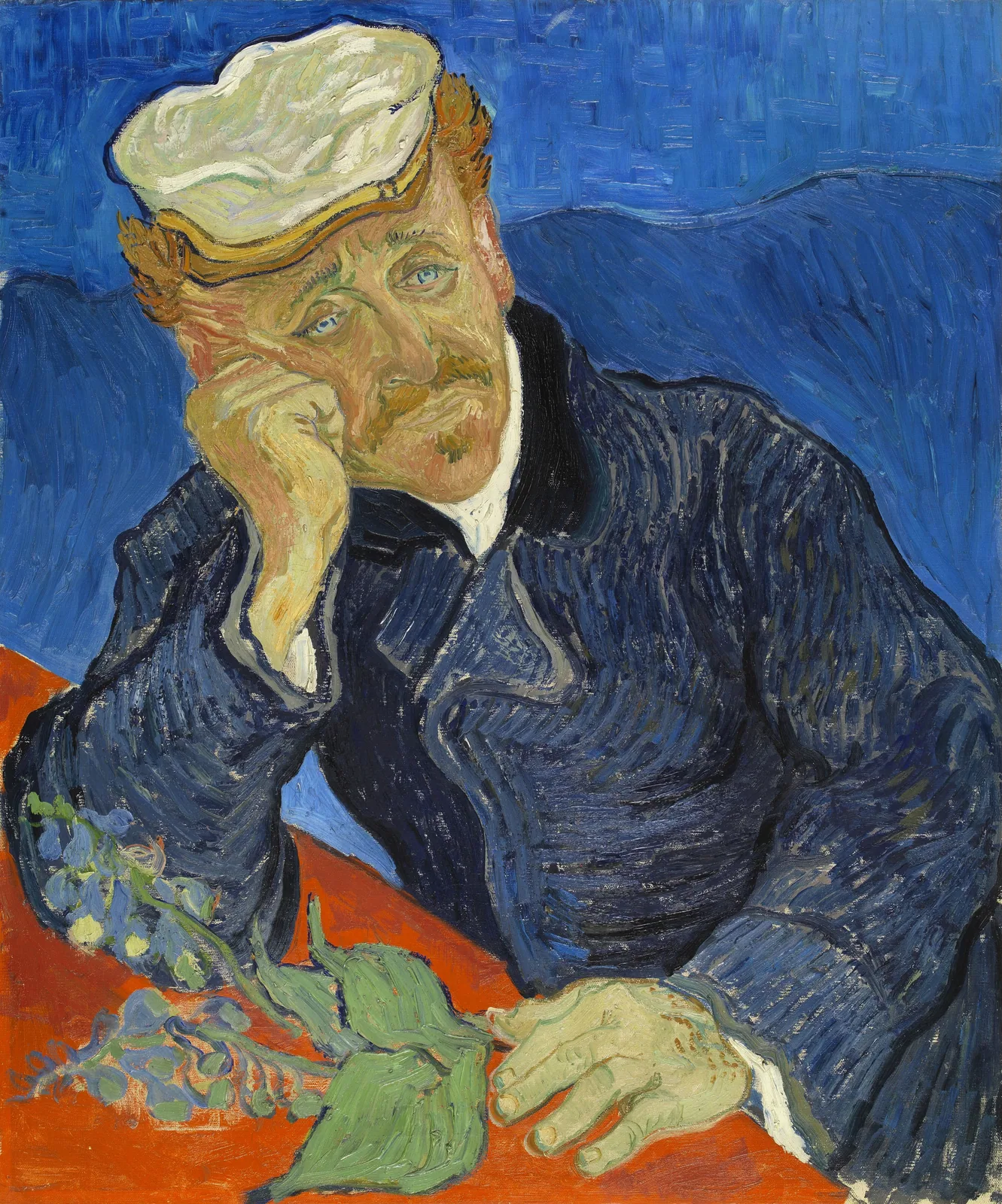
A man in a white cap leans his head on his fist, his eyes pale and tired, a sprig of foxglove on the red table in front of him. Vincent van Gogh painted his doctor, Paul Gachet, in Auvers-sur-Oise in June 1890, a few weeks before his own death. He painted him twice. The first version sold in 1990 for $82.5 million. The second, the one we print, is in the Musée d’Orsay in Paris.
Who was Dr. Gachet?
Paul Gachet was a homeopathic doctor who kept a second home in Auvers, a village on the river Oise north of Paris. He was also an amateur artist, and a collector of the new painting. The painter Camille Pissarro, a former patient, recommended him to Theo van Gogh as someone who could keep an eye on his brother after Vincent left the asylum at Saint-Rémy in the south. Gachet’s son, also called Paul, painted too; father and son made copies of works in their collection, including works by Cézanne.
“The heartbroken expression of our time”
Van Gogh wrote about the portrait in his letters. To Paul Gauguin he described the doctor’s sensitive face, with “the heartbroken expression of our time.” To his sister he put it this way: “Sad but gentle, yet clear and intelligent, that is how many portraits ought to be done.”
That is the key to the picture. It is not a flattering likeness of a professional man. It is a portrait of a mood, the melancholy Van Gogh saw in his doctor and shared with him. Everything leans: the head on the fist, the body across the table, the wavy lines of the coat and the hills behind.
Why the foxglove?
The purple-blue flower in front of him is foxglove, the plant digitalis comes from. Digitalis was used for certain heart complaints, so the sprig is probably there as an attribute of Gachet the physician, the way a saint in an old painting holds the sign of their story.
Two versions: how to tell them apart
Both were painted in June 1890 and both are about 67 by 56 cm, but they are easy to tell apart in color and style.
- The first version has two yellow novels on the table, the ones Van Gogh mentions in his letters. It hung in the Städel museum in Frankfurt from 1911 until the Nazis seized it in 1937 as “degenerate art.” Hermann Göring sold it on through an agent. In May 1990 it sold at Christie’s for $82.5 million to the Japanese businessman Ryoei Saito, and then it disappeared from public view. It is in a private collection.
- The second version, the one we print, has no books, and only the foxglove on the table. It came to France with the Gachet family’s collection, which his heirs left to the French state in the early 1950s, and it hangs in the Musée d’Orsay.
Is the Orsay version really by Van Gogh?
It has been doubted. Because the Gachets made copies, and because Van Gogh painted so much in so few weeks in Auvers, critics have questioned some works from the family’s collection. Jacob-Baart de la Faille, who catalogued Van Gogh’s work, called this version a weak replica of the first, missing the piercing look; later editors of his catalog disagreed. In 1999 the Musée d’Orsay studied the Gachet pictures scientifically and found clear differences between the Van Gogh works and the copies: the copies were drawn in outline and filled in, and their pigments aged differently. The Orsay keeps it as a Van Gogh, and its defenders say it is far beyond anything either Gachet could paint.
Look closer
These details come from the scan we print from, 6,748 pixels on the long side. Pick a detail, or zoom in and drag to look around: the brushstrokes in the coat all follow the folds.
Pale blue eyes, a drooping mouth, the head propped on a fist: Van Gogh’s “heartbroken expression of our time.”
Choosing a print
Life size. The canvas is about 26 by 22 inches. Our 20 × 24 in framed print is just under the original, and 25 × 30 in just over. Canvas goes up to 33 × 40 in. Framed prints go up to 25 × 30 in, canvas up to 33 × 40 in and unframed art prints up to 33 × 40 in.
Where it works. A thoughtful face and deep blues suit a study, a library corner or a quiet hallway. It is a strong, saturated picture, so give it a wall of its own rather than a crowded gallery wall.
Which material. The thick, ridged strokes are the point. Canvas gives them a painted feel and has no cover to reflect light; smooth matte paper in a frame keeps every stroke sharp. See canvas and our papers.
Frames. Natural oak warms the blues and echoes the red table; black wood makes the blues deeper and the face brighter. See all our frames.
Auvers, 1890. Van Gogh painted the village church the same summer, in The Church at Auvers. Open the two as a set. For his most famous picture, read the story of The Starry Night.
Questions
Who was Dr. Gachet?
Paul Gachet, a homeopathic doctor and amateur artist in Auvers-sur-Oise who looked after Van Gogh in the last weeks of his life.
How many versions are there?
Two, both from June 1890. The first, with yellow books, is privately owned; the second is in the Musée d’Orsay.
How much did Portrait of Dr. Gachet sell for?
The first version sold for $82.5 million at Christie’s in May 1990.
What is the flower in the painting?
Foxglove, the source of digitalis, a heart medicine. It probably marks Gachet as a doctor.
Can it be printed legally?
Yes. Van Gogh died in 1890, and his paintings are in the public domain. What public domain means.
More Van Gogh
All Van Gogh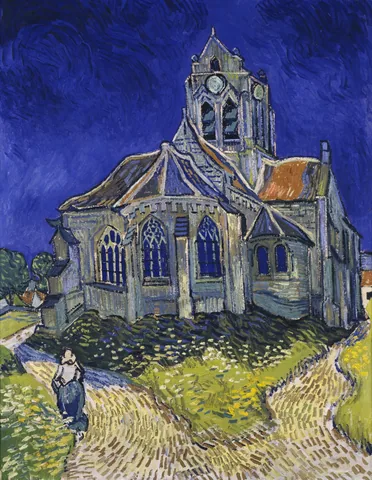
More in Interiors and Portraits and Impressionists.
Sources
More from the Journal
 Story · 7 min
Van Gogh’s Starry Night: the facts, and choosing a print
Painted in June 1889 at an asylum in Provence: the view from his window, plus a village he made up. What is real, what it means, and which print to choose. Story · 7 min
The Great Wave off Kanagawa: meaning, history and prints
A woodblock print, not a painting, and a storm wave, not a tsunami. What it shows, why no two impressions match, and how to choose a print. Story · 7 min
Klimt’s The Kiss: gold leaf, meaning and choosing a print
Real gold leaf on canvas, finished in 1909. The story of Klimt’s lovers, what a print can and can’t reproduce, and which size to choose. Story · 7 min