
Story
The Red Vineyard: the only Van Gogh he surely sold
A vineyard “completely red like red wine”, seen on a walk with Gauguin in 1888 and sold for 400 francs in 1890. Its story, and how to choose a print.
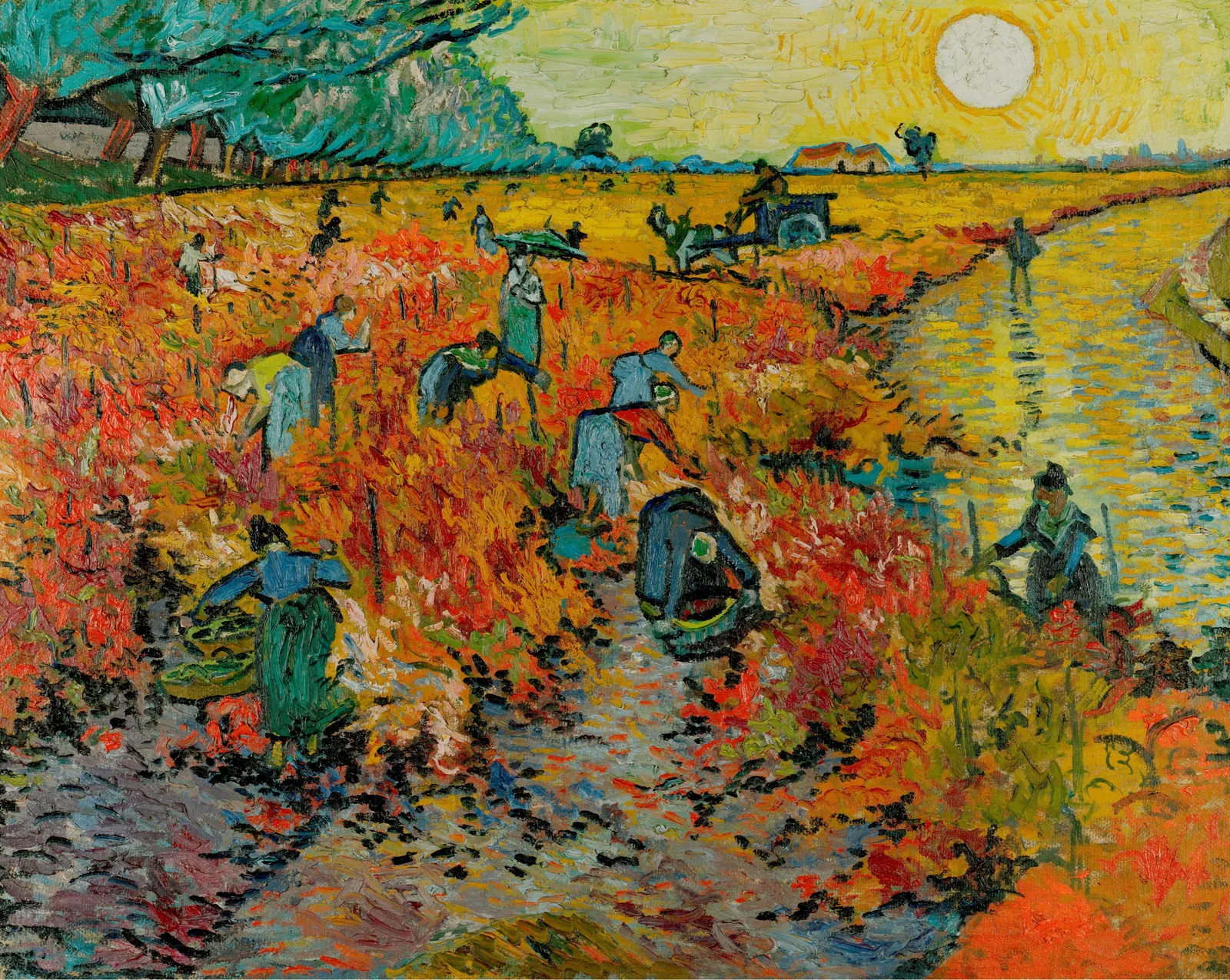
Women bend over the vines in a field that burns red and orange, the low sun turning the sky and the water to gold. Vincent van Gogh painted The Red Vineyard in Arles in November 1888, and it carries one of the best-known facts about him: it is the only painting he is certain to have sold in his lifetime.
A walk with Gauguin
On 28 October 1888, five days after Paul Gauguin arrived to stay with him in Arles, the two painters went for a walk in the late afternoon near Montmajour, outside the town. They saw a vineyard at harvest time, its leaves turned by autumn. Van Gogh described it to his brother Theo in one phrase: “A red vineyard, completely red like red wine.”
He did not paint it on the spot. He finished it back in his studio, working from imagination. You can feel it in the picture: the colors are stronger than any real field, and the scene is arranged rather than recorded. Gauguin painted the same vineyard too, in his own way, in a picture he called Human Misery (The Wine Harvest), which he thought his best of the year.
What is in the painting?
A grape harvest at the end of the day. Women bend double to pick, a figure stands under a green umbrella, and on the far side a horse and cart waits for the load. On the right a strip of water reflects the sun in a blaze of yellow. The sun itself is a pale disc low in the sky. The vines are not green at all: they are red, orange, purple and brown, the colors of late autumn, laid on in short, thick strokes that make the field shimmer.
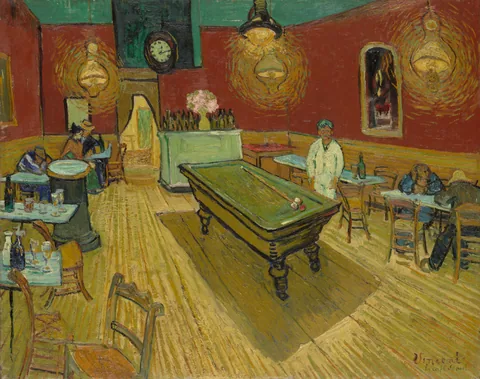
The picture is built on a clash of hot and cool. Reds and oranges fill the field; the workers wear blues and greens, which make the red look even redder. It is the same idea as The Night Café, painted two months before, used this time for warmth instead of unease.
Was it really the only painting Van Gogh sold?
It is the only one he is certain to have sold, and the only one known by name. In early 1890 it was shown at the annual exhibition of Les XX (Les Vingt) in Brussels, and the Belgian painter Anna Boch, herself a member of the group, bought it for 400 francs. She was the sister of Eugène Boch, a painter Van Gogh had befriended and painted in Arles. Vincent wrote to Theo, a little embarrassed, that the Bochs had paid the full price when they probably deserved a friend’s price.
There are hints that other small sales happened, so the “only painting he ever sold” story is part legend. But no other sale of a named painting is certain. Van Gogh died a few months later, in July 1890.
How it ended up in Moscow
Anna Boch kept the painting until 1907. In 1909 the Russian collector Ivan Morozov bought it in Paris; by then the price had risen to 30,000 francs. After the Russian Revolution, Morozov’s collection was nationalized in 1918, and he left Russia the following year. In 1948 the painting went to the Pushkin Museum in Moscow, where it still is. It has not been lent abroad for more than sixty years, and conservators have judged it too fragile to travel.
Look closer
These details come from the scan we print from, 11,406 pixels on the long side. Since the painting doesn’t travel, this is the closest most of us will get. Pick a detail, or zoom in and drag to look around.
A pale disc low in a yellow sky, ringed with strokes of light. It is late afternoon.
Choosing a print
Life size. The canvas is about 29½ by 36½ inches, and our 36 × 29 in framed print is almost exactly that. Unframed art prints go up to 48 × 38 in. Framed prints go up to 36 × 29 in, canvas up to 40 × 32 in and unframed art prints up to 48 × 38 in.
Where it works. The obvious place is a dining room or a kitchen, near the wine. Its reds and oranges warm a north-facing room and suit autumn, but they are strong, so give it a wall to itself. At 24 × 19 in it fits a bar cart corner or a hallway.
Which material. The thick strokes suit canvas, which has a matte finish and no cover to reflect light. A framed print on smooth paper keeps the small figures sharp. See canvas and our papers.
Frames. Gold picks up the sun and the reflections; black wood makes the reds glow harder. See all our frames.
Another sunset near Montmajour. Van Gogh painted the hill of Montmajour the same year in Sunset at Montmajour. Open the two as a set.
Questions
Is The Red Vineyard the only painting Van Gogh sold?
It is the only one he is certain to have sold, and the only one known by name: Anna Boch bought it for 400 francs in Brussels in 1890.
Where was it painted?
In Arles. Van Gogh saw the vineyard on a walk with Gauguin near Montmajour and painted it in his studio.
Where is The Red Vineyard now?
In the Pushkin State Museum of Fine Arts in Moscow, since 1948.
How big is it?
About 75 × 93 cm, 29½ × 36½ in.
Can it be printed legally?
Yes. Van Gogh died in 1890, and his paintings are in the public domain. What public domain means.
More Van Gogh
All Van Gogh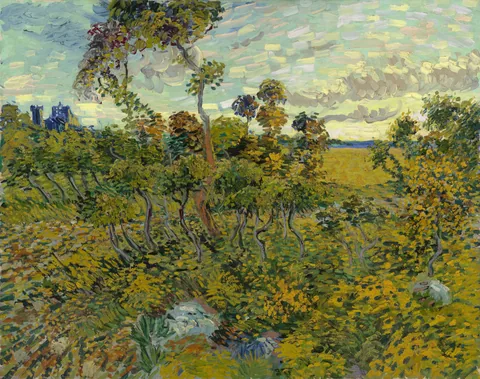
More in Landscapes and Impressionists.
Sources
More from the Journal
 Story · 7 min
Van Gogh’s Starry Night: the facts, and choosing a print
Painted in June 1889 at an asylum in Provence: the view from his window, plus a village he made up. What is real, what it means, and which print to choose.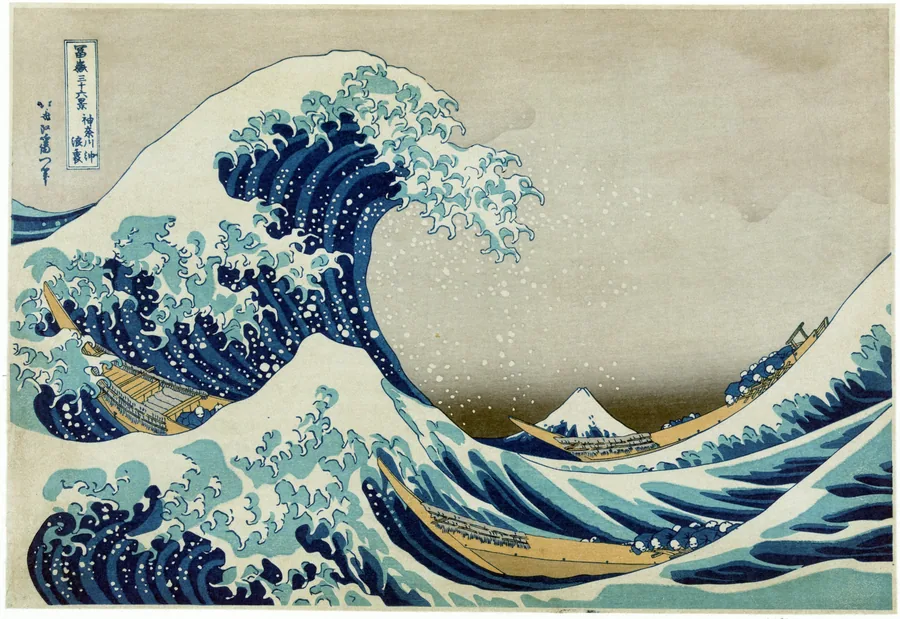 Story · 7 min
The Great Wave off Kanagawa: meaning, history and prints
A woodblock print, not a painting, and a storm wave, not a tsunami. What it shows, why no two impressions match, and how to choose a print. Story · 7 min
Klimt’s The Kiss: gold leaf, meaning and choosing a print
Real gold leaf on canvas, finished in 1909. The story of Klimt’s lovers, what a print can and can’t reproduce, and which size to choose. Story · 7 min