
Story
Wheatfield with Crows: was it Van Gogh’s last painting?
Painted in Auvers in July 1890. The myth of the last painting, what Van Gogh wrote about sadness and loneliness, and choosing a wide print.
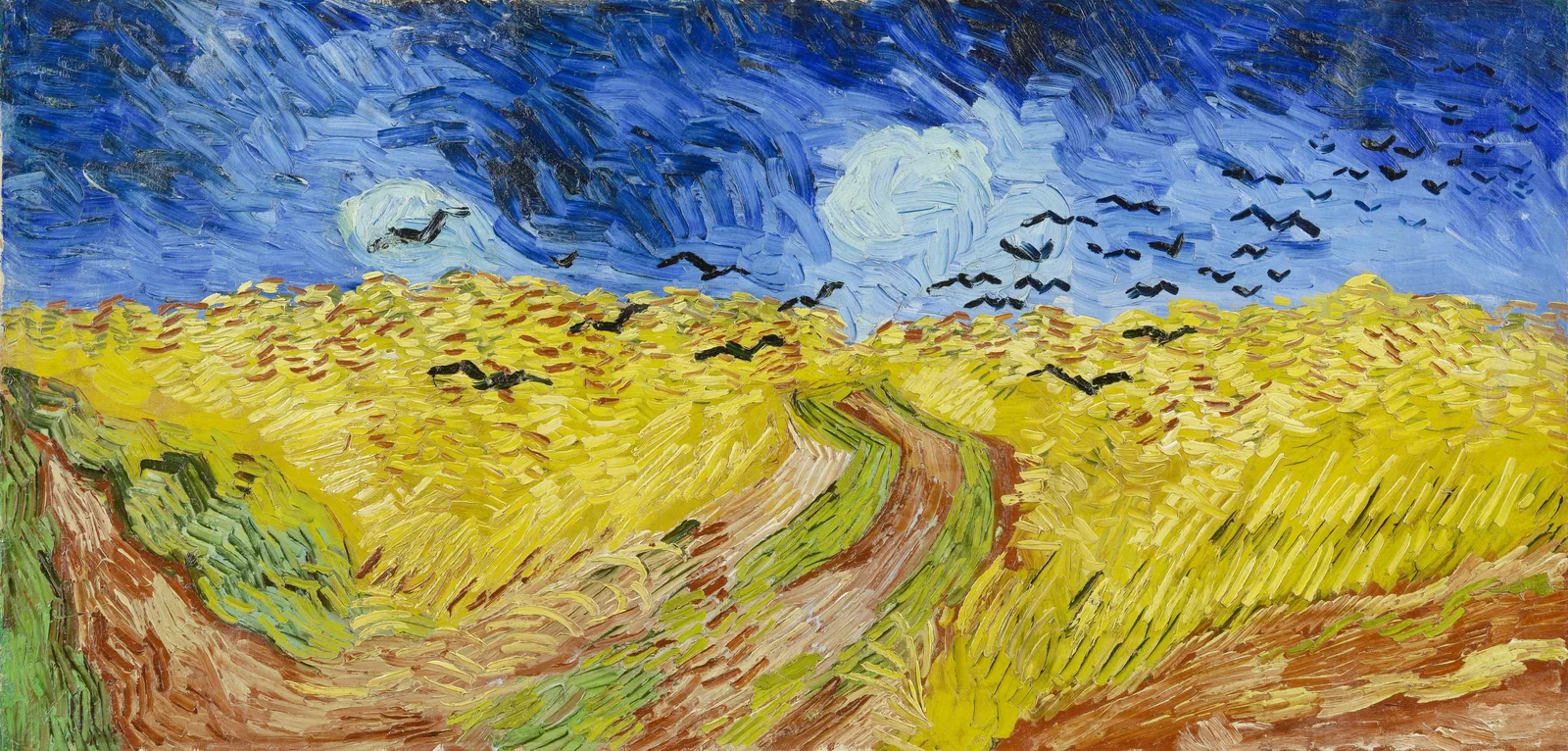
A field of ripe wheat stretches the whole width of the canvas. Above it the sky is a dark, churning blue, and a flock of crows flies low over the grain. A red earth road runs into the field and simply stops. Vincent van Gogh painted it in Auvers-sur-Oise, north of Paris, in July 1890, the month he died, and it has carried the weight of that ending ever since.
Was it Van Gogh’s last painting?
Probably not, though it is often called that. The idea that he painted it and then went out and shot himself owes a lot to the 1956 film Lust for Life, which put the two moments together. The letters tell a different story. Van Gogh wrote about a group of large wheatfield canvases around 10 July 1890, more than two weeks before his death, and this picture is likely one of them. His last painting was more likely a different one, Tree Roots.
What Van Gogh wrote about it
In a letter to his brother Theo and Theo’s wife, Jo, written around 10 July 1890, Van Gogh described three large new canvases of immense wheatfields under turbulent skies. He said he had made a point of trying to express sadness, and then, as if to make sure, added the words de la solitude extrême: extreme loneliness.
In the same breath he said something more hopeful. He believed the canvases would show Theo and Jo what he could not put into words: what he found healthy and fortifying about the countryside. So the painting holds both at once, the loneliness and the strength of the land, and that is part of why it is hard to look away from. Scholars still argue about exactly which three paintings he meant; this is one of the two most often named.
What do the crows and the paths mean?
It is tempting to read every part as a sign of death: black crows, a storm coming, a road that ends in the middle of a field. Some writers do. The writer Kathleen Erickson sees sorrow and a sense of his life ending, and reads the road as a picture of the pilgrim’s path in The Pilgrim’s Progress. She also points out that for Van Gogh crows could stand for death and rebirth, not death alone.
Others warn against the easy reading. The authors Ingo Walther and Rainer Metzger argue that nothing in Van Gogh’s own words supports a simple story of artistic despair, and that the crows were a personal symbol of his. Look again and the picture is also full of energy: the wheat is ripe and gold, and the color is as strong as anything he painted.
Why the shape matters
The canvas is a double square, about twice as wide as it is tall. The field fills about two thirds of it. With no trees, houses or people to stop the eye, it reads like a panorama, the way a field looks when you stand at its edge and turn your head.
Where is Wheatfield with Crows now?
In the Van Gogh Museum in Amsterdam. In 1991 it was stolen from the museum with nineteen other Van Gogh paintings; it was badly damaged but quickly recovered.
Look closer
These details come from the scan we print from, 7,762 pixels on the long side. Pick a detail, or zoom in and drag to look around: the paint on the wheat is laid on thick.
A flock of black birds, each one a quick V or two strokes. You can’t tell if they are coming or going.
Choosing a print
A wide picture for a long wall. This is one of the best shapes there is for over a sofa, a bed or a sideboard, because it is long and low like the furniture. At 40 × 19 in it is about the size of the original, and framed prints go up to 48 × 23 in. A 48 × 23 in canvas spans most of a standard sofa. Framed prints, canvas and unframed art prints all go up to 48 × 23 in. See what size art over a sofa and what to hang over a bed.
Smaller. At 24 × 11 in it suits a hallway or the space over a desk. A narrow picture can look lost on a big wall, so go wide rather than small if you can.
Which material. The paint is thick and ridged, and canvas suits that, with no cover to reflect light in a bright room. A framed print on smooth paper keeps the crows and the strokes sharpest. See canvas and our papers.
Frames. A black frame matches the dark sky and makes the yellow blaze; natural wood is softer and picks up the earth path. See all our frames.
Two fields, two moods. Van Gogh painted calmer fields at Auvers that summer too, like Green Wheat Fields, Auvers. Open the two as a set.
Questions
Was Wheatfield with Crows Van Gogh’s last painting?
Probably not. It dates from about 10 July 1890; Tree Roots is more likely his last.
What does Wheatfield with Crows mean?
Van Gogh said he set out to express sadness and extreme loneliness, but also what he found healthy and fortifying about the countryside. Both are in the picture.
Where was it painted?
In the wheat fields around Auvers-sur-Oise, north of Paris.
Where is Wheatfield with Crows?
In the Van Gogh Museum in Amsterdam. It is 50.2 × 103 cm, about 20 × 41 in.
Can it be printed legally?
Yes. Van Gogh died in 1890, and his paintings are in the public domain. What public domain means.
More Van Gogh
All Van Gogh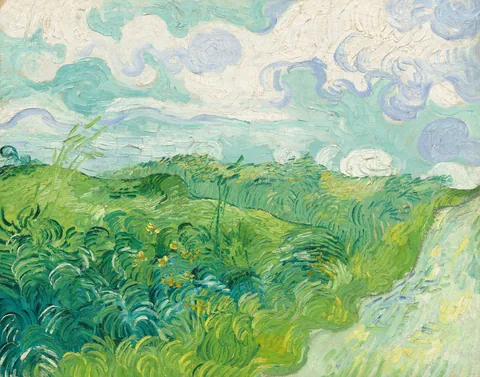
More in Landscapes and Moody Landscapes.
Sources
More from the Journal
 Story · 7 min
Van Gogh’s Starry Night: the facts, and choosing a print
Painted in June 1889 at an asylum in Provence: the view from his window, plus a village he made up. What is real, what it means, and which print to choose. Story · 7 min
The Great Wave off Kanagawa: meaning, history and prints
A woodblock print, not a painting, and a storm wave, not a tsunami. What it shows, why no two impressions match, and how to choose a print. Story · 7 min
Klimt’s The Kiss: gold leaf, meaning and choosing a print
Real gold leaf on canvas, finished in 1909. The story of Klimt’s lovers, what a print can and can’t reproduce, and which size to choose. Story · 7 min