
Story
Las Meninas: who is who, the mirror and a print
Who everyone is in Velázquez’s Las Meninas, who the mirror shows, why the painter wears a red cross, and how to choose a print.
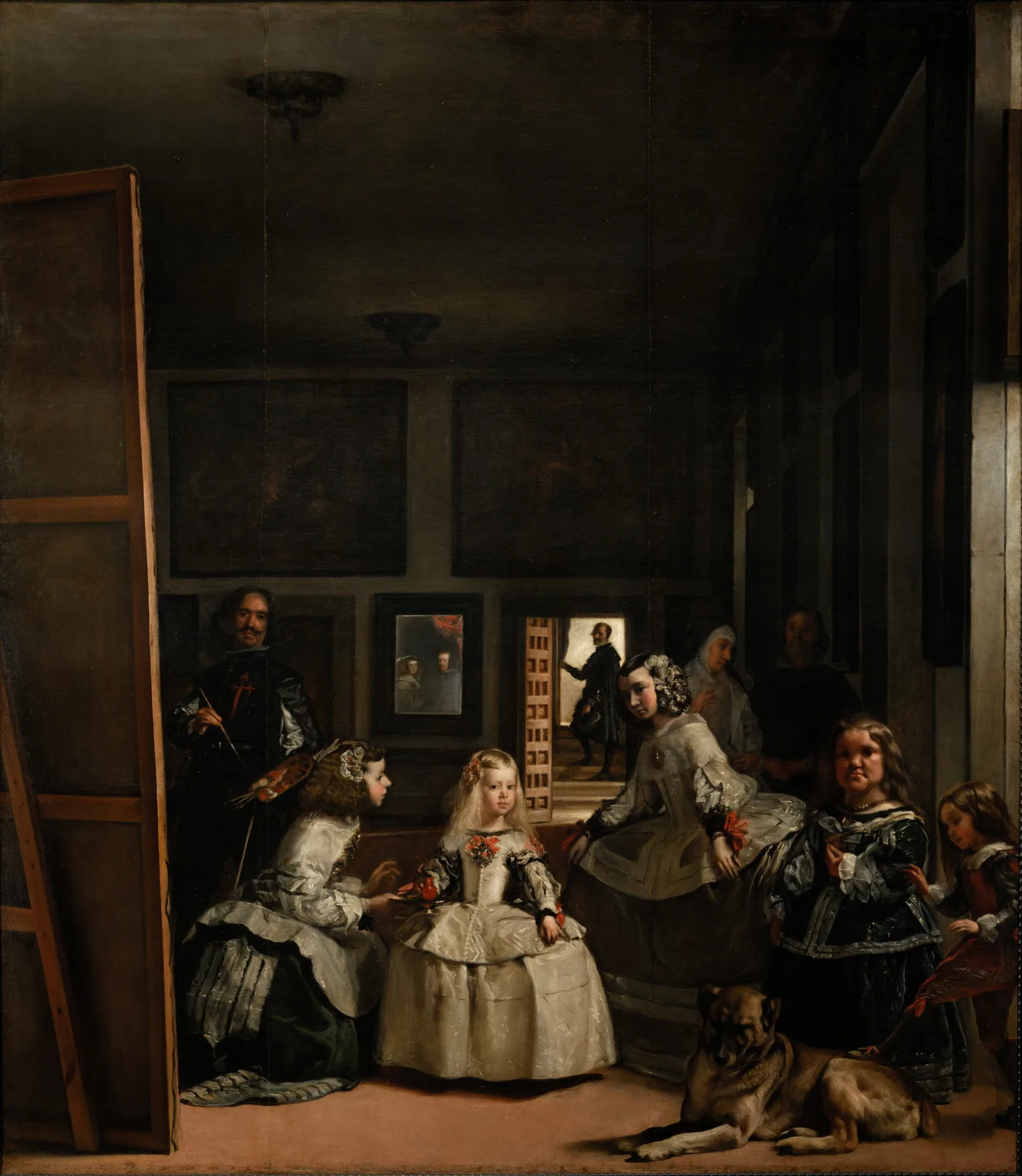
A little princess in a pale silk dress stands in the middle of a tall, dim room. Her ladies fuss over her, a dog dozes, and on the left a painter steps back from a huge canvas and looks straight at you. Diego Velázquez painted Las Meninas in Madrid in 1656, and painters have been puzzling over it ever since. Luca Giordano, who saw it in 1692, called it the “theology of painting.”
What does Las Meninas mean?
Las Meninas is Spanish for “the ladies-in-waiting,” the two young women of the court who attend the princess. That name came late. The palace inventories of the 1600s called it La Familia, “The Family,” and the Prado’s catalog first listed it as Las Meninas in 1843.
Who is who
Almost everyone in the picture is a real, named person from the court of King Philip IV of Spain.
- The Infanta Margarita Teresa, the king’s five-year-old daughter, in the center.
- María Agustina Sarmiento, a lady-in-waiting, kneeling to offer her a drink in a small red clay cup on a gold tray.
- Isabel de Velasco, the other lady-in-waiting, on the right, about to curtsy.
- Mari Bárbola, a court dwarf from Austria, looking out at us, and Nicolás Pertusato, an Italian, nudging the dog with his foot.
- Marcela de Ulloa, the princess’s chaperone, in mourning dress, talking with a bodyguard in the shadows.
- José Nieto Velázquez, the queen’s chamberlain, framed in the bright doorway at the back.
- Diego Velázquez, the painter, at his easel on the left.
- King Philip IV and Queen Mariana, seen only as a blurred reflection in the mirror on the back wall.
The room is real too. In the early 1650s the king gave Velázquez a large room in the Alcázar, his palace in Madrid, as a studio: the main room of the rooms that had belonged to his late son, Prince Balthasar Charles. The dark paintings high on the back wall are copies of works by Rubens and Jacob Jordaens, scenes from Ovid’s myths, hung where an inventory of the time says they were.
Who is in the mirror?
The king and queen. The mirror shows their heads and shoulders, so they must be standing where we are, outside the picture, and everyone in the room is reacting to them. The princess turns, a lady starts to curtsy, the chamberlain stops on the stairs. That is the trick of the painting: the subject is the viewer. What Velázquez is painting on the canvas we can’t see is still argued about. It could be a portrait of the royal couple, and some historians think the mirror reflects that canvas rather than the king and queen themselves.
The red cross on the painter’s chest
Velázquez wears the red cross of the Order of Santiago, one of Spain’s great knightly orders. He was only made a knight in 1659, three years after he finished the painting, so the cross was added later. An early biographer, Antonio Palomino, wrote that the king had it added after the painter’s death, and some even said Philip IV painted it himself. Nobody can prove that.
Fire, and Picasso
In 1734 the Alcázar burned down, and Las Meninas was damaged. The painter Juan García de Miranda restored it, and almost all of the princess’s left cheek is his repainting. Three centuries later Pablo Picasso studied the picture so closely that between August and December 1957 he painted 58 versions of it. They are now in the Museu Picasso in Barcelona. The French philosopher Michel Foucault opened his 1966 book The Order of Things with a long essay on it.
Where is Las Meninas now?
In the Museo del Prado in Madrid. It is a big picture, about 10½ feet tall and 9 feet wide, so the room in the picture seems to open straight off the gallery.
Look closer
These details come from the scan we print from, 30,000 pixels on the long side. Look at how loosely the dresses are painted up close, a few quick strokes that turn into silk from a step away. Pick a detail, or zoom in and drag to look around.
Margarita Teresa, five years old, in a wide pale dress, with a red flower at her chest. Her lady-in-waiting kneels to offer her a drink.
Choosing a print
Big enough for the faces. The figures take up only the lower half of the picture; above them is a tall, dark room. In a small print the faces get tiny, so this is a painting to buy large. Our largest framed print is 26 × 30 in, and canvas goes to 35 × 40 in. Framed prints go up to 26 × 30 in, canvas up to 35 × 40 in and unframed art prints up to 42 × 48 in.
Smaller sizes. At 17 × 20 in it works on a narrow wall or a bookshelf, where you stand close. It is nearly square, so it sits well in a gap between two windows or doors.
Mind the dark. The whole top half is shadow. Dark pictures behind clear acrylic mirror a facing window, so hang a framed print where the light comes from the side, or choose canvas, which has no cover and a matte finish. Smooth cotton paper keeps the most detail in the shadows. See our papers and canvas.
Frames. A gold frame belongs with a Spanish court painting; a wide one like our Gold Plein Air picks up the gold tray and the princess’s hair. See all our frames.
The princess again. Velázquez painted Margarita Teresa several more times as she grew up. We sell Infanta Margarita Teresa in a Blue Dress, painted when she was about eight. Open the two as a set.
Questions
What does Las Meninas mean in English?
“The Ladies-in-Waiting.” Early inventories called it “The Family.”
Who is the girl in Las Meninas?
The Infanta Margarita Teresa, daughter of King Philip IV of Spain, aged five.
Who is in the mirror?
King Philip IV and Queen Mariana, the princess’s parents.
Is the painter in the picture Velázquez?
Yes. It is a self-portrait, at work on a large canvas.
Where is Las Meninas?
In the Museo del Prado in Madrid. It is 318 × 276 cm, about 10½ × 9 ft.
Can it be printed legally?
Yes. It was painted in 1656 and is in the public domain. What public domain means.
More Velázquez
All Velázquez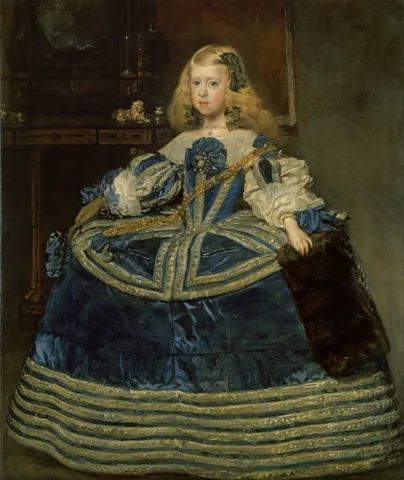
More in Old Masters and Interiors and Portraits.
Sources
More from the Journal
 Story · 7 min
Van Gogh’s Starry Night: the facts, and choosing a print
Painted in June 1889 at an asylum in Provence: the view from his window, plus a village he made up. What is real, what it means, and which print to choose. Story · 7 min
The Great Wave off Kanagawa: meaning, history and prints
A woodblock print, not a painting, and a storm wave, not a tsunami. What it shows, why no two impressions match, and how to choose a print. Story · 7 min
Klimt’s The Kiss: gold leaf, meaning and choosing a print
Real gold leaf on canvas, finished in 1909. The story of Klimt’s lovers, what a print can and can’t reproduce, and which size to choose. Story · 7 min