
Story
Velázquez’s Old Woman Cooking Eggs: the story
A kitchen in Seville, two eggs in a clay dish and a boy with a melon, painted by Velázquez in 1618. What to look for, and choosing a print.
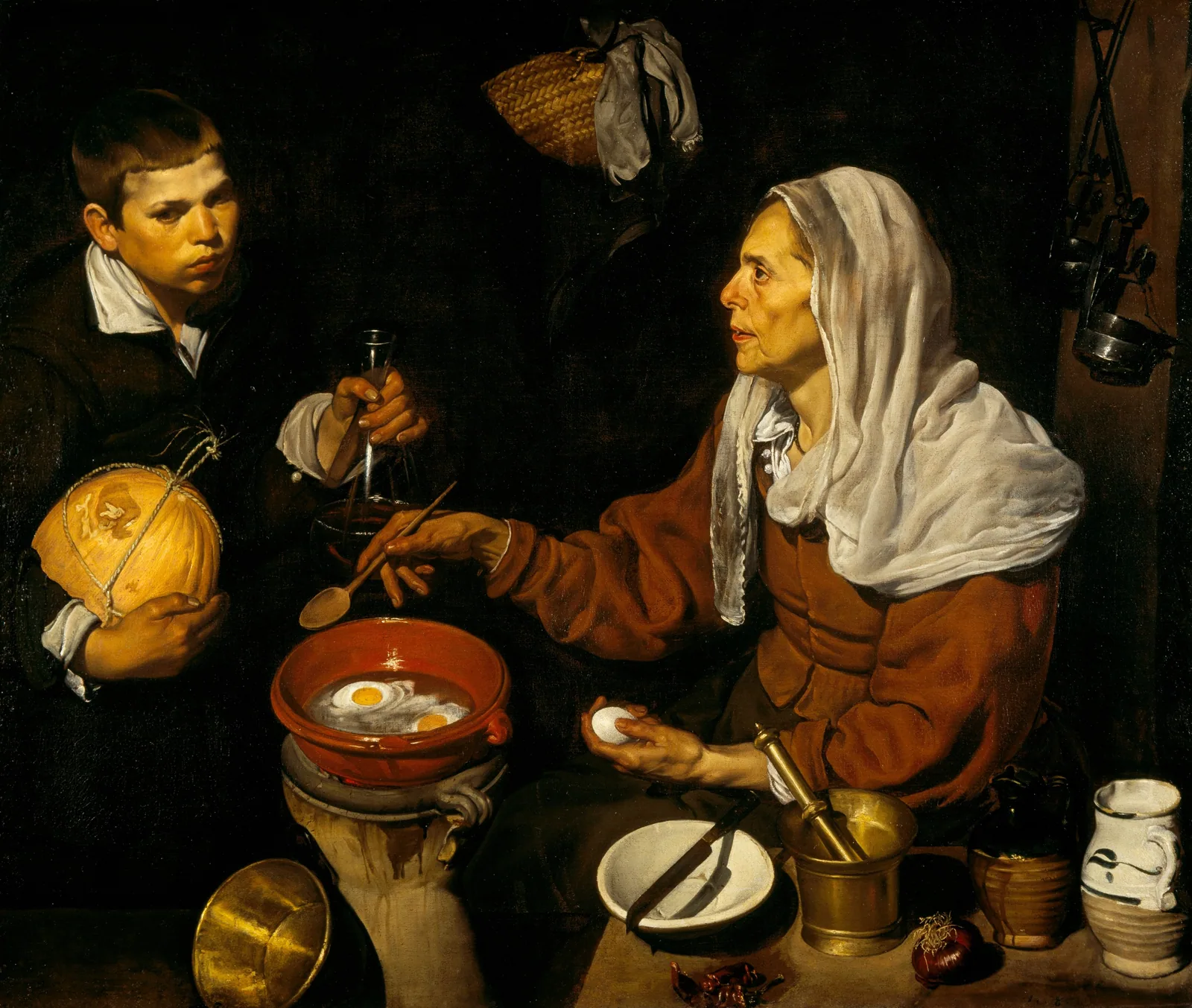
In a dark kitchen, an old woman in a white headcloth cooks two eggs in a clay dish over a small brazier. She holds a wooden spoon in one hand and the next egg in the other. A boy comes in with a melon under his arm and a glass flask, and looks straight at us. Diego Velázquez painted it in Seville in 1618, a year after he qualified as a painter, five years before he moved to Madrid.
A kitchen scene
In Spanish this kind of picture is called a bodegón: a kitchen or tavern scene with food and everyday things. A strong light from the left picks out the woman, her pots and the eggs, while the boy and the wall behind sink into deep shadow. The colors are mostly ochres and browns.
Look at the eggs. They are shown in the middle of cooking, the whites turning from clear to opaque. Writers on the painting point to how carefully Velázquez caught that change, along with every surface around it: the glaze on the jugs, the brass of the mortar and pestle, the skin of a red onion, a few dried chili peppers. There is even a debate over whether the eggs are being fried or poached, which is why the painting is also called Old Woman Poaching Eggs.
Who are they?
Nobody knows for sure. The boy looks out at us, the old woman seems lost in thought, and their relationship is left open. Neither is made into a joke; both are painted with dignity. The same old woman seems to appear in Velázquez’s Christ in the House of Martha and Mary, from the same year, and the boy’s pose matches the youth in The Waterseller of Seville. Velázquez often used working people, and sometimes his own family, as models.
What does it mean?
Readings differ. It has long been linked to the Spanish picaresque novel, as an illustration of a passage in Mateo Alemán’s Guzmán de Alfarache. One scholar suggested it stands for the sense of taste; another, for sight and touch, noting that the old woman might be blind. Many simply see it as one of the strongest of Velázquez’s early works.
Where is Old Woman Cooking Eggs?
In the Scottish National Gallery in Edinburgh. It was first recorded in 1698 in Seville, in the collection of the Flemish merchant Nicolás de Omazur. By 1813 it was in England, and in 1955 Edinburgh bought it from the heirs of Sir Francis Cook. The date 1618 was found in the lower right corner during a cleaning in 1957.
Look closer
These details come from the scan we print from, 5,816 pixels on the long side. Pick a detail, or zoom in and drag to look around.
Two eggs cooking in a clay dish, the whites turning from clear to opaque.
Choosing a print
Size. The canvas is about 39½ by 47 inches. Our scan prints sharply up to 30 × 25 in, a little smaller than the original, and we don’t sell it bigger than that. Framed prints go up to 30 × 25 in, canvas up to 36 × 30 in and unframed art prints up to 36 × 30 in.
Where it works. A kitchen, of course, or a dining room. At 24 × 20 in it fits over a sideboard or a counter. It is a perfect gift for a cook. See our gift guide.
Which material. The picture is mostly dark. Behind clear acrylic, dark areas reflect a facing window, so hang a framed print with side light, or choose canvas, with its matte finish and no cover. See our papers and canvas.
Frames. Black wood melts into the dark background; a wide gold frame like our Gold Plein Air picks up the brass and the ochres. See all our frames.
Seville, two scenes. Pair it with The Waterseller of Seville. Open the two as a set.
Questions
Where is Old Woman Cooking Eggs?
In the Scottish National Gallery in Edinburgh, since 1955.
When was it painted?
In 1618, in Seville. The date was found on the canvas during a cleaning in 1957.
Is she frying or poaching the eggs?
Scholars disagree, which is why it is also called Old Woman Poaching Eggs.
How big is it?
100.5 × 119.5 cm, about 39½ × 47 in.
Can it be printed legally?
Yes. It is more than 400 years old and in the public domain. What public domain means.
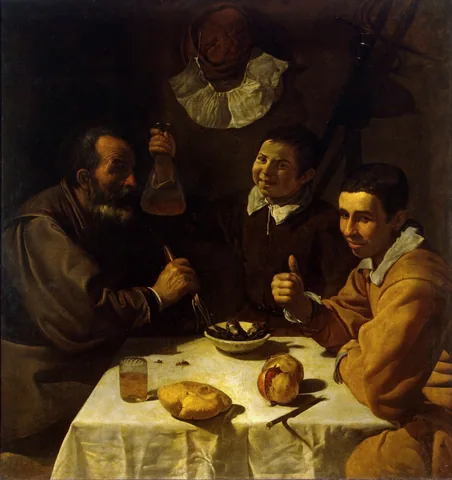
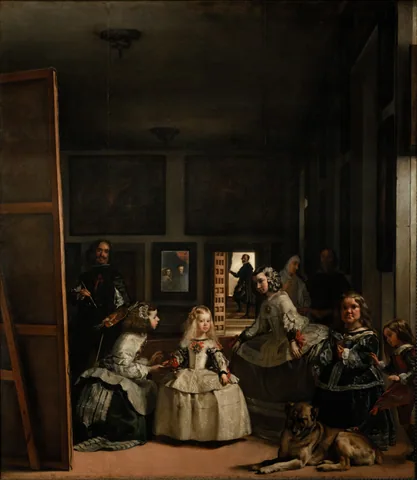
More Velázquez and kitchens
All Velázquez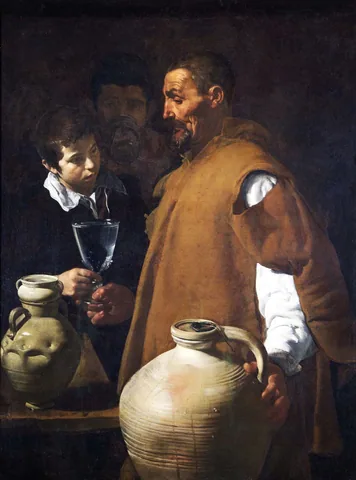
More in Old Masters and Still Life.
Sources
More from the Journal
 Story · 7 min
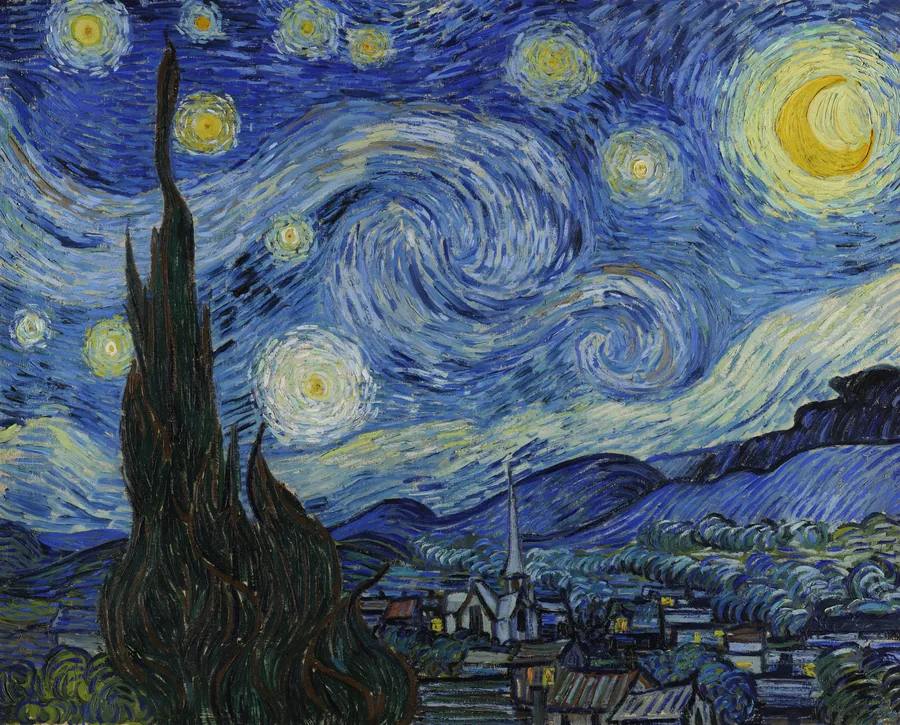
Van Gogh’s Starry Night: the facts, and choosing a print
Painted in June 1889 at an asylum in Provence: the view from his window, plus a village he made up. What is real, what it means, and which print to choose. Story · 7 min
The Great Wave off Kanagawa: meaning, history and prints
A woodblock print, not a painting, and a storm wave, not a tsunami. What it shows, why no two impressions match, and how to choose a print. Story · 7 min
Klimt’s The Kiss: gold leaf, meaning and choosing a print
Real gold leaf on canvas, finished in 1909. The story of Klimt’s lovers, what a print can and can’t reproduce, and which size to choose. Story · 7 min