
Story
Girl Reading a Letter at an Open Window: the hidden Cupid
For two centuries a Cupid was painted over on the wall behind her. How it was found and uncovered, what it means, and choosing a print.
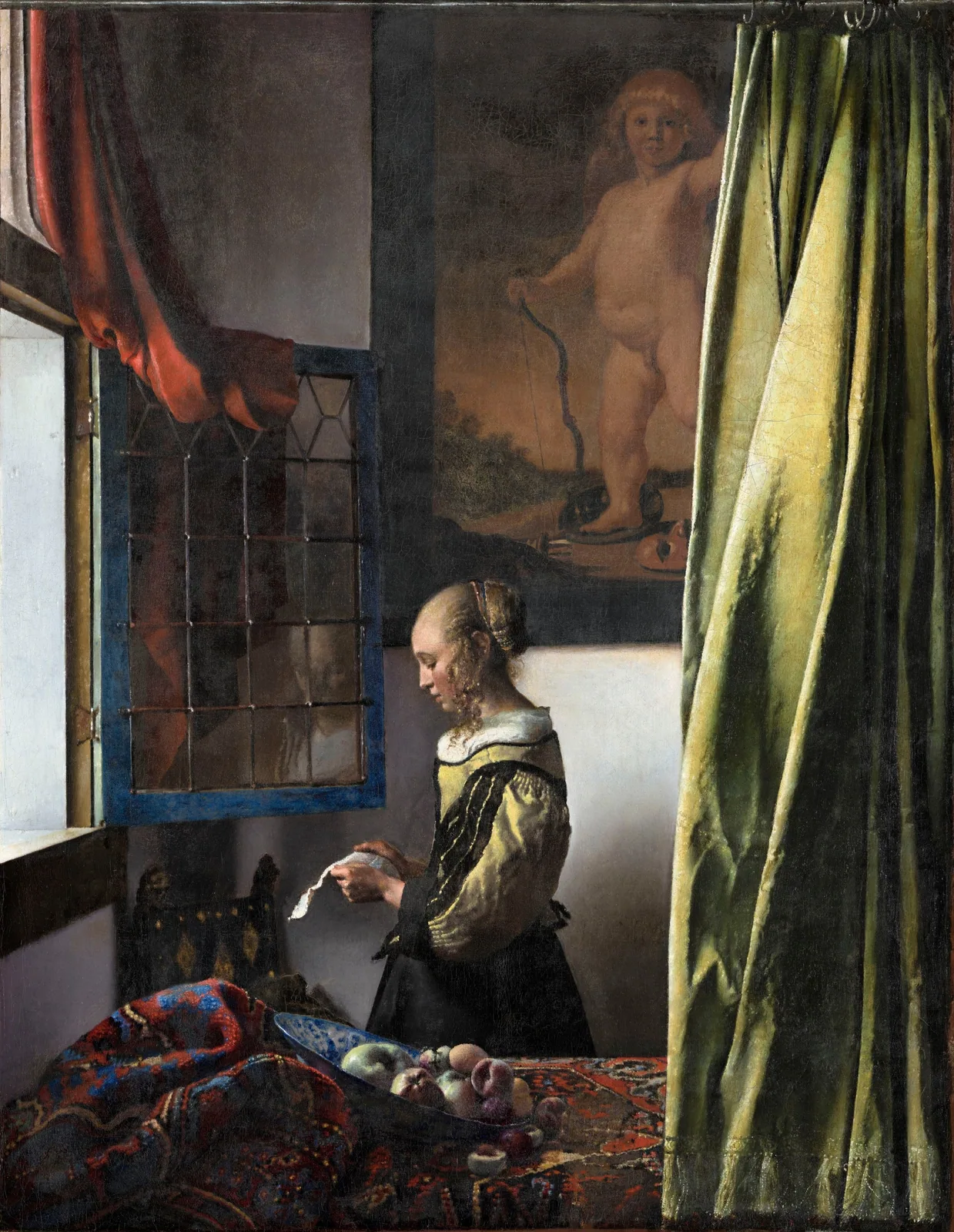
A young woman stands by an open window, reading a letter in the light. Her face is reflected faintly in the glass. A green curtain is drawn partly across the scene, and on the table a bowl of fruit tips toward us. Johannes Vermeer painted it around 1657 to 1659. For about two hundred years, nobody could see the most important clue in the picture: a painting of Cupid on the wall behind her.
The hidden Cupid
For most of its life, the wall behind the girl was blank. X-rays showed that something was underneath: a picture-within-the-picture of Cupid, the god of love. For a long time it was assumed that Vermeer had painted it out himself.
In 2017 the conservator Christoph Schölzel studied that area closely and found that the varnish there had been applied after Vermeer died. Someone else had painted over the Cupid, it seems in the late 1700s. In 2019 the museum in Dresden decided to bring back Vermeer’s original, and between 2018 and 2021 the overpaint was removed. The restored painting, Cupid and all, was shown in 2021. The scan we print from shows it as it looks now.
What does the Cupid change?
Everything about how we read the letter. With a blank wall, she could be reading news from anyone. With Cupid standing over her, bow in hand, the letter is most likely a love letter. Vermeer was telling his viewers exactly what she is thinking about, and someone later decided to make it a mystery.
Other details to look for
The reflection. The window has swung inward, and in the lower right of the glass you can see her face reflected, a second, ghostly version of her.
The fruit. The bowl on the red-draped table is tilted, and beside it a peach has been cut in half to show its stone.
The curtain. A heavy ochre-green curtain with tassels hangs at the right, partly closed. It makes us feel like we are looking at something private.
Rembrandt, de Hooch, then Vermeer
The painting has been in Dresden since 1742, when Augustus III, Elector of Saxony, bought it believing it was by Rembrandt. In 1826 it was given to Pieter de Hooch. Only in 1860 did the French critic Théophile Thoré-Bürger, restore it to its real painter.
In the Second World War it was among the works rescued from the bombing of Dresden and stored in a tunnel in Saxony. The Red Army found the hiding place and took the paintings. In 1955 the Soviet Union decided to return the art to Germany, and the painting came home.
Look closer
These details come from the scan we print from, 4,263 pixels on the long side. Pick a detail, or zoom in and drag to look around.
The painting on the wall, hidden under overpaint for about two centuries: Cupid, god of love, holding up his bow.
Choosing a print
Size. The canvas is about 33 by 25½ inches. Our scan prints sharply up to 19 × 24 in, a little smaller, and we don’t sell it bigger than the file can print well. Framed prints, canvas and unframed art prints all go up to 19 × 24 in.
Where it works. A bedroom, a reading nook or a writing desk: a picture about a letter from someone you love. It is a good Valentine’s or anniversary gift. At 12 × 16 in it fits beside a window or a bookshelf.
Which material. The corners are dark. Behind clear acrylic, dark areas reflect a facing window, so hang a framed print with side light, or choose canvas, with its matte finish and no cover. Smooth cotton paper keeps the reflection in the glass visible. See our papers and canvas.
Frames. Black wood is the classic Dutch choice; a wide gold frame like our Gold Plein Air picks up the ochre curtain. See all our frames.
Two letters. Pair it with Woman in Blue Reading a Letter, Vermeer’s other great letter reader. Open the two as a set.
Questions
Why was the Cupid painted over?
Nobody knows. Tests in 2017 showed the overpaint was added after Vermeer’s death, probably in the late 1700s.
When was the Cupid uncovered?
Restorers in Dresden removed the overpaint between 2018 and 2021, and the restored painting was shown in 2021.
Where is the painting?
In the Gemäldegalerie Alte Meister in Dresden, where it has been since 1742.
How big is it?
83 × 64.5 cm, about 33 × 25½ in.
Can it be printed legally?
Yes. It is more than 350 years old and in the public domain. What public domain means.
More Vermeer
All Vermeer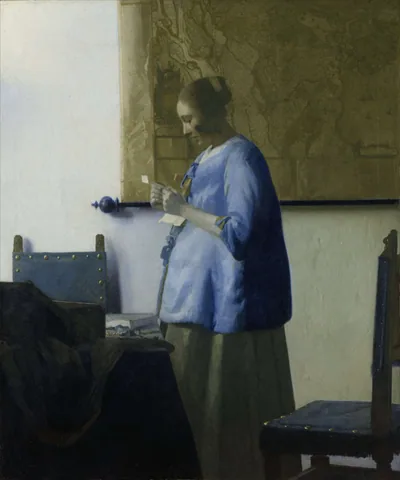
More in Dutch and Flemish Masters and Interiors and Portraits.
Sources
More from the Journal
 Story · 7 min
Van Gogh’s Starry Night: the facts, and choosing a print
Painted in June 1889 at an asylum in Provence: the view from his window, plus a village he made up. What is real, what it means, and which print to choose. Story · 7 min
The Great Wave off Kanagawa: meaning, history and prints
A woodblock print, not a painting, and a storm wave, not a tsunami. What it shows, why no two impressions match, and how to choose a print. Story · 7 min
Klimt’s The Kiss: gold leaf, meaning and choosing a print
Real gold leaf on canvas, finished in 1909. The story of Klimt’s lovers, what a print can and can’t reproduce, and which size to choose. Story · 7 min