
Story
Bruegel’s The Peasant Wedding: where is the groom?
A wedding feast in a Flemish barn: the bride under her paper crown, a door used as a tray, and a groom nobody can find. The story, and a print.
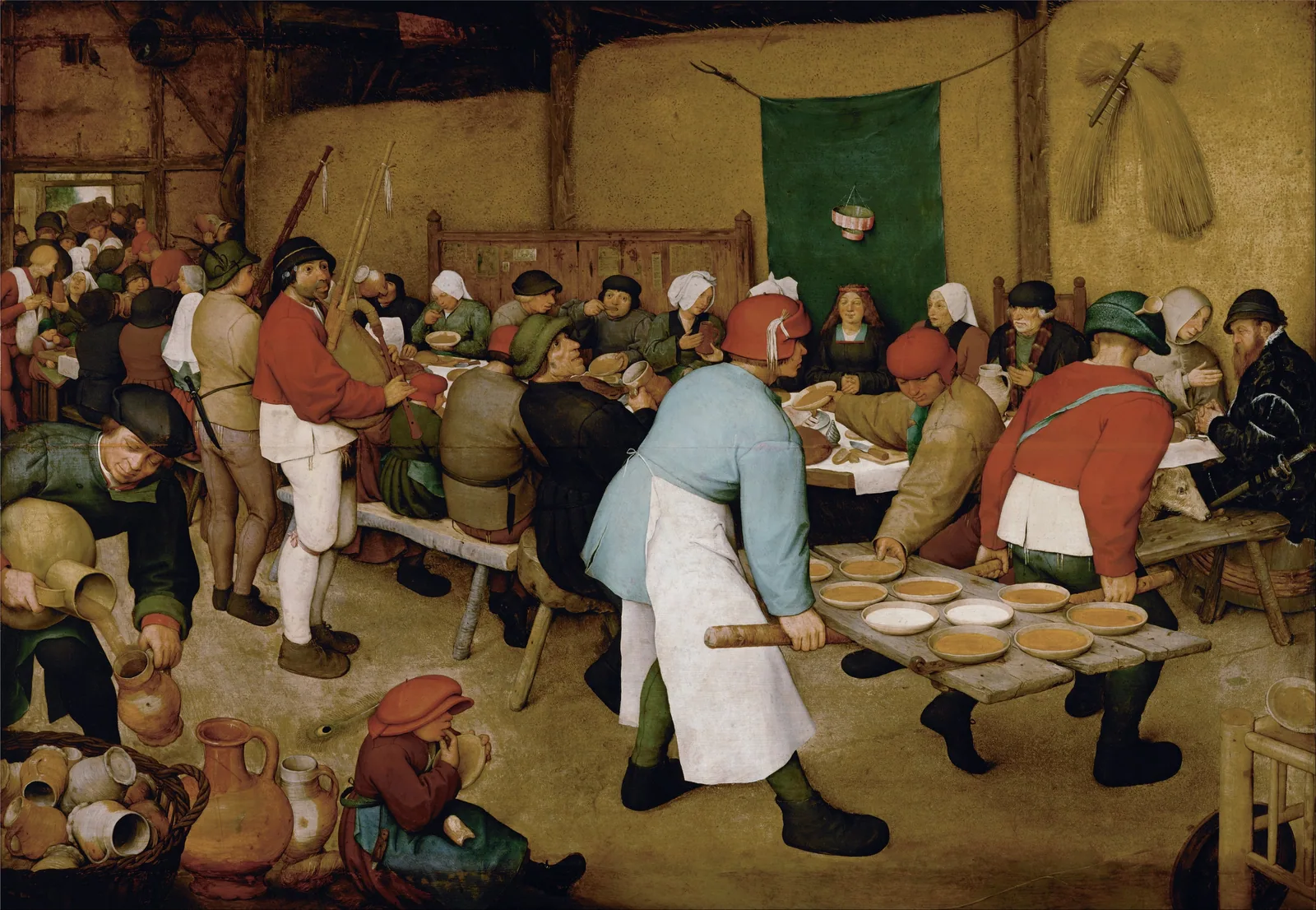
A wedding feast in a Flemish barn in summer. Guests crowd a long table, two bagpipers play, a man fills jugs with beer, and two more carry in bowls of porridge on a door they have taken off its hinges. In the middle of it all, in front of a green cloth, the bride sits perfectly still. Pieter Bruegel the Elder painted The Peasant Wedding in 1567, and it is one of the liveliest pictures of a party ever made.
Where is the bride?
She is easy to find once you know where to look: in front of the green wall-hanging, under a paper crown hung above her head. She wears a crown herself, sits with her hands folded and her eyes half closed, and does nothing at all. Everyone else is eating, serving, drinking or playing; the bride simply sits and receives the feast.
Where is the groom?
That is the puzzle. He is not obvious, and scholars have suggested several candidates:
- The man in the center in a dark coat, seen in profile.
- The young man eating with a spoon, his manners not the best.
- The man pouring the beer.
- The man in a red cap handing out the plates from the door.
One explanation is an old Flemish saying, quoted by the historian Van der Elst: it is a poor man who is not able to be at his own wedding. Bruegel leaves it for us to work out.
What to look for
The door. The serving tray is a door taken off its hinges, loaded with bowls of porridge.
The food. Bread, porridge and soup: simple country food, plenty of it.
The music. Two pipers play the pijpzak, the bagpipe. One of them stares at the food going past.
The child. In the foreground a small boy, too young yet for breeches, sits on the floor licking his plate.
The guests of honor. At the far right, a wealthy man is deep in conversation with a Franciscan friar, a little apart from the noise. A dog steals bread from the bench.
The harvest. On the back wall hang two sheaves of grain with a rake, a reminder that the feast is held in the barn where the year’s crop is stored.
Is there a hidden meaning?
Possibly. Some scholars read the painting as a Christian allegory, a warning about a corrupted Church, and others connect it to the Wedding at Cana, the feast in the Gospel of John. Most people simply enjoy it for what it shows: a village celebration, painted with warmth and humor, and no one looking very romantic.
Where is The Peasant Wedding now?
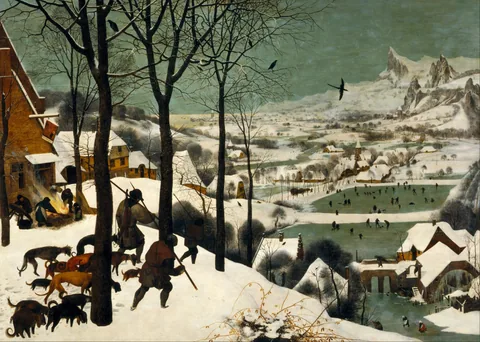
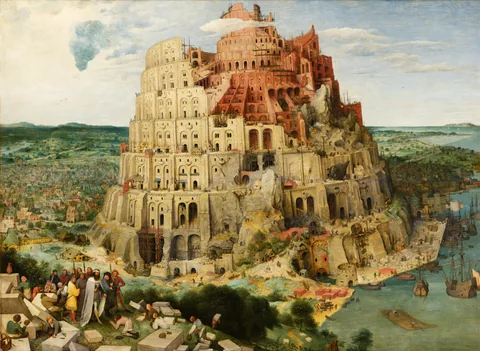
In the Kunsthistorisches Museum in Vienna, along with The Hunters in the Snow and The Tower of Babel.
Look closer
These details come from the scan we print from, 7,681 pixels on the long side. Pick a detail, or zoom in and drag to look for the groom yourself.
Sitting still in front of the green wall-hanging, hands folded, eyes half closed, a crown on her head.
Choosing a print
Wide, for the table. The panel is about 45 by 65 inches, and the figures are the size of a real party. Our largest framed print is 36 × 25 in, and unframed art prints go to 48 × 33 in. Framed prints go up to 36 × 25 in, canvas up to 48 × 33 in and unframed art prints up to 48 × 33 in.
The dining room picture. A feast belongs where people eat. It is a wonderful picture over a dining table or a sideboard, and a natural wedding or anniversary gift with a sense of humor. At 24 × 17 in it fits a kitchen wall. See our gift guide.
Which material. Smooth cotton paper in a frame keeps the many faces sharp. Canvas, with its matte finish and no cover, suits a bright kitchen or dining room. See our papers and canvas.
Frames. Natural oak suits the barn and the wooden table; black wood sharpens the reds. See all our frames.
After the feast, the dance. Pair it with The Peasant Dance. Open the two as a set.
Questions
Where is the bride in The Peasant Wedding?
In front of the green wall-hanging, under a paper crown, sitting still with her hands folded.
Where is the groom?
Nobody is sure. Several men have been suggested.
What are they carrying on the door?
Bowls of porridge. The door has been taken off its hinges to use as a tray.
Where is the painting?
In the Kunsthistorisches Museum in Vienna. It is 114 × 164 cm, about 45 × 65 in.
Can it be printed legally?
Yes. It was painted in 1567 and is in the public domain. What public domain means.
More Bruegel
All Bruegel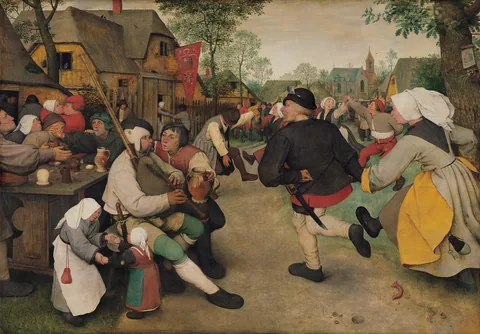
More in Dutch and Flemish Masters and Old Masters.
Sources
More from the Journal
 Story · 7 min
Van Gogh’s Starry Night: the facts, and choosing a print
Painted in June 1889 at an asylum in Provence: the view from his window, plus a village he made up. What is real, what it means, and which print to choose. Story · 7 min
The Great Wave off Kanagawa: meaning, history and prints
A woodblock print, not a painting, and a storm wave, not a tsunami. What it shows, why no two impressions match, and how to choose a print. Story · 7 min
Klimt’s The Kiss: gold leaf, meaning and choosing a print
Real gold leaf on canvas, finished in 1909. The story of Klimt’s lovers, what a print can and can’t reproduce, and which size to choose. Story · 7 min