
Story
Bruegel’s Tower of Babel: meaning, details and a print
A tower like the Colosseum, built around a rock and already crumbling. What Bruegel’s Tower of Babel means, what to look for, and choosing a print.
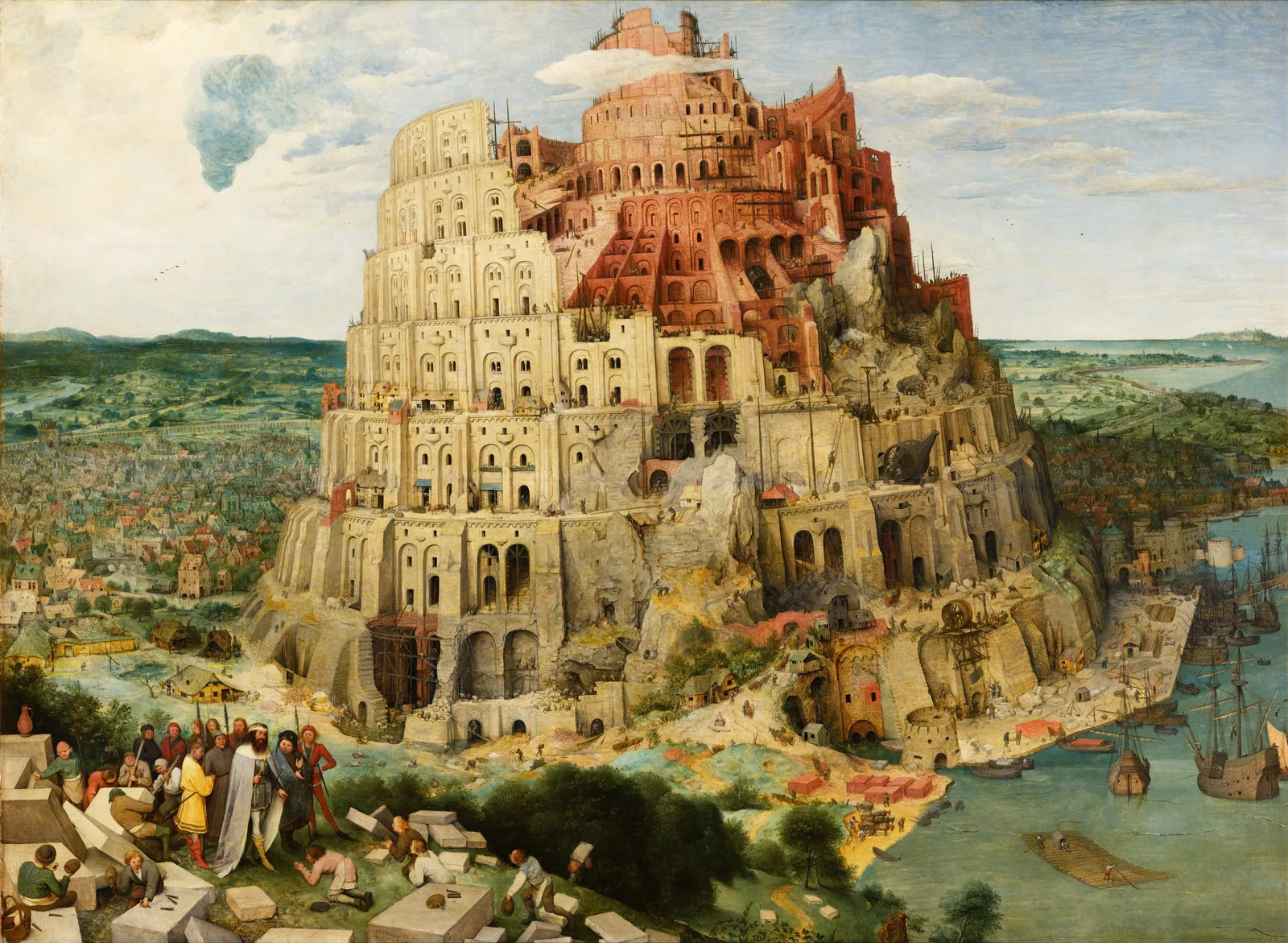
A tower the size of a mountain rises out of a busy port, ring upon ring of arches spiraling up into the clouds. Tiny workers swarm over it, ships crowd the harbor at its feet, and a king has come to inspect the work. Pieter Bruegel the Elder painted it in 1563, and it is the picture most people see when they think of the Tower of Babel.
The story behind it
The story is in the Book of Genesis, chapter 11. After the Flood, the people of the earth all spoke one language. They decided to build “a city, and a tower with its top in the heavens,” to make a name for themselves. God, seeing their pride, confused their speech so they could no longer understand one another, and scattered them across the earth. The tower was never finished. Babel is the name given to the city, and the story explains why the world has so many languages.
What to look for
The king. In the lower left, a king and his courtiers have come to see the builders. The figure is presumably Nimrod, the king traditionally linked to the tower. The stonemasons kneel to him in the middle of their work. Bruegel signed and dated the picture on a block of stone in front of him.
The Colosseum. The rows of round Roman arches deliberately recall the Colosseum in Rome. Bruegel had been to Rome ten years earlier, and he may also have used a 1551 print of the Colosseum by Hieronymus Cock. The Rome connection mattered: Rome, like Babylon, could stand for earthly pride and the way great things decay.
The rock. Look at the middle of the tower and you see bare rock. The tower is built around a steep little mountain, which the builders are carving away and wrapping in masonry at the same time.
It is already failing. The longer you look, the worse the building gets. The arches are built at right angles to sloping ground, so they lean and some are already crumbling. No layer is truly level; the whole thing is one rising spiral. And the lower levels are not finished while the upper ones are going up. It is a lesson in bad engineering as well as in pride.
The harbor and the city. On the right, ships crowd a harbor and rafts of timber float on the water. On the left, a town of steep roofs spreads out to the horizon, Flemish in look, though the story is set in Mesopotamia.
What does it mean?
The plain reading is the Bible’s: human pride, punished, and the futility of trying to reach heaven by your own effort. Writers have added others. In Bruegel’s Netherlands, Catholics and Protestants were in growing conflict, and a tower of people who can no longer understand each other spoke to that. A few years after he painted it, in 1566, a Bible in several languages, the Polyglot Bible, was published in Antwerp, which may have made the subject even more topical.
Three Towers of Babel
Bruegel painted the subject at least three times. The first, a miniature on ivory made in Rome around 1552 or 1553, is lost. This one, the large panel in Vienna, was painted for an Antwerp banker, Nicolaes Jonghelinck, and is often called the “Great” Tower of Babel. A smaller one, about 60 by 75 cm, is in the Museum Boijmans Van Beuningen in Rotterdam, and is known as the “Little” Tower; most scholars think it came after this one.
Look closer
These details come from the scan we print from, 30,000 pixels on the long side. Pick a detail, or zoom in and drag to find the workers, ladders and cranes all over the tower.
A king, presumably Nimrod, with his court, visiting the stonemasons, who kneel before him.
Choosing a print
Big, so you can explore. This is a picture to stand in front of and search. Our largest framed print is 36 × 26 in, and unframed art prints and canvas go to 48 × 35 in. Framed prints go up to 36 × 26 in, canvas up to 48 × 35 in and unframed art prints up to 48 × 35 in. Its wide shape suits a sofa wall, a dining room or a long hallway.
Where it works. A study, a library or an office, anywhere people think about building things. At 24 × 18 in it fits over a desk.
Which material. The detail is extraordinary, so a framed print on smooth cotton paper is the best way to keep the tiny workers sharp. Canvas has a matte finish and no cover, which suits a bright room. See our papers and canvas.
Frames. A wide gold frame like our Gold Plein Air suits a Renaissance panel and warms the stone; black wood is crisper and more modern. See all our frames. For more Bruegel, read the stories of The Hunters in the Snow and Netherlandish Proverbs.
Questions
What does the Tower of Babel painting mean?
Human pride and its punishment, from Genesis 11. The tower is already crumbling as it rises.
Who is the king in the painting?
Presumably Nimrod, the king linked to the tower, visiting the stonemasons with his court.
Why does it look like the Colosseum?
Bruegel modeled the arches on the Colosseum in Rome, which he had seen, on purpose.
Where is the painting?
This one, the “Great” Tower of Babel, is in the Kunsthistorisches Museum in Vienna. A smaller version is in the Museum Boijmans Van Beuningen in Rotterdam.
Can it be printed legally?
Yes. It was painted in 1563 and is in the public domain. What public domain means.
More Bruegel
All Bruegel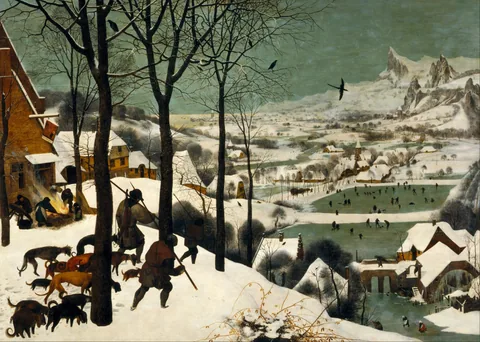
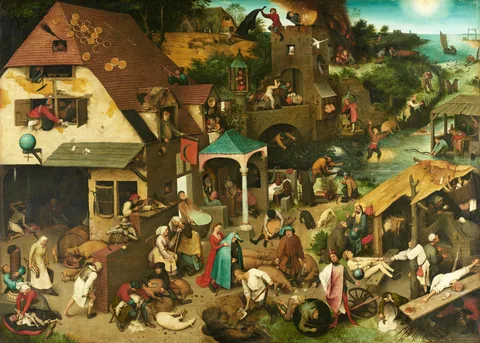
More in Old Masters and Cityscapes.
Sources
More from the Journal
 Story · 7 min
Van Gogh’s Starry Night: the facts, and choosing a print
Painted in June 1889 at an asylum in Provence: the view from his window, plus a village he made up. What is real, what it means, and which print to choose. Story · 7 min
The Great Wave off Kanagawa: meaning, history and prints
A woodblock print, not a painting, and a storm wave, not a tsunami. What it shows, why no two impressions match, and how to choose a print. Story · 7 min
Klimt’s The Kiss: gold leaf, meaning and choosing a print
Real gold leaf on canvas, finished in 1909. The story of Klimt’s lovers, what a print can and can’t reproduce, and which size to choose. Story · 7 min