
Story
Bruegel’s Winter Landscape with a Bird Trap: the story
Skaters on a frozen river and a trap waiting for the birds. The story of Bruegel’s small winter scene, its many copies, and choosing a print.
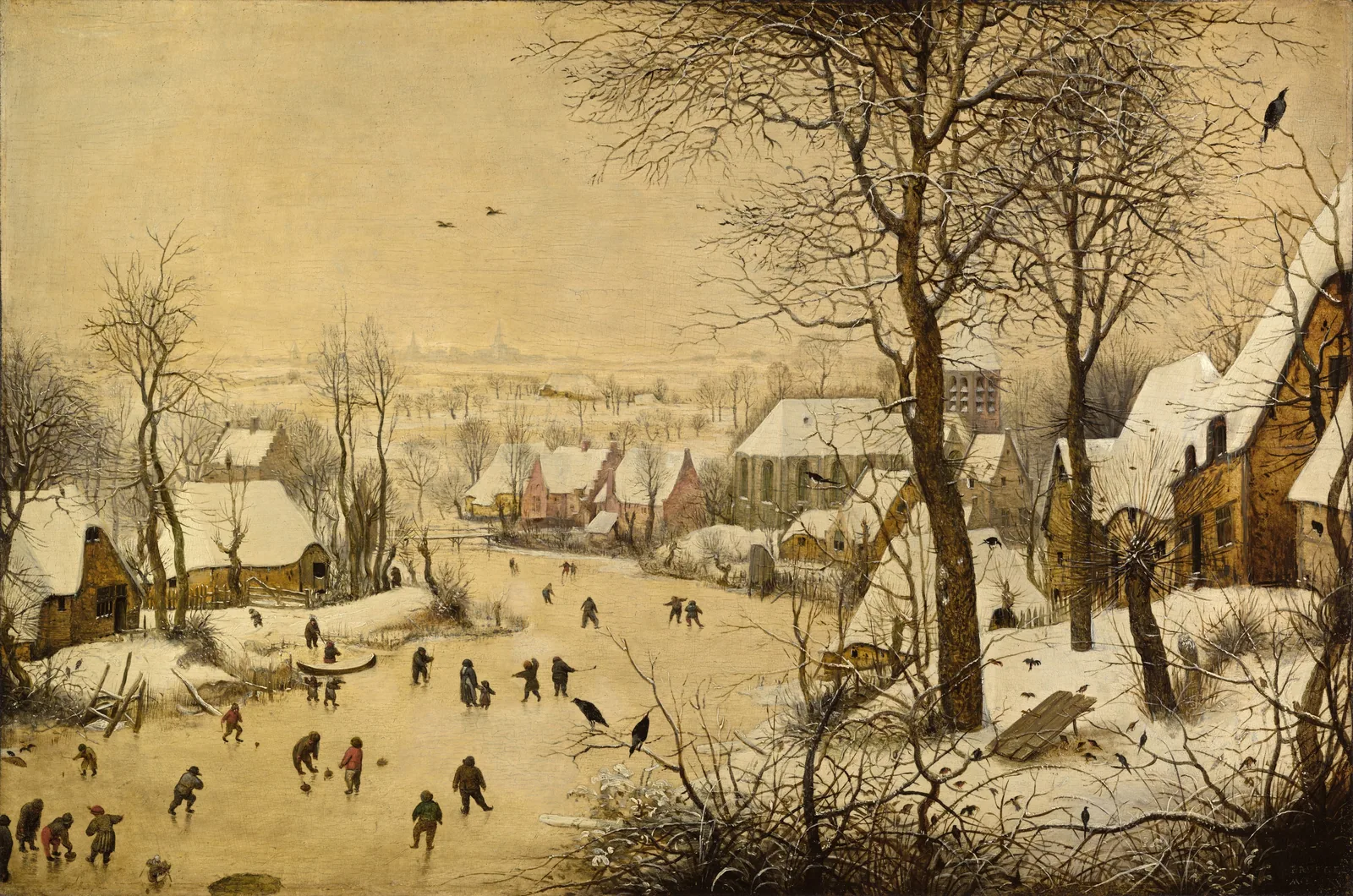
A village lies under snow. The river below it has frozen, and the villagers are out on the ice, skating, sliding and playing a game like curling. It looks like a cheerful winter afternoon. But over on the right bank, birds are pecking at seed scattered under an old door, propped up on a stick, with a rope running back to a house. Someone is waiting to pull it. Pieter Bruegel the Elder painted this small panel in 1565, and it became one of the most copied pictures of its age.
The trap
It is a simple, old trick. Prop up a board, scatter bait underneath, and when the birds gather, pull the stick away and the board falls on them. Bruegel painted it plainly: the door, the stick, the rope, the bait and the birds feeding on it, quite unaware.
Oddly, the trap was not part of his first plan. Technical study of the panel has found that the bird trap does not appear in the underdrawing, the sketch beneath the paint, so it was probably added late. Bruegel seems to have decided, as he worked, that the picture needed it. And once you notice it, it is hard to see the rest of the scene the same way.
What does it mean?
One natural way to read it is as a parallel. The birds feed happily under the trap; the people skate happily on the ice, and there is a hole in the ice near them. Both are carefree, and both are closer to danger than they know. On that reading the picture becomes a quiet reflection on how precarious life is.
Bruegel left no explanation, and art historians have proposed several moral and allegorical readings without any one of them winning general agreement. Part of the picture’s strength is that it does not insist. You can enjoy it as a lively snow scene, full of small figures and incident, and the trap is there for anyone who looks closely. Notice, too, the scale of the birds in the nearest trees: the three closest are at least as large as the skaters, as if Bruegel wanted us to weigh the two kinds of creature side by side.
Looking closely
The panel rewards slow looking. Start on the ice, where the small figures skate, slide and bend over the curling game, each one caught in a different movement. Find the hole in the ice and the skaters gliding past it. Then lift your eyes to the bare trees where the birds perch, and follow them down to the right bank: the door, the stick and the rope running to the house. Last, look at the village itself under its snow, the place all these people will go home to when the light fails.
Bruegel was a pioneer in making the life of ordinary country people the main subject of a painting, at a time when that was rare. There are no saints or heroes here, only a village on a cold day, and the drama is as small as a door falling on a few birds.
A real village
The village is said to be based on Sint-Anna-Pede, a village near Brussels; Bruegel had moved to Brussels around 1563. Its church also appears in his painting The Blind Leading the Blind. Bruegel signed and dated this panel at the lower right, as “BRVEGEL” with the year 1565. He had dropped the h from his name in 1559, while his children kept the spelling Brueghel, which is why the family name appears both ways.
The winter of 1565
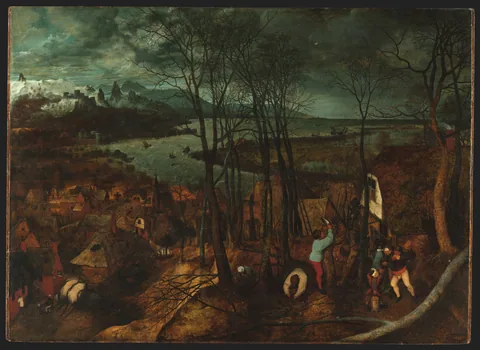
This is one of five snowy landscapes Bruegel painted in a short burst of years, pictures that helped make the winter landscape a subject in its own right. The most famous of them, The Hunters in the Snow, was painted the same year, as part of a series of the months commissioned by the Antwerp merchant Niclaes Jonghelinck. That series also includes The Gloomy Day. Bruegel’s winters of 1565 are often cited as evidence of the harsh weather of the period known as the Little Ice Age.
The two snow scenes make a good comparison. The Hunters in the Snow is large and sweeping. The bird trap is small, only about 15 by 22 inches, and more intimate, with the village close and the skaters almost within reach. Read the full story of the larger picture in Bruegel’s Hunters in the Snow.
A picture copied 127 times
After Bruegel’s death, his son Pieter Brueghel the Younger ran a large studio that made replicas of his father’s compositions, and the bird trap was one of its favorites. In 2000 the scholar Klaus Ertz catalogued 127 copies of it, all made in the 17th century. He attributed 45 to Pieter the Younger, considered 51 doubtful, and rejected 31 that were still worth noting. Each copy differs in small details: the curling game, the trap, the hole in the ice.
With so many copies around, the original itself was not widely recognized for a long time. The Brussels panel was rediscovered in 1925, stayed in a private collection in Brussels, and was bequeathed to the Royal Museums of Fine Arts of Belgium in 1973 by Mrs Delporte-Livrauw and Dr Franz Delporte. A new technical investigation in 2012 supported its authenticity as Bruegel’s own work. This is the painting our print is made from.
Choosing a print
Size. The original is small, but our scan is very large, 12,406 pixels on its long side, so every skater and bird stays crisp even in a big print: up to 36 × 24 in framed, or 48 × 32 in on canvas. Framed prints go up to 36 × 24 in, canvas up to 48 × 32 in and unframed art prints up to 48 × 32 in. At 24 × 16 in it is close to the size of the panel. A larger print lets you find all the little figures without leaning in.
Paper or canvas. Smooth paper keeps the tiny figures and the fine branches sharp. Canvas has a painted feel and no glass, which suits a bright room. See our papers and canvas.
Frames and walls. A dark wood or black frame suits a Netherlandish panel; gold gives it a more traditional look. It looks good on a warm white, gray or soft blue wall. See our frames.
Season. It is a winter scene without any holiday signs, so it can stay up all season. For more ideas, see winter art prints.
Questions
What is the bird trap in Bruegel’s painting?
An old door propped up on a stick over scattered bait, with a rope running to a house. When birds gather, the stick is pulled and the door drops.
What does the painting mean?
It is often read as a parallel between the carefree birds near the trap and the carefree skaters near a hole in the ice, a reflection on how fragile life is. No single reading is agreed.
Is this the original or a copy?
Our print is made from the panel in Brussels, which a 2012 study supported as Bruegel’s own. Many 17th-century copies exist, many of them by Pieter Brueghel the Younger.
Where is it?
In the Royal Museums of Fine Arts of Belgium, Brussels, since 1973. It is 37 × 56 cm.
Can it be printed legally?
Yes. Bruegel died in 1569, and the painting is in the public domain. What public domain means.
More Bruegel
All Bruegel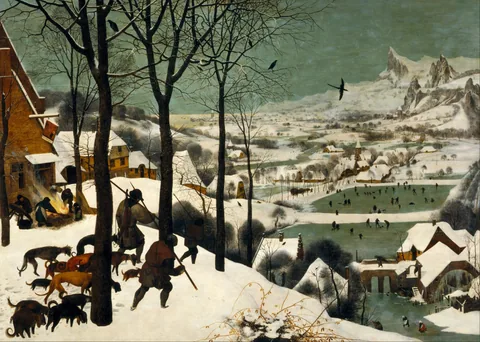
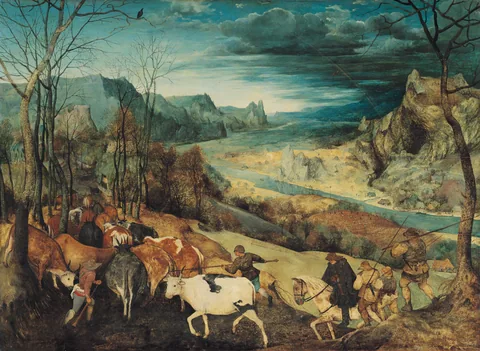
More in Birds and Animals.
Sources
More from the Journal
 Story · 7 min
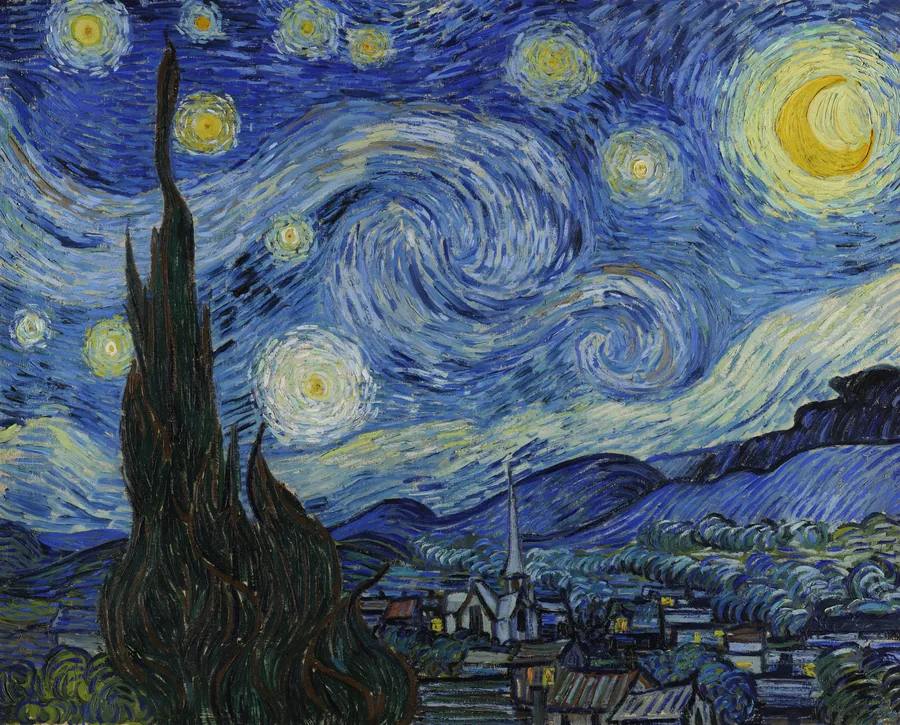
Van Gogh’s Starry Night: the facts, and choosing a print
Painted in June 1889 at an asylum in Provence: the view from his window, plus a village he made up. What is real, what it means, and which print to choose.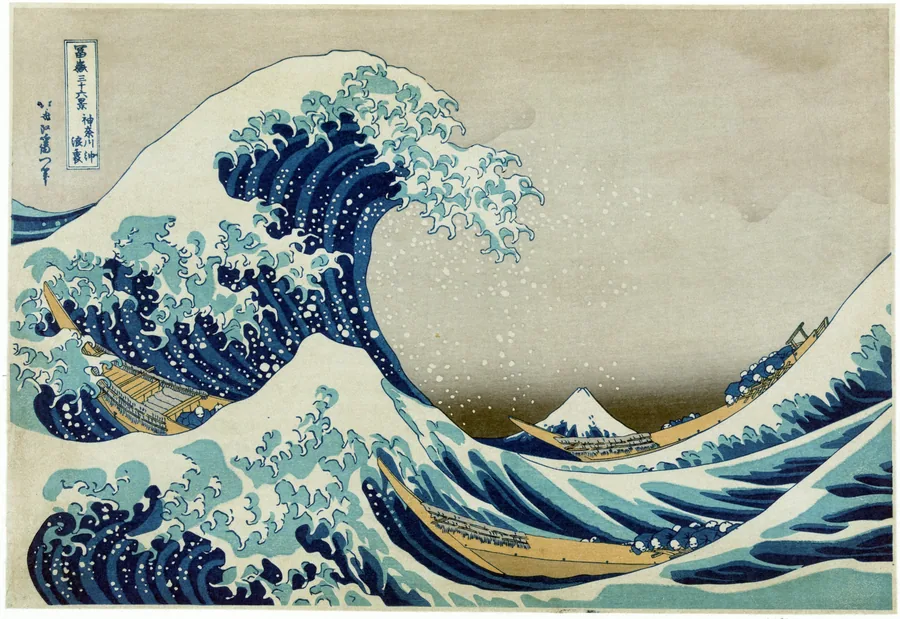 Story · 7 min
The Great Wave off Kanagawa: meaning, history and prints
A woodblock print, not a painting, and a storm wave, not a tsunami. What it shows, why no two impressions match, and how to choose a print. Story · 7 min
Klimt’s The Kiss: gold leaf, meaning and choosing a print
Real gold leaf on canvas, finished in 1909. The story of Klimt’s lovers, what a print can and can’t reproduce, and which size to choose. Story · 7 min