
Story
The Abbey in the Oakwood: Friedrich’s winter funeral
Monks carry a coffin into a ruined abbey at dusk. What Friedrich’s darkest painting means, its pairing with The Monk by the Sea, and a print.
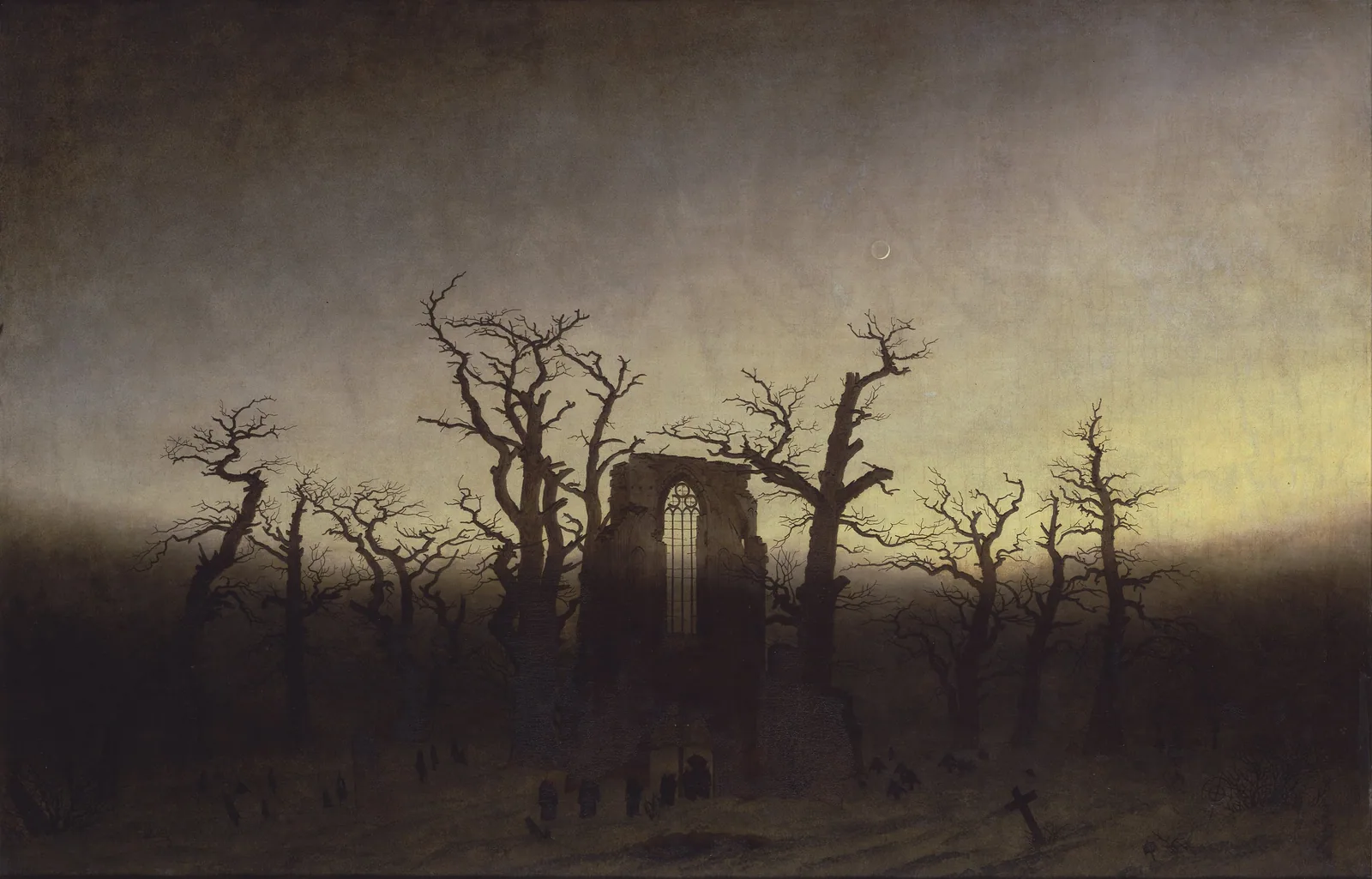
Winter, at dusk. The ruined gable of a Gothic church stands among bare, twisted oaks, a thin crescent moon above it. Below, in the snow and the dark, a line of monks carries a coffin toward the ruin, lit by only two candles, past a freshly dug grave. Caspar David Friedrich painted it in Dresden in 1809 and 1810. It is one of the most somber pictures of the Romantic age.
What is happening?
A funeral. The monks are bringing a coffin to the ruined church. In the foreground a newly dug grave opens out of the snow, and crosses lean faintly in the dark. The whole lower third of the picture is in near darkness; the setting sun lights only the top of the ruin and the tips of the oaks. High above, a waxing crescent moon has come up. Everything is about endings: the end of the day, of the year, of a life, of a building.
Is the abbey real?
Yes. Friedrich based it on his studies of the ruins of Eldena Abbey, near Greifswald on the Baltic coast. The abbey had been wrecked in the Thirty Years’ War by Swedish troops, who later used its bricks for fortifications. As always, Friedrich rearranged what he had drawn into a scene of his own.
What does it mean?
On one level it is about death and what follows it: the procession moves from the dark ground toward the ruined church and the light above. Friedrich returned to graves and cemeteries in more than two dozen works.
It also had a political edge in 1810. Friedrich drew a parallel between the soldiers who wrecked Eldena long ago and the French soldiers who were using the churches of Greifswald as barracks. The art historian Albert Boime read the funeral as a symbol of the burial of Germany’s hopes for resurrection.
The pair: Monk by the Sea
Friedrich first showed it in 1810 at the Prussian Academy of Arts exhibition in Berlin, together with The Monk by the Sea, and at his request it was hung beneath that picture. King Frederick William III bought both. The two still hang side by side in the Alte Nationalgalerie in Berlin: a lone monk before an empty sea, and a burial in a frozen wood.
Look closer
These details come from the scan we print from, 4,000 pixels on the long side. The painting is very dark at the bottom, so the monks are hard to see. Pick a detail, or zoom in and drag to look around.
The gable of a ruined Gothic church, its tall window empty, drawn from the ruins of Eldena Abbey.
Choosing a print
Size, honestly. The original is big, about 43 by 67 inches, but our scan of it only prints sharply up to 24 × 15 in, so that is our largest. Framed prints, canvas and unframed art prints all go up to 24 × 15 in. At that size the silhouette of oaks and ruin reads strongly, but the tiny monks become hard to make out.
Where it works. A wide, dark picture for a study, a library or a hallway: somewhere quiet, lit from the side. It suits anyone who loves the Gothic, winter or the Romantics.
Which material. This is a very dark painting. Behind clear acrylic, dark areas reflect a facing window, so a framed print needs side light; canvas, with its matte finish and no cover, avoids that. Smooth cotton paper gives the deepest darks. See canvas and our papers.
Frames. Black wood suits the mood; a white mat gives a small dark picture room to breathe. See all our frames and mats.
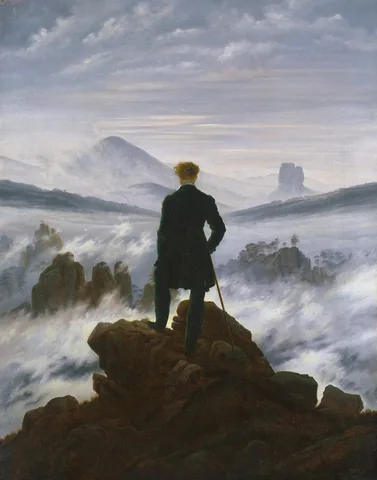
The Berlin pair. Open it with The Monk by the Sea, the way Friedrich wanted them seen. And read the story of his Wanderer above the Sea of Fog.
Questions
What does The Abbey in the Oakwood show?
A funeral procession of monks carrying a coffin to a ruined Gothic church among bare oaks, at dusk in winter.
Is it a real place?
It is based on Friedrich’s studies of the ruins of Eldena Abbey, near Greifswald.
Where is the painting?
In the Alte Nationalgalerie in Berlin, beside its pair, The Monk by the Sea.
How big is it?
110 × 171 cm, about 43 × 67 in.
Can it be printed legally?
Yes. Friedrich died in 1840, and the painting is in the public domain. What public domain means.
More Friedrich
All Friedrich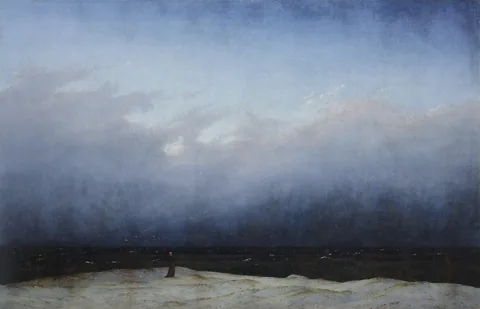
More in Moody Landscapes and Winter.
Sources
More from the Journal
 Story · 7 min
Van Gogh’s Starry Night: the facts, and choosing a print
Painted in June 1889 at an asylum in Provence: the view from his window, plus a village he made up. What is real, what it means, and which print to choose. Story · 7 min
The Great Wave off Kanagawa: meaning, history and prints
A woodblock print, not a painting, and a storm wave, not a tsunami. What it shows, why no two impressions match, and how to choose a print. Story · 7 min
Klimt’s The Kiss: gold leaf, meaning and choosing a print
Real gold leaf on canvas, finished in 1909. The story of Klimt’s lovers, what a print can and can’t reproduce, and which size to choose. Story · 7 min