
Story
Wanderer above the Sea of Fog: meaning and places
Who the man on the rock might be, the real mountains Friedrich combined, why we only see his back, and what to know before buying a print.
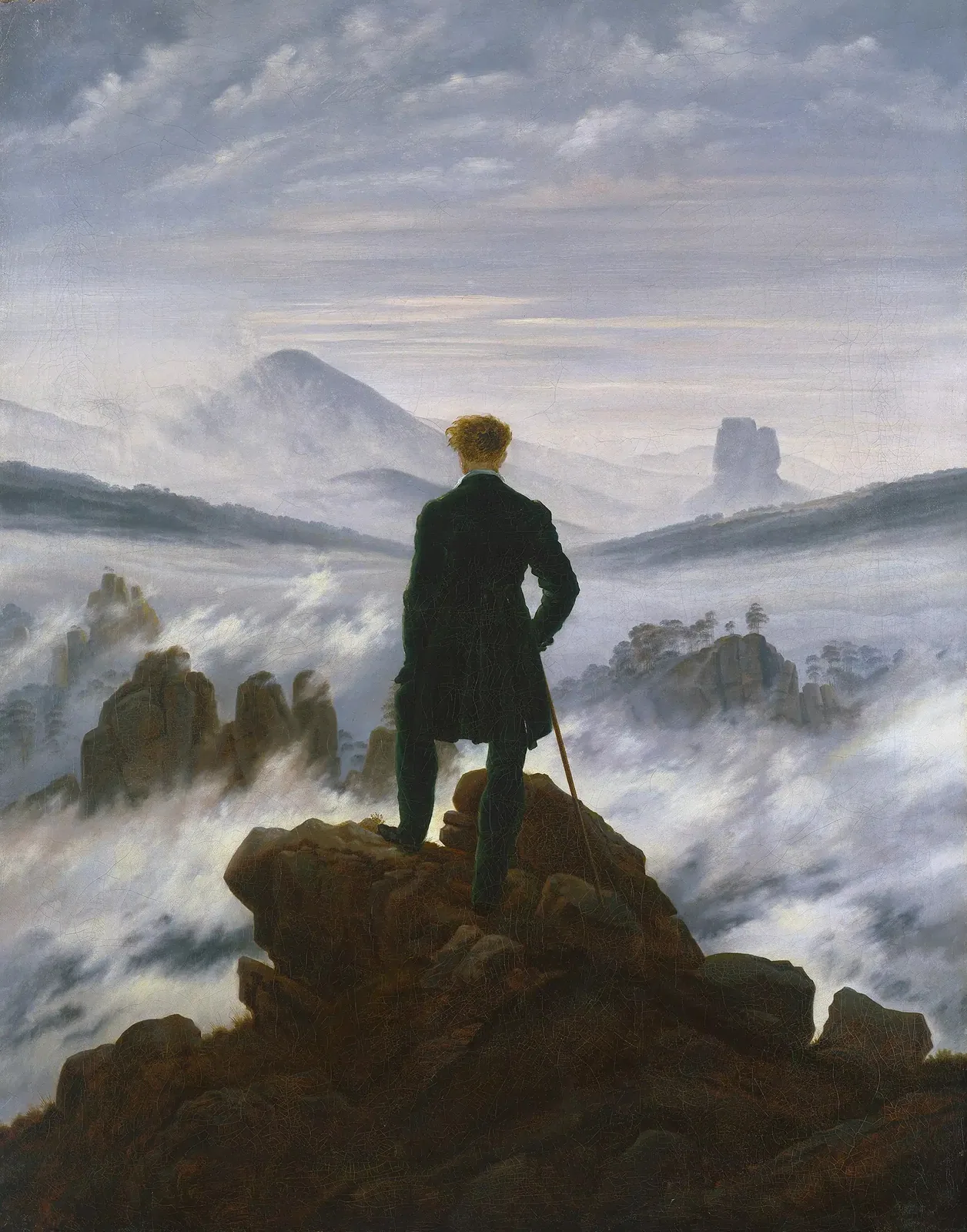
A man stands on a rock at the top of a mountain, his back to us, his hair blown by the wind. Below him, fog fills the valleys, with peaks and pinnacles poking through like islands. The German painter Caspar David Friedrich made it around 1818, and two centuries later it is the picture that stands for the whole Romantic movement, on book covers, posters and parodies.
What is the painting called?
In German, Der Wanderer über dem Nebelmeer: the wanderer above the sea of mist, or fog. The date is usually given as 1818, though some sources say 1817. It is a full-size studio painting, about 37 by 29 inches, not a quick outdoor sketch.
Who is the wanderer?
Nobody knows. Friedrich left no name. Some people see a self-portrait, partly because the wanderer has the same reddish hair as the painter. He wears a dark green overcoat and carries a walking stick. Writers have read that coat in different ways: the art historian Norbert Wolf sees altdeutsch, “old German,” patriotic dress, while others see the uniform of a Jäger, a rifleman. Either way, he is a man of his time, not a timeless hiker.
Why do we only see his back?
Germans have a word for a figure seen from behind: Rückenfigur. Friedrich used it more than almost any other painter, in pictures of people at windows, on beaches and under the moon. The trick is simple and strong. Because we can’t see his face, we can’t read his mood, so we bring our own. We stand just behind him and look where he looks. This one, set dead center and filling so much of the canvas, is perhaps the most famous Rückenfigur in art.
Is it a real place?
Yes and no. Friedrich made drawings on the spot in the Elbe Sandstone Mountains, the craggy hills along the river Elbe in Saxony and Bohemia, then rearranged them in his studio into a view that does not exist from any one point. You can still name the pieces:
- The wanderer stands on the rocks of the Kaiserkrone.
- The rock group on the left, in the fog, is the Gamrig near Rathen.
- The cone-shaped mountain behind it is the Rosenberg or the Kaltenberg; writers disagree.
- The flat-topped rock on the right horizon is the Zirkelstein.
What does it mean?
Friedrich did not explain it, and that openness is part of its appeal. The usual readings:
- Looking inward. The man on the summit as an image of thinking about your own life and the road ahead, the core of Romanticism.
- The sublime. Nature so big it overwhelms you. Friedrich himself wrote that mist makes a landscape appear larger and more sublime.
- Politics. If the coat is patriotic dress, the painting carries the hopes of German liberals and nationalists after Napoleon.
- Faith. The art historian Joseph Koerner links the mist rising from the earth to the Book of Genesis, as if we were watching the world being made.
It has also become the image of the mountaineer as a visionary; the writer Robert Macfarlane called it the archetypal picture of one. It is on the cover of a well-known paperback of Frankenstein, and it has been parodied in Doctor Who and Minecraft.
Where is Wanderer above the Sea of Fog?
In the Hamburger Kunsthalle, the art museum in Hamburg, Germany. It passed through private collections; by 1939 it was with a Berlin dealer, Wilhelm August Luz, and the Kunsthalle acquired it in 1970.
Look closer
These details come from the scan we print from, 2,500 pixels on the long side. Pick a detail, or zoom in and drag to look around.
A man in a dark green overcoat, his back to us, a walking stick at his side. We see what he sees, but never his face.
Choosing a print
A small print, honestly. The scan we have of this painting is good, but not large, and we only sell sizes a file can print sharply. So this one goes up to 13 × 16 in, well under the 37 by 29 inch original. Framed prints, canvas and unframed art prints all go up to 13 × 16 in. That is the right scale for a desk wall, a bookshelf, a hallway or a study, places where you stand close.
Hang it low and close. Small pictures look best at eye level, where you meet the wanderer at his own height: center it 57 to 60 inches from the floor, or group it with others. See how high to hang art.
Frames and paper. The colors are soft grays and browns. A black or dark wood frame gives the small picture weight; a white mat around it makes it look bigger and calmer. Smooth matte paper keeps the fine mist and the edges of the rocks crisp. See our frames, mats and papers.
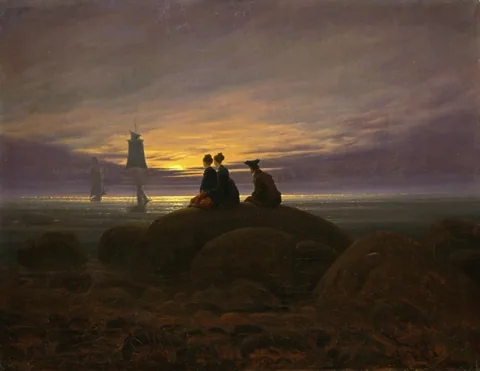
A pair. Friedrich’s Two Men Contemplating the Moon is another back view, two men on a rocky path at dusk under a crescent moon. Open the two as a set.
Questions
Who painted Wanderer above the Sea of Fog?
The German Romantic painter Caspar David Friedrich, around 1818.
Who is the man in the painting?
He is not named. Some think it is a self-portrait; the painter and the wanderer share the same reddish hair.
Where is the view?
A combination of real places in the Elbe Sandstone Mountains, in Saxony and Bohemia, put together in the studio. The Zirkelstein is on the right horizon.
Where is the original?
In the Hamburger Kunsthalle in Hamburg, Germany. It is 94.8 × 74.8 cm, about 37 × 29 in.
Can it be printed legally?
Yes. Friedrich died in 1840, and the painting is in the public domain. What public domain means.
More Friedrich
All Friedrich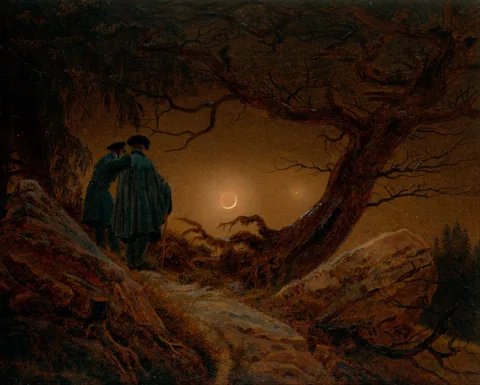
More in Moody Landscapes and Landscapes.
Sources
More from the Journal
 Story · 7 min
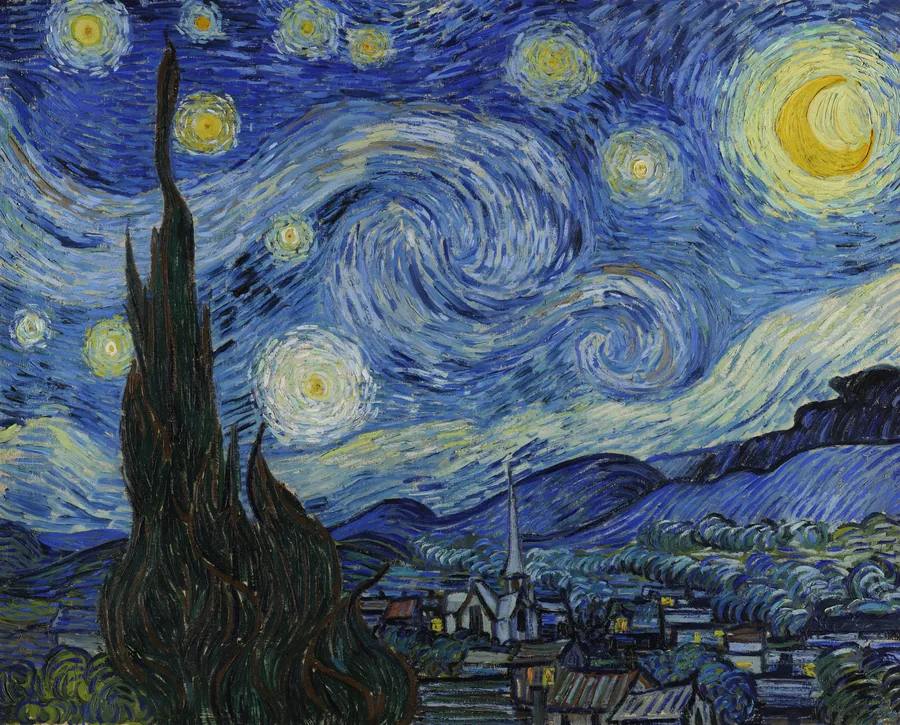
Van Gogh’s Starry Night: the facts, and choosing a print
Painted in June 1889 at an asylum in Provence: the view from his window, plus a village he made up. What is real, what it means, and which print to choose.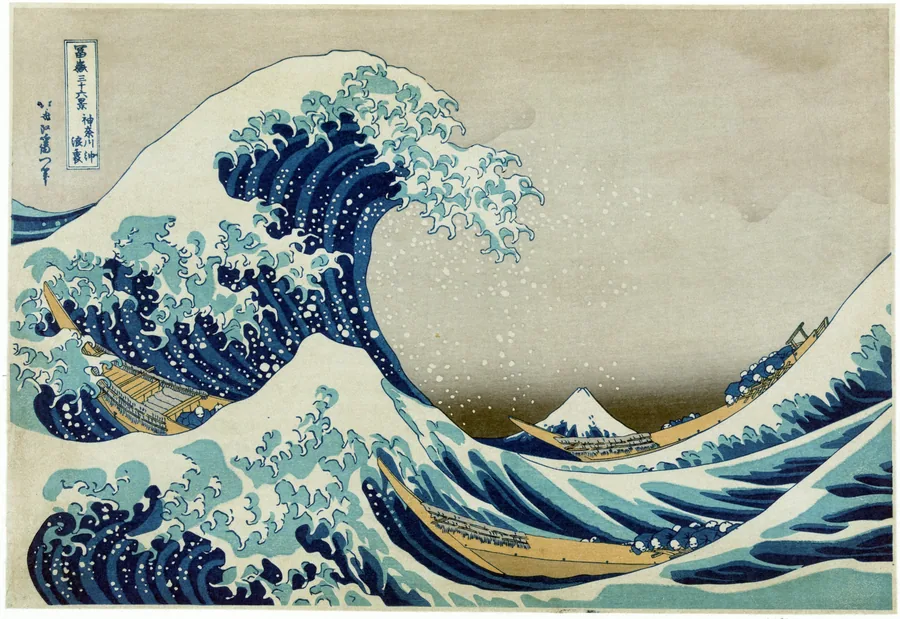 Story · 7 min
The Great Wave off Kanagawa: meaning, history and prints
A woodblock print, not a painting, and a storm wave, not a tsunami. What it shows, why no two impressions match, and how to choose a print.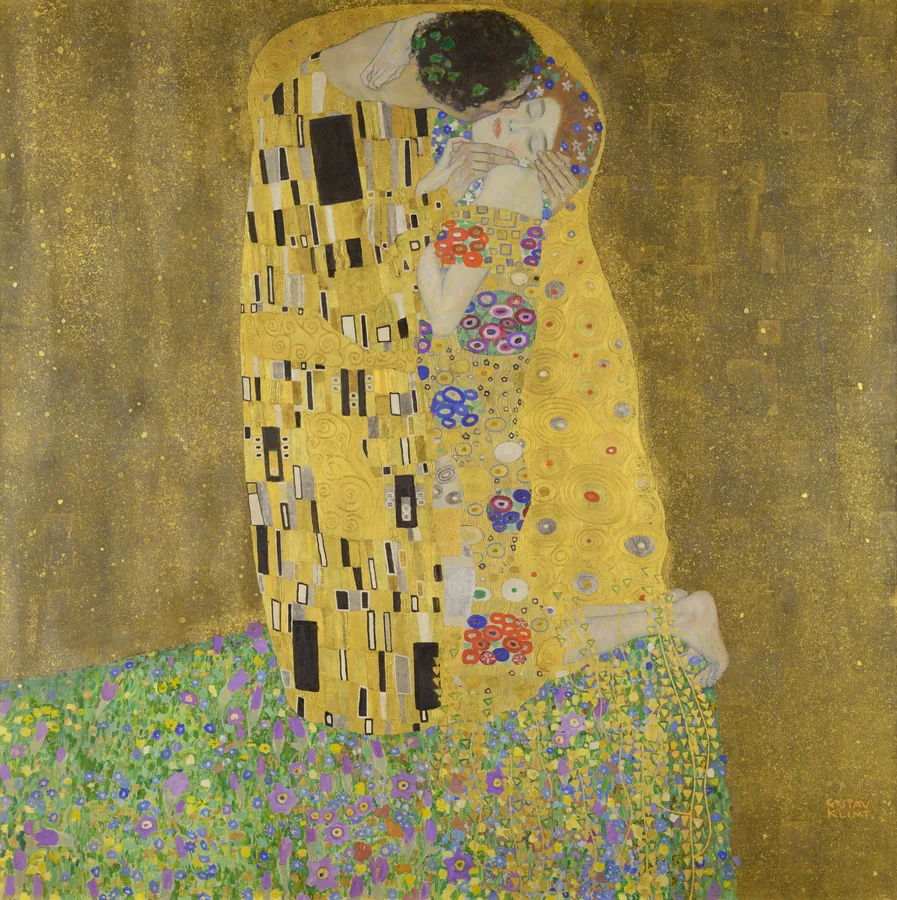 Story · 7 min
Klimt’s The Kiss: gold leaf, meaning and choosing a print
Real gold leaf on canvas, finished in 1909. The story of Klimt’s lovers, what a print can and can’t reproduce, and which size to choose. Story · 7 min