
Story
Haeckel’s jellyfish: the story of Art Forms in Nature
Jellyfish drawn like chandeliers and lace. The story behind Ernst Haeckel’s Art Forms in Nature, its jellyfish plates, and choosing a print.
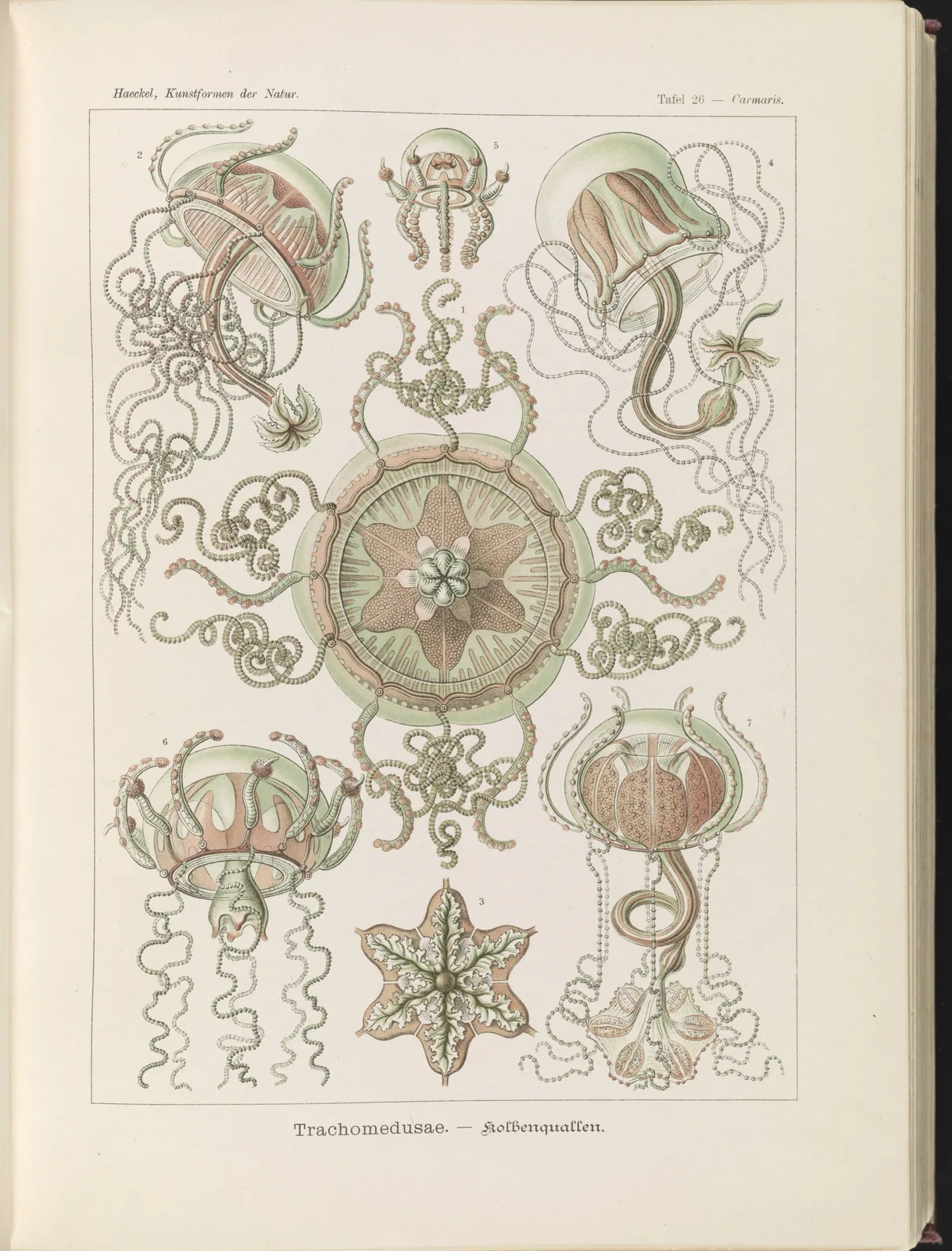
Jellyfish drift across the page, their bells like glass domes, their tentacles hanging like threads of lace. Each one is drawn with perfect symmetry, arranged on the plate as carefully as jewels in a case. This is one of the jellyfish plates from Kunstformen der Natur, or Art Forms in Nature, the great picture book by the German biologist Ernst Haeckel. More than a century later, its plates are still reprinted, framed and admired.
What this print is
It helps to be clear about how these pictures were made. Haeckel drew his subjects in sketches and watercolors. The plates in the book were then made by a lithographer, Adolf Giltsch, who translated Haeckel’s drawings into prints using lithography and halftone. This plate, number 26, shows the jellyfish group Haeckel called Trachomedusae, and in German Kolbenquallen. Our print is a reproduction of an impression in the Library of Congress.
How a lithograph is made
Lithography, invented in the 1790s, works on a simple principle: grease and water do not mix. The printer draws the image on a smooth stone or plate with a greasy crayon or ink, then wets the surface. The water stays only where there is no drawing, and when oily printing ink is rolled on, it sticks only to the drawn lines. A sheet of paper pressed against the stone picks up the image. For a color plate, the printer uses a separate stone for each color and prints them one after another, lining each up exactly.
It is painstaking work, and it took real skill to turn Haeckel’s sketches into plates this fine. Giltsch’s name is less known than Haeckel’s, but every line you see in the print passed through his hands.
A book of a hundred wonders
Art Forms in Nature came out in sets of ten plates between 1899 and 1904, and was then collected in two volumes in 1904, with 100 plates in all. A second edition in 1914 had 30. The plates show sea creatures, microscopic organisms, plants and animals, many of them species Haeckel had studied himself.
The book was never meant to be only a set of illustrations. The historian Olaf Breidbach describes it as the summation of Haeckel’s view of the world. Its great themes are symmetry and the level of organization in living things: the way nature builds complex, orderly forms, often with a regularity that looks designed. Haeckel arranged each plate to show that order off, which is why the creatures look so composed, as if placed on the page by a decorator.
The jellyfish plates
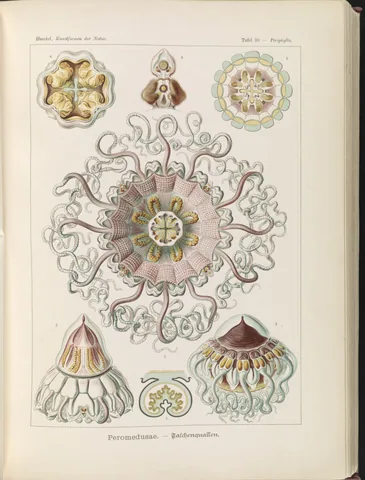
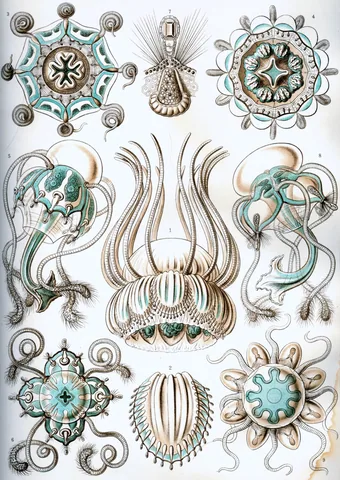
Jellyfish and their relatives, the cnidarians, are among the most prominent subjects in the book. The eighth plate shows the Discomedusae, and there are several more jellyfish plates, each devoted to a different group: the Trachomedusae shown here, and others including the Leptomedusae, Narcomedusae, Stauromedusae, or stalked jellyfish, and Peromedusae, the crown jellyfish. Hung side by side, they make a kind of catalog of how varied a jellyfish can be.
Haeckel knew jellyfish well. He wrote the report on deep-sea medusae for the British Challenger expedition, published in 1881. And one of his jellyfish carries a personal story. His first wife, Anna Sethe, died in the 1860s. Haeckel named a jellyfish Desmonema annasethe after her; its long, trailing tentacles reminded him of her hair. It appears in the first set of Art Forms in Nature, and the species is now called Cyanea annasethe.
Who was Ernst Haeckel?
Haeckel was a zoologist, physician, marine biologist and artist, and a professor of zoology at the University of Jena for 47 years. He was one of the leading promoters of Charles Darwin’s ideas in Germany. He also coined words we still use every day, including ecology, phylum and phylogeny. His monograph on radiolarians, tiny sea creatures with intricate glassy skeletons, is among his best-known scientific works; on one trip to the Mediterranean he named nearly 700 new species of them. The shop has his plate of disc radiolarians from the same book.
His legacy is not simple. His famous idea that the development of an embryo replays the evolution of its species has been refuted, and his embryo drawings have been criticized as oversimplified and partly inaccurate. More seriously, he promoted scientific racism and ranked human races, and historians still argue over how far his social Darwinism fed later ideologies. The pictures in Art Forms in Nature can be admired for what they are, but they come from a complicated man.
From the sea to Art Nouveau
The book landed at exactly the right moment. Around 1900 the Art Nouveau style was at its height, with its love of organic, flowing, natural forms, and designers found in Haeckel’s plates a whole library of shapes. The architect René Binet, the photographer Karl Blossfeldt, the designer Hans Christiansen and the glass artist Émile Gallé were all influenced by his images. The Amsterdam Commodities Exchange, designed by Hendrik Petrus Berlage, was partly inspired by them too.
That is part of why the plates still feel modern. They sit somewhere between science and decoration, and they look at home in a laboratory, a design studio or a living room.
Choosing a print
Size. The original sheet is about 14 by 10 inches. Our scan is 8,297 pixels on its long side, so it can go much bigger than the book page: at 12 × 16 in it is close to the original, and it holds up to 27 × 36 in framed, or 30 × 40 in on canvas. Framed prints go up to 27 × 36 in, canvas up to 30 × 40 in and unframed art prints up to 37 × 48 in.
Paper or canvas. Smooth paper keeps the fine lines of the tentacles as sharp as the original lithograph. See our papers.
Frame and mat. A thin black frame with a white mat gives it the look of a scientific plate; natural wood makes it warmer. See our frames and mats.
Where it works. A bathroom, a study, a hallway or a child’s room. The jellyfish plates look best as a set of two, three or four, hung in a grid. Or hang a jellyfish beside the radiolarian plate to show two sides of the book: creatures you can see in the sea, and creatures so small they need a microscope. Both are full of the symmetry Haeckel set out to show. For more ideas, see our guide to botanical and natural history prints.
Questions
What is Art Forms in Nature?
Kunstformen der Natur, a book of 100 plates by the German biologist Ernst Haeckel, issued in sets from 1899 to 1904, showing the symmetry and order of living things.
Who made the prints?
The lithographer Adolf Giltsch, working from Haeckel’s sketches and watercolors.
Which jellyfish is named after Haeckel’s wife?
Desmonema annasethe, now Cyanea annasethe, named after Anna Sethe. Its tentacles reminded him of her hair.
Is this an original lithograph?
No. It is a reproduction of plate 26, made from an impression in the Library of Congress, printed on modern paper.
Can it be printed legally?
Yes. The plate was published in 1904 and is in the public domain. What public domain means.
More from Art Forms in Nature
All Haeckel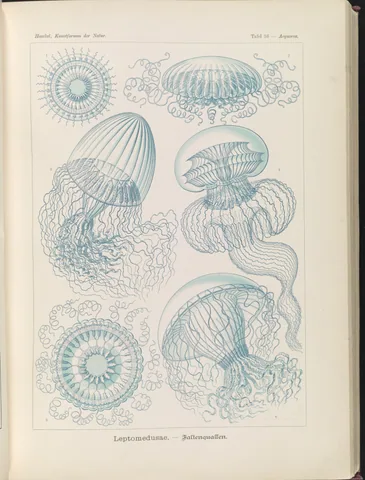
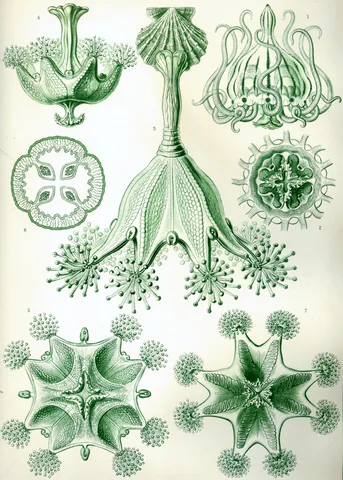
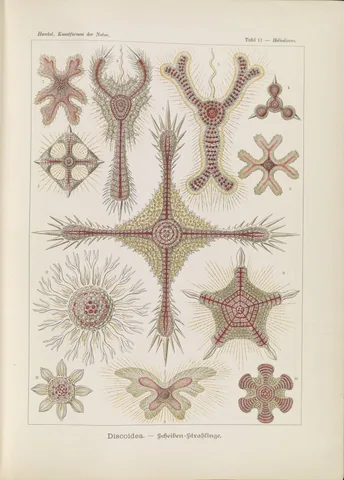
More in Natural History Plates.
Sources
More from the Journal
 Story · 7 min
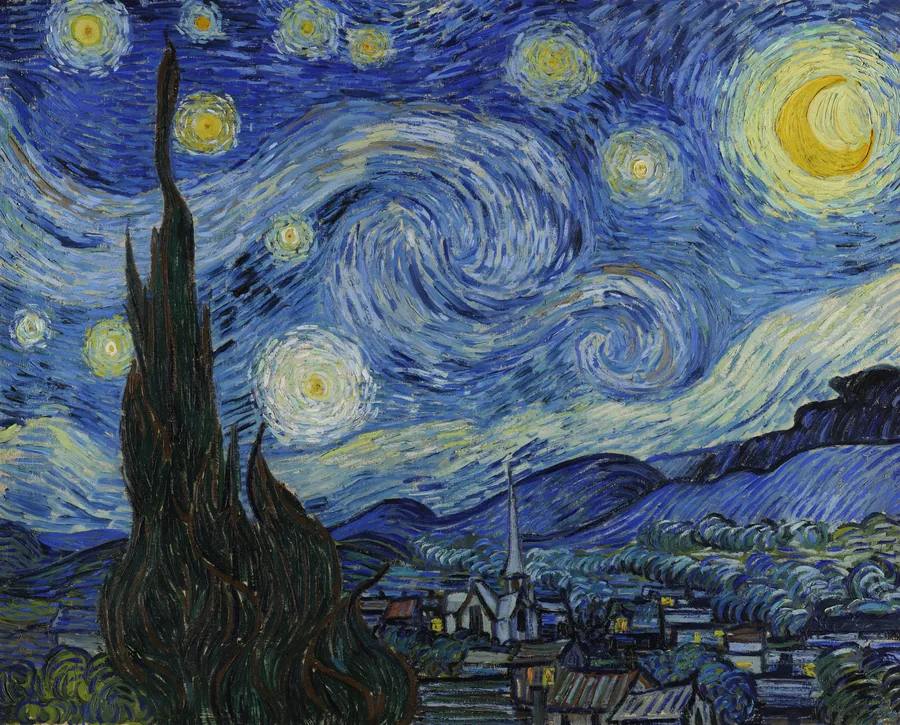
Van Gogh’s Starry Night: the facts, and choosing a print
Painted in June 1889 at an asylum in Provence: the view from his window, plus a village he made up. What is real, what it means, and which print to choose.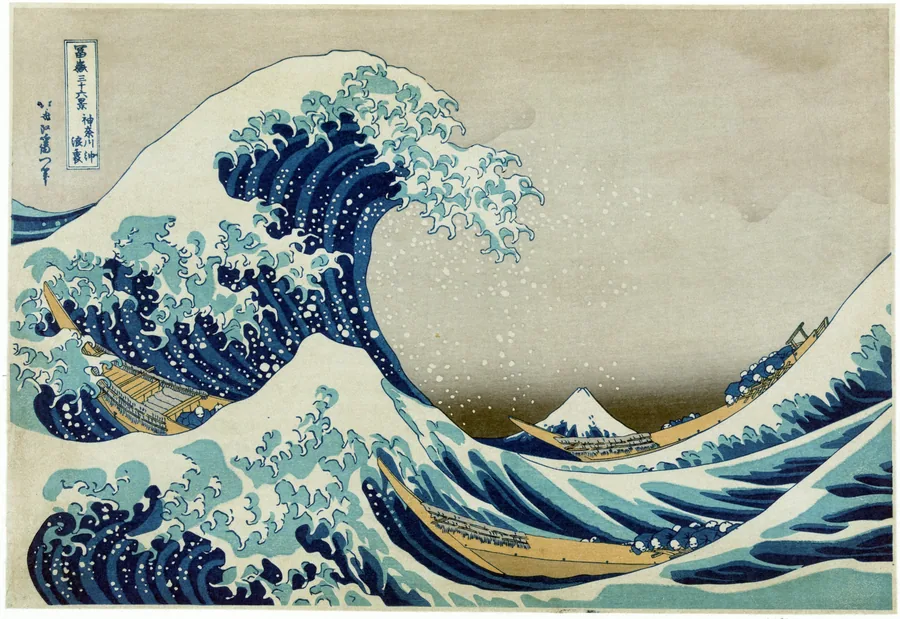 Story · 7 min
The Great Wave off Kanagawa: meaning, history and prints
A woodblock print, not a painting, and a storm wave, not a tsunami. What it shows, why no two impressions match, and how to choose a print. Story · 7 min
Klimt’s The Kiss: gold leaf, meaning and choosing a print
Real gold leaf on canvas, finished in 1909. The story of Klimt’s lovers, what a print can and can’t reproduce, and which size to choose. Story · 7 min