
Story
Plum Park in Kameido: Hiroshige’s print and Van Gogh
A dark plum branch cutting across a red sky. The story of Hiroshige’s Plum Park in Kameido, the copy Van Gogh painted, and choosing a print.
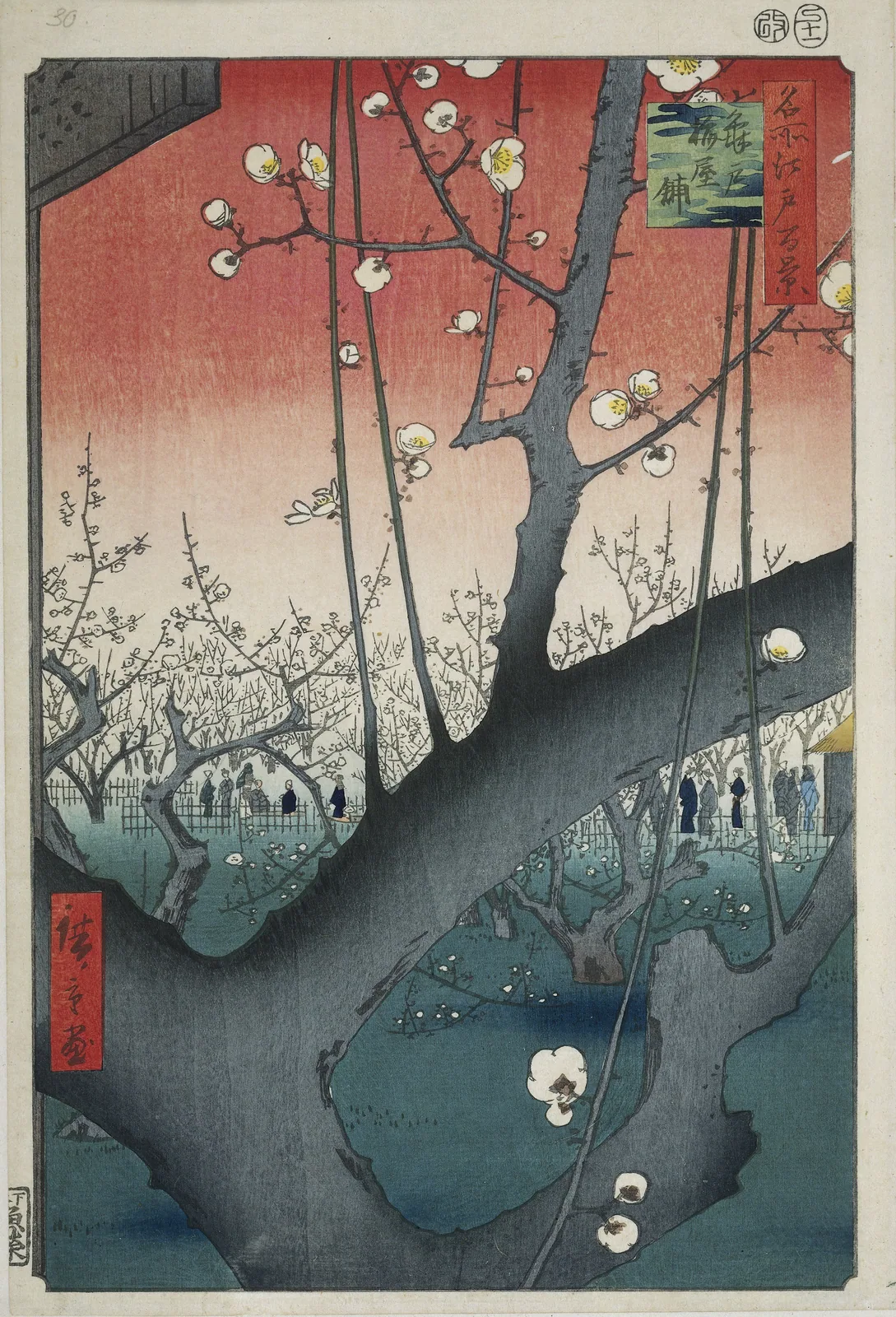
A dark plum branch cuts across the front of the picture, so close that we see only part of it, twisting like a stroke of a brush. Behind it, a garden of plum trees is in white blossom, a few small figures stand behind a low fence, and the sky glows red. Utagawa Hiroshige designed this woodblock print in 1857, near the end of his life. Thirty years later Vincent van Gogh copied it in oil, and through his copy the print became famous far beyond Japan.
The Sleeping Dragon Plum
The garden was real. Kameido, on the east side of Edo, the city we now call Tokyo, had a famous plum garden near the Sumida River. Its most celebrated tree was known as the Garyūbai, the Sleeping Dragon Plum. That is the tree in the foreground of the print, or rather part of it. Hiroshige let the frame cut it off, so the trunk and branch become a dark, calligraphic shape laid over the whole scene.
The Japanese title, Kameido Umeyashiki, means the plum estate at Kameido. In the top left corner is a sign, as you would find at a real garden. The visitors behind the fence are tiny, which makes the tree feel even larger and closer.
A view through the branches
What makes the print so striking is the way it is built. Most landscape pictures put the main subject in the middle distance. Hiroshige puts a huge, cropped object right in front of your face and makes you look past it. He exaggerates the perspective, so the garden seems to fall away behind the branch. And he paints the sky an unnatural red, which flattens the space and makes the whole picture read almost as a pattern of shapes and colors.
The scene is usually described as an early morning view of the blossom. The trees are Prunus mume, the Japanese apricot, always called plum in English, and the print sits in the spring part of the series. In the same series, Hiroshige made a second plum print, Plum Orchard in Kamada, close to this one in color and theme. And the design outlived him: in 1862 his pupil Hiroshige II reused the composition in a series of his own.
One Hundred Famous Views of Edo
The plum garden is number 30 in One Hundred Famous Views of Edo, a series of 119 prints published from 1856. It was arranged by the seasons, spring, summer, autumn and winter, and the plum garden belongs to spring. The publisher was Sakanaya Eikichi. The prints were issued one by one, and this one appeared in the eleventh month of 1857 by the Japanese calendar.
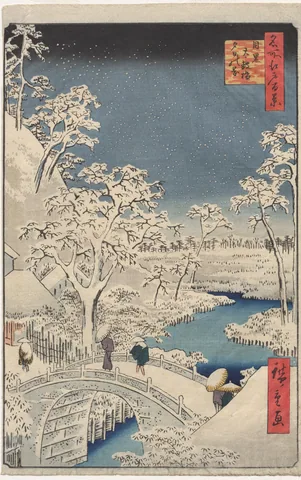
The series used a tall, vertical format that Hiroshige had pioneered a few years earlier, a break from the wide landscapes of his earlier famous series. Edo had been hit by a great earthquake in 1855, and several prints show buildings reopened or rebuilt after it, so the series can be seen in part as a portrait of a city recovering. Hiroshige died in 1858, before it was finished, and his pupil, known as Hiroshige II, completed it. The series was hugely popular and was reprinted many times. Another famous sheet from it is Sudden Shower over Shin-Ōhashi Bridge and Atake, with its slanting lines of rain.
Van Gogh’s copy
Van Gogh lived in Paris from 1886 to 1888, and there he fell for Japanese prints. He bought more than 600 of them from the dealer Siegfried Bing, at an average of about 15 centimes a sheet, and most of them are now in the Van Gogh Museum in Amsterdam, including 78 by Hiroshige.
In October and November 1887 he painted Flowering Plum Orchard (after Hiroshige), a close copy of this print, now in the Van Gogh Museum. He made a tracing of the print, squared it up and enlarged it slightly onto his canvas. Remarkably, the very sheet he traced has been identified, in the British Museum: a short pencil line on its upper right edge, where the background changes from pink to cream, lines up with the tracing. Van Gogh kept the cropped tree, the bold blocks of color, the strong outlines and the diagonals, but painted them with his own flat, intense brushwork. He also added two vertical strips of Japanese characters down the sides, real words taken from other prints that have nothing to do with the garden.
His own copy of the print has faded over the years. The Art Newspaper links that to the casual way he treated prints in Paris, where they were cheap enough to pin up and handle. What mattered to him was what he could learn from them. Writing on a drawing a year later, in the south of France, he noted that it did not look Japanese, and yet it was the most Japanese thing he had done.
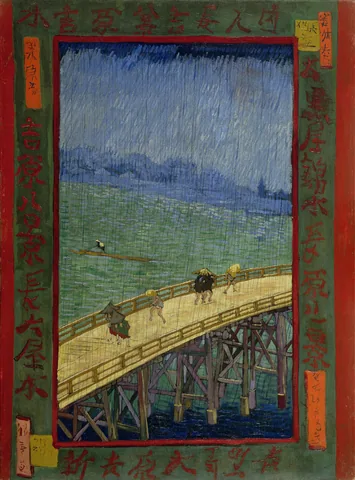
He painted a companion picture at the same time, Bridge in the Rain (after Hiroshige), based on the Sudden Shower print, with a red and green border of characters. The series as a whole inspired Western artists, Van Gogh among them, to experiment with Japanese methods, and the plum garden was one of the ways in. The Art Newspaper also reports that the print was a source for Paul Gauguin’s Vision of the Sermon of 1888.
About this print
A Japanese woodblock print was made from several carved wooden blocks, one for each color, printed by hand onto paper, so there were many impressions, and they vary. What we print is a reproduction of one historical impression of Hiroshige’s design, photographed and printed on modern paper or canvas. It is not an original woodblock print. Read more in our guide to Japanese woodblock prints.
Size. The original sheet is about 14½ by 10 inches. Our scan is 3,000 pixels on its long side, which keeps it to a modest size: framed up to 14 × 20 in. Framed prints, canvas and unframed art prints all go up to 14 × 20 in. That is close to the scale of the original, which is how a print like this is meant to be seen.
Paper and frame. Smooth paper suits a print that was made on paper, and keeps the fine black lines crisp. A thin black or natural wood frame with a white mat is the classic way to show a Japanese print. See our papers, frames and mats.
Where it works. Its tall, narrow shape fits beside a window or a door, and the red sky warms a cool room. It looks good hung as a pair with Sudden Shower, or in a row of prints from the same series.
Questions
What does Plum Park in Kameido show?
The Sleeping Dragon Plum, a famous tree in a plum garden at Kameido in Edo (now Tokyo), in blossom, seen up close with the garden and its visitors beyond.
When was it made?
In 1857, as number 30 of Hiroshige’s series One Hundred Famous Views of Edo.
Did Van Gogh copy it?
Yes. He painted Flowering Plum Orchard (after Hiroshige) in Paris in 1887, from a tracing of the print. It is in the Van Gogh Museum, Amsterdam.
Is this an original woodblock print?
No. It is a reproduction of a historical impression, printed on modern paper or canvas.
Can it be printed legally?
Yes. Hiroshige died in 1858, and the design is in the public domain. What public domain means.
More Hiroshige, and Van Gogh’s copy
All Hiroshige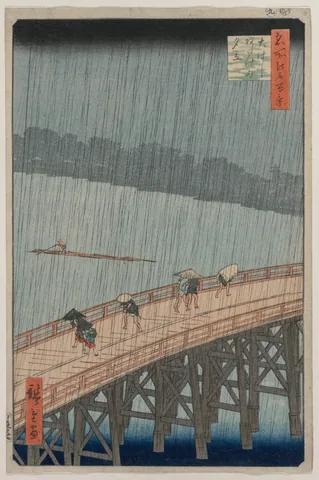
More in Japanese Woodblock.
Sources
More from the Journal
 Story · 7 min
Van Gogh’s Starry Night: the facts, and choosing a print
Painted in June 1889 at an asylum in Provence: the view from his window, plus a village he made up. What is real, what it means, and which print to choose. Story · 7 min
The Great Wave off Kanagawa: meaning, history and prints
A woodblock print, not a painting, and a storm wave, not a tsunami. What it shows, why no two impressions match, and how to choose a print. Story · 7 min
Klimt’s The Kiss: gold leaf, meaning and choosing a print
Real gold leaf on canvas, finished in 1909. The story of Klimt’s lovers, what a print can and can’t reproduce, and which size to choose. Story · 7 min