
Story
Hokusai’s Ejiri in Suruga Province: a sudden gust of wind
Travelers bent double, a hat in the air and papers flying past Mount Fuji. The story of Hokusai’s windy print, and choosing a print.
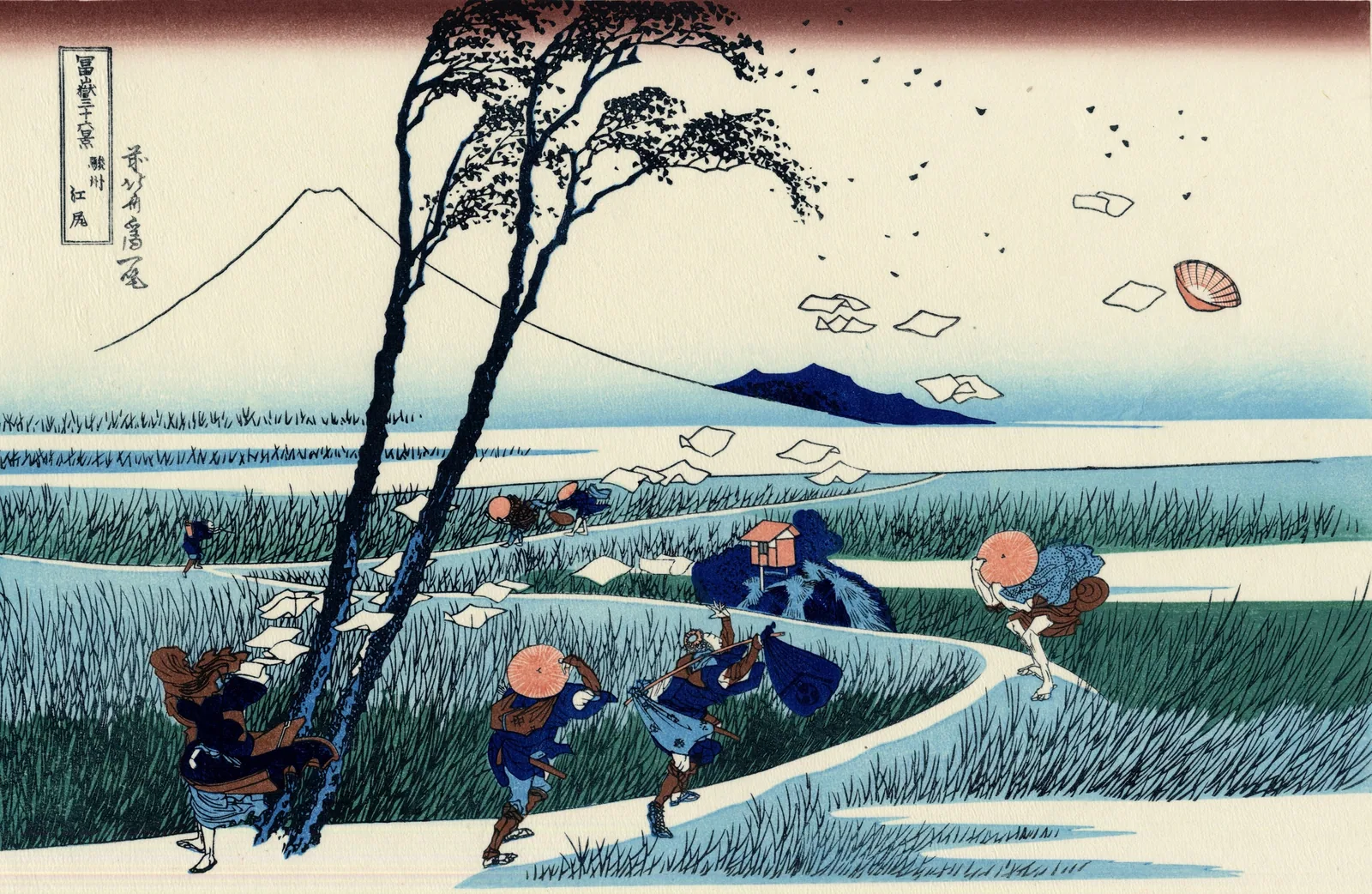
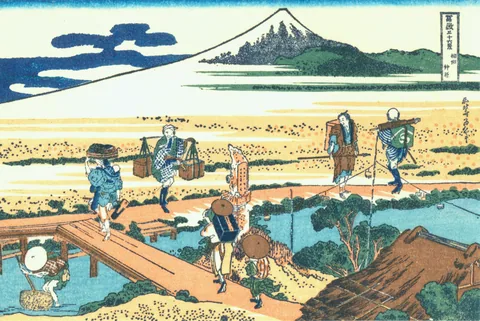
A gust of wind sweeps across a marsh. Travelers on a winding path bend double against it, clutching their hats and their clothes. A porter’s hat sails up into the air. Squares of paper are torn away and scatter across the field, and leaves fly off a tree. In the distance, untouched by any of it, stands the pale outline of Mount Fuji. Katsushika Hokusai designed this print around 1831 for his series Thirty-six Views of Mount Fuji. Its title is simply Ejiri in Suruga Province, but it is often called A Sudden Gust of Wind.
A comedy in the wind
The critic Andrew Graham-Dixon calls Fuji the serene backdrop to a scene of natural turbulence enlivened by human comedy, and comedy is the right word. Every figure is in trouble in a different way. The travelers along the path are bent double, clutching at their scarves and hats and holding their kimonos closed. In the foreground a porter, with two cloth-wrapped bundles slung on a bamboo pole, reaches up just too late to save his hat. A woman has the cloth over her head blown across her face, and from her pack a stream of papers flies off across the field. Two thin trees bend in the gale, and their leaves whirl away, as Graham-Dixon puts it, like confetti.
Look closely and you will find that no two figures react the same way. Each one adds a different touch of humor. It is a scene anyone who has been caught out in a storm will recognize.
Fuji, drawn in a single line
Against all that movement, the mountain is almost nothing: a simple outline, a silhouette, barely more than a line. That is the joke and the point of the print. Everything in the foreground is flying, bending, slipping and grabbing. Fuji does not move. The series is about the mountain, and here Hokusai shows it the way you might glimpse it on a bad day, in the background, while you are busy chasing your hat.
The DailyArt writers see in it a theme that runs through Hokusai’s work: the fragility of the human world against the power of nature. In The Great Wave, that power is terrifying. Here it is only a gust of wind, and the result is comic, but the idea is the same.
How the picture is built
Follow the path. It winds in from the foreground and snakes away through the reeds into the distance, and the travelers are strung out along it, so your eye moves from one small drama to the next. The trees stand up on one side like a pair of posts, bending with the gust, and the flying papers and leaves carry the movement across the open sky. Then, at the end of it all, there is the still shape of the mountain.
The whole scene is open and low, with a wide, empty sky, which makes the wind feel even stronger. There is nowhere to shelter. Hokusai used open space to make you feel the cold gust go straight through the picture.
An ordinary place
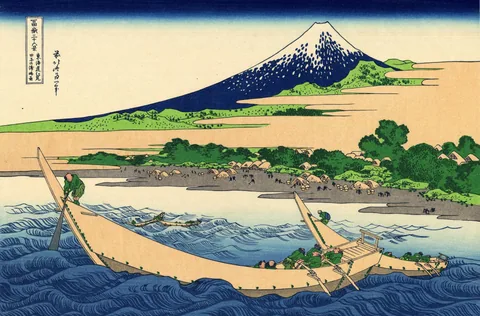
Ejiri was a post station on the Tōkaidō, the great highway between Edo and Kyoto, west of the port of Shimizu. The area was famous for the pine grove at Miho no Matsubara, one of the beauty spots of Japan. Hokusai ignored it. He chose instead a prosaic stretch of reedy marshland with a path snaking through it. Graham-Dixon suggests that he did it on purpose, to prove that he could bring even the most ordinary setting to life through composition, wit and imagination. The store also has his other view near Ejiri, Shore of Tago Bay, Ejiri at Tōkaidō, for comparison.
Thirty-six Views of Mount Fuji
Hokusai made the series from about 1830 to 1832, when he was in his seventies and at the height of his career. The publisher, Nishimura Yohachi, issued 36 prints, and the series was such an immediate success that ten more were added, for 46 in all. Ejiri in Suruga Province is number 18. Mount Fuji had deep cultural and religious significance in Japan, which helped the prints sell.
The series is also known for its blues. Prussian blue, a pigment made in Europe, had not long before reached Japan, and Hokusai used it extensively in these prints, helping to make it popular. A few years later he went back to the mountain in a book, One Hundred Views of Mount Fuji, published in 1834 and 1835.
A gust of wind in Vancouver
In 1993 the artist Jeff Wall remade the print as a large color photograph, A Sudden Gust of Wind (after Hokusai), now in the collection of Tate Modern in London. It is 250 by 397 cm, shown in a light box. Wall worked on it for five months with five actors, shooting in a landscape near Vancouver, British Columbia, when the weather was right, and then combining elements of different shots digitally. In his version a woman’s papers scatter across the picture, two men hold onto their hats, and a third looks up as his hat flies away, under two bending trees. The marsh has become brown farm fields with a canal, shacks and telegraph poles. More than a century and a half later, Hokusai’s little joke about the wind still worked.
About this print
What we print is a reproduction of a historical impression of Hokusai’s design, on modern paper or canvas. It is not an original woodblock print. Read more in our guide to Japanese woodblock prints.
Size. The original sheet is about 10 by 14½ inches, a wide landscape. Our scan is 4,374 pixels on its long side. At 16 × 10 in it is close to the size of the original. It holds up to 24 × 16 in framed. Framed prints, canvas and unframed art prints all go up to 24 × 16 in.
Paper and frame. Smooth paper keeps the fine lines of the reeds and the flying papers crisp. A thin black or natural wood frame with a white mat is the classic choice for a Japanese print. See our papers, frames and mats.
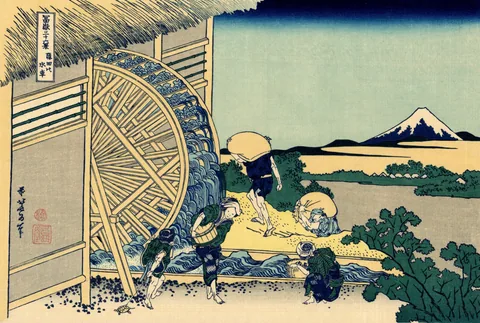
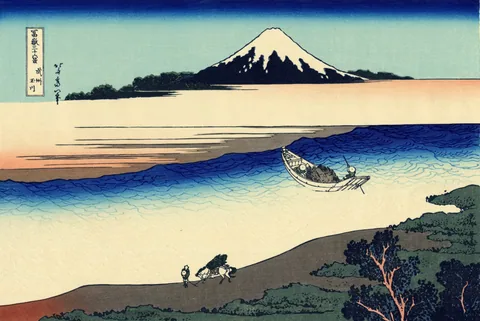
Where it works. An entryway, a hallway or a home office, anywhere a little humor helps. It makes a lively pair with the Great Wave, two very different kinds of weather from the same series, or a set of three with two calmer views of Fuji, such as the Watermill at Onden and the Tama River.
Questions
What does Ejiri in Suruga Province show?
Travelers on a path through marshland near Ejiri, on the Tōkaidō road, caught in a sudden gust of wind, with hats, papers and leaves flying and Mount Fuji outlined behind.
Why is it called A Sudden Gust of Wind?
That is a popular name. Hokusai’s title is Ejiri in Suruga Province (Sunshū Ejiri), number 18 of Thirty-six Views of Mount Fuji.
Who remade it as a photograph?
Jeff Wall, in 1993, as A Sudden Gust of Wind (after Hokusai), now at Tate Modern.
Is this an original woodblock print?
No. It is a reproduction of a historical impression, printed on modern paper or canvas.
Can it be printed legally?
Yes. Hokusai died in 1849, and the design is in the public domain. What public domain means.
More views of Fuji
All Hokusai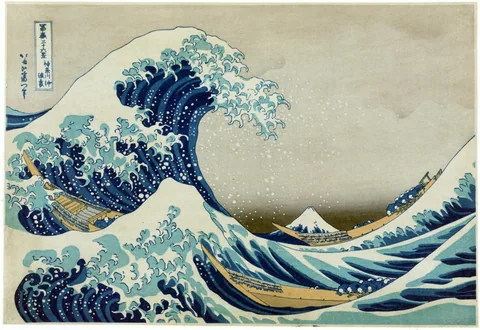
More in Japanese Woodblock.
Sources
More from the Journal
 Story · 7 min
Van Gogh’s Starry Night: the facts, and choosing a print
Painted in June 1889 at an asylum in Provence: the view from his window, plus a village he made up. What is real, what it means, and which print to choose. Story · 7 min
The Great Wave off Kanagawa: meaning, history and prints
A woodblock print, not a painting, and a storm wave, not a tsunami. What it shows, why no two impressions match, and how to choose a print. Story · 7 min
Klimt’s The Kiss: gold leaf, meaning and choosing a print
Real gold leaf on canvas, finished in 1909. The story of Klimt’s lovers, what a print can and can’t reproduce, and which size to choose. Story · 7 min