
Story
The Mona Lisa: who she was, the theft and choosing a print
Who sat for Leonardo, why the smile seems to move, how a Louvre worker stole her in 1911, and what size print to choose.
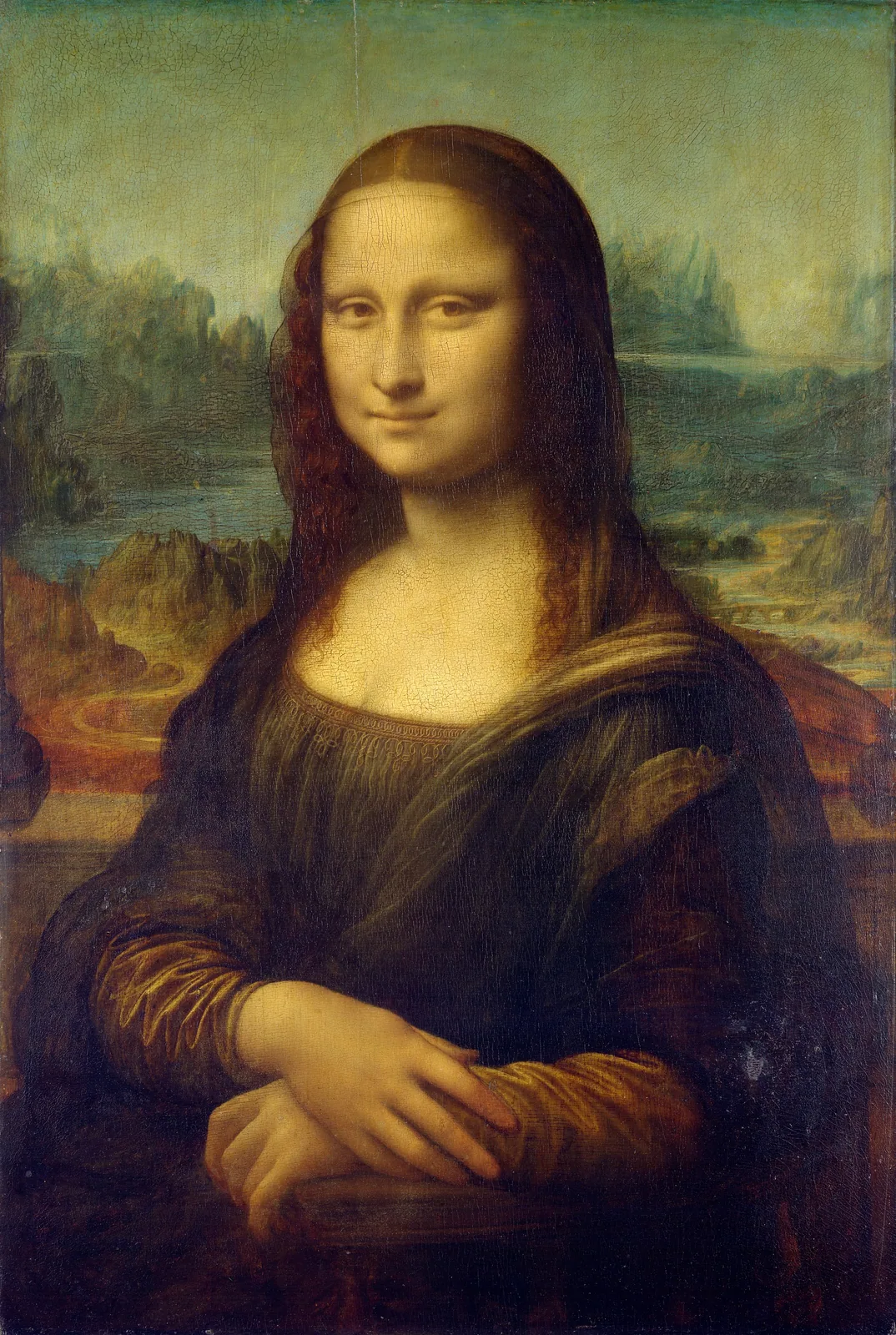
She is smaller than most people expect. The Mona Lisa is a wooden panel about 30 inches tall and 21 wide, and in the Louvre she hangs on her own wall, behind glass, across a crowded room. Up close, in a good print, you can see what the crowd mostly can’t: how little Leonardo da Vinci drew, and how much he left to shadow.
Who was the Mona Lisa?
The sitter is traditionally identified as Lisa Gherardini, the wife of Francesco del Giocondo, a silk merchant in Florence. That is where both of the painting’s other names come from. Italians call it La Gioconda and the French La Joconde, after her married name, and the Italian word also means cheerful or jolly, a pun that fits the smile. “Mona” is the English spelling of Monna, a polite Italian title shortened from ma donna, close to “my lady.”
For a long time the identification rested mostly on Giorgio Vasari, whose life of Leonardo came out in 1550, 31 years after the painter died. Then in 2005 a scholar at Heidelberg University found a note in the margin of an old book, written in October 1503 by Agostino Vespucci, a Florentine who knew Leonardo’s work. It says that Leonardo was then working on a portrait of Lisa del Giocondo. The likeness is still not certain, and some historians have suggested other women, but the 1503 note is the strongest evidence anyone has.
When was it painted?
The Louvre dates it to between 1503 and 1506, when Leonardo was back in Florence. He never gave it to the Giocondo family. He kept the panel, most likely took it with him when he moved to France, and may have gone on working on it until about 1517. King Francis I of France, who had invited Leonardo to his court, bought it from him; the Louvre gives the year as 1518, a year before Leonardo died. It stayed in the French royal collection and has been at the Louvre since 1797.
Why the smile seems to move
Leonardo built the face from thin, glazed layers of paint and soft blends of tone, a way of working called sfumato, from the Italian for smoke. There are almost no hard edges. The corners of the mouth and the corners of the eyes, the places where we read a person’s mood, are the softest of all, so they shift a little depending on where your own eyes rest. Look at her eyes and the smile seems warmer; look straight at her mouth and it seems to fade.
She also has no visible eyebrows or eyelashes. Vasari described her eyebrows in detail, which has puzzled readers for centuries. In 2007 a French engineer, Pascal Cotte, said his high-resolution scans showed that Leonardo did paint them and that they had faded or been cleaned away over time. It is a claim, not a settled fact.
The landscape behind her
She sits in an open loggia, with the dark bases of two columns at the edges of the panel. Behind her the land drops away to winding paths, water, a distant bridge and icy mountains. Leonardo puts the horizon at the height of her eyes, which ties her to the land, and he paints each layer of distance paler and bluer than the one before, the way far hills really look on a hazy day.
The 1911 theft
On 21 August 1911 the painting vanished from the Louvre. The thief was Vincenzo Peruggia, a museum worker who had helped build its glass case. He kept it for more than two years. In late 1913 he took it to Florence and tried to sell it to Giovanni Poggi, the director of the Uffizi, who called the police. Peruggia said he wanted to return the painting to Italy. It was shown in Florence and went back to the Louvre on 4 January 1914, more famous than ever.
It has been attacked since. In 1956 a man threw a rock that broke the glass and knocked off a speck of paint near her left elbow. Later attacks, a teacup in 2009, cake in 2022 and soup in 2024, hit the glass and left the painting untouched.
Where is the Mona Lisa now?
In the Louvre’s Salle des États, room 711 in the Denon wing, its largest room. Since 2005 she has hung alone in the middle of the room, inside a glass case that controls temperature and humidity. On the opposite wall is the biggest painting in the museum, Veronese’s Wedding Feast at Cana, more than 6 meters high and almost 10 meters wide. She has traveled only rarely: in 1962 and 1963 she toured the United States, where about 1.7 million people queued to see her in New York alone, and in 1974 she was shown in Tokyo and Moscow.
Look closer
These details come from the scan we print from, 11,146 pixels on the long side, far more than any visitor can see through the glass. Pick a detail, or zoom in and drag to look around.
No line marks the corners of the mouth. The shadows melt into the cheeks, so the smile seems to come and go.
Choosing a print
Life size. At 20 × 30 in she is almost exactly the size of the panel in Paris, and that is the size we would choose for a wall of your own. The face is then about as big as a real face. Framed prints go up to 24 × 36 in, canvas up to 32 × 48 in and unframed art prints up to 32 × 48 in.
Small and close. At 11 × 16 in she suits a desk wall, a bookshelf or a hallway, somewhere you pass close by. The picture is mostly dark greens and browns, so it holds its own small; it does not need a big wall to read.
Which material. A framed print on smooth cotton paper keeps the finest detail, down to the cracks in the paint. The picture is dark, and dark pictures behind clear acrylic act like a mirror if they face a window, so hang it on a wall that does not face the light. Canvas has nothing in front of it, and our matte finish has no shine; it goes up to 32 × 48 in, larger than life. See our papers and canvas.
Frames. Gold suits a Renaissance panel and picks up the warm light on her face and hands; a wide one like our Gold Plein Air gives it the weight of a museum frame. A slim black or dark wood frame keeps it quieter in a modern room. See all our frames, and how to choose a frame color.
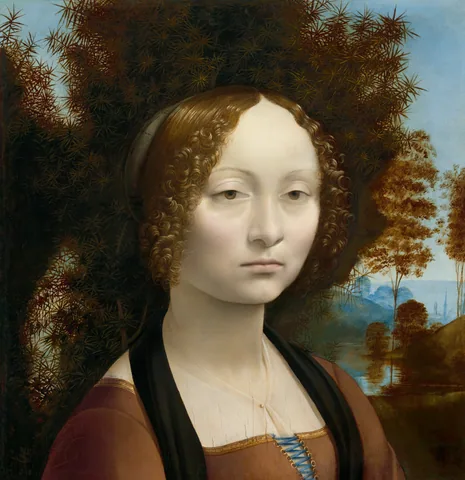
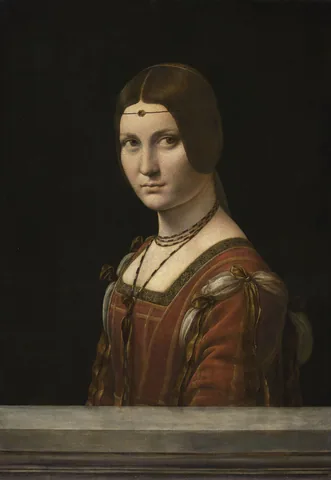
Three Leonardo women. We sell two more of his portraits of women, Lady with an Ermine and La Belle Ferronnière. Open the three as a set, with the Mona Lisa in the middle.
Questions
Who painted the Mona Lisa?
Leonardo da Vinci, the Italian painter, engineer and inventor, starting around 1503 in Florence.
Who is the woman in the Mona Lisa?
Most likely Lisa Gherardini, the wife of the Florentine silk merchant Francesco del Giocondo. A note written in 1503 says Leonardo was painting her portrait, though the identification is still debated.
How big is the Mona Lisa?
77 × 53 cm, about 30 × 21 in. It is painted in oil on a poplar wood panel, not on canvas.
Where is the Mona Lisa kept?
In the Louvre in Paris, in the Salle des États, behind glass. It has been in the museum since 1797.
Who stole the Mona Lisa?
Vincenzo Peruggia, a Louvre worker, in August 1911. It was recovered in Florence in late 1913 and returned to Paris in January 1914.
Can it be printed legally?
Yes. It is more than 500 years old and in the public domain. What public domain means.
More portraits
All Leonardo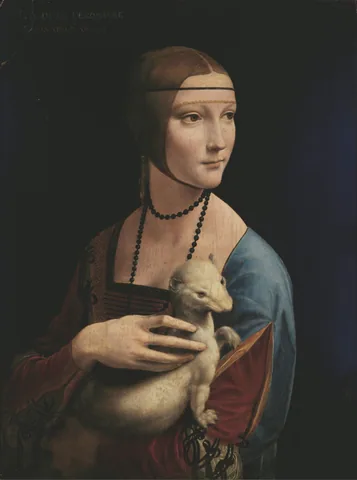
More in Old Masters and Interiors and Portraits.
Sources
More from the Journal
 Story · 7 min
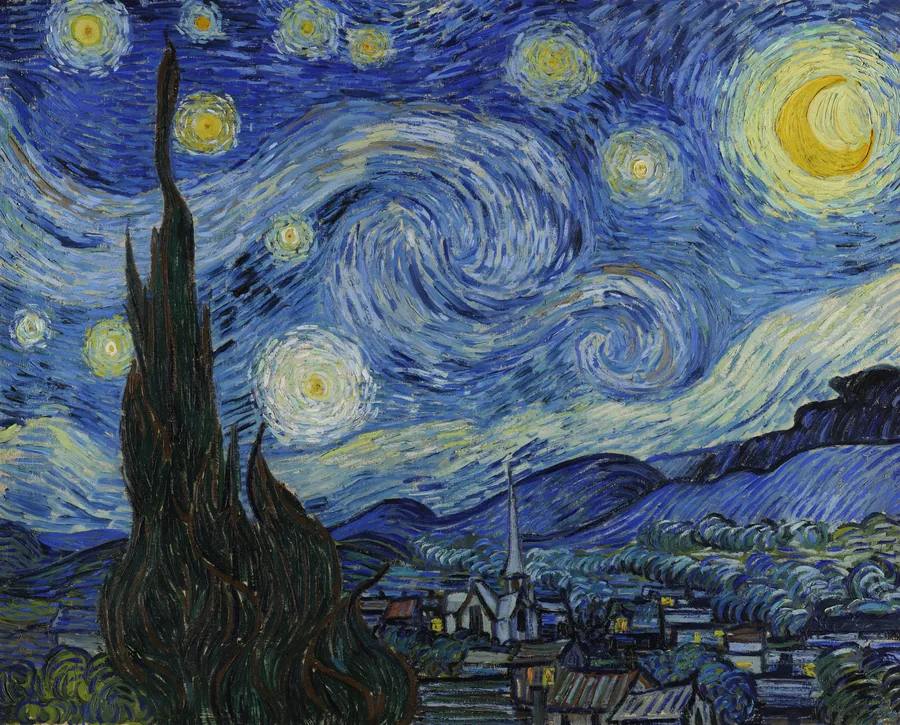
Van Gogh’s Starry Night: the facts, and choosing a print
Painted in June 1889 at an asylum in Provence: the view from his window, plus a village he made up. What is real, what it means, and which print to choose.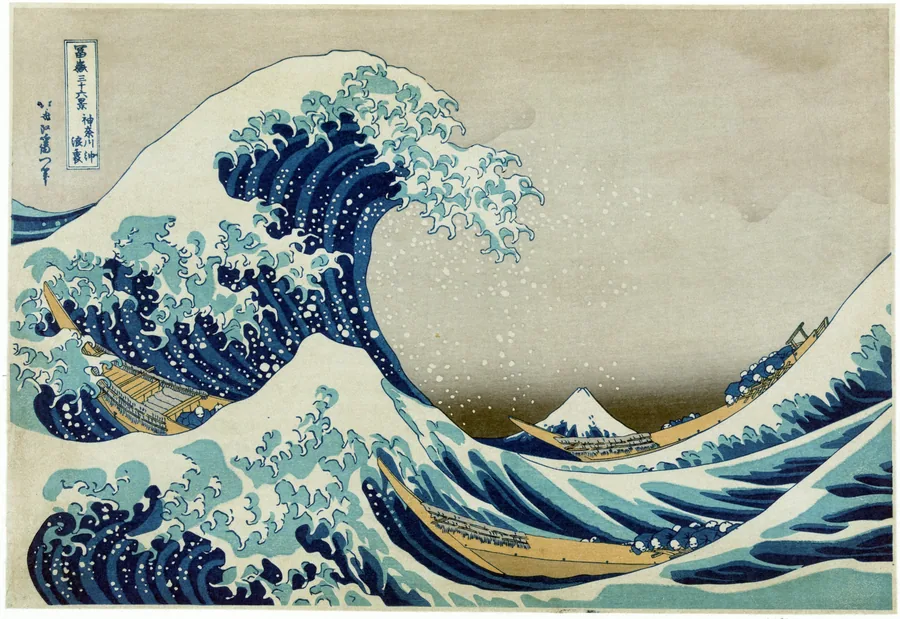 Story · 7 min
The Great Wave off Kanagawa: meaning, history and prints
A woodblock print, not a painting, and a storm wave, not a tsunami. What it shows, why no two impressions match, and how to choose a print.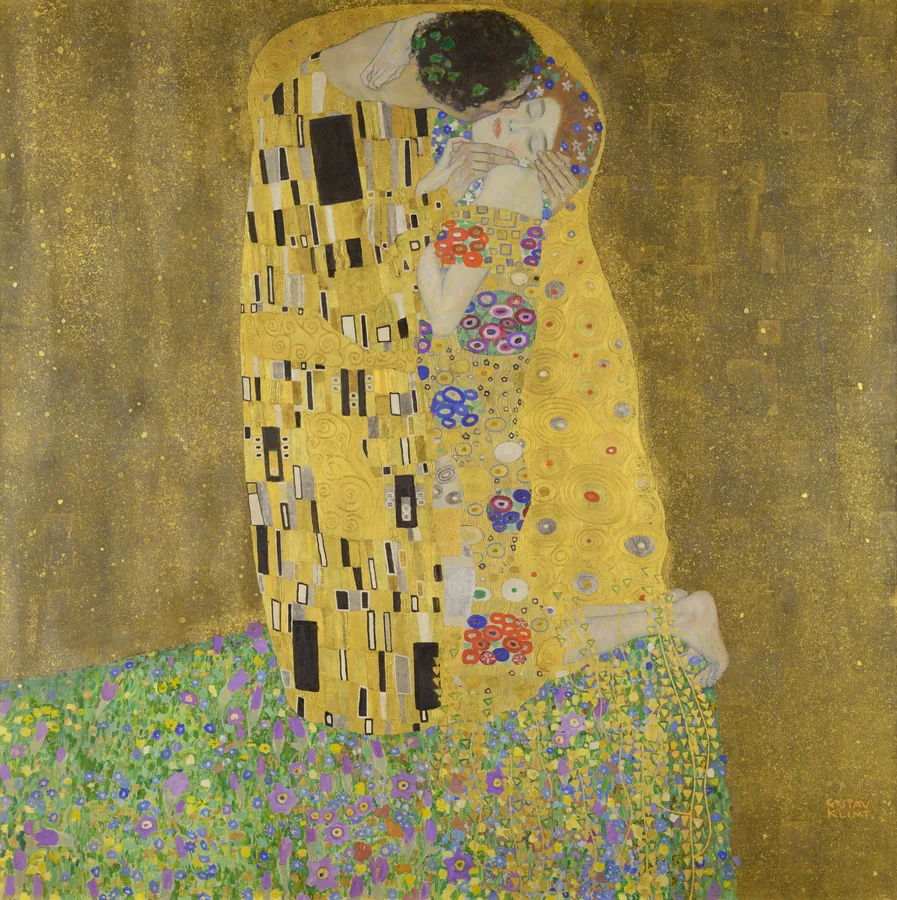 Story · 7 min
Klimt’s The Kiss: gold leaf, meaning and choosing a print
Real gold leaf on canvas, finished in 1909. The story of Klimt’s lovers, what a print can and can’t reproduce, and which size to choose. Story · 7 min