
Story
Millais’s Ophelia: the story behind the painting
Painted on a Surrey riverbank and in a bathtub in London. The scene from Hamlet, the model who caught a chill, the flowers, and choosing a print.
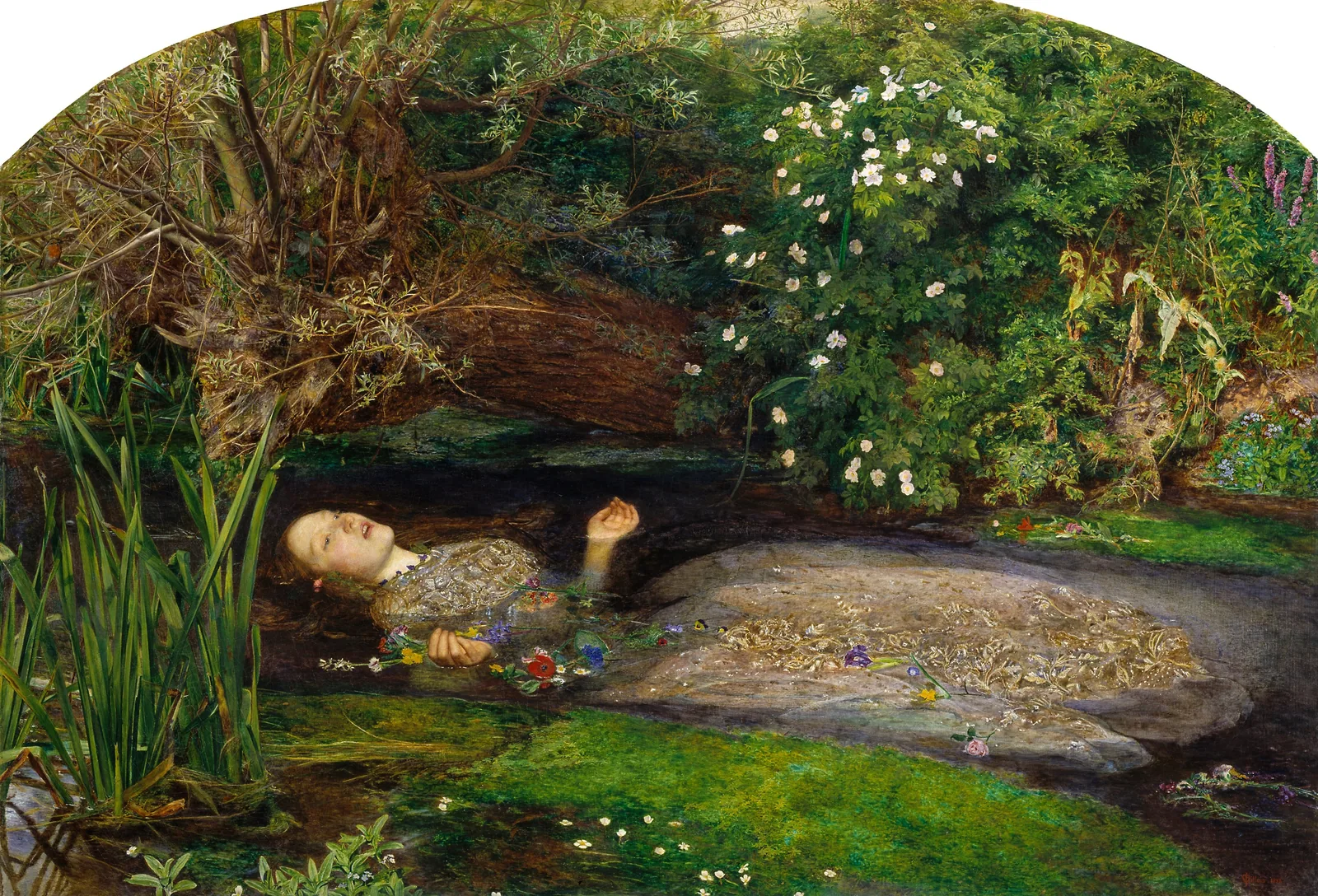
A young woman floats on her back in a stream, her hands open, her mouth parted as if singing, her dress spreading around her on the water. Flowers drift past her. Around her, every leaf of the riverbank is painted so precisely you could name the plants. John Everett Millais painted Ophelia in 1851 and 1852, and today it hangs in Tate Britain in London.
The scene from Hamlet
Ophelia is the young woman Hamlet loves, then rejects. After Hamlet kills her father, she loses her mind, and she drowns in a stream. Shakespeare never shows her death on stage. Instead, in Act 4, Scene 7, Queen Gertrude describes it: Ophelia was hanging garlands of flowers on a willow over the water when a branch broke; she fell in, and for a while her clothes spread out and held her up as she sang old songs, until they grew heavy and pulled her under.
Millais paints that moment, while she is still floating and singing, before the end. That is why her eyes are open. It is calm, almost peaceful, which makes it sadder.
Painted on a real riverbank
Millais was a member of the Pre-Raphaelite Brotherhood, young painters who wanted bright color, close attention to detail and truth to nature. So he did not invent the riverbank. He painted it on the spot, on the banks of the Hogsmill River in Surrey, near Tolworth; one researcher, Barbara Webb, has placed it at Six Acre Meadow by Church Road in Old Malden.
He worked up to eleven hours a day, six days a week, for five months in 1851, fighting the weather and the flies, and sitting in a little hut he built against the wind. He painted the landscape first and added the figure later. He even painted a water vole into the scene, then painted it out; a faint sketch of it is still there, hidden under the frame.
The model in the bathtub
Back in his London studio, Millais painted Ophelia from a model, Elizabeth Siddal, then 22, who lay fully dressed in a bath of water. Lamps under the tub kept the water warm. One day they went out, and Siddal caught a severe cold. Her father demanded £50 for her doctor’s bills; Millais’s son later said his father settled for less.
What do the flowers mean?
Millais chose the flowers to match the garlands in Shakespeare’s text and the Victorian “language of flowers,” in which each bloom carried a meaning. He added one Shakespeare doesn’t mention: a red poppy, a symbol of sleep and death. The willow over the water is Shakespeare’s too; Gertrude’s speech begins with it.
Reviews, sales and where it is now
When it was shown at the Royal Academy in 1852, reviews were mixed: the critic of The Times was harsh, and John Ruskin doubted the Surrey setting. Henry Farrer had already bought it from Millais, on 10 December 1851, for 300 guineas. Today it hangs in Tate Britain in London, and experts have valued it at at least £30 million.
Look closer
These details come from the scan we print from, 7,087 pixels on the long side. The painting has a rounded top, and so does our print: the two upper corners are pale. Pick a detail, or zoom in and drag to look around.
Eyes open, lips parted: Ophelia singing as she floats, not yet drowned.
Choosing a print
Life size. The canvas is 30 by 44 inches. Our largest framed print, 36 × 24 in, comes close. Canvas goes to 40 × 27 in. Framed prints go up to 36 × 24 in, canvas up to 40 × 27 in and unframed art prints up to 40 × 27 in. It is wide, so it suits the space over a sofa or a bed.
Where it works. All greens and soft light, it is calming in a bedroom or a reading room, and it suits anyone who loves Shakespeare or gardens. At 24 × 16 in it fits a smaller wall.
Which material. The detail is extraordinary, so a framed print on smooth cotton paper is the best way to keep every leaf sharp. Canvas, with a matte finish and no cover, suits a bright room. See our papers and canvas.
Frames. A gold frame suits a Victorian painting and warms the greens; a white mat sits well with the pale upper corners. See all our frames and mats.
Questions
What is happening in Millais’s Ophelia?
Ophelia from Hamlet floats and sings in a stream just before she drowns, as Queen Gertrude describes in Act 4, Scene 7.
Who was the model for Ophelia?
Elizabeth Siddal, who posed in a bath of water in Millais’s studio and caught a severe cold.
Where was it painted?
The landscape on the Hogsmill River in Surrey; the figure in Millais’s London studio.
Where is Ophelia now?
In Tate Britain in London. It is 76.2 × 111.8 cm, 30 × 44 in.
Can it be printed legally?
Yes. It was painted in 1851 to 1852 and is in the public domain. What public domain means.
More Millais
All Millais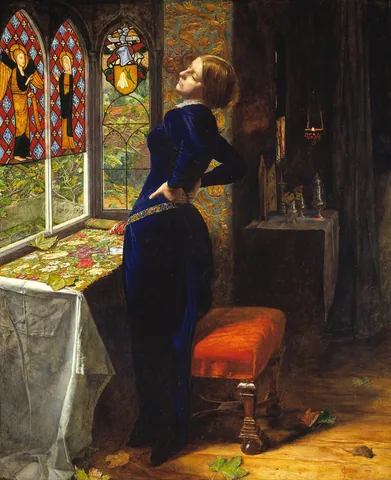
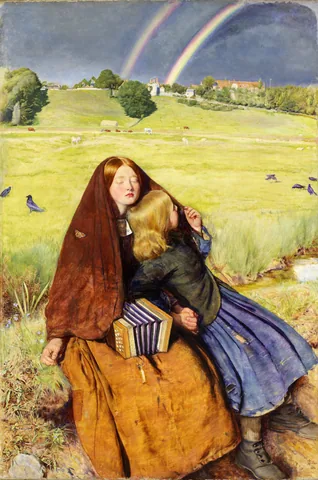
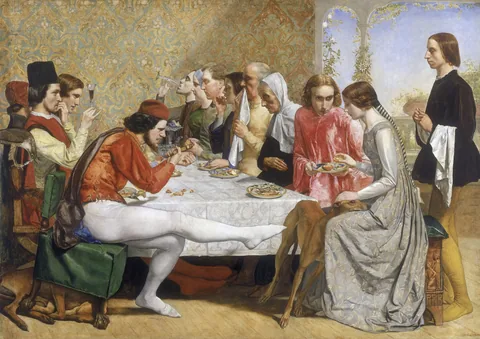
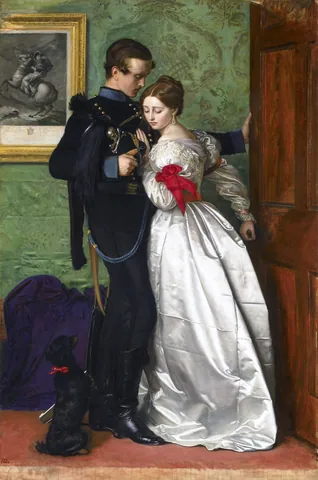
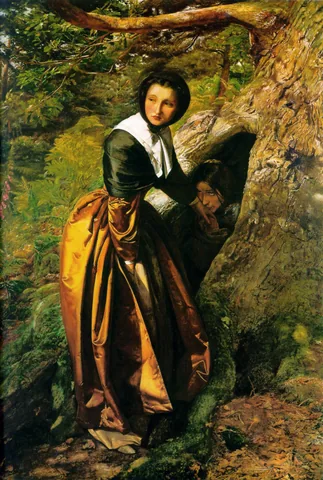
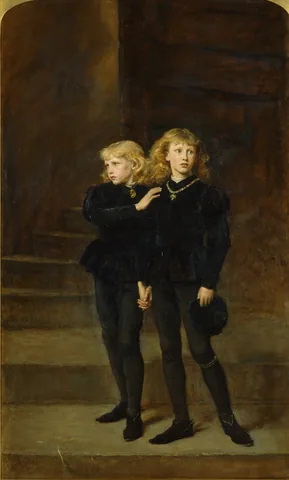
More in Landscapes and Interiors and Portraits.
Sources
More from the Journal
 Story · 7 min
Van Gogh’s Starry Night: the facts, and choosing a print
Painted in June 1889 at an asylum in Provence: the view from his window, plus a village he made up. What is real, what it means, and which print to choose. Story · 7 min
The Great Wave off Kanagawa: meaning, history and prints
A woodblock print, not a painting, and a storm wave, not a tsunami. What it shows, why no two impressions match, and how to choose a print. Story · 7 min
Klimt’s The Kiss: gold leaf, meaning and choosing a print
Real gold leaf on canvas, finished in 1909. The story of Klimt’s lovers, what a print can and can’t reproduce, and which size to choose. Story · 7 min