
Story
Millet’s The Gleaners: meaning and why it shocked
Three poor women picking up the last stalks of wheat. Why Millet’s Gleaners alarmed Paris in 1857, what it means, and how to choose a print.
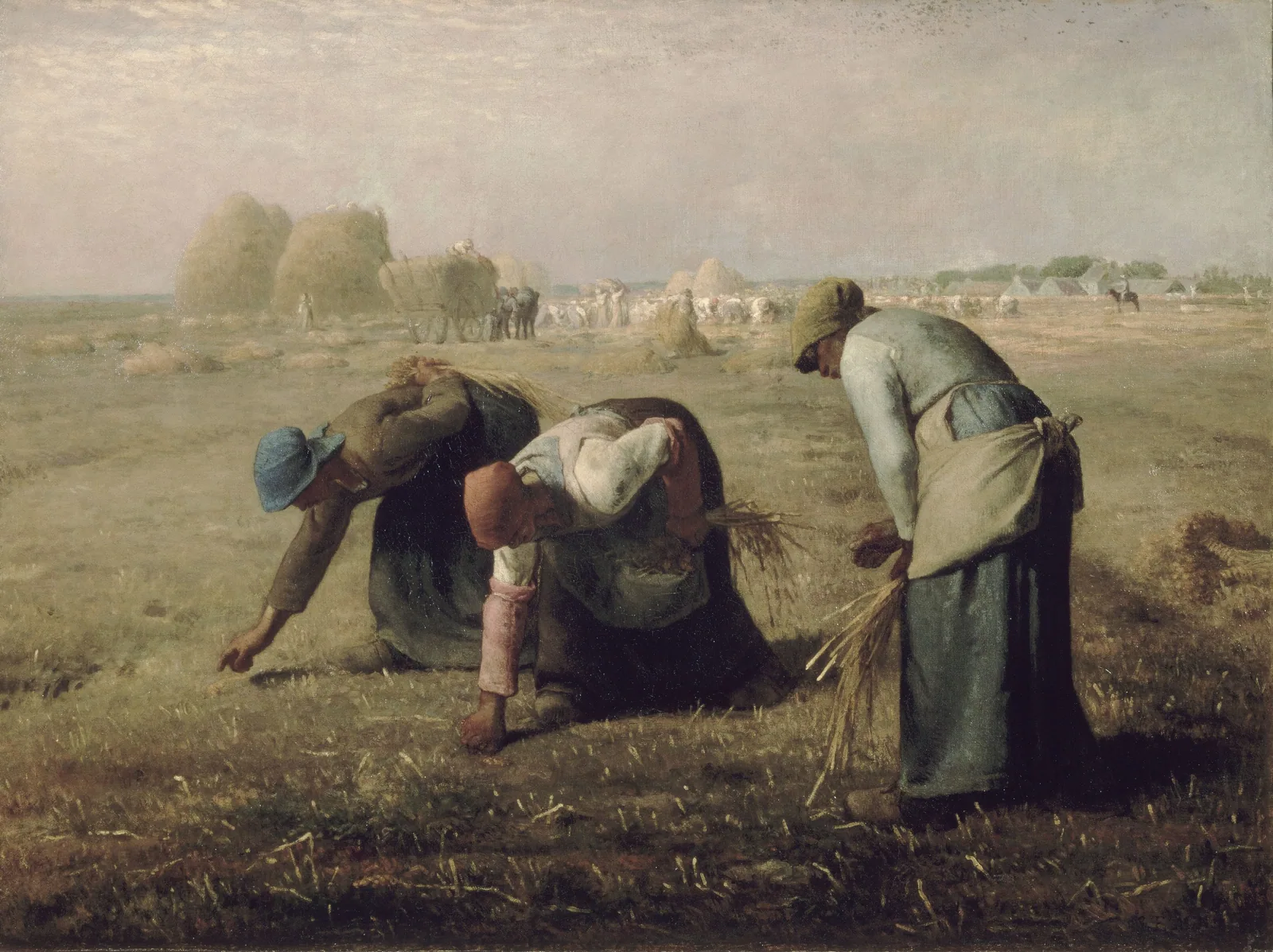
Three women bend low over a field that has already been harvested, picking up the stray stalks of wheat the reapers left behind. Behind them, in the sunlit distance, huge stacks of grain rise and a loaded wagon rolls in. Jean-François Millet painted The Gleaners in 1857. When it was first shown, it frightened people.
What is gleaning?
Gleaning is gathering what is left in a field after the harvest: the odd stalk of wheat that fell or was missed. It was work for the rural poor. Millet painted the gleaners near the villages of Barbizon and Chailly, outside Paris, where he lived and worked.
What does the painting mean?
The meaning is in the contrast. In the foreground, three women stoop over bare stubble. In the distance, the real harvest is being gathered in plenty, with stacks, a wagon, a crowd of workers and a man on horseback watching. The poverty is up close; the wealth is far away, bathed in light. Millet does not make the women pitiful or pretty. He makes them solid, heavy and dignified, with the weight and seriousness usually given to saints and heroes.
Why did The Gleaners cause a scandal?
When it was shown at the Paris Salon of 1857, critics and the middle and upper classes reacted badly. France had been through the revolution of 1848 only nine years earlier, and to many viewers a big, serious painting of poor workers looked like a glorification of the working class, close to socialism. One critic saw behind the three women “the scaffolds of 1793,” a reference to the guillotines of the Reign of Terror.
The size was part of the problem. A canvas this large was normally kept for religious or mythological subjects, not for peasant women in a field. Millet was giving the poor the scale of a grand painting, and some people did not like what that implied.
From 3,000 francs to the Louvre
Millet was short of money and sold the painting for 3,000 francs, less than the 4,000 he had asked. After his death in 1875 its reputation soared. In 1889 it sold at auction for 300,000 francs, a hundred times the first price, to the champagne maker Jeanne-Alexandrine Louise Pommery. When she died in 1891, it was given to the Louvre, and it now hangs in the Musée d’Orsay.
Younger painters, among them Pissarro, Renoir, Seurat and Van Gogh, borrowed its bending figures, and in 2000 the filmmaker Agnès Varda made a documentary, The Gleaners and I, that discusses it.
Look closer
These details come from the scan we print from, 5,356 pixels on the long side. Pick a detail, or zoom in and drag to look around.
The woman on the left stretches her rough hand to the stubble for a single stalk.
Choosing a print
Size. The canvas is 33 by 44 inches. Our scan prints sharply up to 30 × 22 in, and we don’t sell it bigger than that. Framed prints, canvas and unframed art prints all go up to 30 × 22 in. Its wide shape suits a sofa wall, a dining room or a long hallway.
Where it works. A kitchen, a farmhouse dining room or anywhere with wood, linen and earthy colors. It is a natural picture for a baker, a gardener or anyone who grows food. At 20 × 15 in it fits over a desk or a sideboard.
Which material. The soft, hazy light suits smooth matte paper in a frame, which keeps the gentle gradations. Canvas, with its matte finish and no cover, gives it a painted feel. See our papers and canvas.
Frames. Natural oak suits the earth tones and the country subject; gold picks up the golden light in the distance. See all our frames.
A Millet pair. Hang it with The Angelus, another of his field scenes. Open the two as a set.
Questions
What are the women doing in The Gleaners?
Gleaning: picking up the stray stalks of wheat left in a field after the harvest.
Why was The Gleaners controversial?
In 1857, nine years after the 1848 revolution, many saw its large, dignified poor women as a glorification of the working class and a hint of socialism.
Where is The Gleaners?
In the Musée d’Orsay in Paris. It is 83.8 × 111.8 cm, 33 × 44 in.
How much was it sold for?
Millet sold it for 3,000 francs. In 1889 it fetched 300,000 francs at auction.
Can it be printed legally?
Yes. Millet died in 1875, and the painting is in the public domain. What public domain means.
More Millet
All Millet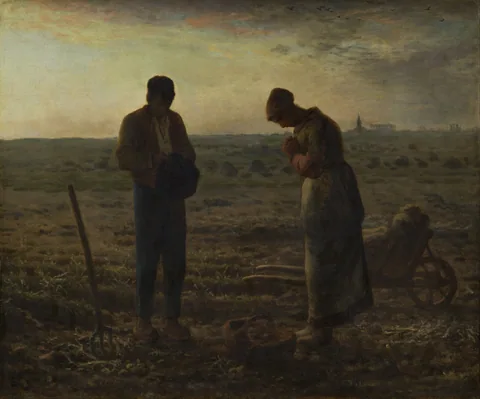
More in Landscapes.
Sources
More from the Journal
 Story · 7 min
Van Gogh’s Starry Night: the facts, and choosing a print
Painted in June 1889 at an asylum in Provence: the view from his window, plus a village he made up. What is real, what it means, and which print to choose.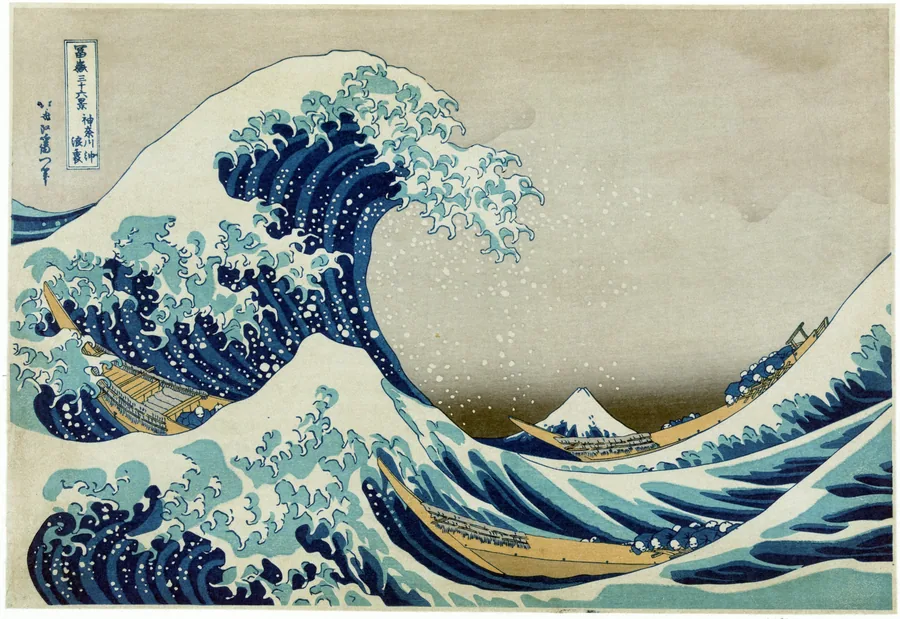 Story · 7 min
The Great Wave off Kanagawa: meaning, history and prints
A woodblock print, not a painting, and a storm wave, not a tsunami. What it shows, why no two impressions match, and how to choose a print. Story · 7 min
Klimt’s The Kiss: gold leaf, meaning and choosing a print
Real gold leaf on canvas, finished in 1909. The story of Klimt’s lovers, what a print can and can’t reproduce, and which size to choose. Story · 7 min