
Story
Monet’s Garden at Sainte-Adresse: the story and a print
A sunny terrace above the sea, two flags in the wind, Monet’s family in the garden, and a Japanese print behind it all. The story, and a print.
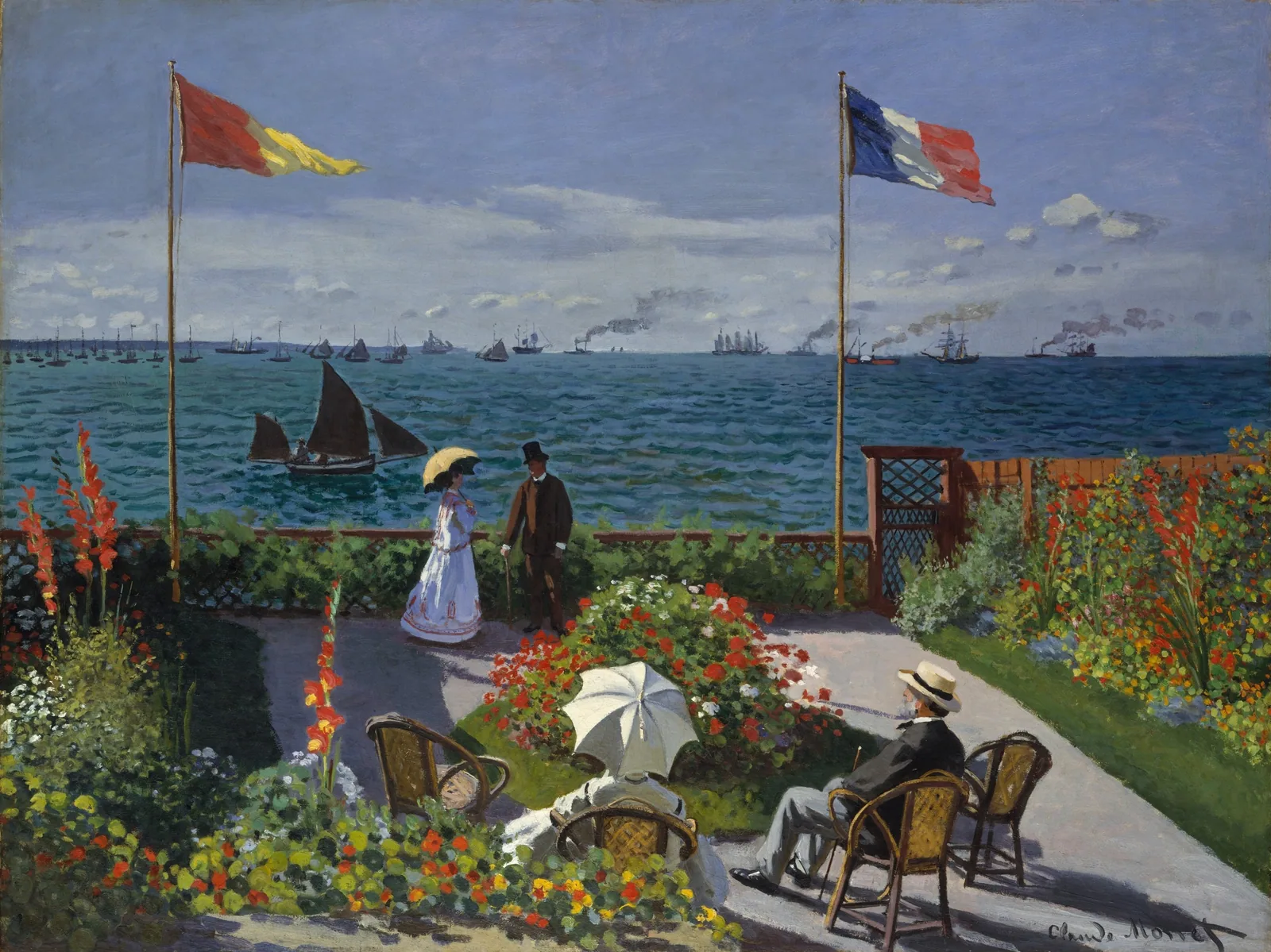
A garden terrace blazes with red flowers in the summer sun. Beyond the fence the sea is crowded with sailing ships and steamers, and two flags snap in the wind on tall poles. A man in a straw hat sits in a wicker chair, a couple chats at the railing, and a woman shelters under a white parasol. Claude Monet painted it in the summer of 1867, when he was 26, and it is one of the sunniest pictures he ever made.
Where is Sainte-Adresse?
A seaside resort just outside Le Havre, on the coast of Normandy, where Monet grew up. He spent the summer of 1867 there. On the far horizon, across the water, is the town of Honfleur.
Who is in the garden?
The figures are probably Monet’s family and relations:
- Adolphe Monet, the painter’s father, in the straw hat in the foreground.
- Jeanne-Marguerite Lecadre, standing at the fence with her parasol, talking with her father, also called Adolphe.
- Perhaps her sister Sophie, seated under the white parasol with her back to us.
“The Chinese painting with flags”
Monet had his own nickname for it: “the Chinese painting in which there are flags.” His friend Renoir called it “the Japanese painting.” Both were pointing at the same thing. The picture is built in three flat horizontal bands, garden, sea and sky, seen from a high viewpoint, with the two tall flagpoles slicing down through all three. That flattened, patterned design owes a lot to Japanese woodblock prints. The print most often named as Monet’s model is Hokusai’s Turban-shell Hall of the Five-Hundred-Rakan Temple (1830), and Monet’s own copy still hangs in his house at Giverny.
The color is just as bold. Strong reds, greens and blues sit side by side in full sunlight, with very few soft shadows. It is a picture made a few years before Impressionism had a name, and you can see it coming.
From Paris to New York
Monet showed it at the fourth Impressionist exhibition in Paris in 1879, as Jardin à Sainte-Adresse. In December 1967 it was sold at auction at Christie’s, as La terrasse à Sainte-Adresse, and went to the Metropolitan Museum of Art in New York, where it hangs today.
Look closer
These details come from the scan we print from, 5,940 pixels on the long side. Pick a detail, or zoom in and drag to look around.
Two flags snapping in the sea wind, one red and yellow, one blue, white and red: the “flags” of Monet’s own title for the picture.
Choosing a print
Size. The canvas is about 38½ by 51 inches. Our scan prints sharply up to 36 × 27 in, and we don’t sell it bigger than that. Framed prints, canvas and unframed art prints all go up to 36 × 27 in. Its wide shape suits a sofa wall, a dining room or a long hallway. See what size art over a sofa.
Where it works. A beach house, a sunroom, a living room that needs summer all year. It is cheerful and full of color, a natural gift for anyone who loves the sea or gardens. At 24 × 18 in it fits over a desk or a dresser.
Which material. Canvas suits the bright, painterly strokes, with a matte finish and no cover to reflect light in a sunny room. Smooth paper in a frame keeps the little ships on the horizon crisp. See canvas and our papers.
Frames. A white frame keeps it fresh and coastal; gold warms the flowers. See all our frames.
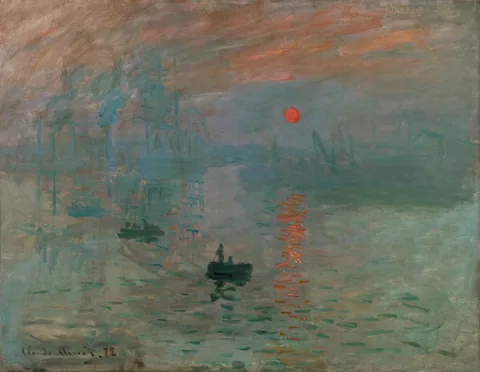
Sainte-Adresse, twice. Pair it with Monet’s Regatta at Sainte-Adresse. Open the two as a set. And read the story of Impression, Sunrise, painted at Le Havre five years later.
Questions
Where is Sainte-Adresse?
A seaside resort next to Le Havre, in Normandy, France.
Who are the people in the painting?
Probably Monet’s father Adolphe, Jeanne-Marguerite Lecadre and her father, and perhaps her sister Sophie.
What inspired it?
Japanese prints, probably Hokusai’s Turban-shell Hall of the Five-Hundred-Rakan Temple. Monet called it “the Chinese painting in which there are flags.”
Where is the painting?
In the Metropolitan Museum of Art in New York. It is 98.1 × 129.9 cm.
Can it be printed legally?
Yes. Monet died in 1926, and the painting is in the public domain. What public domain means.
More Monet
All Monet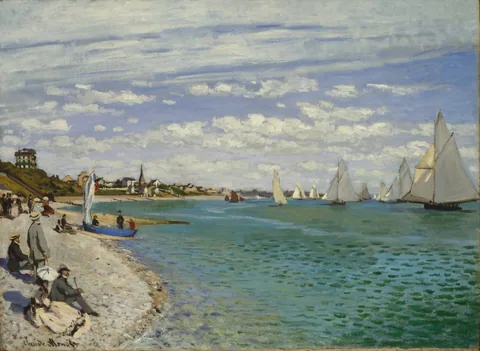
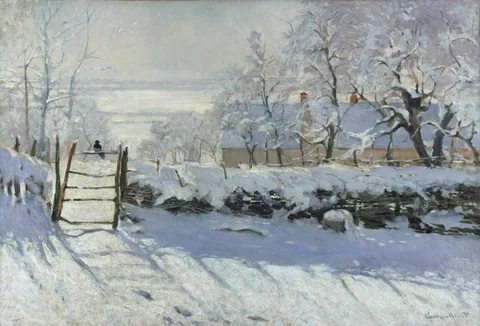
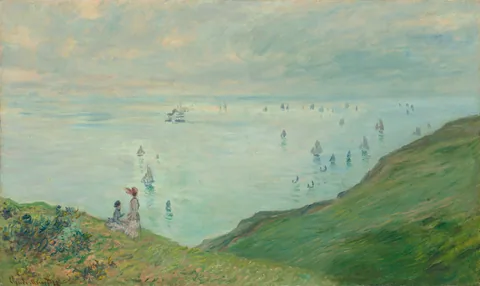
More in Impressionists and Sea and Ships.
Sources
More from the Journal
 Story · 7 min
Van Gogh’s Starry Night: the facts, and choosing a print
Painted in June 1889 at an asylum in Provence: the view from his window, plus a village he made up. What is real, what it means, and which print to choose.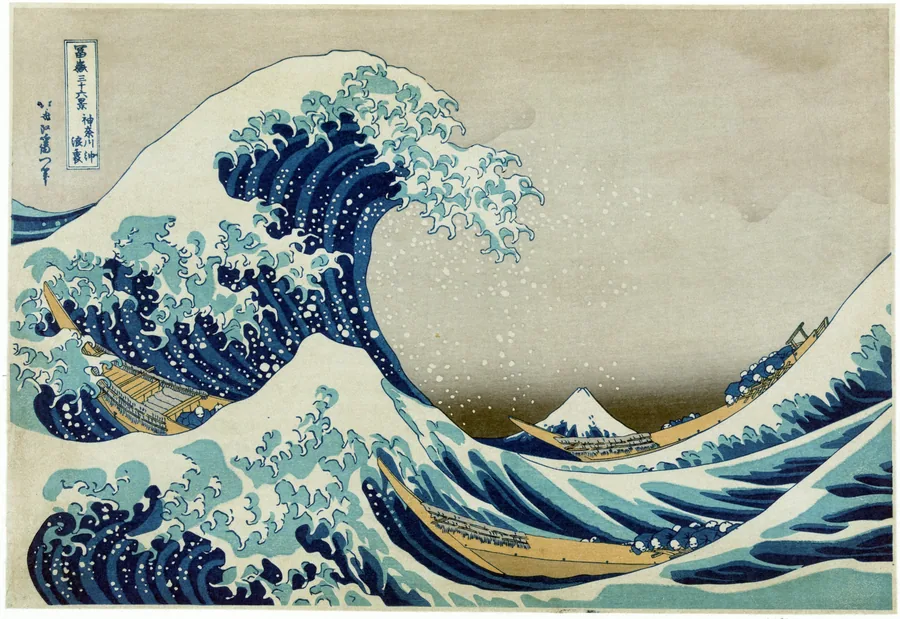 Story · 7 min
The Great Wave off Kanagawa: meaning, history and prints
A woodblock print, not a painting, and a storm wave, not a tsunami. What it shows, why no two impressions match, and how to choose a print. Story · 7 min
Klimt’s The Kiss: gold leaf, meaning and choosing a print
Real gold leaf on canvas, finished in 1909. The story of Klimt’s lovers, what a print can and can’t reproduce, and which size to choose. Story · 7 min