
Story
Impression, Sunrise: the Monet that named a movement
The morning in Le Havre Monet painted in a few hours, the review that turned its title into an insult, and how to choose a print.
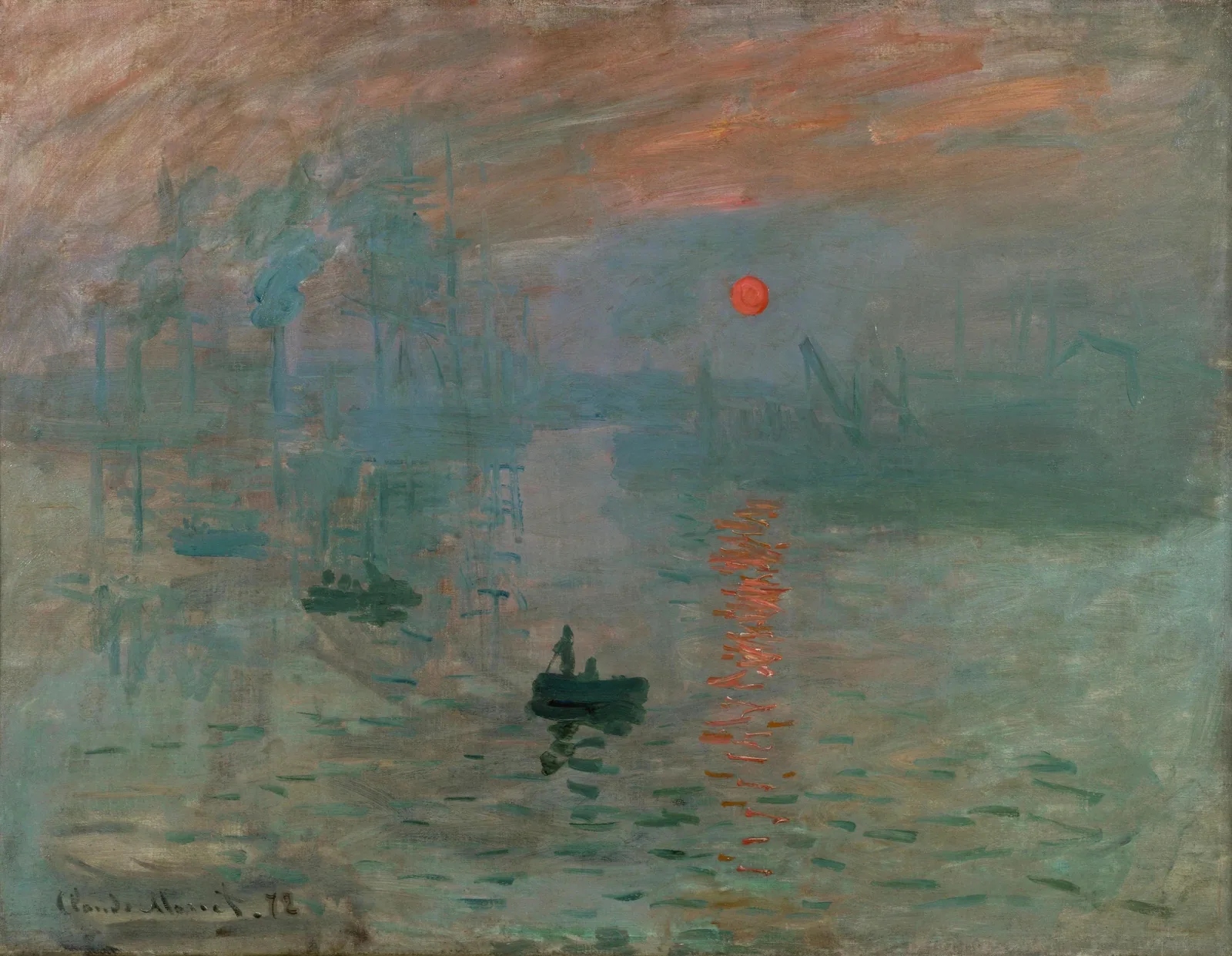
An orange sun comes up through the mist over a harbor. Below it a ferryman stands in his rowboat, and behind him the masts, cranes and chimneys of the port dissolve into blue and gray. Claude Monet painted it in 1872, in a few hours, from a hotel window in Le Havre. Two years later a critic used its title to mock a whole group of painters, and the name stuck. That group became the Impressionists.
A morning in Le Havre
Le Havre was Monet’s hometown, a busy port at the mouth of the Seine. According to the Musée Marmottan, which owns the painting, he painted the view from his room at the Hôtel de l’Amirauté around November 1872, looking out over the outer harbor in the autumn mist. The rowboats and the orange sun went on last.
In 2014 the astronomer Donald Olson and his colleagues tried to pin down the exact moment. They worked from the position of the sun, the tide tables, old weather records and the direction of the smoke in the picture, and concluded that it shows the morning of 13 November 1872, at about 7:35.
How did it give Impressionism its name?
In April 1874 Monet and his friends put on their own show in the former studio of the photographer Nadar in Paris. When the catalog needed a title for this picture, Monet felt it could not pass for a proper view of Le Havre. His answer, as he remembered it later, was short: “Put Impression.”
On 25 April 1874 the critic Louis Leroy reviewed the show in the satirical paper Le Charivari. He wrote it as a conversation with an old-fashioned painter who grows more horrified at every picture. In front of Monet’s harbor the old painter says that wallpaper in its embryonic state is more finished than that seascape. Leroy took Monet’s title and headed his article “The Exhibition of the Impressionists.” It was meant as a joke. Later the critic Jules Castagnary used the word as praise, and the painters took it as their own.
Why the sun seems to glow
The sun looks like the brightest thing in the picture, but it isn’t. Measured with a light meter, it is about as light as the sky around it; only its color is different. The neuroscientist Margaret Livingstone pointed out that in a black-and-white copy the sun almost disappears.
Stolen in 1985
In 1985 thieves took Impression, Sunrise from the Musée Marmottan in Paris. It was found and returned in 1990 and went back on the wall in 1991. The museum had it from Eugène and Victorine Donop de Monchy, who gave it in 1940.
Where is Impression, Sunrise now?
In the Musée Marmottan Monet in Paris, on the rue Louis-Boilly. It is not a big picture: about 20 by 25½ inches, smaller than many people expect for something so famous.
Look closer
These details come from the scan we print from, 5,773 pixels on the long side. The paint is so thin in places that the canvas shows through, and a good print keeps that. Pick a detail, or zoom in and drag to look around.
A small disc of orange, put on near the end. In a black-and-white photo it almost vanishes into the sky.
Choosing a print
Life size. The canvas is about 20 by 25½ inches, and our 24 × 19 in framed print is very close to it. That is the size Monet meant you to see it at. Our largest framed size is 36 × 28 in, for a wall over a sofa or a bed. Framed prints, canvas and unframed art prints all go up to 36 × 28 in.
Which material. The picture is all soft blues and grays with one hot spot of orange. Smooth matte paper in a frame keeps the thin, dry strokes crisp. Canvas suits it too: the grain of a real canvas sits well with a painting where the weave shows through. See our papers and canvas.
Frames. A white frame keeps it light and modern and lets the blue mist spread. A gold frame picks up the orange sun and looks more like a museum. Black is too heavy for so soft a picture. See all our frames and how to choose a frame color.
A pair. Monet painted the sun low over water again in Venice in 1908, San Giorgio Maggiore at Dusk. Open the two as a set. For the late Monet, read the story of the Water Lilies.
Questions
Where was Impression, Sunrise painted?
In Le Havre, in Normandy, from Monet’s hotel room overlooking the port.
Is it a sunrise or a sunset?
A sunrise. The title says so, and the 2014 study of the sun’s position puts it at about 7:35 on a November morning.
Why is it important?
A critic used its title to name the painters in the 1874 exhibition “Impressionists,” and the name became the name of the movement.
Where is Impression, Sunrise?
In the Musée Marmottan Monet in Paris.
How big is it?
50 × 65 cm, about 20 × 25½ in, according to the museum.
Can it be printed legally?
Yes. It was painted in 1872 and is in the public domain. What public domain means.
More Monet
All Monet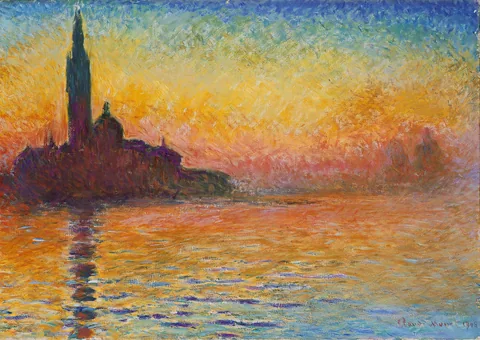
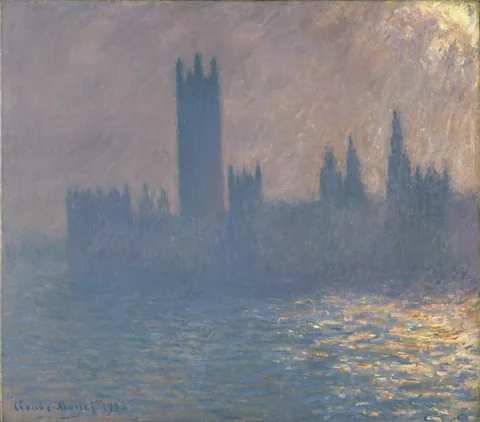
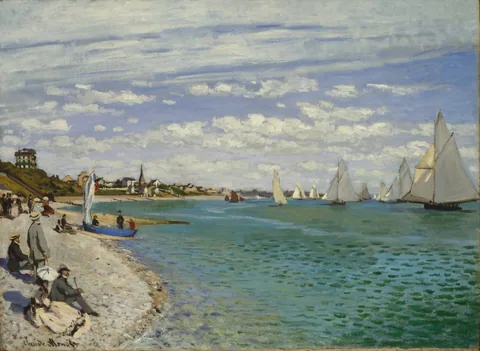
More in Impressionists and Sea and Ships.
Sources
More from the Journal
 Story · 7 min
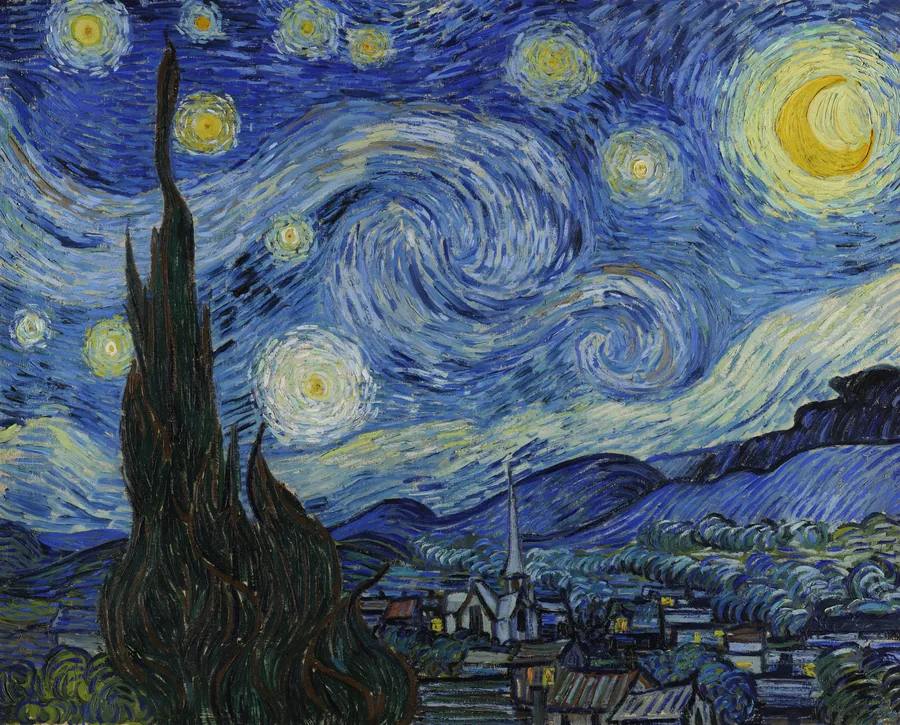
Van Gogh’s Starry Night: the facts, and choosing a print
Painted in June 1889 at an asylum in Provence: the view from his window, plus a village he made up. What is real, what it means, and which print to choose. Story · 7 min
The Great Wave off Kanagawa: meaning, history and prints
A woodblock print, not a painting, and a storm wave, not a tsunami. What it shows, why no two impressions match, and how to choose a print. Story · 7 min
Klimt’s The Kiss: gold leaf, meaning and choosing a print
Real gold leaf on canvas, finished in 1909. The story of Klimt’s lovers, what a print can and can’t reproduce, and which size to choose. Story · 7 min